Categories
Brooklyn News

NYC’s most dangerous: Safe streets coalition spotlights hazardous intersections in push for universal ‘daylighting’ bill


A coalition of safe streets advocates released a new analysis of Department of Transportation (DOT) data on Tuesday, highlighting the city’s most dangerous intersections. The group is pushing the City Council to vote on a bill that would eliminate parking near intersections across the five boroughs, with the goal of making them safer.

The collective — comprised of advocates with Transportation Alternatives, Families for Safe Streets, and Open Plans — found that there are 118 intersections across the city where New Yorkers have either been killed or seriously injured since City Council Speaker Adrienne Adams was elevated to her post in early 2022. Nearly three million New Yorkers live within a half-mile of one of those intersections.

Elizabeth Adams, Transportation Alternatives’ deputy director of public affairs (who is not related to the outgoing council speaker), said the data shows that dangerous intersections are a scourge citywide.

“This is an issue that impacts all of us, because what we’re talking about is almost 3 million New Yorkers who are within a half-mile of walking distance to a serious, dangerous intersection,” Adams said during a Tuesday news conference outside a lower Manhattan council office building.

“That impacts us, our loved ones, our families, our neighborhoods and our city has an urgent issue to act now,” she added.

The report also identified the most dangerous intersections, where it says clearing parking spots around crosswalks would make drivers and pedestrians safer — a practice known as “daylighting.” Those include:

  • West 120th Street and Lenox Avenue in Manhattan;
  • Northern Boulevard and 48th Street in Queens;
  • Flatbush Avenue and Avenue H in Brooklyn;
  • Bruckner Boulevard and St. Ann’s Avenue in the Bronx; and
  • Hunton Street and Richmond Road on Staten Island.

Shedding ‘daylighting’ on street safety

Adams said the analysis underscores the pressing need to pass Intro. 1138 — a measure sponsored by City Council Member Julie Won (D-Queens) — which would ban parking or idling within 20 feet of any intersection. Currently, the city allows parking right up to the crosswalk.

The bill, which would implement what is known as universal daylighting, also requires DOT to install hard barriers at 1,000 intersections a year.

Daylighting, is aimed at boosting visibility for pedestrians, cyclists, and drivers around intersections to decrease the risk of deaths or injuries at traffic crossings.

“Daylighting is the practice of removing curb space at the intersection to create visibility for everyone,” Adams said. “So, whether you are a driver, a pedestrian, or a cyclist, you have the sight lines you need to see everyone who’s turning the corner, who’s coming around the bend.”

A DOT spokesperson responded with a statement saying: “One traffic death is one too many, and that is why under Vision Zero we have taken a data-driven approach to street safety that has helped reduce fatalities to historic lows. There isn’t a one-size-fits-all quick fix, but we will continue to use every tool available – including targeted daylighting – to make our streets safer.”

They added that there has been some amount of daylighting at the top intersections in each borough identified in the report.

The DOT also cited a study the agency released earlier this year that argued universal daylighting without hard infrastructure does not make intersections safer and may cause as many as 15,000 more traffic injuries per year. The report further concluded that daylighting should only be used in certain instances.

However, Streetsblog reported last month on internal documents it obtained from the City Council’s data team that found DOT’s study was based on faulty data.

The advocates released the analysis as part of their push for Speaker Adams to schedule the bill for a vote in the last City Council meeting of the session, next Thursday.

The bill currently has majority support — 27 co-sponsors in the 51-member council. But it needs at least 34 votes in favor to override a likely veto from outgoing Mayor Eric Adams.

Elizabeth Adams charged that if the speaker does not schedule the bill for a vote next week, it is “a failure of this council and of this speaker’s leadership.”

Council spokesperson Julia Agos, in a statement, responded that “The safety of pedestrians and all street users remains a top priority for Speaker Adams and the council.”

According to reports from Streetsblog and Gothamist, the DOT sent the council a counterproposal that would mandate the city to daylight 100 locations per year, with no requirement to add hard barriers. That is far below what the bill’s proponents are pushing for, but the outlets reported that the speaker has embraced it.

At the same time, both outlets reported that Council Member Won has been considering amendments to the bill to help secure supermajority support for it. The changes would reportedly result in the bill requiring daylighting at three-quarters of city intersections, rather than all of them.

Agos said the bill is still being negotiated.

“Introduction 1138 continues to be actively worked on and negotiated as part of the council’s legislative process, which includes consideration of public input, ahead of the Council’s final Stated Meeting,” she said.

Categories
Brooklyn

Рене Магритт. «Портрет». 1935 г.


Categories
Brooklyn News

NYPD will do morning sweeps of Brooklyn school in response to bomb threats – FOX 5 New York


NYPD will do morning sweeps of Brooklyn school in response to bomb threats  FOX 5 New York

Categories
Brooklyn News

The 24 Hour Plays brings high-wire magic to Brooklyn for the first time


For a quarter-century, The 24 Hour Plays have challenged theater-makers to attempt the impossible: write, rehearse and perform six brand-new plays in a single day. What began as an experiment in 1995 has become a beloved institution, a rite of passage for performers, and an annual gala that draws talent from theater, film, television, comedy and music.

But this year marks a first — the flagship fall event is moving across the river. After 24 editions in Manhattan, the 25th Annual 24 Hour Plays will take place at The Space at Irondale in Fort Greene on Dec. 12.

“It’s the same event — the same 24 Hour Plays people know and love — but in Brooklyn,” Artistic Director Mark Armstrong told Brooklyn Paper.

The 24 Hour Plays
Mark Armstrong, the artistic director of this iteration of The 24 Hour Plays, has previously been involved as a writer.Photo courtesy of The 24 Hour Plays

For Brooklyn audiences unfamiliar with the adrenaline-fueled tradition, Armstrong offered a simple explanation: “These are plays that are written, rehearsed and performed in 24 hours.”

That sentence describes a whirlwind process that begins the night before, when six writers, six directors and 24 actors meet for the first time. After introductions, the writers dive into an overnight writing session. Scripts are due at 6 a.m., Armstrong said, but “more often than not, you have to gently let people know that it’s time to wrap it up because printing and copying have to start.”

In the morning, actors gather for breakfast and the highly anticipated casting reveal. Then they scatter into six rehearsal rooms across Irondale and nearby studios, shaping worlds that did not exist before sunrise. Armstrong notes that choices must be made quickly as the company cycles through line memorization, costume and prop requests, tech, and finally a communal dinner before the curtain rises.

“It’s exciting and stressful and vulnerable,” Armstrong said. “These artists can just focus on this thing they’ve agreed to do, which is rehearse and memorize on stage and completely perform off book in front of a big audience.”

A community-building pressure cooker 

Why do so many performers — famous and emerging alike — line up for such a daunting challenge?

“People beg to do this,” Armstrong said. “Really, really famous people because a friend of theirs has told them, ‘Oh, I did this thing and it was so much fun.’”

This year’s performers include Elaine Hendrix (“The Parent Trap”), Ralph Macchio (“The Karate Kid”), Kirsten Vangsness (“Criminal Minds”), Havana Rose Liu (“Bottoms”) and Jaboukie Young-White (“The Daily Show”).

Returning artists include Olli Haaskivi (“Oppenheimer”) and Morgan Siobhan Green (“Hadestown”), both veterans who said the event offers creative freedom rarely found in their day-to-day work.

The 24 Hour Plays
Olli Haaskivi, who previously starred in films like “Oppenheimer,” is a repeat player who says he’s enjoyed every minute.Photo courtesy of The 24 Hour Plays

“As an actor, you are often cast in the most logical way that you can be cast,” Haaskivi told Brooklyn Paper. “There’s something about the 24 Hour Plays where anything can happen; it feels high pressure because it has to happen very quickly, but it’s also incredibly low pressure because it’s just this one time ever.”

One of his most vivid memories comes from performing at the Los Angeles edition. After he and fellow actor Zoë Chao exited the stage following a grueling day, “She and I hugged silently off stage and did not let each other go, laughing so hard for several minutes,” he recalled. “It was just like the release of all this stress and exhaustion.”

Haaskivi has also formed lasting artistic relationships through the event — most notably with Jesse Eisenberg, who has written roles specifically for him.

“I said I wanted to be part of a heist, and [Eisenberg] wrote me a heist,” he laughed.

Green first came to the event through the equally chaotic 24 Hour Musicals, both writing and performing.

“There really is a loop of emotions in the day,” she said. “You don’t have time to think too much.” That urgency, she said, uncovers artistic bravery that mainstream theater sometimes suppresses.

“The thing I love about the 24 Hour Plays,” Green said, “it really can make a place where something you didn’t really have in you is born.”

The 24 Hour Plays
Morgan Siobhan Green had been involved in both the event’s plays and musical versions, serving in multiple capacities.Photo courtesy of The 24 Hour Plays

As a performer, she recalled receiving a script with a serious solo without yet having heard the melody. Panic set in as noon approached with no demo in sight. But when the music finally began at the performance, “I was like, here we go,” she said.

“To this day, that was probably one of the best performances I’ve ever done because I just couldn’t think about it,” Green continued.

As a writer, she partnered with Pulitzer Prize winner Michael R. Jackson, writer of Broadway’s “A Strange Loop,” and laughed about the underestimation of time in the writers’ room.

“They had to tell us, you guys have to go,” she said.

Why Brooklyn, and why now? 

Armstrong, a Brooklynite of more than 20 years, said the decision to bring the gala to Irondale felt natural.

“I love Brooklyn,” he said. “The theater community and the NYC community are such a presence there already.” 

And for every Manhattanite who thinks Fort Greene is too far, Armstrong added, “There will be another person who will say, whoa, that’s even closer to my house.”

The new venue also gives the night a festive spirit, taking place just before the holidays. Armstrong jokingly dubbed the night “Holiday in Brooklyn” — a tagline some mistakenly assumed meant a reinvention.

“I was just trying to say, hey, it’s Dec. 12, Happy Holidays, everyone. This is our regular show, only it’s in this other borough now,” Armstrong laughed.

With just three full-time staff members and a mission centered on creative collaboration, The 24 Hour Plays operates as both a theater company and a service organization, helping artists make meaningful new connections under wild circumstances.

And regardless of venue, the performances remain a true one-night-only act.

“It’s the first day of rehearsal, opening night and closing night — all in the same day,” Armstrong said.

For more information about The 24 Hour Plays and tickets to the 25th Annual event on Dec. 12 at The Space at Irondale in Fort Greene, visit 24hourplays.com.


Categories
Brooklyn

Австрийский художник Эдмунд Адлер (1876-1965). «Девочка с котятами».


Categories
Brooklyn

Noisy work but worth it brooklyneagle.com/355099/str…


Categories
Brooklyn News

New heritage walk at Kingsborough Houses celebrates community history and Barthé frieze


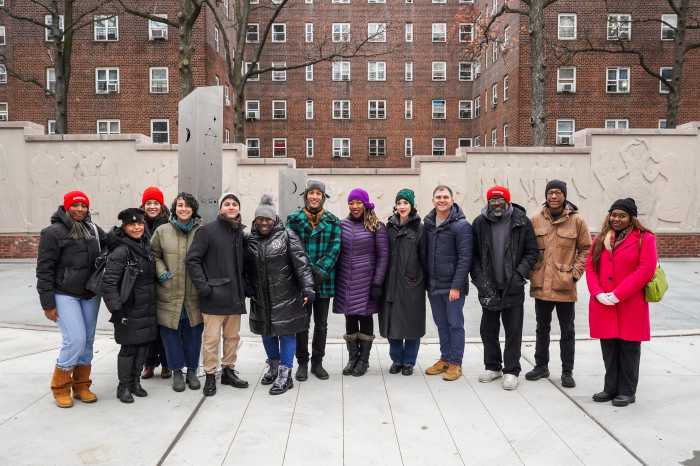
City officials, artists, residents, and cultural leaders unveiled a new permanent outdoor heritage walk and community art installation at Kingsborough Houses in Crown Heights on Dec. 5.

Titled “Migration,” the project marks the second phase of a broader cultural initiative that began with the landmark restoration of Harlem Renaissance sculptor Richmond Barthé’s  “Exodus and Dance” frieze. The restoration received the 2025 Moses Award for Preservation Projects from the New York Landmarks Conservancy and the 2025 Excellence in Historic Preservation Award from the Preservation League of New York State.

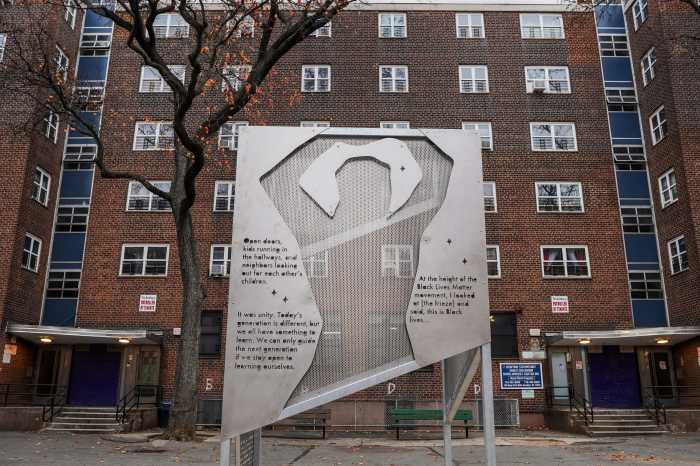
The heritage walk honors the “Great Migration” and features 35 illuminated steel sculptures ranging from six to 12 feet high, spread across the 16-acre campus. The installation amplifies the voices, memories, and aspirations of Kingsborough residents while honoring the recently restored, monumental 8-foot-by-80-foot frieze, installed in 1941.

The design team, led by New York City-based artists Ifeoma Ebo and Jerome Haferd, alongside Pedro Cruz Cruz and Violet Greenberg, sought input from Kingsborough residents, local artists from the Fulton Art Fair — including the late artist-in-residence Larry Weekes — lighting designers, and cultural historians to ensure the work reflected authentic community voices.

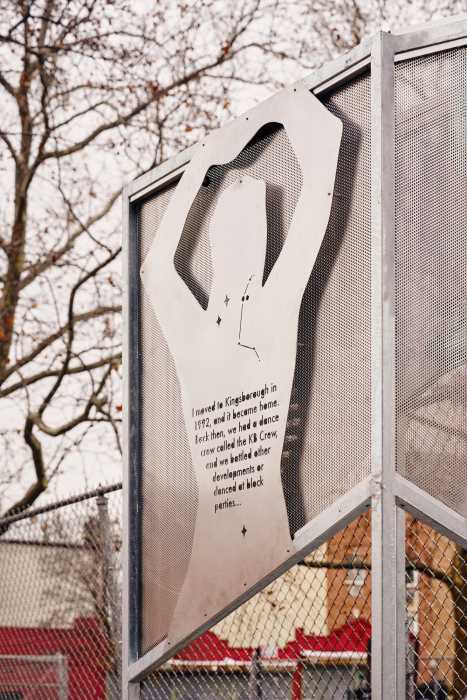
Participants shared memories, drawings, and stories, shaping the inscriptions on the sculptures. These include oral histories from residents, historic accounts of Barthé’s life and work, residents’ personal memories of the Exodus and Dance frieze, and quotes on community, extended family, and resilience.

Each sculpture features integrated lighting that illuminates the pathways and open spaces.
City officials, artists, residents, and cultural leaders unveil a new permanent outdoor heritage walk and art installation at Kingsborough Houses in Crown Heights.Photo courtesy of Tameek Williams

All sculptures, fabricated in Brooklyn, feature illustrations inspired by Egyptian and other diasporic motifs as well as Barthé’s own artistic vocabulary. Some include seating elements to invite engagement and reflection. Each structure has integrated lighting, illuminating pathways and open spaces in the evening and guiding visitors from neighboring streets toward the Exodus and Dance frieze. The open space around the frieze was also transformed with improved lighting and new community-inspired murals on the back wall.

Ebo, principal at Creative Urban Alchemy, said art is most powerful when it amplifies the voices of the community.

“Working alongside Kingsborough residents through months of workshops, the heritage walk became inscribed with their memories, dreams, and deep connection to this place,” Ebo said. “We’ve transformed these outdoor spaces into a celebration where Richmond Barthé’s historic frieze meets the living creativity of present-day Brooklyn, creating pathways that honor both preservation and the voices that make Kingsborough home.”

Angelina Whitaker, president of the Kingsborough Houses Resident Association, said the NYCHA public housing community has always been rich in history and pride.

“Migration honors the generations who came before us and celebrates those who continue to make Kingsborough home today,” Whitaker said. “The stories, art, and light now woven throughout our campus remind us that our community is alive with creativity and resilience.”

Newly installed artworks at Kingsborough Houses highlight residents’ memories and the historic Barthé frieze.Photo by Anna Dave
Steel sculptures and illuminated pathways bring the stories of Kingsborough Houses to life.

The project was funded by the Mellon Foundation and New York City Council. In 2019, NYCHA received $1.8 million for both phases from former City Council Speaker Corey Johnson and former City Council Member Alicka Ampry-Samuel, and an additional $2 million grant from the Mellon Foundation to the Public Housing Community Fund in 2023. Funding supported the frieze restoration, an artist-in-residency program, an oral history project, and the installation of the heritage walk. Other collaborators included the Kingsborough Houses Stakeholder Advisory Group, Weeksville Heritage Center, African Peach Arts Coalition, the NYC Public Design Commission, and various local cultural institutions and community organizations.

For NYCHA Chief Executive Officer Lisa Bova-Hiatt, the restoration of “The Wall,” as Barthé’s symbol of community pride is often called, underscores the importance of preserving Kingsborough Houses’ cultural identity.

“The Migration heritage walk takes inspiration and builds on the momentum of the frieze restoration, providing residents and community members with an incredibly unique and culturally significant art walk experience right on the Kingsborough campus,” Bova-Hiatt said. “We are deeply appreciative of the Public Housing Community Fund, the Mellon Foundation, artists Jerome Haferd and Ifeoma Ebo, and all the partners involved in this project, which pays homage not only to the original frieze installation but also to the generations of residents who have called Kingsborough Houses home.”


Categories
Brooklyn

#Stoicism #philosophy #MarcusAurelius Stoicism is often called the “philosophy of emperors” largely due to one man: MarcusAurelius, the Roman Emperor who ruled from 161 to 180 AD.1 He famously penned Meditations not as a book for publication, but as a private journal to himself—a tool to keep his sanity intact while ruling the known world.2 However, the philosophy’s power lies in a fascinating paradox: it was championed by both the most powerful man in the world (Marcus Aurelius) and a crippled former slave (Epictetus).3 This range proves its central claim—that inner freedom is accessible to anyone, regardless of their external chains or crowns. Here is an analysis of Stoicism as the operati


Categories
(@mikenov) / Twitter

#Stoicism #philosophy #MarcusAurelius Stoicism is often called the “philosophy of emperors” largely due to one man: MarcusAurelius, the Roman Emperor who ruled from 161 to 180 AD.1 He famously penned Meditations not as a book for publication, but as a private journal to himself—a tool to keep his sanity intact while ruling the known world.2 However, the philosophy’s power lies in a fascinating paradox: it was championed by both the most powerful man in the world (Marcus Aurelius) and a crippled former slave (Epictetus).3 This range proves its central claim—that inner freedom is accessible to anyone, regardless of their external chains or crowns. Here is an analysis of Stoicism as the operati


Categories
Brooklyn News

SUV hits e-bike in Bed-Stuy, rider critical


AN SUV DRIVER collided with a person riding an ebike in Bedford-Stuyvesant Monday morning, sending them to the hospital in critical condition.

The post SUV hits e-bike in Bed-Stuy, rider critical appeared first on Brooklyn Eagle.