Categories
The News And Times – thenewsandtimes.com

4 Argentine Israelis dead, others missing from kibbutzes after Hamas attack


GettyImages-1713749302.jpg?_t=1696819013

(JTA) — Argentina’s Jewish community is reeling after at least four people with local roots were killed in the Hamas attack on Israel Saturday, while several others are missing and feared kidnapped or dead.

The distress is being acutely felt in Buenos Aires, which until Saturday held the ignominious record of being the site of the worst terrorist attack on Jews since the Holocaust. Eighty-five people died in the 1994 bombing of the headquarters of AMIA, Argentina’s umbrella Jewish organization. At least 700 people died in Saturday’s surprise attack by Hamas, which like the assumed perpetrators of the AMIA bombing is linked with Iran.

Meanwhile, four of five people running for president in Argentina expressed solidarity with Israel during a televised debate Sunday. The fifth, Myriam Bregman, a left-wing candidate and self-identified atheist Jew, said that while “lamenting the civilian victims,” she blamed “the occupation and apartheid” of Israel for the violence.

Argentina is home to an estimated 180,000 Jews, the sixth-largest Jewish population of any country in the world. A long-faltering economy coupled with the violence of the AMIA bombing and other attacks in the 1990s have fueled a high rate of emigration to Israel for decades.

The dead in Israel include Rodolfo “Rody” Fabián Skariszewski, 56, who lived in Ohad, a small agricultural community in southern Israel. A graduate of the ORT Jewish high school in Buenos Aires and the Hechalutz Lamerchav youth movement, he was the father of three.

“I don’t know who I am without you,” his daughter Danielle wrote on Facebook. “You are my heart.”

Silvia Mirensky, 80, was also confirmed dead. Mirensky moved to Israel more than 50 years ago with her husband and sons, moving to Ein Hashlosha, a kibbutz near Gaza that, like others in the region, drew many immigrants from South America. According to her sister, who also lived on the kibbutz, she died when militants breached her security room and set it afire.

Ronit Rudman Sultan, 55, was killed at Kibbutz Holit along with her husband Rolan. She had lived in Israel for 35 years since moving there from Buenos Aires and is survived by two sons and a grandson.

News of the death of Abi Korin, 56, traveled especially quickly because his father, Moshe Korin, is a prominent communal leader, an educator who directed the Ramat Shalom primary school in Buenos Aires and served as AMIA’s culture secretary. Abi Korin moved to Israel in the 1980s and had three children; he was also a resident of Kibbutz Holit. “He fell fighting,” his daughter Sara told local media.

Several other Argentinians in Israel remain missing, all from Kibbutz Nir Oz, a community of about 400 that was hard-hit in the violence. Brothers Eitan and Iair Horn disappeared from the kibbutz, where Iair lives and Eitan was visiting. Friends who launched a campaign for their release, “Free the Argentinean Hostages,” also highlighted another missing woman from Nir Oz, Ofelia Roitman.

Also missing is Jose Luis Silberman, born in Buenos Aires, who has been living in Israel for 40 years, and his wife Marguit, daughter Shiri, and two sons Kfir (9 months old) and Ariel (3 years old).

Friends and family of the missing are hoping that they are among the more than 100 people that Israel believes Hamas is holding captive in Gaza.

This article originally appeared on JTA.org.

The post 4 Argentine Israelis dead, others missing from kibbutzes after Hamas attack appeared first on The Forward.

The post 4 Argentine Israelis dead, others missing from kibbutzes after Hamas attack first appeared on The News And Times – thenewsandtimes.com.


Categories
The News And Times – thenewsandtimes.com

Tehran Stock Exchange Plummets on 2nd Day of Israel-Hamas Conflict


The Tehran Stock Exchange saw a sharp decline on the second day of fighting between Israel and Hamas militants, with the overall index plummeting approximately 51,000 points.

According to the ISNA news agency prominent companies, including Persian Gulf Petrochemical Industries, Esfahan Oil Refining, Parsian Oil and Gas Development, Bandar Abbas Oil Refining, and Mapna Group, were at the forefront of stock market transactions and all experienced a decline Sunday.

The over-the-counter market’s composite index also stalled with a 659-point drop, closing at 25,025 units.

Economist Siamak Ghasemi attributed the stock market’s decline to a “clear indication of a substantial surge in systemic risk in Iran.” In a message on the ‘X’ messaging platform (formerly Twitter), he said that Hamas’ attack on Israel and the onset of a new conflict are the most critical systemic economic risks in Iran, and possibly the entire Middle East, this year.

Following Saturday’s attack by Hamas, which enjoys the support of the Islamic Republic, the foreign currency exchange market in Iran saw an uptick, with the U.S. dollar reaching 52,250 Iranian tomans at the time of this report, up from 51,500 Iranian tomans a few hours earlier.

The dollar’s price surpassing 51,000 tomans broke the previous high of 49,000 tomans, which had been consistent in recent months despite assurances from Iranian  officials of a declining trend in the second half of the year.

According to Iranian domestic news sources, in Tehran’s gold and coin exchanges the price of Bahar Azadi gold coins surged from approximately 28 million tomans to over 30 million tomans.

The post Tehran Stock Exchange Plummets on 2nd Day of Israel-Hamas Conflict first appeared on The News And Times – thenewsandtimes.com.


Categories
The News And Times – thenewsandtimes.com

Iran ‘gave green light,’ helped plan Hamas massacre – WSJ


555713

Hamas’s attacks on Israel, which began Saturday morning, were planned weeks in advance with assistance from Iranian security officials, according to a Sunday report from The Wall Street Journal.

The report, citing senior members of Hamas and Hezbollah, stated that the Iranian officials “gave the green light” for the attacks during a meeting between them and Hamas in Beirut last week.

IRGC officers worked with Hamas since August to plan incursions from the “air, land, and sea,” the report noted. Officers of Iran’s Islamic Revolutionary Guard Corps were also at the meetings in Beirut.

Iran’s supreme leader, Ayatollah Ali Khamenei, had praised the attacks, posting on X earlier this week that the cancer of the usurper Zionist regime will be eradicated at the hands of the Palestinian people and the Resistance forces throughout the region.” Formerly known as Twitter, X stated that Khamenei’s post violated the platform’s rules.

At least 700 Israelis were killed and around 2,300 injured in attacks by Hamas since Saturday morning, with the number expected to rise.

Iran’s Supreme Leader Ayatollah Ali Khamenei speaks during a meeting with the guests of the Islamic Unity Conference in Tehran, Iran October 3, 2023. (credit: Office of the Iranian Supreme Leader/WANA/Handout via Reuters)

Hours earlier, Hamas spokesman Ghazi Hamad told the BBC that the terrorist group had direct backing and support from Iran, which also promised it would “stand by the Palestinian fighters until the liberation of Palestine and Jerusalem,” the report quoted him as saying.

This is a developing story.

The post Iran ‘gave green light,’ helped plan Hamas massacre – WSJ first appeared on The News And Times – thenewsandtimes.com.


Categories
The News And Times – thenewsandtimes.com

“Several“ US citizens have died following attacks in Israel, NSC spokesperson says


2023-10-08T23:35:09Z

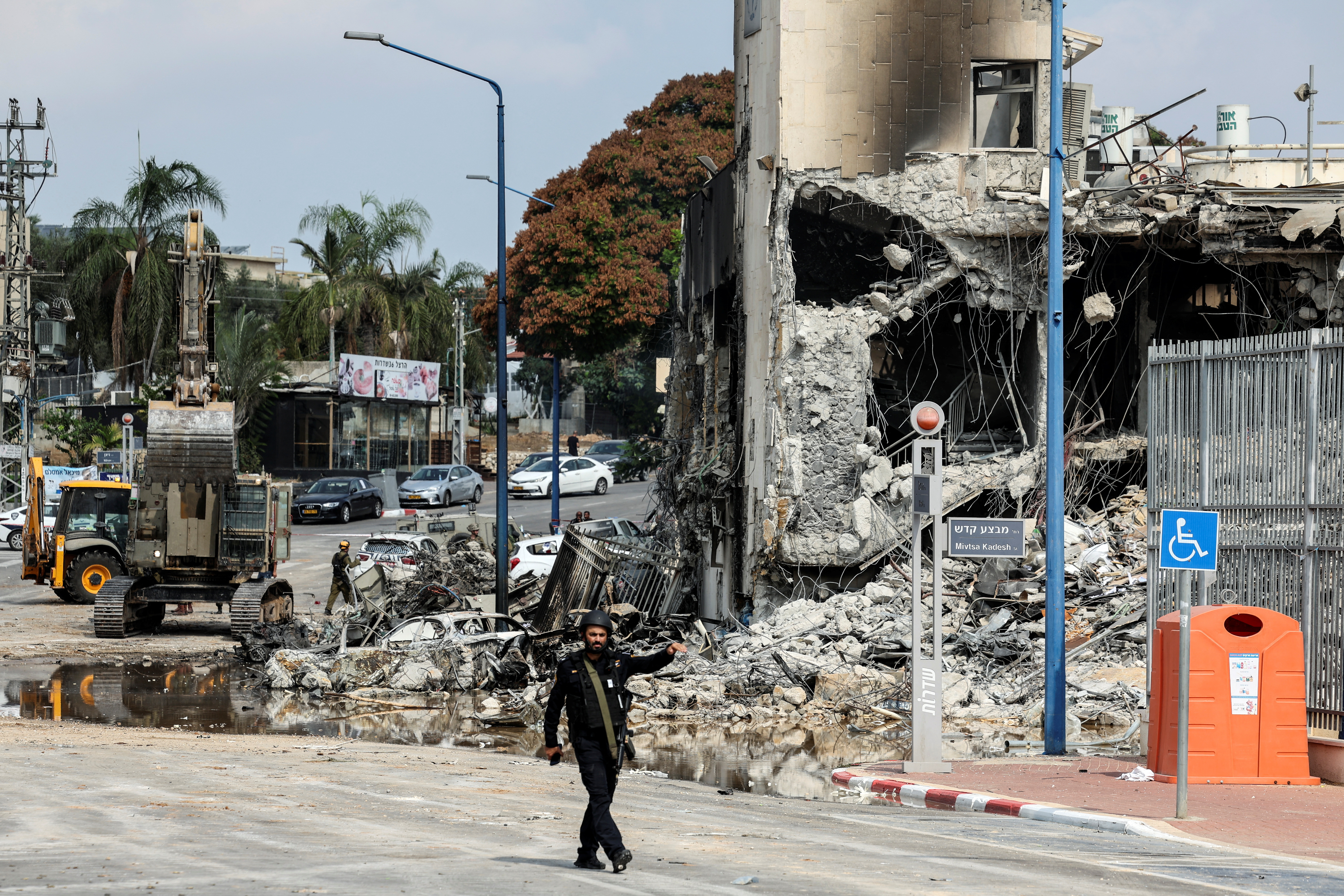
A member of Israel’s security walks past a police station which was the site of a battle following a mass infiltration by Hamas gunmen from the Gaza Strip, in Sderot, southern Israel October 8, 2023. REUTERS/Ronen Zvulun/File Photo

Several U.S. nationals have died since the start of Hamas’ surprise attack on Israel on Saturday, a National Security Council spokesman said Sunday, adding that U.S. officials remained in touch with their Israeli counterparts.

Official word of Americans killed in the conflict came as Israel retaliated for the incursion, one of the bloodiest in it history, launching attacks on the Palestinian enclave of Gaza.


The post “Several“ US citizens have died following attacks in Israel, NSC spokesperson says first appeared on The News And Times – thenewsandtimes.com.


Categories
The News And Times – thenewsandtimes.com

Israel Demands UN Security Council Condemn Hamas ‘War Crimes’


Israel’s U.N. ambassador demanded Sunday that the Security Council condemn what he said are Hamas war crimes against Israeli citizens.  

“Israel has one sole demand: Hamas’s war crimes must be unequivocally condemned,” Gilad Erdan told reporters. “This unimaginable atrocity must be condemned. Israel must be given steadfast support to defend ourselves.” 

He spoke ahead of a closed-door meeting of the 15-nation council, convened in the aftermath of a brutal surprise multi-prong attack Saturday morning by Hamas fighters on Israeli towns and cities. Hundreds of Israelis were killed, injured and kidnapped by the terrorist group in what Ambassador Erdan said is his country’s “9/11” – a reference to the al-Qaida terrorist attacks on the United States in 2001 that killed nearly 3,000 people.  

“They will not stop until they murder every single one of us,” Erdan said of Hamas, which has vowed the destruction of Israel. “This is precisely why this atrocity is Israel’s 9/11. From now, nothing will be as it was. I promise you.” 

Prime Minister Benjamin Netanyahu’s government responded quickly to the attack that its intelligence and security agencies failed to prevent. He has said the country is entering a long war.  

Israeli airstrikes targeted buildings in the Hamas-controlled Gaza Strip and several hundred Palestinians were reported killed in the first 24 hours of retaliation.  

The U.N. agency that assists Palestinian refugees, UNRWA, said Sunday that one of its schools in Gaza that is sheltering more than 225 displaced people was bombed. No one was injured, but the building was severely damaged.  

UNRWA said nearly 74,000 displaced people are in 64 shelters it runs, with numbers likely to increase as civilian areas are hit. 

The U.S. representative at the meeting, Ambassador Robert Wood, told reporters after the council session that the situation in Israel is still fluid and dangerous.  

“We are working hard, as I know other countries in the region are, to try to prevent this conflict from spreading,” he said.  

Palestinian Ambassador Riyad Mansour said the Palestinian Authority has requested an emergency meeting of Arab League foreign ministers later this week in Cairo. 

He said the Palestinian people have endured one deadly year after another under Israeli occupation.  

“Israel cannot wage a full-scale war on a nation, its people, its land, its holy sites, and expect peace in exchange,” he told reporters. 

But he urged a different path, one where neither Palestinians nor Israelis are killed. 

“Peace will save lives, because it is the only way forward,” Mansour said.  

The council did not release a formal statement after the meeting. Diplomats said none was put forward. They said during the meeting most council members expressed condemnation for Hamas’ attacks, the need for the unconditional release of hostages held by Hamas, and the need for de-escalation and a cease-fire.

The post Israel Demands UN Security Council Condemn Hamas ‘War Crimes’ first appeared on The News And Times – thenewsandtimes.com.


Categories
The News And Times – thenewsandtimes.com

Hamas Attack Is Latest Tragedy in Long Cycle of Middle East Violence


When Hamas militants from the Gaza Strip carried out attacks in Israel on Saturday, resulting in thousands of Israeli and Palestinian civilian casualties, it was the latest clash in a conflict with origins ascribed to biblical times. 

The modern battle between Israelis and Palestinians is primarily a territorial dispute, although there is a religious component as Israel is a Jewish state and the Palestinians are predominately Muslims in a land deemed holy by several religions, including Christianity. 

In Jerusalem, the holiest site in Judaism is known as The Temple Mount, because two ancient Jewish temples that were destroyed are located there. It is also the location of the Al-Aqsa Mosque and the Dome of the Rock, the third-most sacred site in Islam (known in Arabic as Haram al-Sharif, meaning Noble Sanctuary) Muslims believe the Prophet Muhammad ascended into heaven from there. 

A Hamas leader referred to Saturday’s assault into southern Israel, which included Palestinian gunmen on paragliders under cover of thousands of rocket launches, as the “al-Aqsa flood” in defense of the mosque, 75 kilometers to the northwest of Gaza.  

There have been numerous assaults on the mosque “by Israeli soldiers marching in with their boots on, which is total desecration. If that happened in any synagogue in the world, something comparable, we’d be screaming that it was antisemitism, which indeed it would be,” said Professor Joel Beinin of Stanford University. 

For the Israeli government, Jerusalem is its “unified, eternal” capital. It has held the eastern part of the city since the 1967 Middle East war, a setback for Palestinian dreams of a capital there. 

Israel’s annexation of largely Palestinian eastern Jerusalem is not internationally recognized. There are now more than 200,000 people living in Jewish settlements in east Jerusalem. 

A nationalistic mythology, rooted in biblical scripture, is used by those on the right in Israel to justify the occupation of Palestinian territories and the continuing repression of its people, according to Khaled Elgindy, director of the Palestine and Israeli-Palestinian Affairs program at the Middle East Institute in Washington. 

The primary area in dispute is on the west bank of the Jordan River, which the Israeli government refers to as Judea and Samaria. Many Jews living there assert it is the land of their people going back 4,000 years and was never under Arab rule. 

Palestinians see history differently and point to their families’ residing there under four centuries of Turkish rule and before. 

Hope for peace between Israelis and Palestinians and a two-state solution waxed and waned through declarations, armed conflict and treaties since the early 20th century after the British took control of the region following the end of the First World War. Britain and France then carved the area into spheres of influence. Violence between the Arab indigenous population and arriving Jewish settlers, part of a burgeoning Zionist movement, escalated. 

A war erupted in 1948, a day after Israel declared independence and Arab armies from five countries marched into areas that had not been apportioned by the United Nations to the Jews. The Israelis emerged victorious. For Palestinians, it was a historic loss known as the Nakbah or “catastrophe” for the large number of families who lost their land and became refugees. 

More wars would follow. 

“It’s hard to ignore the parallels [Saturday] with events from exactly 50 years ago when Egypt and Syria launched a surprise attack on Israel. Israel had been feeling quite triumphalist and invincible after its lightning victory of 1967,” Elgindy told VOA. 

There was a burst of hope, 30 years ago, when Israeli Prime Minister Yitzhak Rabin and Palestine Liberation Organization chairman Yasser Arafat, with U.S. President Bill Clinton as a witness, signed the Oslo Accords at the White House.  But the interim agreement failed. It did not lead the Palestinians to a state of their own after a period of self-governance under the Palestinian Authority. Israel did not stop settlement building, blaming the Palestinian leadership for failing to prevent terrorist attacks emanating from territory under Fatah control. 

No U.S. president since Barack Obama has effectively raised the issue of scaling back the Israeli presence in their territories, according to the Palestinians. 

The two-state solution “has been dead for decades, unfortunately. I never would have said that before because I never wanted to subject the Palestinian people to more years of trauma and tragedy living in a one state that was not giving them their rights,” said James Zogby, the founder and president of the Arab-American Institute. “The result is that today, I don’t know where you get a Palestinian state. I don’t know where it’s to be set up.” 

Analysts across the political spectrum generally concur there will be continuing repercussions if the plight of the Palestinians is ignored. 

“The Palestinian people are not going to vanish into thin air. This issue is not going to go away just because you think it’s too much of a problem to deal with it,” Beinin told VOA. 

Palestinian disgust with the corruption of Fatah, the largest faction of the PLO, led to Hamas as the victor in 2006 balloting in Gaza, the last time elections were held there.  

“Israel has been pounding the Gaza Strip every several years since 2008. They call it ‘mowing the grass,’” said Beinin, a former president of the Middle East Studies Association of North America.

The deterioration of the situation in the Middle East in recent decades “is clearly an American failure,” according to Zogby, contending that Washington has not effectively used its influence. Zogby refers to the Israelis as America’s spoiled child and the Palestinians as the abused child.

“America has not taken the adult role that it should take and create limits for both sides. We put pressure on and punished Palestinians, and we’ve continually rewarded and placated Israel,” Zogby told VOA. 

That led to an inevitable violent outburst from Hamas in the densely populated Gaza Strip, according to Beinin. “You’re going to imprison 2.1 million people for a decade-and-a-half and there won’t be an explosion?” 

The Stanford professor said he has family at a kibbutz that was attacked on Saturday, adding, “I don’t know where they all are at this moment.”

More than 600 Israelis were killed and at least 2,200 wounded in the Saturday attacks by Hamas, according to officials in Tel Aviv. It was the deadliest day of violence for Israel since the Yom Kippur War 50 years ago. 

Hamas has also abducted 100 Israelis, including women, children and the elderly, as well as soldiers, and taken them to Gaza.

Israeli retaliation in Gaza, through shelling and airstrikes, has killed 300 people, half of them civilians, according to Hamas. 

There is a wider geopolitical context with the timing of the Hamas attack – an attempt to thwart the normalization of relations between Israel and Saudi Arabia. 

“Who opposes it? Hezbollah, Hamas, and Iran,” said U.S. Secretary of State Antony Blinken on Sunday during an appearance on ABC’s “This Week” program.

“So, to the extent that this was designed to try to derail the efforts that were being made, that speaks volumes.”

The Abraham Accords, initiated by the previous U.S. administration of President Donald Trump, effectively ignored the Israeli-Palestinian conflict in pursuing diplomatic recognition between Israel and additional Arab nations. 

Iran and Hamas have a long relationship, noted Blinken in his Sunday TV interviews.

“Hamas wouldn’t be Hamas without the support it’s had for many years from Iran. In this moment, we don’t have anything that shows us that Iran was directly involved in this attack, in planning it or in carrying it out. But that’s something we’re looking at very carefully, and we’ve got to see where the facts lead,” said Blinken on NBC’s “Meet the Press” program.  

“I think it’s unlikely Hamas could have carried this out without that support,” said Elgindy at the Middle East Institute. But, he added, “Hamas is not an operative or a proxy of the Iranian regime.”

For decades, the Saudis, who are Sunni Muslims, have been engaged in a rivalry with the Iranians, who are Shiite Muslims, for leadership of the Islamic world. The split goes back to the 7th century when Muslims became divided about who should be the Prophet Muhammad’s successor as caliph. 

Nearly all Palestinian Muslims are Sunnis and Hamas is a Sunni-led faction, something that has not prevented support from the Shiite Islamic Republic in Tehran.

State television in Iran on Saturday showed video of members of parliament in Tehran standing and chanting “Death to Israel” and “Palestine is victorious,” while government officials were quoted pledging support for the “anti-Zionist resistance” across the region. 

“People will talk about Israeli intransigence and Palestinian suffering. All true. None of that justifies this barbaric attack on civilians and hostage taking. The Middle East will never be the same,” predicted Steven David, a professor of international relations at Johns Hopkins University.

The post Hamas Attack Is Latest Tragedy in Long Cycle of Middle East Violence first appeared on The News And Times – thenewsandtimes.com.


Categories
The News And Times – thenewsandtimes.com

“Several“ US citizens have died following attacks in Israel -NSC spokesperson


2023-10-08T23:18:31Z

Several U.S. nationals have died since the start of Hamas’ surprise attack on Israel on Saturday, a National Security Council spokesman said Sunday, adding that U.S. officials remained in touch with their Israeli counterparts.

Official word of Americans killed in the conflict came as Israel retaliated for the incursion, one of the bloodiest in it history, launching attacks on the Palestinian enclave of Gaza.

The post “Several“ US citizens have died following attacks in Israel -NSC spokesperson first appeared on The News And Times – thenewsandtimes.com.


Categories
The News And Times – thenewsandtimes.com

Foreign Correspondent Assesses Situation on the Ground in Israel


Press Trust of India (PTI) correspondent Harinder Mishra is in Jerusalem where he spoke to VOA Afghan Service journalist Nazrana Ghaffar Yousafzai about the reaction among Israelis to the attacks and mass kidnapping of soldiers and civilians by Hamas. 

This transcript has been condensed for clarity and brevity. 

VOA: Please update us on how the situation in Israel is right now?

PTI correspondent Harinder Mishra: Right now, I’m in Jerusalem, and here the streets look completely deserted. I went shopping and, you know, even the supermarkets were completely empty. There were hardly any people there. So as far as Jerusalem is concerned yesterday, people rushed to the shelter houses and everybody was instructed to stay indoors and close to the shelter houses, which most of the people did, but let’s say that since yesterday afternoon it has been calm here in Jerusalem. 

But it’s, again, a disturbing comfort. People look quite worried. There are hardly any people on the streets but everybody you speak to over the phone sounds quite worried. Most of the action today is in the south of Israel. 

VOA: Were the Israeli people ready for such a situation, to move to shelters?

Mishra: As far as such situations are concerned, they try to be always ready and prepared for such bad eventualities. And during the last 10 days, there were frequent checks by the municipal authorities, and they were coming and looking at the shelter houses across the country. But that could also be a routine exercise which happens every now and then. And it could also be because Israeli security has been kind of focusing completely on the Iranian nuclear program, and Iran is what was talked about all the time, and the whole focus was there. So, this has come as a great surprise. It is quite unexpected, and nobody thought about Hamas launching such a major offensive from the Gaza Strip.

VOA: How do the Israelis see the intelligence failure? Has it shaken Israelis’ trust in their intelligence agencies? 

Mishra: I look at [it] as definitely a lot of people are questioning Israel takes a lot of pride in its intelligence apparatus, and for Hamas to launch an offensive of this scale was unheard of, [not] thought of, nobody could really imagine anything like this happening. And the truth is that I get a sense that even Hamas didn’t really realize that they would have ever achieved this kind of a success in the attack that they have carried out. Probably, they were looking at abducting a few soldiers and then carrying out negotiations on releasing prisoners. And those are the kinds of things that were generally being talked about, and those were the things that generally they were looking at, that would be generally the aim. But to achieve this kind of  — they see it as a success — and definitely an Israeli failure. It was unthinkable. 

Israelis have been quite divided internally. There have been protests going on against the government for almost 40 weeks. But in this kind of a situation suddenly there’s a talk of formation of an emergency national unity government. There is a show of unity — people, nobody is blaming anybody, but then analysts here, political analysts are asking this question quite a lot. It’s very, you know, can be heard loud and clear in the media as to… is [it] possible that Iran, Iran was such a focus everybody was looking at Iran in such a way that they forgot to look at their own backyard here — that the Hamas militants could carry out such an attack.

Secondly, people are also saying that what are the… what are the preparations affected by what is going on internally within the Israeli society because if you look at it, a lot of reservists and a lot of Israeli soldiers had announced that they would be boycotting and not coming for a reserve duty and they had stopped going for reserve duty and their surveillance apparatus was said to have also been affected. This is something that was there, open, in the open. It was there in the media. It was something that was already known.

VOA: There is a strong reaction from the political leadership to it. What does it mean for Gaza and the Palestinian people?

Mishra: Look, what has happened will definitely lead to massive retaliation. It is already happening there. I have spoken to people in the Gaza Strip. There are also some Indians living in Gaza and there is no internet connectivity at the moment, [the] electricity supply has also been stopped. And if you look at it, almost 70% of Gaza’s electricity supply comes from Israel. So, Israel is determined to black out completely Gaza, they can very easily do that. And the energy minister has clearly made his intent clear. Now with the security cabinet, taking a decision and declaring war against Hamas. It gives them the authority to go to any extent in order to defeat Hamas. 

And in view of that, it is almost certain that people in Gaza are going to suffer a lot. Yesterday there were scenes of people hurriedly trying to buy and stockpile food stuff and all the emergency stuff at home so that they wouldn’t run out of stock. So, such preparations were underway could be seen yesterday, people could have — good people — had already said even though you know, a lot of Hamas activists would be seen on the streets rejoicing with what had happened, but the common people were shaken up. So, the common people on both sides look quite shaken up actually. 

Even here, nobody had imagined that 600 people could be killed in such a, such an attack, which was so certain and swift. Even you know during the Second Lebanon War in 2006 the casualties were almost one fourth of what has happened in a few hours yesterday.

The post Foreign Correspondent Assesses Situation on the Ground in Israel first appeared on The News And Times – thenewsandtimes.com.


Categories
The News And Times – thenewsandtimes.com

Netanyahu Says Attempts to Cause Friction Between Him and Ben-Gvir Are ‘False and Done Purposefully’ – Israel News – Haaretz.com


583562.jpg?precrop=2200,1279,x0,y83&heig

Haaretz | Israel News

The Prime Minister’s Office issued the statement following reports that Netanyahu excluded National Security Minister Ben-Gvir from a sensitive security discussion

Get email notification for articles from Jonathan Lis Follow

Oct 1, 2023

Get email notification for articles from Jonathan Lis Follow

Israeli Prime Minister Benjamin Netanyahu said on Sunday that any attempt to cause friction between him and National Security Minister Itamar Ben-Gvir is “false and done purposefully.”

Paid by Attorney Rakefet Shfaim

The post Netanyahu Says Attempts to Cause Friction Between Him and Ben-Gvir Are ‘False and Done Purposefully’ – Israel News – Haaretz.com first appeared on The News And Times – thenewsandtimes.com.


Categories
The News And Times – thenewsandtimes.com

Escalation In Azerbaijan: Iran Flexes Muscles To Warn Israel, Russia A Main Benefactor


Iran accuses Azerbaijan-ally Israel of having a part in the escalation, saying it will not tolerate any ‘Zionist initiative on border reshuffling in the region’

Azerbaijan’s anti-terror operation launched on Tuesday in its Nagorno-Karabakh conclave – a response to a series of terror attacks on civilian and police vehicles – was aimed at separatist militia in the territory, populated by Armenians who live under the control of a Russian peacekeeping force. 

The escalation plays into the hands of two major players in the region – Iran and Russia.

As official Iranian Revolutionary Guard (IRGC) sources report, as of Tuesday, after explosions in the Hojavend district killed six Azerbaijanis, Iranian forces stationed in Eastern Azerbaijan were prompted to be on high alert. 

Simultaneously, reconnaissance drones operated by the IRGC took to the skies, initiating the collection of vital information regarding the events unfolding in Karabakh. Shortly thereafter, it was reported that all of Iran’s ground forces along the border with Azerbaijan stood ready to engage in combat operations.

Numerous Iranian media outlets started to disseminate information regarding Israel and Turkey’s alleged involvement through support for Azerbaijani military actions, emphasizing that Iran will not tolerate any “Zionist initiative on border reshuffling in the region,” even though Azerbaijan’s military operations are confined to their own territory. 

Strikes were being carried out against separatist units known as the Defense Army of Artsakh – an entity unrecognized even by Armenia. These units, in accordance with agreements following the 2020 war, were not supposed to exist at all. Nevertheless, they were formed despite the presence of Russian “peacekeepers” tasked with ensuring the absence of any other armed forces on the ground.

The armed forces of Azerbaijan, employing Israeli technology, have released videos showcasing the destruction of military installations using drones, including highly expensive systems like the SA-15 Gauntlet. It remains unknown from whom the separatists acquired such expensive military technology, but it is likely they got it from Armenia’s armed forces, which, it is worth recalling, do not recognize the independence of the separatist republic.

The second beneficiary of this escalation is Russia. Against the backdrop of Armenian Prime Minister Nikol Pashinyan’s demonstration of his desire to reorient the country towards the West and his refusal to recognize the separatist enclave as part of Armenia, the escalation triggered by terrorism plays into Moscow’s hands.

“In Armenia, they do indeed believe that Russia has abandoned them, but at the same time, somewhat oddly, they claim that the West won’t help them,” noted Joseph Epstein, an expert on Iran and the former Soviet Union.

“Right now, there’s a protest taking place in front of the Russian embassy in Yerevan. Demonstrators are demanding assistance, particularly through the CSTO, from which Pashinyan threatens to withdraw Armenia. The Russian Foreign Ministry acknowledges that they can’t do anything. Pashinyan has ‘tied’ their hands by not recognizing the enclave as part of Armenia. So according to his own declaration, there’s no aggression – Azerbaijan is within its rights.”

For the vast majority of Armenians, the enclave is seen as a part of “Greater Armenia,” and Pashinyan’s inability to provide assistance – his direct refusal to send troops there – is sure to result in his removal, effectively ending his pro-Western policies. Surprisingly, this outcome is not beneficial to Azerbaijan.  

Moscow has a vested interest in the instability and the continued existence of the enclave, which ultimately serves as a “switch” against Baku, their competitor in the energy resources supplied to the European Union. 

Azerbaijan, for various objective reasons – including its alignment with the West – has no plans for mass expulsion of enclave residents to Armenia. Furthermore, Russia simply won’t allow it to happen, as it wants to prolong its peacekeepers staying in the area even after the end of the mandate in 2025. 

“There are numerous possibilities, including even the issuance of Russian passports to enclave residents,” suggested Epstein, who does not rule out the possibility that the terror acts against Azerbaijani citizens were carried out with the coordination of “peacekeepers.”

It should be noted that the timing of the bombings was very deliberate: a day after the opening of two humanitarian supply roads leading to the enclave from both Armenia and Azerbaijan. As its pro-Russian leaders claimed, the population of the enclave was “dying from hunger like Jews in the ghettos,” – a comparison that caused outrage among EU rabbis and created a lot of public relations problems for Baku. 

The open roads – one of which was blocked by the Armenians – solved this problem. So, stemming from that there was a need to create another issue. 

It was obvious to the perpetrators that Azerbaijan had to react to the murder of its citizens. And did it in a somewhat Israeli manner – the enclave population received SMS warnings before the upcoming attacks to leave the areas where separatist units were stationed.

The post Escalation In Azerbaijan: Iran Flexes Muscles To Warn Israel, Russia A Main Benefactor first appeared on The News And Times – thenewsandtimes.com.