Categories
The News And Times – thenewsandtimes.com

Colombia court rejects shelving of case against ex-president Uribe


2023-10-06T23:51:16Z

The Superior Court of Bogota on Friday rejected a prosecutor’s request to shelve a witness tampering and fraud case against divisive former President Alvaro Uribe, extending a long-running legal battle.

Uribe and several allies have been investigated over allegations of witness tampering carried out in an attempt to discredit accusations he had ties to right-wing paramilitaries.

The post Colombia court rejects shelving of case against ex-president Uribe first appeared on The News And Times – thenewsandtimes.com.


Categories
The News And Times – thenewsandtimes.com

Ransomware attack on MGM Resorts costs $110 Million


image-19.png

Hospitality and entertainment company MGM Resorts announced that the costs of the recent ransomware attack costs exceeded $110 million.

In September the hospitality and entertainment company MGM Resorts was hit by a ransomware attack that shut down its systems at MGM Hotels and Casinos.

The incident affected hotel reservation systems in the United States and other IT systems that run the casino floors.

The company now revealed that the costs from the ransomware attack have exceeded $110 million. The company paid third-party experts $10 million to clean up its systems.

A few days later, an affiliate of the BlackCat/ALPHV ransomware group known as Scattered Spider claimed responsibility for the attack.

“The Company believes that the operational disruption experienced at its affected properties during the month of September will have a negative impact on its third quarter 2023 results, predominantly in its Las Vegas operations, and a minimal impact during the fourth quarter. The Company does not expect that it will have a material effect on its financial condition and results of operations for the year. Specifically, the Company estimates a negative impact from the cyber security issue in September of approximately $100 million to Adjusted Property EBITDAR for the Las Vegas Strip Resorts and Regional Operations, collectively.” reads the 8-K report filed with SEC. “The Company has also incurred less than $10 million in one-time expenses in the third quarter related to the cybersecurity issue, which consisted of technology consulting services, legal fees and expenses of other third party advisors.”

The Company states that its cybersecurity insurance will cover the financial losses and future expenses, however, the full scope of the costs and related impacts has yet to be determined.

According to the ongoing investigation, threat actors had access to the data of some of the Company’s customers who transacted with the Company prior to March 2019. Personal information exposed includes name, contact information (such as phone number, email address and postal address), gender, date of birth and driver’s license numbers). For a limited number of customers, Social Security numbers and passport numbers were exposed. The types of impacted information varied by individual.

The attack caused disruptions at some of the company’s properties, however, the incident did not expose any customer bank account numbers or payment card details.

Follow me on Twitter: @securityaffairs and Facebook and Mastodon

Pierluigi Paganini

(SecurityAffairs – hacking, MGM Resorts)

The post Ransomware attack on MGM Resorts costs $110 Million appeared first on Security Affairs.

The post Ransomware attack on MGM Resorts costs $110 Million first appeared on The News And Times – thenewsandtimes.com.


Categories
The News And Times – thenewsandtimes.com

Typhoon Koinu Heads Toward Southern China, Hong Kong


A typhoon was headed toward southern China and Hong Kong Friday after bringing record-breaking winds and leaving one dead in Taiwan. 

Typhoon Koinu, after initially weakening, regained strength as it headed west across the South China Sea toward China’s Guangdong province, the China Meteorological Administration said. The slow-moving storm was forecast to remain at sea, bringing rain to China’s southern coast through the weekend as it passes south of Guangdong and Hong Kong. 

The storm was about 240 kilometers (150 miles) southeast of Hong Kong and moving at about 12 kilometers (7 miles) per hour Friday evening, the city government’s Hong Kong Observatory said. It issued a strong wind warning and forecast squally showers, heavy at times, in the coming days. 

Hong Kong was hit by heavy rains about one month ago that killed at least two people and caused widespread flooding. 

Ferry service was suspended in parts of Guangdong province, and the city of Guangzhou canceled some flights and trains.  

Koinu, which means “puppy” in Japanese, brought pounding rain and wind gusts Thursday to southern and central Taiwan, downing trees and damaging buildings. An 84-year-old woman was killed by flying glass in Taichung city and about 400 others were injured around the island, Taiwan’s fire department said. 

A weather monitoring station on Taiwan’s outlying Orchid Island measured a gust of 342.7 kph (212.9 mph) at 9:53 p.m. Wednesday, as well as sustained winds that reached 198.7 kph (123.5 kph) at 9:40 p.m. The device measuring the wind speeds broke shortly afterward, Taiwan’s Central News Agency reported. 

The post Typhoon Koinu Heads Toward Southern China, Hong Kong first appeared on The News And Times – thenewsandtimes.com.


Categories
The News And Times – thenewsandtimes.com

Appeals Judge Declines to Halt Trump’s New York Civil Fraud Trial


Former President Donald Trump lost a bid Friday to halt his civil fraud trial while he fights a pretrial ruling that could strip him of Trump Tower and other marquee properties.

An appeals court judge rebuffed Trump’s push to pause the New York trial, which will start next week, but agreed to leave him in control of his holdings for now. The decision, after an emergency hearing Friday afternoon, came five days into the closely watched trial.

Trump went to the courthouse for the first three days of the trial in New York Attorney General Letitia James’ lawsuit, observing testimony — and complaining to TV cameras outside about a case he deemed a “a witch hunt and a disgrace.”

Trump’s lawyers had asked the state’s intermediate appellate court to suspend the trial and prevent Judge Arthur Engoron from enforcing a ruling he made last week. Engoron’s decision revoked the Republican presidential front-runner’s business licenses and put a court-appointed receiver in charge of his companies.

“This is a massive error. It is irreparable,” Trump lawyer Christopher Kise told the appellate judge, Associate Justice Peter H. Moulton. Kise argued that the ruling would make defendants in other cases fear that their companies and properties will be seized without recourse.

“We’re not seeking a delay. We’re seeking a fair trial,” Kise said.

Trump’s lawyers said Engoron’s ruling could harm not only the ex-president and other defendants but as many as 1,000 employees.

Offer from state

State Deputy Solicitor General Judy Vale told the appeals judge that James’ office had already offered to keep the business licenses as they are until after the trial. Kise acknowledged the offer, but said he was worried Engoron wouldn’t allow it.

“We could have resolved some of this, and we’re still happy to do so,” Vale said.

She called the defense arguments for a delay “completely meritless” and noted that mounting the trial has been “an enormous endeavor.” It has entailed extensive court planning, security resources for Trump’s attendance, and special arrangements for press and public access.

Ahead of the hearing, James said Trump and the other defendants “can continue to try to delay and stall, but the evidence is clear, and our case is strong.”

She declined to comment as she left the emergency hearing, at the state Supreme Court, Appellate Division, First Department, in Manhattan.

In a statement, Kise said: “We are very pleased the First Department upheld New York law and put a halt to any cancellation of business certificates, receivers or dissolution. The trial court’s attempt to reach issues, entities and assets beyond the scope of this case has been suspended.”

The appellate court last week rejected the defense’s last-minute effort to delay the trial just days before it began. On Thursday, Trump’s lawyers dropped a lawsuit they filed against Engoron as part of that challenge.

Routine fraud found

Engoron ruled last week that Trump had committed years of fraud as he built the real estate empire that vaulted him to fame and the White House.

The judge, ruling on the top claim in James’ lawsuit, found that Trump had routinely deceived banks, insurers and others by exaggerating the value of assets on his annual financial statements, which were used in making deals and securing loans.

Trump has denied wrongdoing, arguing that some of his assets are worth far more than what’s listed on the statements.

Before the appellate action, former Trump Organization controller Jeffrey McConney testified at the trial Friday that values he assigned to Trump’s Mar-a-Lago resort in Florida — as much as $739 million in 2018 — were based on the false premise that it could be sold as a private residence. Such use is prohibited by Trump’s 2002 agreement with the National Trust for Historic Preservation.

“Were you aware that Mr. Trump had deeded away his right to use the property for any other purpose than a social club?” state lawyer Andrew Amer asked.

“I was not aware,” said McConney, who’s also a defendant in this case.

The trial will resume Tuesday with Trump’s longtime finance chief, Allen Weisselberg, on the witness stand. Weisselberg, a defendant, oversaw Trump’s dealmaking, was involved in securing loans and supervised McConney’s work on the financial statements. He left jail in April after serving about 100 days for dodging taxes on $1.7 million in job perks.

Procedures for ruling

As the trial was unfolding this week, Engoron issued an order Thursday setting procedures for enforcing his ruling. He gave both sides until October 26 to submit names of potential receivers and gave Trump and other defendants seven days to provide a court-appointed monitor, retired federal Judge Barbara Jones, with a list of all entities covered by the ruling.

He also ordered the defendants to give Jones advance notice of any application for new business licenses in any jurisdiction and any attempts to create new entities to “hold or acquire the assets” of a company that’s being dissolved under the ruling.

Trump’s lawyers argued in court papers that Engoron had “no rationale or legal authority” to impose what they described as “the corporate death penalty.” They also rapped the judge for not being clear in explaining the real-world effects of his decision.

At a pretrial hearing on September 26, Trump lawyer Kise pressed Engoron to clarify whether his ruling meant Trump would be required simply to close up some corporate entities or if he’d be forced to relinquish some of his most prized assets. 

Engoron then said he wasn’t “prepared to issue a ruling right now.”

The post Appeals Judge Declines to Halt Trump’s New York Civil Fraud Trial first appeared on The News And Times – thenewsandtimes.com.


Categories
The News And Times – thenewsandtimes.com

Kosovo accuses Serbia of being behind ‘terrorist attack’ against it and calls for ‘clear action’ from EU and west – Europe as it happened


Kosovo deputy prime minister says incident on 24 September was ‘open act of aggression’ and says it represents risk to entire region. This live blog is closed.

Tue 3 Oct 2023 18.37 CESTFirst published on Tue 3 Oct 2023 11.12 CEST

— Catherine Colonna (@MinColonna) October 3, 2023

Julian Borger

Julian Borger

The signs over the weekend suggested that the immediate crisis over Kosovo has been defused.

Some Serbian troops are pulling back from the border, and the threat of a return to armed conflict has receded for now.

The Biden administration acted decisively on Friday, drawing on some of the lessons from the run-up to the Ukraine invasion, going public with US intelligence on Serbian troop movements, and calling Belgrade to threaten sanctions and ostracism. The Nato peacekeeping force, Kfor, was immediately reinforced by the transfer of command of a battalion of British troops who were in the region for training.

While the immediate danger may have passed, however, the chronic crisis over Kosovo continues to fester.

The events of the past week could be an inflection point, depending on whether they lead to a policy rethink in Washington and Brussels.

Read the full story here.

The Serbian president, Aleksandar Vučić

The Serbian president, Aleksandar Vučić, speaks during an interview with Reuters in Belgrade, Serbia, on 28 September.

Photograph: Zorana Jevtić/Reuters

Eyes on an international mission

Asked about the UN mission in Nagorno-Karabakh, a spokesperson for the US state department said yesterday that “we welcome that mission” and “we continue to work with our allies and partners about what a more long-term mission ought to look like”.

“Around 100,000 ethnic Armenians have left Nagorno-Karabakh, and relocated to Armenia. We believe that they ought – if they wish to return, they ought to have their rights respected, and that there ought to be an international monitoring mission in place to secure that,” the spokesperson said.

Only a few hundred people remain in the capital of Nagorno-Karabakh, the International Committee of the Red Cross (ICRC) team lead, Marco Succi, said today, Reuters reported.

“The city is now completely deserted,” he said via video link from the Karabakh capital.

“The hospitals … are not functioning; the medical personnel left; the water board authorities left; the director of the morgue also left. So this scenario is quite surreal,” he said.

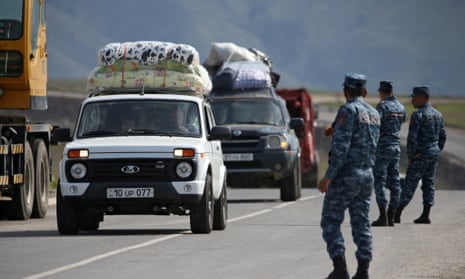
Vehicles carrying refugees arrive watched by soldiers

Refugees from Nagorno-Karabakh arrive in the border village of Kornidzor, Armenia, on 29 September.

Photograph: Irakli Gedenidze/Reuters

French minister heads to Armenia

France’s foreign minister, Catherine Colonna, is visiting Armenia today, where she is expected to meet the prime minister, Nikol Pashinyan, and foreign minister, Ararat Mirzoyan, as well as refugees who fled Nagorno-Karabakh.

Ahead of the trip, the French foreign ministry said Colonna would underline France’s support for Armenia’s territorial integrity.

Armenia’s national assembly has ratified the founding statute of the international criminal court.

Russia had previously called the idea “extremely hostile”.

Pjotr Sauer

Pjotr Sauer

Nearly the entire ethnic Armenian population has left Nagorno-Karabakh, as the first United Nations mission arrived in the largely deserted mountainous region on Sunday.

Stéphane Dujarric, the spokesperson for the UN secretary general, said its team on the ground, the first UN mission to the region in 30 years, would “identify the humanitarian needs” both for people remaining and “the people that are on the move”.

Many of the Armenians who fled Nagorno-Karabkah said they felt the international mission’s visit came too late, after Azerbaijan reclaimed the area in a lightning military operation last month.

Sitting on a bench near the central Republic Square in the Armenian capital, Yerevan, Aren Harutyunyan, who left the region known by Armenians as Artsakh last week, blamed the “international community” for the exodus.

“What is there left for the UN to monitor?” said Harutyunyan, 53, who arrived in Yerevan on Friday after a gruelling three-day journey from Stepanakert, the Nagorno-Karabakh capital.

“No one is there any more, everyone is gone, it’s a ghost town.”

Read the full story here.

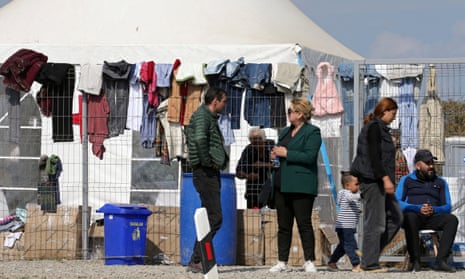
People gather near an aid centre for refugees from the Nagorno-Karabakh region in the border village of Kornidzor, Armenia, on 29 September

People gather near an aid centre for refugees from the Nagorno-Karabakh region in the border village of Kornidzor, Armenia, on 29 September.

Photograph: Irakli Gedenidze/Reuters

Berlin wants international observers to stay in Nagorno-Karabakh to help build “trust” for civilians.

“It is a positive step that Azerbaijan has allowed UN observers into Nagorno-Karabakh for the first time,” the German foreign office said today.

“They need a permanent presence, as only transparency can build trust in Azerbaijan’s promise to protect the rights of all residents and returnees to the region,” it added.

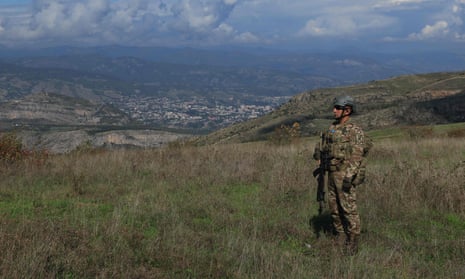
An Azeri serviceman stands at a former Armenian separatists military position in the village of Mukhtar (Muxtar) retaken recently by Azeri troops, during an Azeri government-organised media trip in Azerbaijan’s controlled region of Nagorno-Karabakh on Tuesday.

An Azeri serviceman stands at a former Armenian separatists military position in the village of Mukhtar (Muxtar) retaken recently by Azeri troops, during an Azeri government-organised media trip in Azerbaijan’s controlled region of Nagorno-Karabakh on Tuesday.

Photograph: Emmanuel Dunand/AFP/Getty Images

Good morning and welcome back to the Europe live blog.

Today we will be looking at the latest on two crises that have raised concern across Europe: the situation around Nagorno-Karabakh and tensions between Kosovo and Serbia.

The European parliament is set to debate both issues later today.

Send your comments to lili.bayer@theguardian.com.
The post Kosovo accuses Serbia of being behind ‘terrorist attack’ against it and calls for ‘clear action’ from EU and west – Europe as it happened first appeared on The News And Times – thenewsandtimes.com.


Categories
The News And Times – thenewsandtimes.com

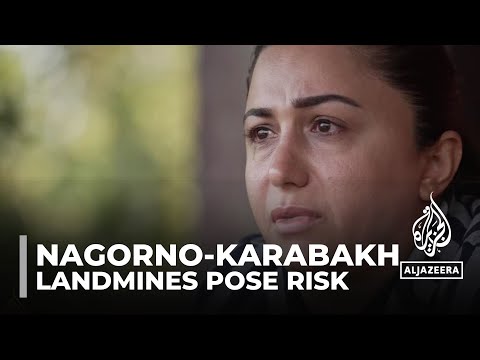
Demining Nagorno-Karabakh: Landmines pose risk to returning civilians


Demining nagorno-karabakh: landmines pose risk to returning civilians

Al Jazeera English published this video item, entitled “Demining Nagorno-Karabakh: Landmines pose risk to returning civilians” – below is their description.

Azerbaijan says up to 10,000sq km (nearly 4,000sq miles) of its territory is contaminated with land mines, unexploded munitions and other remnants of its three-decade conflict with Armenia.

Many of the mines are in residential and agricultural areas and have killed more than 3,500 people.

Al Jazeera’s Osama Bin Javaid reports from a minefield being cleared in Horadiz in the Nagorno-Karabakh region.

Subscribe to our channel http://bit.ly/AJSubscribe

Follow us on Twitter https://twitter.com/AJEnglish

Find us on Facebook https://www.facebook.com/aljazeera

Check our website: https://www.aljazeera.com/

Check out our Instagram page: https://www.instagram.com/aljazeeraenglish/

Download AJE Mobile App: https://aje.io/AJEMobile

@AljazeeraEnglish

#AlJazeeraEnglish

#News

#Azerbaijan #Khankendi #Stepanakert #NagornoKarabakh #KarabakhExodus #Karabakh #Armenia

Al Jazeera English YouTube Channel

Got a comment? Leave your thoughts in the comments section, below. Please note comments are moderated before publication.

The video item below is a piece of English language content from Al Jazeera. Al Jazeera is a Qatari state-funded broadcaster based in Doha, Qatar, owned by the Al Jazeera Media Network.

Recent from Al Jazeera English:

Armenia is a nation, and former Soviet republic, in the mountainous Caucasus region between Asia and Europe.

5 Recent Items: Armenia

Azerbaijan, the nation and former Soviet republic, is bounded by the Caspian Sea and Caucasus Mountains, which span Asia and Europe. Its capital, Baku, is famed for its medieval walled Inner City.

5 Recent Items: Azerbaijan

Nagorno-Karabakh, also known as Artsakh, is a landlocked region in the South Caucasus, within the mountainous range of Karabakh, lying between Lower Karabakh and Zangezur, and covering the southeastern range of the Lesser Caucasus mountains. The region is mostly mountainous and forested.

5 Recent Items: Nagorno-Karabakh

The post Demining Nagorno-Karabakh: Landmines pose risk to returning civilians first appeared on The News And Times – thenewsandtimes.com.


Categories
The News And Times – thenewsandtimes.com

Aliyev says UN mission will visit Karabakh again


default.jpg

The UN mission will visit Karabakh again in the coming days, Azerbaijani President Ilham Aliyev said at a meeting with Hans Henri Kluge, the regional director for Europe at the World Health Organization.

He noted that “in the near future, the office of the UN Resident Coordinator in Azerbaijan, together with representatives of the relevant specialized agencies of the organization, will again visit those territories.”

!

This text available in   Հայերեն and Русский

Print

The post Aliyev says UN mission will visit Karabakh again first appeared on The News And Times – thenewsandtimes.com.


Categories
The News And Times – thenewsandtimes.com

Western Inaction on Nagorno-Karabakh: Is It Impotence or Indifference?


default.jpg

This analytical article by Dan Perry is republished from Newsweek. Dan Perry is managing partner of the New York-based communications firm Thunder11. He is the former Cairo-based Middle East editor and London-based Europe/Africa editor of the Associated Press.

It is a grand vexation of geopolitics: the failure of powers to act while action is possible. It can lead to tragedy, decimate power hard and soft, and leave a mess behind,.

So it has been in Nagorno-Karabakh, the restive province of Azerbaijan. No matter where one stands on the complex and emotive dispute between Armenia and Azerbaijan over the region, it is safe to say the West comes away looking ridiculous from the sudden exodus of its 120,000 indigenous people.

This shocking event, which many see as one of the largest cases of ethnic cleansing in recent history, creates the world’s newest refugee crisis. It coincided with the sudden collapse of the self-governing authority in the region after a Sept. 19 military attack by Azerbaijan – even as the European Union and the United States inadvertently provided a smokescreen with “peace talks” that diplomats kept claiming were “promising.” And though The New York Times claims no one saw this coming, to me it seems preordained by Western inaction, whether due to impotence, inattention or indifference.

From a broader perspective, it’s understandable that few wanted to take a side on Nagorno-Karabakh, a complicated situation with some moral ambiguity. Armenians see the province as a heartland of an empire that once covered most of the Caucasus, parts of Turkey and beyond. But history intervened, the Soviet Union eventually gobbled up the region, and Nagorno-Karabakh was handed to the Soviet Socialist Republic of Azerbaijan.

For the Soviets, such shenanigans were a feature, not a bug. They purposely scrambled ethnic groups and moved internal borders around to complicate the prospect of republics becoming independent countries.

Thus was a Slavic-populated strip of what might have been Ukraine appended to Romanian-speaking Moldova—yielding Trans-Dniester, a separatist region where wars have been fought. A similar strategy also applied to Ukraine to which territories that might plausibly have been in Russia were added; it is no reprieve for Russian President Vladimir Putin to appreciate that this stoked the war there. And so it was with Nagorno-Karabakh ending up in Azerbaijan.

In all cases, when the Soviet Union collapsed three decades ago, none of these countries had the presence of mind to dump these territories, whose unhappy populations anyway diluted the ethnic majority of the dominant group. In this, the newly formed countries found allies in the West. Traumatized by history, Western nations had little patience for separatist movements or border changes. Once you start, the thinking goes, there will be no end to the demands of squabbling tribes. On the one hand, true enough; on the other, a recipe for another kind of trouble.

In Nagorno-Karabakh, ethnic Armenians won control in a war in the early 1990s in which hundreds of thousands of ethnic Azerbaijanis were displaced. The area became a “self-governing entity” within Azerbaijan—but really self-governing, with massive ties to Armenia: the people had Armenian passports and not Azerbaijani ones, while living in territory which still was internationally recognized as Azerbaijan.

The issue became an obsession to the Baku-based regime of Ilham Aliyev. This regime is dictatorial (ranking 157 out of 176 on the Democracy Matrix index), kleptocratic (if the Pandora Papers be believed), and hostile to Armenians (see this Reuters story). In 2020, Azerbaijan attacked, winning back much of the lost area but keeping a rump Nagorno-Karabakh in place. At this point Aliyev decided to test Western resolve.

In September 2021, Azerbaijan launched a series of attacks on Armenian sovereign territory. Then-Speaker of the House Nancy Pelosi (D-CA) chastised Aliyev, but no one threatened concrete action. So, in December 2022, Azeri “eco-activists” blockaded the Lachin Corridor which connects what remained of Nagorno-Karabakh to Armenia. In February the International Court of Justice ordered the blockade ended, which Azerbaijan ignored, again with impunity. In June 2023 Baku dropped the eco-activist ruse and totally blockaded the region, not even allowing through Red Cross humanitarian missions.

At this point Luis Moreno Ocampo, former chief prosecutor of the International Criminal Court, stepped in to declare Azerbaijan’s action a “genocide” by starvation, according to Article 2C of the UN Genocide Convention. Other experts, from the Lemkin Institute for Genocide Prevention to Juan Mendez, the former chief genocide advisor at the United Nations, agreed. Yet even as people scrounged for turnips in the besieged area, no outside government lifted a finger. The UN Security Council and U.S. Congress conducted inconclusive debates.

For governments to accept Ocampo’s logic would require them to take action under the Genocide Convention. Yet the failures in Iraq and Afghanistan left no further patience for international adventure. So great is Western timidity that there was not even serious talk of economic sanctions.

Aliyev had a plausible argument on his side—the inviolability of borders, even silly ones created by the Soviet Union. So, he evidently calculated that no one would stop him and attacked on Sept. 19. Within a day the self-government folded and soon thereafter the entire population fled to Armenia; just a few miles away.

There are now plenty of questions. Should there be a right of return? Under what conditions? Could the status quo ante be restored? Can there be restitution of properties? Should the departure be considered an ethnic cleansing, yielding war crimes charges?

What is not in question is that the mass exodus is an embarrassment to Western powers—as evidenced by the tragic visage of Western humanitarian officials like Samantha Power who finally remembered to arrive upon the scene and survey the empty streets.

I write this from Yerevan, where I am advising an Armenian NGO trying to build civil society in the young democracy. There is debate here about what to do next. Some want to war crimes charges. Others want to focus on the future, and put aside the conflict that has for long defined their country. But no one has a kind word for Western democracies that stood by while tens of thousands were being starved.

I do not think the world wanted to appear so impotent. I don’t think the West wants governments to blatantly ignore the International Court of Justice. I don’t think the U.S. wants a world without rules. So why did the world ignore Ocampo? Does Azerbaijan’s natural gas and oil explain all?

The West’s mobilization on behalf of Ukraine—with weapons and funds, but not with direct involvement—obscures a more fundamental truth: We are born alone, we live alone and we die alone. You want to talk about shared values? That and four dollars will buy a cup of coffee.

The post Western Inaction on Nagorno-Karabakh: Is It Impotence or Indifference? first appeared on The News And Times – thenewsandtimes.com.


Categories
The News And Times – thenewsandtimes.com

Western Inaction on Nagorno-Karabakh: Is It Impotence or Indifference?


default.jpg

This analytical article by Dan Perry is republished from Newsweek. Dan Perry is managing partner of the New York-based communications firm Thunder11. He is the former Cairo-based Middle East editor and London-based Europe/Africa editor of the Associated Press.

It is a grand vexation of geopolitics: the failure of powers to act while action is possible. It can lead to tragedy, decimate power hard and soft, and leave a mess behind,.

So it has been in Nagorno-Karabakh, the restive province of Azerbaijan. No matter where one stands on the complex and emotive dispute between Armenia and Azerbaijan over the region, it is safe to say the West comes away looking ridiculous from the sudden exodus of its 120,000 indigenous people.

This shocking event, which many see as one of the largest cases of ethnic cleansing in recent history, creates the world’s newest refugee crisis. It coincided with the sudden collapse of the self-governing authority in the region after a Sept. 19 military attack by Azerbaijan – even as the European Union and the United States inadvertently provided a smokescreen with “peace talks” that diplomats kept claiming were “promising.” And though The New York Times claims no one saw this coming, to me it seems preordained by Western inaction, whether due to impotence, inattention or indifference.

From a broader perspective, it’s understandable that few wanted to take a side on Nagorno-Karabakh, a complicated situation with some moral ambiguity. Armenians see the province as a heartland of an empire that once covered most of the Caucasus, parts of Turkey and beyond. But history intervened, the Soviet Union eventually gobbled up the region, and Nagorno-Karabakh was handed to the Soviet Socialist Republic of Azerbaijan.

For the Soviets, such shenanigans were a feature, not a bug. They purposely scrambled ethnic groups and moved internal borders around to complicate the prospect of republics becoming independent countries.

Thus was a Slavic-populated strip of what might have been Ukraine appended to Romanian-speaking Moldova—yielding Trans-Dniester, a separatist region where wars have been fought. A similar strategy also applied to Ukraine to which territories that might plausibly have been in Russia were added; it is no reprieve for Russian President Vladimir Putin to appreciate that this stoked the war there. And so it was with Nagorno-Karabakh ending up in Azerbaijan.

In all cases, when the Soviet Union collapsed three decades ago, none of these countries had the presence of mind to dump these territories, whose unhappy populations anyway diluted the ethnic majority of the dominant group. In this, the newly formed countries found allies in the West. Traumatized by history, Western nations had little patience for separatist movements or border changes. Once you start, the thinking goes, there will be no end to the demands of squabbling tribes. On the one hand, true enough; on the other, a recipe for another kind of trouble.

In Nagorno-Karabakh, ethnic Armenians won control in a war in the early 1990s in which hundreds of thousands of ethnic Azerbaijanis were displaced. The area became a “self-governing entity” within Azerbaijan—but really self-governing, with massive ties to Armenia: the people had Armenian passports and not Azerbaijani ones, while living in territory which still was internationally recognized as Azerbaijan.

The issue became an obsession to the Baku-based regime of Ilham Aliyev. This regime is dictatorial (ranking 157 out of 176 on the Democracy Matrix index), kleptocratic (if the Pandora Papers be believed), and hostile to Armenians (see this Reuters story). In 2020, Azerbaijan attacked, winning back much of the lost area but keeping a rump Nagorno-Karabakh in place. At this point Aliyev decided to test Western resolve.

In September 2021, Azerbaijan launched a series of attacks on Armenian sovereign territory. Then-Speaker of the House Nancy Pelosi (D-CA) chastised Aliyev, but no one threatened concrete action. So, in December 2022, Azeri “eco-activists” blockaded the Lachin Corridor which connects what remained of Nagorno-Karabakh to Armenia. In February the International Court of Justice ordered the blockade ended, which Azerbaijan ignored, again with impunity. In June 2023 Baku dropped the eco-activist ruse and totally blockaded the region, not even allowing through Red Cross humanitarian missions.

At this point Luis Moreno Ocampo, former chief prosecutor of the International Criminal Court, stepped in to declare Azerbaijan’s action a “genocide” by starvation, according to Article 2C of the UN Genocide Convention. Other experts, from the Lemkin Institute for Genocide Prevention to Juan Mendez, the former chief genocide advisor at the United Nations, agreed. Yet even as people scrounged for turnips in the besieged area, no outside government lifted a finger. The UN Security Council and U.S. Congress conducted inconclusive debates.

For governments to accept Ocampo’s logic would require them to take action under the Genocide Convention. Yet the failures in Iraq and Afghanistan left no further patience for international adventure. So great is Western timidity that there was not even serious talk of economic sanctions.

Aliyev had a plausible argument on his side—the inviolability of borders, even silly ones created by the Soviet Union. So, he evidently calculated that no one would stop him and attacked on Sept. 19. Within a day the self-government folded and soon thereafter the entire population fled to Armenia; just a few miles away.

There are now plenty of questions. Should there be a right of return? Under what conditions? Could the status quo ante be restored? Can there be restitution of properties? Should the departure be considered an ethnic cleansing, yielding war crimes charges?

What is not in question is that the mass exodus is an embarrassment to Western powers—as evidenced by the tragic visage of Western humanitarian officials like Samantha Power who finally remembered to arrive upon the scene and survey the empty streets.

I write this from Yerevan, where I am advising an Armenian NGO trying to build civil society in the young democracy. There is debate here about what to do next. Some want to war crimes charges. Others want to focus on the future, and put aside the conflict that has for long defined their country. But no one has a kind word for Western democracies that stood by while tens of thousands were being starved.

I do not think the world wanted to appear so impotent. I don’t think the West wants governments to blatantly ignore the International Court of Justice. I don’t think the U.S. wants a world without rules. So why did the world ignore Ocampo? Does Azerbaijan’s natural gas and oil explain all?

The West’s mobilization on behalf of Ukraine—with weapons and funds, but not with direct involvement—obscures a more fundamental truth: We are born alone, we live alone and we die alone. You want to talk about shared values? That and four dollars will buy a cup of coffee.

The post Western Inaction on Nagorno-Karabakh: Is It Impotence or Indifference? first appeared on The News And Times – thenewsandtimes.com.


Categories
The News And Times – thenewsandtimes.com

UAW says GM will allow battery plant workers to be covered by labor deal


2023-10-06T19:48:13Z

The United Auto Workers (UAW) said on Friday General Motors will allow workers at joint-venture battery plants to be covered by a labor agreement, removing one of the major sticking points in negotiations.

However, an agreement with the ‘Detroit Three’ automakers remains elusive, UAW President Shawn Fain said on Friday, though he held off on expanding ongoing, coordinated strikes, citing progress in talks.

As the union’s strike enters its 22nd day, here is a timeline of events beginning with the election of Fain in March:

The post UAW says GM will allow battery plant workers to be covered by labor deal first appeared on The News And Times – thenewsandtimes.com.