Categories
The News And Times – thenewsandtimes.com

Mauritius High Court Decriminalizes Same-Sex Relations


The Supreme Court in the East African island nation of Mauritius has struck down a colonial-era law outlawing same-sex relations, a rare move at time when nations on the continent have passed strict anti-gay or LGBTQ laws.

The court ruled in two cases that were brought by individuals with the support of LGBTQ rights groups, who challenged the law that was established in 1898 under British colonial rule that made “sodomy” or consensual sex between two men a jailable offense. 

In both cases, the country’s Supreme Court ruled the prohibition on consensual same-sex relations is discriminatory and in breach of provisions in the constitution.  

The court said the law, Section 250 in the nation’s criminal code, “was not introduced in Mauritius to reflect any Indigenous Mauritian values but was inherited as part of our colonial history from Britain. Its enactment was not the expression of domestic democratic will, but was a course imposed on Mauritius and other colonies by British rule.”

The ruling was praised by the United Nations, as well as LGBTQ and human rights groups. Human Rights watch urged the Mauritius government to pass laws and adopt policies to ensure the rights of LGBTQ people are protected. 

The ruling goes against a trend seen in recent months in Africa. Earlier this year, Uganda passed what is considered the harshest anti-gay law in the world, making what it calls “aggravated homosexuality” a potentially capital offence with penalties that include life in prison.

The United Nations reports 66 nations have laws which criminalize same-sex relations, and more than half of them are in Africa.

Some information for this report was provided by Reuters and Agence France-Presse.

The post Mauritius High Court Decriminalizes Same-Sex Relations first appeared on The News And Times – thenewsandtimes.com.


Categories
The News And Times – thenewsandtimes.com

“Granada annulled the 2020 trilateral declaration”. Opinion from Yerevan


Outcome of the quadripartite meeting in Granada

“The statement adopted at the end of the quadripartite meeting held in Granada annulled the November 9, 2020 trilateral document signed by the leaders of Armenia, Azerbaijan and Russia at the end of hostilities in Karabakh,” political analyst Gurgen Simonyan believes.

He explains that the text of the Granada statement “recognizes the legitimacy of the countries’ services and laws in relation to their sovereign territories, while the November document implied the presence of Russian special services – Russia’s FSB – on them.”

The day before, Armenian Prime Minister Nikol Pashinyan, French President Emmanuel Macron, German Chancellor Olaf Scholz and European Council President Charles Michel held a quadrilateral meeting in Granada, within the framework of the third summit of the European Political Community.

Azerbaijani President Ilham Aliyev refused to participate in the meeting, citing France’s biased position. In addition, he proposed to invite the Turkish president, which was opposed by Paris and Berlin.

Main provisions of the statement adopted in Granada, as well as a commentary by an Armenian political scientist.

Provisions of the statement adopted in Granada

European Council President Charles Michel, French President Emmanuel Macron and German Chancellor Olaf Scholz

  • emphasized their unwavering support for the independence, sovereignty, territorial integrity and inviolability of Armenia’s borders,
  • expressed their support for the strengthening of EU-Armenia relations in all dimensions, based on the needs of the Republic of Armenia,
  • agreed on the need to provide additional humanitarian assistance to Armenia, as the latter is facing the consequences of the recent mass resettlement of the Armenians of Nagorno-Karabakh,
  • emphasized that these refugees should be able to freely exercise their right to return to their homes and places of residence unconditionally, under international supervision and with due respect for their history, culture and human rights,
  • expressed their commitment to all efforts aimed at the normalization of relations between Armenia and Azerbaijan on the basis of mutual recognition of the sovereignty, inviolability of borders and territorial integrity of Armenia (29,800 km2) and Azerbaijan (86,600 km2),
  • called for strict observance of the principle of non-use of force and threat of use of force,
  • emphasized the urgent need to work on the delimitation of the border on the basis of the USSR General Staff maps provided to the sides, which should also be the basis for the withdrawal of forces, the finalization of the peace treaty and the resolution of all humanitarian issues,
  • called for the opening of all borders, including the border between Armenia and Turkey, as well as the opening of regional communications on the basis of full respect for the sovereignty and jurisdiction of the countries, as well as on the basis of the principle of equality and reciprocity,
  • called for the release of all detainees and for cooperation to resolve the fate of the missing and to facilitate demining efforts.

Commentary

Political analyst Gurgen Simonyan believes Armenia could not have “favorable positions” in the negotiations after its defeat in the 44-day war in 2020.

“It can only count on relatively convenient realities, but Azerbaijan demands much more. Armenia is trying to secure for itself the territories of the Armenian SSR that were under its control during the Soviet Union. But Azerbaijan disputes this too,” he said, commenting on the issue of border demarcation and the map on which it should be carried out.

The political analyst believes that the participation of the Armenian delegation in the meeting in Granada, as opposed to the boycott by Azerbaijan, shows that Armenia has a more constructive position and is ready to promote the peace agenda.

According to Gurgen Simonyan’s assessment, it can be stated that Azerbaijan has always set itself the goal of not only achieving the desired solution to the Nagorno-Karabakh issue, but has also pursued and is pursuing “a policy of complete disintegration, destruction of Armenia’s sovereignty. And this makes all the adopted agreements “untenable and impossible”.

“We need to realize that for peace two sides are needed, and for war one is enough. If they boycott this agenda, the situation will become even more aggravated.”

Referring to the provisions of the statement on Nagorno-Karabakh, the political analyst noted that it uses the terms “mass resettlement” and “refugees.”

“This means that they were deprived of their homeland, subjected to patriocide, which is a phenomenon containing elements of genocide. In the future, Azerbaijan may be accused of committing genocide, and the Kosovo version may work here”.

According to Simonyan, in the current situation the return of NK Armenians to their homeland, to their homes seems unrealistic, but it may eventually become possible.

“If it is possible to send a peacekeeping mission to Artsakh under the auspices of the UN, if the Berdzor corridor [Lachin corridor] operates unhindered, if the border zones are demilitarized, it is not excluded that they will return,” he explained.

When asked by JAMnews what we can expect from the “strengthening of EU-Armenia relations” and “preparation of a joint EU-US event” announced by European Commission head Ursula von der Leyen after her meeting with Pashinyan, the political analyst said:

“We can expect a strategic reversal [of Armenia’s foreign policy vector]. We should realize that Armenia has no alternative. It is necessary to break military-political and economic ties with all hostile parties and try to structure new realities based on our national security.”

According to him, by ratifying the Rome Statute, Armenia showed itself as befits a sovereign state, acting in its national interests. And it was “a much more serious step than leaving Russia’s CSTO military bloc.”

“We are talking about a political and legal U-turn. Now the withdrawal from the Russian CSTO and EAEU blocs are just a consequential, subsequent important step to be taken,” he said.

On October 5, the Armenian Prime Minister also met with the President of the European Commission Ursula von der Leyen in Granada. Following the meeting, a joint statement was adopted, which also states that “in the long term, the European Union and Armenia are determined to strengthen their economic ties”. Ursula von der Leyen informed Nikol Pashinyan about “the preparation of a joint EU-US event in support of Armenia”.

Follow us Twitter | Facebook | Instagram

Outcome of the quadripartite meeting in Granada

The post “Granada annulled the 2020 trilateral declaration”. Opinion from Yerevan first appeared on The News And Times – thenewsandtimes.com.


Categories
The News And Times – thenewsandtimes.com

U.S. Warns E.U.’s Landmark AI Policy Will Only Benefit Big Tech


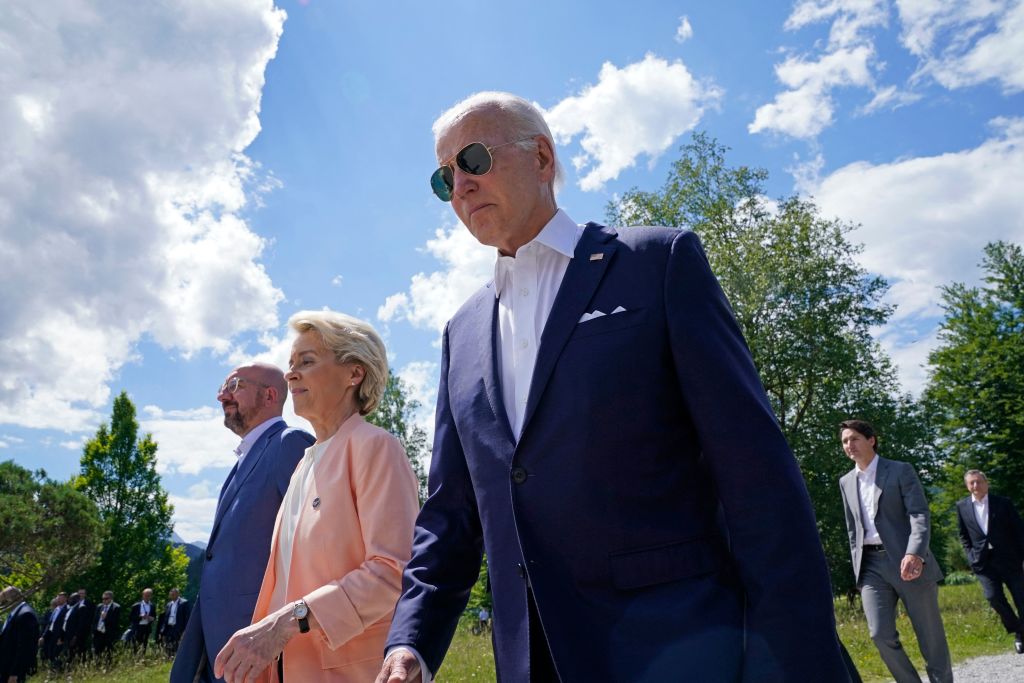
GERMANY-G7-SUMMIT

The US warned the European Union that its proposed law to regulate artificial intelligence would favor companies with the resources to cover the costs of compliance while hurting smaller firms, according to previously undisclosed documents.

The US analysis focuses mostly on the European Parliament version of the AI Act, which includes rules on generative AI. Some rules in the parliament law are based on terms that are “vague or undefined,” according to the documents, which were obtained by Bloomberg News.

[time-brightcove not-tgx=”true”]

The analysis is Washington’s most detailed position on the EU legislation that could set the tone for other countries writing rules for AI. One US concern is that the European Parliament focuses on how AI models are developed, whereas the US would prefer an approach that focuses on the risk involved in how these models are actually used.

The analysis warns that EU regulations risk “dampening the expected boost to productivity and potentially leading to a migration of jobs and investment to other markets.” 

The new rules would also likely hamper “investment in AI R&D and commercialization in the EU, limiting the competitiveness of European firms,” because training large language models is resource-intensive, it said.

The US State Department feedback, including a line-by-line edit of certain provisions in the law, was shared with European counterparts in recent weeks, according to people familiar with the matter who asked not to be identified discussing private documents. 

One of the people said the comments were offered in the spirit of cooperation and alignment of values. Some of the US concerns have been echoed by EU member countries in response to the European Parliament version, the person said. 

The State Department and the European Commission declined to comment.

The EU Parliament’s AI Act, which lawmakers voted on in June, would require more transparency about the source material used to train the large language models that underpin most generative AI products. That vote cleared the way for negotiations among parliament, the European Commission and member states, and officials hope to have a deal by the end of the year for the final rules.

The US analysis is in keeping with the State Department’s calls for a more hands-off approach to the technology so as not to stifle innovation. Secretary of State Antony Blinken objected to a number of the EU Parliament’s proposals to control generative AI during a meeting with commission officials in Sweden at the end of May.

At the same time, Washington has given mixed messages to EU policymakers about its views on regulation. While the US pushed back when the commission first proposed the AI Act in 2021, some American officials have begun to view mandatory rules more favorably as AI developers and ethicists warn about the possible harms from the technology.

Aaron Cooper, head of global policy at BSA The Software Alliance, a trade group that has engaged with both US and EU officials regarding AI regulation, said it’s important for countries’ AI rules to agree on basics, including definitions. 

“The most important thing that the Biden administration can do is continue to have a good candid conversation with their European counterparts about what the objectives are for AI policy,” Cooper said.

The post U.S. Warns E.U.’s Landmark AI Policy Will Only Benefit Big Tech first appeared on The News And Times – thenewsandtimes.com.


Categories
The News And Times – thenewsandtimes.com

Canaanites gradually moved from the ‘Near East’ to the Southern Levant


28934148-0-image-a-17_1590678460204.jpg

Published: 16:03 BST, 28 May 2020 | Updated: 19:29 BST, 28 May 2020

The ancient Canaanite community mentioned in the Bible were a distinct population that migrated from the ‘Near East’ to the Southern Levant over several centuries, new DNA analysis reveals. 

Canaanites lived in the Southern Levant – which is now Israel, the Palestinian Authority, Jordan and Lebanon – between 3,500 and 1,150 BC.

They lived in various townships and, previously, their genetic make-up and ancestry was not well understood.

But a new study has confirmed that they were genetically different to anyone else seen in the world. 

An international team of researchers has found they were descended from a combination of two main groups of people: Neolithic inhabitants of the Levant and populations related to Copper Age Iranians, specifically the region of the Zagros Mountains, and Bronze Age people from Caucasus.

Over hundreds of years, Canaanites migrated from the Ancient Near East – what is now modern Georgia, Armenia, and Azerbaijan – into the Southern Levant.

Modern-day inhabitants share much of this Canaanite DNA, as only at three points in the last 4,000 years has an external influence penetrated the gene pool. 

The three points were monumental in world history and are: the beginning of the Iron Age (1,000BC); the arrival of Alexander the Great (from 330BC); and the domination of the Ottoman Empire (1516AD). 

Scroll down for video  

The Canaanite populations did not remain static over time. Instead, they migrated slowly, over hundreds of years, from the Ancient Near East, what is now modern Georgia, Armenia, and Azerbaijan, into the Southern Levant (pictured)

Two studies have found Canaanites were a secular people, rarely breeding with outsiders, and were descended from two main lineages: Neolithic inhabitants of the Levant and populations related to Bronze Age Iranians and people from Caucasus.pictured, one of the study sites in Israel 

A host of researchers from all around the world analysed the remains of 93 individuals who lived over 1,500 years, at nine different sites in the Levant. 

It revealed that the Canaanites do represent a clear group and, despite being from various locations, are closely related.  

‘The Canaanites, albeit living in different city-states, were culturally and genetically similar,’ says Liran Carmel of The Hebrew University of Jerusalem.

The findings reveal that most of the Canaanites’ genetics was inherited from a mixture of local Neolithic populations and people from Copper-Age Iran and the Bronze Age Caucasus — modern-day Armenia, Azerbaijan, Georgia, and Russia. 

Dr Carmel adds: ‘In addition, this region has witnessed many later population movements, with people coming from the northeast, from the south, and from the northwest.

‘Individuals from all sites are highly genetically similar, albeit with subtle differences, showing that the archaeologically and historically defined “Canaanites” corresponds to a demographically coherent group.’ 

This, they say, is proof that the Southern Levant saw a gradual and continuous stream of migration from the Near East. 

Canaanites migrated slowly, over hundreds of years, from the Ancient Near East, what is now modern Georgia, Armenia, and Azerbaijan, into the Southern Levant. Pictured, one of the study sites 

An ancient 3,200-year-old Canaanite temple has been discovered in Israel which was part of a biblical city destroyed by Joshua.  

Inside, archaeologists found various statues of different gods, including two bronze figurines said to be ‘smiting’. 

The temple, from about the 12th century BC, was once part of the powerful Canaanite city of Lachish. 

This city was mentioned in the book of Joshua, with Lachish supposedly delivered by God into the hands of Israel, where ‘[they] put it and all the people in it to the sword’. 

Archaeologists from the Hebrew University of Jerusalem and Southern Adventist University in Tennessee say this is a ‘unique opportunity’ to study the Canaanite’s. 

The Late Bronze Age temple had two pillars and two towers leading to a large rectangular hall – unusual for the period, according to Professor Yosef Garfinkel. 

They found a host of other objects in the temple, including two bronze figurines said to be armed ‘smiting gods’ – housed near the altar.

‘The settlement is mentioned in both the Bible and in various Egyptian sources and was one of the few Canaanite cities to survive into the 12th century BCE,’ Hebrew University explained in a statement. 

The layout was common in the earlier Bronze Age and similar to bible descriptions of the First Temple in Jerusalem said to have been built by King Solomon.

It was a rare discovery for the researchers – who say a find along these lines and of this scale only happens every few decades. 

‘The strength of the migration from the northeast of the Ancient Near East, and the fact that this migration continued for many centuries, may help to explain why rulers of city-states in Canaan in the Late Bronze Age carry non-Semitic, Hurrian names,’ says Shai Carmi of The Hebrew University of Jerusalem. 

‘There were strong and active connections between these regions through movements of people that help to understand the shared elements of culture.’ 

When compared to modern inhabitants of the region, the scientists said 50 per cent of the ancestry of Canaanites comes from the Caucasus and the Zagros Mountains. 

An unknown proportion comes from the local Neolithic inhabitants of the Southern Levant and a smaller, but also unknown proportion from both Europe and Africa. 

It is unknown when African and European genes first made it into the genomes of modern-day inhabitants of the Levant.   

The Near East has been a tumultuous region over the last 4,000 years, with innumerable conflicts and invasions. 

However, 19 of the 93 skeletons used in the aforementioned research were also studied by a separate team of scientists. 

They found that, despite a range of almost 4,000 years, the ancestry of the skeletons was largely the same. 

In fact, the researchers say that only three events had a significant impact on the gene pool of modern-day Lebanese people.    

The Levant has been ruled by Egyptians, Babylonians, Assyrians, Persians, Greeks, Romans, Crusaders, Arabs, and Ottomans in its extensive history, but the genes of modern-day residents of Beirut were 90 per cent similar to ancestors who lived around 4,000 years ago.

Even one of the most recent invaders, the Crusaders, have left barely a mark on the genetics of the Levant. 

Dr Marc Haber, first author from the University of Birmingham and previously from the Wellcome Sanger Institute, said: ‘We revealed a genetic history of the area across 4,000 years, with a time-point approximately every 500 years. 

‘This showed us that despite the huge cultural changes that were occurring during this period, there were only a few times that the genetics of the general population changed enough to affect the ordinary people.’

The first study was published in Cell Press and the second study is today available in the American Journal of Human Genetics. 

The post Canaanites gradually moved from the ‘Near East’ to the Southern Levant first appeared on The News And Times – thenewsandtimes.com.


Categories
The News And Times – thenewsandtimes.com

Police Detain Azerbaijani Opposition Leader After Fundraiser


2D31C639-5BE8-4011-9A8C-42F07D743AB4_w12

BAKU — Police in Baku briefly detained the leader of the opposition Popular Front Party of Azerbaijan (AXCP), Ali Karimli, before letting him go amid allegations he was trying to undermine public stability.

Opposition politician Tofiq Yaqublu told RFE/RL that police detained Karimli on June 28 as he was leaving an event in the capital to raise money to help activists in the former Soviet republic pay fines resulting from what they call bogus charges.

Police officials gave no explanation for Karimli’s detainment, but Yaqublu said the authorities were trying to disrupt the fundraising event organized at the headquarters of the opposition Musavat party. Critics of longtime President Ilham Aliyev’s government say authorities of the oil-rich South Caucasus nation frequently seek to silence dissent by jailing reporters, human-rights activists, and civil-society advocates without grounds. Dozens of AXCP members have been arrested, and some imprisoned, in recent years on what their supporters have called trumped-up charges.

Aliyev denies any rights abuses. He took power in 2003 shortly before the death of his father, Heydar Aliyev, a former KGB officer and communist-era leader who had ruled Azerbaijan since 1993.

The post Police Detain Azerbaijani Opposition Leader After Fundraiser first appeared on The News And Times – thenewsandtimes.com.


Categories
The News And Times – thenewsandtimes.com

Azerbaijani Opposition Leader’s Bodyguard Jailed On ‘Politically Motivated’ Charge


Narges Mohammadi

Narges Mohammadi

Imprisoned Iranian women’s rights activist Narges Mohammadi, who was awarded the 2023 Nobel Peace Prize on October 6, said the honor only strengthens her resolve to fight oppression even if it means spending the rest of her life behind bars.

In bestowing the award at an announcement ceremony in the Norwegian capital of Oslo, the Norwegian Nobel Committee said it was honoring the 51-year-old for “her fight against the oppression of women in Iran and her fight to promote human rights and freedom for all.”

“I will never stop striving for the realization of democracy, freedom and equality,” she said in a statement released through The New York Times after the Nobel announcement.

“Standing alongside the brave mothers of Iran…I will continue to fight against the relentless discrimination, tyranny, and gender-based oppression by the oppressive religious government until the liberation of women.”

The award was widely applauded by the international community, though it is likely to be derided by the government in Iran, where Mohammadi’s campaign for freedom of expression and women’s rights has prompted the Islamic regime to arrest her 13 times, convict her five times, and sentence her to a total of 31 years in prison and 154 lashes.

Mohammadi is currently serving multiple sentences in Tehran’s Evin prison amounting to about 12 years’ imprisonment — she has not seen her family in more than eight years — on charges that include spreading propaganda against the state.

“Although the years of her absence can never be compensated for us, the reality is that the honor of recognizing Narges’s efforts for peace is a source of solace for our indescribable suffering,” a family statement said.

“For us, who know that the Nobel Peace Prize will aid her in achieving her goals, this day is a blessed day,” it added.

Mohammadi is the 19th woman to win the 122-year-old prize and the second Iranian woman, after human rights activist Shirin Ebadi won it in 2003.

“This prize means that the world is paying attention to the activities that is being done in Iran for the rights of women, the world sees how the establishment represses women,” Ebadi told RFE/RL’s Radio Farda after the announcement.

“As I have repeatedly said, democracy will enter Iran through the gate of women’s rights.”

Berit Reiss-Andersen, the chair of the Norwegian Nobel Committee, who announced the prize in Oslo, said it remains to be seen whether Mohammadi will be able to receive the award in Norway at a ceremony on December 10.

“If the Iranian authorities make the right decision, they will release her. So she can be present to receive this honor, which is what we primarily hope for,” Reiss-Andersen said.

The Nobel Committee said the 2023 prize also recognizes the hundreds of thousands of people who “have demonstrated against Iran’s theocratic regime’s policies of discrimination and oppression targeting women,” the Norwegian Nobel Committee said in making the announcement on October 6.

The anti-government protests in Iran were sparked by the death of 22-year-old Mahsa Amini while in police custody for an alleged head-scarf violation.

The authorities responded to the unrest with a crackdown on demonstrations that has left hundreds dead.

More recently, 16-year-old high-school student Armita Garavand was reportedly assaulted by the city’s notorious morality police on the Tehran subway on October 1 for not wearing a head scarf.

A source at the Fajr Air Force Hospital, who spoke to RFE/RL’s Radio Farda on condition of anonymity due to security reasons, said Garavand had suffered internal bleeding in the brain and was in critical condition.

Mohammadi’s husband, Taghi Rahmani, told RFE/RL’s Radio Farda that the Nobel announcement “opens a window for the fight for democracy, for human rights, civil equality and it also makes Narges’s responsibility heavy and as she’s said, ‘Any prize makes me stronger for the human rights goals that I have.’”

“I think this is important, it’s not just a prize for Narges, it brings attention to the resistance that is ongoing in Iran for freedom, democracy, and civil equality,” he added.

First arrested 22 years ago, Mohammadi has spent much of the past two decades in and out of jail over her unstinting campaigning for human rights in Iran. She has most recently been incarcerated since November 2021.

Still, the Nobel laureate has managed to remain an activist even while imprisoned, winning the 2018 Andrei Sakharov Prize for Freedom of Thought.

Though she was behind bars for the anti-government protests over the past year that highlighted the Women, Life, Freedom movement triggered by Amini’s death, Mohammadi and fellow inmates staged a symbolic protest in the yard of Evin by burning their head scarves on the anniversary of the 22-year-old’s death.

From behind bars, Mohammadi still contributed an opinion piece for The New York Times in September where she called the dissent a testament to the resilience of protesters and the waning authority of the “theocratic authoritarian regime.”

“What the government may not understand is that the more of us they lock up, the stronger we become,” she wrote.

Last year, in a letter addressed to Javaid Rehman, the UN special rapporteur on human rights in Iran, Mohammadi described the “assault on women during arrest and in detention centers” as part of the Islamic republic’s “suppression program” against activist women.

Iranian authorities have yet to comment publicly on the award.

However, Iran’s semiofficial Fars news agency said Mohammadi “received her prize from the Westerners” for “actions against Iran’s national security.” Teheran has repeatedly blamed the West for fueling the protests, without providing any evidence.

The Nobel Peace Prize, awarded by experts appointed by the Norwegian parliament, comes with an award of 11 million Swedish crowns (about $1 million).

Last year, the prize was awarded to human rights activists in Belarus, Russia, and Ukraine amid harsh crackdowns by Minsk and Moscow on dissent and the Kremlin’s invasion of Ukraine.

This year the Norwegian Nobel Committee received 351 nominations — 259 for individuals and 92 for organizations. The full list is kept secret for 50 years.

With reporting by AP, AFP and Reuters

The post Azerbaijani Opposition Leader’s Bodyguard Jailed On ‘Politically Motivated’ Charge first appeared on The News And Times – thenewsandtimes.com.


Categories
The News And Times – thenewsandtimes.com

Armenian Prime Minister meets with European Commissioner for Crisis Management


Armenian Prime Minister meets with European Commissioner for Crisis Management
17:15, 6 October 2023

YEREVAN, OCTOBER 6, ARMENPRESS. Armenian Prime Minister Nikol Pashinyan has met with European Commissioner for Crisis Management Janez Lenarčič.

PM Pashinyan welcomed Lenarčič’s visit to Armenia in this difficult situation and said that international support is required, including financial support, to overcome the crisis resulting from the forced displacement of more than 100,000 Armenians as a result of Azerbaijan’s policy of ethnic cleansing in Nagorno-Karabakh. PM Pashinyan added that he had productive discussions with President of the European Commission Ursula von der Leyen in Granada regarding needs assessment and further assistance.

Janez Lenarčič reiterated EU’s commitment to provide assistance to the government of Armenia and the Armenians of Nagorno-Karabakh to mitigate and overcome the current problems.

The Armenian Prime Minister and the European Commissioner for Crisis Management also discussed issues related to future partnership and actions.

The post Armenian Prime Minister meets with European Commissioner for Crisis Management first appeared on The News And Times – thenewsandtimes.com.


Categories
The News And Times – thenewsandtimes.com

More Americans Are Living to 100. Get Ready for the Super-Aging Era


Elderly people

It’s a startling projection that conveys an astonishing new American reality: One in every two five-year-olds alive right now will live to 100. That’s according to researchers at Stanford University’s Center on Longevity, who believe a century-long life expectancy will be the norm for all newborns by 2050—less than three decades from now.

Not to mention, more than kindergarteners can anticipate a triple-digit life span. Propelled by aging baby boomers and continued medical advances, the number of centenarians worldwide is expected to increase eightfold. Twenty-five years from now, there will be 3.7 million of us aged 100 or older—roughly equivalent to everyone now living in Connecticut or Los Angeles.

[time-brightcove not-tgx=”true”]

The United Nations declares this a “longevity revolution,” and it’s going to challenge everything we thought we knew about health care, personal finance, retirement, politics, and more. If we get it right, our 100-year lives will hold the potential for far more brightness than bleakness. Imagine an extra decade or two (or more) to continue creating and contributing—think 101-year-old television producer Norman Lear or 102-year-old fashion icon Iris Apfel—or simply enjoying an extra 20 or 30 vibrant years spent in the company of those we love the most.

Revolutions, though, are unpredictable. In our mutiny against mortality, there will be winners and losers, triumph and tragedy—and our action or inaction today will determine the quality of all those bonus tomorrows.

Read More: Believing Myths About Aging Makes Growing Old Worse

First things first: We must do everything in our power to close the unthinkable racial and ethnic gaps in longevity. White Americans live about six years longer than Black Americans, and they account for more than eight in 10 centenarians in this country—a glaring inequity we must address. We can start by lifting communities of color out of poverty, ensuring they have equal access to quality health care, and improving outcomes for Black mothers and infants, who die in childbirth at disproportionately higher rates.

But there’s also another troubling question for anyone contemplating a 100-year life: Where will we find the cash to pay a century’s worth of bills? Too many of us begin preparing for retirement in our 50s when we need to start in our 20s and 30s. That’s especially true in a world now largely devoid of pensions and driven by a growing gig economy. The median amount of money Americans have stashed away for when they stop working is a woefully insufficient $30,000. Already, 40% of those aged 65 and older rely solely on Social Security, which is projected to start running out of money a decade from now if Congress doesn’t act by raising the retirement age, increasing payroll taxes, lowering benefits or doing some combination of those things. Ignoring all this risks ushering in a grim new age of elder poverty on a scale we’ve never seen.

Who’s going to take care of us when we’re 100? Medicare doesn’t pay for long-term care; private care insurance is expensive; and assisted living facilities can run as high as $8,000 a month. On top of that, we face a chronic shortage of caregivers. One solution: sensible immigration reform to bring in skilled newcomers who can help with home health care and understaffed nursing homes, if we can overcome our xenophobia to enact it. In fact, we must, warns Ai-jen Poo, president of the National Domestic Workers Alliance. “There is actually no way to meet the demands of care without a strong immigrant workforce,” she says.

An equally daunting challenge we’ll face at 100: Making sure we don’t wind up all alone. Loneliness theoretically may ease when we eventually hit the stage of our longevity evolution where large numbers of us are reaching 100 together. But we’re not there yet, leaving millions of seniors to languish in solitude. U.S. Surgeon General Vivek Murthy has proclaimed loneliness a public health crisis, and the National Institute on Aging says the health effects of prolonged social isolation are like smoking 15 cigarettes a day. As we hurtle collectively into our super-aging future, we’re going to need to connect with one another—physically, socially, and emotionally—like never before.

And because our youth-obsessed society still values youngsters over elders, we’ll have to contend with rampant and growing ageism. The University of Michigan’s National Poll on Healthy Aging found eight in 10 people 65 and older complain they’ve experienced ageism, something the World Health Organization says is damaging to our health and well-being. Australia offers an elegant solution with its innovative Centenarian Portrait Project: High school artists are paired with 100-year-olds, and they get to appreciate one another as the teens paint or sketch the elders. It’s simple, inspired, and beautiful.

By now, you’re probably wondering whether living to 100 is worth it. If so, take heart: Everything that’s wrong is fixable. And there’s encouraging news on the mental health front even beyond researchers making headway on treatments for Alzheimer’s and other dementia—the scenario we fear the most as we age. A 2021 study by the Amsterdam University Medical Centers of 340 Dutch centenarians living independently found they suffered no serious decline in memory or other brain function and performed at a high level on tests—and some were as old as 108. “Cognitive impairment is not inevitable at extreme ages,” the researchers concluded.

Herlda Senhouse is like that. Adroit and quick-witted at 112, the Massachusetts supercentenarian cracks jokes, discusses politics, dines out with friends, plays the slots at a local casino, and attends church, getting around with a walker she teasingly calls her Cadillac. When I fumbled for my glasses while speaking to her, I suddenly realized she doesn’t wear any herself, and she’s got 40 years on me.

“I’ve had a journey I never thought I’d ever have,” she says.

Will we join her? Our chances have never been better.

Want more fresh perspectives? Sign up for TIME POV, our opinion newsletter

The post More Americans Are Living to 100. Get Ready for the Super-Aging Era first appeared on The News And Times – thenewsandtimes.com.


Categories
The News And Times – thenewsandtimes.com

Scrooge’s Secret to Living Your Best Life


Ebenezer Scrooge Talking to Marley's Ghost

Ebenezer Scrooge is one of Charles Dickens’s most memorable characters—an embodiment of greed and pursuing wealth at the expense of everything else. Scrooge is visited by three spirits who show him images of the past, the present, and a future that might be. In that future, Scrooge is dead, and the spirit allows him to eavesdrop on people’s conversations about him: they’re pleased Scrooge is gone, spiteful at his memory, unrepentant about stealing his things, and relieved that he’s no longer a presence—a curse—in their lives. Scrooge sees the long-term consequences of the decisions he’s made, regrets them, begs for a second chance, and gets an opportunity to change course.*

[time-brightcove not-tgx=”true”]

Scrooge played by society’s scoreboard—the one that amplifies our biological instinct toward hierarchy and leads us to pursue money, status, and power at all costs. But his vision of the long-term future made him realize that none of these things really mattered, that a life lived according to someone else’s scoreboard is not a life worth living. He realized before it was too late that the key to a successful life is good company and meaningful relationships.

The quality of what you pursue determines the quality of your life. We think things like money, status, and power will make us happy, but they won’t. The moment we get them, we’re not satisfied. We just want more. The psychologists Philip Brickman and Donald T. Campbell coined a term for this phenomenon: the hedonic treadmill. Who hasn’t taken a run on it?

Social comparison happens all the time. Sometimes it’s about possessions like houses or cars, but more often it’s about status.

We tell ourselves that the next level is enough, but it never is. The next zero in your bank account won’t satisfy you any more than you are satisfied now. The next promotion won’t change who you are. The fancy car won’t make you happier. The bigger house doesn’t solve your problems. More social media followers won’t make you a better person.

Running on the hedonic treadmill only turns us into what I call “happy-when” people— those who think they’ll be happy when something happens. For example, we’ll be happy when we get the credit we deserve, or happy when we make a bit more money, or happy when we find that special someone. Happiness, however, isn’t conditional.

Happy-when people are never actually happy. The moment they get what they think they want—the “when” part of the conditional—having that thing becomes the new norm, and they automatically want more. It’s as if they’ve walked through a one-way door that closes behind them. Once the door closes, they lose perspective. They can’t see where they’ve been, only where they are.

The way things are now is the way we expect them to be, and we start taking the good things around us for granted. Once that happens, nothing will make us happy. And while we’re busy running on the treadmill chasing after all the things that won’t make us happy, we’re not pursuing the things that really matter.

Scrooge is a fictional example of achieving “success” at the cost of things that really matter. But there are many real examples. I once worked with someone who came to his position running a large company in a way that should be familiar to most of us: with sharp elbows in a hypercompetitive culture. The people he ran into on the way to becoming CEO were only means to help him achieve his ends: he wanted to be wealthy, he wanted to be respected, he wanted people to know his name. He wanted status and recognition.

A while after stepping away, he concluded that he’d been trying to win the wrong game. He’d aimed at achieving wealth, power, and prominence— the goals so many people tell us to pursue. He’d prioritized these goals above all others and pursued them relentlessly. In the end, he got what he thought he wanted. But it left him feeling empty. He achieved what he’d wanted at the expense of having meaningful relationships—which, he came to realize, was something that really mattered. Unlike Scrooge, he got no second chance.

How many of us—at whatever stages of our careers—are on the same trajectory? We value wealth and status more than happiness—the external more than the internal—and we give little thought to how we pursue them. In the process, we end up chasing praise and recognition from people who don’t matter at the expense of people who do.

I’ve known many successful people whose lives I wouldn’t want to have. They had intelligence, they had drive, they had opportunity, and the wherewithal to use them all. But they were missing something else. They knew how to get what they wanted, but the things they wanted weren’t worth wanting. In fact, the things they wanted ended up disfiguring their lives. They were missing what Scrooge gains at the happy turning point of his story—that ingredient that makes the difference between the unhappy masses and the happy few.

The Greeks had a word for this ingredient: “phronesis”—the wisdom of knowing how to order your life to achieve the best results.

When you look back to the decisions you made as a teenager, they probably seem pretty silly now. These decisions didn’t seem stupid at the time so why do they appear so now? Because you have perspective now that was inaccessible to you back then. What seemed like the most important thing in the world at the time—the very thing that consumed you—seems silly now in hindsight.

Wisdom requires all the things we’ve talked about: the ability to keep the defaults in check, to create space for reason and reflection, to use the principles and safeguards that make for effective decisions. But being wise requires more. It’s more than knowing how to get what you want. It’s also knowing which things are worth wanting—which things really matter. It’s as much about saying no as saying yes. We can’t copy the life decisions of other people and expect better results. If we want to live the best life we can, we need a different approach.

Knowing what to want is the most important thing. Deep down, you already know what to do, you just need to follow your own advice. Sometimes, it’s the advice we give other people that we most need to follow ourselves.

The post Scrooge’s Secret to Living Your Best Life first appeared on The News And Times – thenewsandtimes.com.


Categories
The News And Times – thenewsandtimes.com

The Unwavering Confidence of Deion Sanders


Coach Deion Sanders seated at Folsom Field in the campus of Colorado University

On an autumn weekend in Boulder, the sports miracle of the season is clearer than the blue Rocky Mountain sky. Whereas for years, the University of Colorado football team delivered Saturday misery—the Buffaloes enjoyed just four winning seasons in the past 20 years and finished 1-11 in 2022—Boulder now may be the hippest, happiest place in America. “The Stampede,” a Friday-night pregame pep rally down Pearl Street, used to feel more like a tiptoe. But on Sept. 29, the night before Colorado faced off against No. 8 USC, the restaurants are full and the sidewalks packed. A handful of little kids even line the rooftop of a trattoria to watch the marching band play.

[time-brightcove not-tgx=”true”]

A little before 6 a.m. Mountain time the next day, hundreds of University of Colorado fans, most wearing white cowboy hats adorned with LED lights, have assembled on Farrand Field, smack in the middle of campus. Some are students, others alums and locals, while a significant number have traveled from far afield, never having imagined they’d have reason to gaze at those picturesque peaks in the backdrop. Fox Sports’ Big Noon Kickoff pregame show won’t start for hours, but the revelers are ready. They’re here to see Deion Sanders, or Coach Prime—a play on Prime Time, his nickname from his 1980s and ’90s heyday—who arrived as head coach in December, radically made over this year’s team, and turned Colorado into the biggest story in sports.
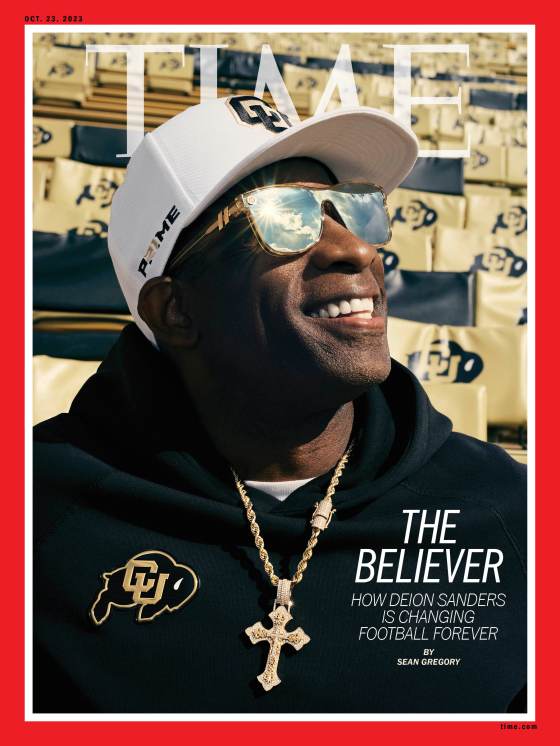
Deion Sanders The Believer Time Magazine cover

Before kickoff, the sidelines at Colorado’s stadium are now the place to be seen. There’s rapper DaBaby hyping up the crowd. There are Sanders’ friends and fellow football Hall of Famers Terrell Owens, Warren Sapp, and Michael Irvin. Hey, that’s basketball Hall of Famer Kevin Garnett and future baseball Hall of Famer CC Sabathia and rapper Symba. The VIPs wear a special credential around their necks: Prime Passes, in the shape of the gold whistle Sanders uses in practice. Boulder County is 1.3% Black, yet as one sideline spectator observes, the scene “feels like Black Hollywood.” 

And what’s been happening on the field is as spectacular as what’s happening off. As the Buffaloes charged back against the Trojans, slicing a 41-14 third-quarter deficit to 48-41 with just under two minutes left, Folsom Field, filled with more than 54,000 roaring fans, felt like the epicenter of sports. Could Sanders’ squad, which had already exceeded expectations, stimulated the college-football economy, and compelled more than 8 million people to watch Colorado beat Colorado State in double overtime after 2:15 a.m. Eastern time in mid-September—ESPN’s highest college-football viewership figure at that hour—pull off this monumental comeback?

USC recovered the late onside kick to clinch the game, but Colorado’s charge just added to the Coach Prime euphoria. “The atmosphere is electric, man,” DaBaby tells me before leaving the field. “Look, f-ck the NFL game. Right now this is the most exciting place to be in football.” 

Swifties may disagree. But while the rumored relationship between Taylor Swift and Kansas City Chiefs tight end Travis Kelce drives headlines and ticket sales, Coach Prime’s efforts are much more far-reaching. At Colorado, he has the power to change not only the fate of the team but also the multibillion-dollar college-football industry. His success could open doors for more Black head coaches at the highest levels of the college game, a long overdue development especially given that teams with majority-Black players help generate, in some cases, north of $100 million in annual revenue for their schools. After decades of coaches “protecting” players from “distractions,” Sanders has invited cameras to embed with Colorado for the second season of Amazon’s Coach Prime. His embrace of social media exposure for players—they wear their Instagram handles on their practice jerseys—and their recently won right to capitalize on their name, image, and likeness (NIL) should shake up the sport’s stodgy DNA. Plus, after two successful seasons at Jackson State, a historically Black college or university (HBCU), Sanders used the “transfer portal”—the still-newish NCAA mechanism that lets players switch schools without sitting out a year—to overhaul Colorado’s roster. He brought in 57 transfers, while more than 60 Colorado players left for other programs or ended their college-football careers.

In short, he treats college sports as what it is: a business. CU hired him to win, and win now. And he’s doing it his way, with straight talk and unshakable confidence.

“In the world of college football, there is a certain expectation of how coaches should be and how they should act,” says Dwayne “The Rock” Johnson, a former defensive lineman at the University of Miami who won a national championship in 1991. “Prime tore that playbook up and threw it out the window.”

Read More: Jalen Hurts Is Fueled by the Doubters

Some of Sanders’ methods have proved unpopular. He was criticized for having DaBaby, who has been decried for using homophobic language and has had multiple run-ins with the law, give his team a pep talk about overcoming adversity. He’s pushed players out the door. Many people are rooting for his failure. But that word, Sanders insists, isn’t part of his vocabulary. Love Coach Prime—a ubiquitous presence in ads for Aflac, California Almonds, and KFC—or hate him, you’re paying attention.

“We’re being unapologetically who we are,” Sanders, 56, tells me in an interview in Boulder the week of the USC game. “You can tell, by everything that we’re accomplishing right now, that we’re headed in the proper direction at a speed that is undeniably a lot more expeditious than many people would have suspected. Shoot, this is going to be good. It’s just like the trailer of a movie you’re seeing. Just wait until you see the whole dern movie.”


Sanders patrols his team’s morning practices on a golf cart with “Prime” emblazoned on the front (a “Prime” bicycle and “Prime” Segway rest outside his office). Before one session, the team huddles around him. “Line, you’re going to have a great day. You’re going to kick some butt up front, right?” Sanders says. “Yes, sir,” players respond in unison. “You’re going to protect that quarterback, right?” “Yes, sir.” “Defensive line, we’re going to get to the quarterback, right?” “Yes, sir.”

He drives from station to station to observe and occasionally weigh in. Sanders moves more gingerly these days: due to blood clots, he had two toes on his left foot amputated in 2021. “Get off the field! Garbage! That’s horrible!” he says to one player who erred. “You ran onto the field as if you are about to have a baby in three months,” he tells a player who wasn’t hustling enough for Coach Prime’s liking. “Hey guys, that was horrible offensively today, I want y’all to know that,” Sanders says at the end of a practice. “There’s not a commitment to excellence whatsoever. You’re just going through the dern motions.”

Sanders eschews profanity, often saying dern where a curse word would do. But he reserves his biggest smile of the week for when two of his coaches—defensive coordinator Charles Kelly and defensive-tackles coach Sal Sunseri, both of whom left Alabama, the premier program of the past 15 years, to take on this rebuilding project—get into a shouting match that devolves into an exchange of F-yous. He appreciates their intensity.

At one practice, David Kelly, Colorado’s general manager and a longtime Sanders confidant, shows me a text he got from Nike co-founder Phil Knight, who had talked to Sanders before Colorado faced Oregon in Eugene on Sept. 23 and met with Barack Obama at Nike headquarters a few days later. “I greeted him with, ‘you’re the second biggest celebrity I’ve talked to this week,’” Knight wrote.

Little about Sanders’ program is typical. “Is You Working or Twerkin?” reads a sign on Sanders’ office door. (Working or twerking is one of multiple phrases, including Coach Prime and It’s personal, for which he has filed for trademarks.) A conference room houses his sneakers and hats. On Friday afternoon, a woman walks toward his door and asks, “Are that many people really in there?” Sanders doesn’t allow shoes in his office, and 11 pairs of shoes sit in front of the reception desk. A few minutes later, members of the documentary crew; his manager; Sanders’ son Shilo, a Colorado safety; Garnett; and fellow basketball Hall of Famer Paul Pierce file out of Sanders’ space.

These days, everyone wants time with Prime. Colorado’s game against Oregon, a 42-6 blowout victory for the Ducks, drew 10.03 million viewers, making it one of the most-watched college-football games of the year. The school’s online team-store merchandise sales are up 892% year-to-date over 2022. Colorado chancellor Philip DiStefano says out-of-state applications have climbed 40%. “It’s transformational,” he says. Sanders is even developing a half-hour comedy with Kevin Hart’s media company based on his journey and billed as “Entourage meets the gridiron,” Sanders’ team tells TIME exclusively.

Read More: The Most Influential People of 2023: Patrick Mahomes II

“People are drawn to hope, man,” says Sanders. “Shoot, we’re David. We ain’t got but a couple of stones here. We’re playing against Goliath every week. We were 1-11, and now you’re tripping about us? We’re pulling people in, man, that just want a chance to be seen, to be heard, to be noticed, to be recognized. They just want to be pushed in the swing set of life every once in a while and say, ‘Wheeee, wheeee.’” 

One could dismiss these words as self-serving, if Sanders weren’t onto something. Because it’s not just celebrities who have flocked to town to pay homage to Sanders. (The Rock, Lil Wayne, Offset, and Key Glock have also made appearances since the start of the season.) Fan after fan in Boulder mentions Coach Prime’s inspiration. At the Colorado team store, Veronica Jones, a retired law-enforcement officer from Charlotte, N.C., wearing gold-rimmed “Fierce But Fabulous” glasses and a T-shirt for the HBCU Johnson C. Smith University, fished for Prime gear in the same area as a guy who looked like a member of ZZ Top. Her husband Wil Jones noted that most of the Black passengers on their flight to Denver were going to cheer on Sanders. “It was like a family reunion,” he says.

Kedric Mallory made the trip from Atlanta with friends and family, including his 1-year-old son. “I’m here to support the movement,” says Mallory, a real estate broker. “In my 42 years of living, I never thought of coming to Colorado. My son could have stayed at home with his grandmother. But I want him to be able to say, ‘When I was 16 months old, I witnessed the Prime Effect.’”


When Sanders was rocking Jheri curls and gold chains in the late 1980s—Neon Deion was another nickname back then—few would have pegged him for a major-college football coach, provider of hope, and leader of men. His talent was indisputable. But his swagger rubbed many the wrong way. “Everybody occupies two persons in their natural being,” says Sanders now. “People wish they could develop that other person a lot more. That other person says the things they want to say and does the things they want to do. Prime has been that cat. And I developed that cat a long time ago.”

Sanders grew up in Fort Myers, Fla., where his mother worked around the clock to support him. A two-time All-American at Florida State, Sanders won the Jim Thorpe Award, given to the top defensive back in the country, in 1988. Both the Atlanta Falcons and the New York Yankees drafted him. During a 1990 Yankees–Chicago White Sox game in the Bronx, Sanders got into a verbal exchange with White Sox catcher Carlton Fisk, who took exception to Sanders’ failing to run out a pop-out. Contemporaneous news reports said Sanders drew dollar signs in the batter’s-box dirt. Fisk seconded that account over the years. The exchange contributed to Sanders’ image as an arrogant heel.

But Sanders insists he drew no dollar signs, only markings to help position his feet. “Carlton Fisk lied,” he says. “Sir, with all due respect, I would never do such a thing.” (“Why would I lie about something like that?” Fisk says. “Check the tape.”) 

Regardless, Sanders rocketed to 1990s stardom. He made a cameo in MC Hammer’s “2 Legit 2 Quit” video. He won back-to-back Super Bowls after the 1994 and 1995 seasons, with the San Francisco 49ers and Dallas Cowboys, respectively.

Years before Colorado, Sanders was creating culture. Dwayne Johnson was watching closely during these years. Over Zoom, I ask him about Sanders’ influence on his own career, and he shows me goose bumps on his forearm. “No one has ever asked me that,” he says. “So much of the character and the entity of the Rock came from Prime. One of the characteristics of the character of the Rock was talking in the third person. Deion would say certain things in the third person. I always found that so f-cking cool. Because he walked the walk.” 

After his NFL career ended in 2005, Sanders became a TV analyst and began coaching on the youth and high school levels when two of his children who now play for Colorado—safety Shilo, 23, and quarterback Shedeur, 21—were kids. In 2019, Sanders told his manager and business partner, Constance Schwartz-Morini, he might reach out to his alma mater about helping with recruiting. “I said, ‘Why don’t you just be a head coach at a college then?’” says Schwartz-Morini, CEO of SMAC Entertainment. “I’m not stupid. I understand there’s a huge difference between coaching youth and high school and jumping into the collegiate level. But while the real estate may change, his methods have not.”

He interviewed at Florida State and Arkansas, but without any college experience, he couldn’t get those jobs. Jackson State, which plays a level below major programs like Colorado in the Football Championship Subdivision, took a chance on him. Star power allowed Sanders to skip the typical assistant’s route. It didn’t matter: he finished 27-6, winning a pair of Southwestern Athletic Conference championships. “I hate when people say dumb sh-t, like he didn’t pay his dues,” says his former Cowboys teammate Michael Irvin. “OK, how many of you head coaches in college right now started at the Little League level? If I’m going to be a great CEO one day, I want to start in the damn mail room, so I can learn every piece of the job along the way.”

Sanders caught the attention of the big schools. As Colorado struggled last season, its athletic director, Rick George, started texting him pictures of Folsom Field’s mountain view. When he met with Sanders in mid-November, at Sanders’ home in Canton, Miss., Sanders surprised him with a written assessment of every Colorado player. Sanders took the job without visiting Boulder. “You choose this naked and not ashamed,” he says. 

He took heat on the way out of Jackson. Sanders had helped draw much-needed attention and resources to an HBCU. So his exit, for some, felt like a betrayal. A commentator said on CNN that “he sold a dream and then walked out on the dream.” To Sanders, however, his work in Jackson was done. “It wasn’t like we just abandoned it,” he says. “What more can I do?”

During his first meeting with Colorado’s holdover players in December, Sanders, who signed a five-year deal worth $29.5 million, was brutally honest about his intentions. “Those of you that we don’t run off, we’re going to try to make you quit,” he said in a speech broadcast on social media.

Sanders acknowledges that come season’s end, some of his players will surely hit the transfer portal. With opportunities to earn playing time—and cash—elsewhere, churn is now part of college football. While players don’t get paid by their universities, as of July 2021, NCAA athletes can earn income through third-party sponsors and boosters. Shedeur, for example, has deals with Gatorade, Beats by Dre, and Topps, among others. According to On3.com, he has a $4.8 million NIL valuation, second only to Bronny James, LeBron’s son. Colorado two-way player Travis Hunter also ranks in the top 10. “They want to be treated like pros, but you’ve got to understand, now there’s scrutiny like the pros,” says Sanders. “There’s cuts. There’s dissatisfaction. So you can’t have a pity party and want it both ways. ‘Well, I’m still a kid.’” He says that in a baby voice. “No, no. You’ve got a Benz parked outside.”


After Oregon humbled Colorado, many celebrated Coach Prime’s comeuppance, which felt a bit odd given how recently the Buffs were 1-11. Don’t Americans root for the underdogs?

I ask Sanders to explain this one afternoon as we sit in the Colorado recruiting lounge, a spacious area overlooking the football field designed to impress prospects. His Belgian Malinois, Gunner, watches from a cage by the window, marking the first time a college coach’s dog has listened in on one of my interviews. “You know why,” says Sanders. “Everybody knows why. Nobody will say it.” 

We put the cards on the table. Does he sense a resistance to a Black head coach who’s known to break protocol? 
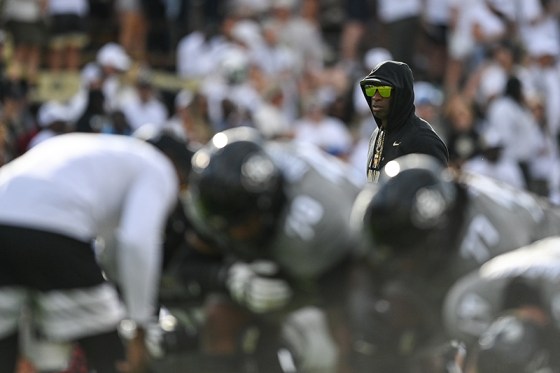
Sanders looks on as players warm up before a game

“If somebody has on a shirt that has wrinkles on it, I’m going to say, ‘Hey man, is your iron OK?’” says Sanders. “I’m not going to pretend it’s not there. I’m too old to play games. I’m not one to sit up here and wave the racial flag because I’ve been given some tremendous opportunities.” But the stats—just 10% of top Division I head coaches are Black—make it hard to argue that racism doesn’t persist in the sport. “We can play, but we can’t coach?” says Sanders. “Seventy percent of us can be in the locker room, but we can’t lead ourselves? It don’t add up.” Sanders vows to fix this discrepancy. “The Bible says, in Ecclesiastes, there’s a time and a season for every activity under the sun,” he says. “I believe it’s time that we make those strides.”

Opponents are taking shots at Sanders too. He didn’t appreciate comments from Colorado State coach Jay Norvell, who before the CU-CSU game said, “When I talk to grownups, I take my hat off and my glasses off,” a reference to Coach Prime’s sartorial choices. (Sanders’ sunglasses collaboration with Blenders then sold $1.5 million in preorders in one day.) Oregon coach Dan Lanning told his team in the pregame locker room that “they’re fighting for clicks, we’re fighting for wins.”

“You’ve got to understand where that comes from,” says Sanders. “That comes from something that’s deep down inside of him. That the pressure of that moment forced it out. He couldn’t hide. Successful people and confident people don’t do that.” Sanders notes he hasn’t initiated spats with other coaches. “Putting you down doesn’t lift me up,” he says. “We’re not on the seesaw of life.” 

Coach Deion Sanders at Folsom Field in the campus of Colorado University

I mention that Shilo was caught on a film cursing at Ducks players before the game. “Shilo is Shilo,” Sanders says. “Shilo has been like that since he was a kid. Shilo doesn’t really start it. He finishes it. I’m pretty sure he was provoked in some kind of way.” For his part, Shilo insists he trash-talks his own teammates, including his brother. “They provoked me by just being there,” he says of Oregon. “They just look at you, and you just want to slap them.” (An Oregon spokesperson declined to comment.) 

The comeback against USC offered a glimpse of the Buffs’ potential. If Colorado plays as strong as it did against a top-10 team for a full game, instead of just a half, it could contend in year one of the Coach Prime era. After the game, players bowed their heads as a Sanders friend led the team in prayer. “Lord … This is a day of resurrection. Thank you that you got the bitter taste of last week out of our mouths.” Sanders told his team he loved everyone in the room: players, coaches, all of them. 

In a quiet moment after the uplifting loss, I ask Sanders what America could learn from it. “Everything about us is designed and built to go forward,” he says. “I’ve never been a rock, an idle person. I’ve always been a mover and a shaker, a wave maker and a go-getter.” He shares one more message before heading back to the recruiting lounge. “We coming,” Sanders says. “You’ve got to be crazy if you can’t see that. We coming.” —With reporting by Leslie Dickstein, Simmone Shah, and Julia Zorthian


The post The Unwavering Confidence of Deion Sanders first appeared on The News And Times – thenewsandtimes.com.