“Vovchik” Putin and his minions (yes, he has them too!) try to attack my Twitter account, Blogs, and websites with the DDOS attacks and other means of protest. They do not like what I am posting. Too bad. Get used to it!
Musk, hack them back! pic.twitter.com/EnjatEo1lG— Michael Novakhov (@mikenov) November 29, 2023
Day: November 29, 2023
https://t.co/rcmOrXbWcm
The News And Times #News #Times #NewsAndTimes #NT #TNT #Israel Israel #World World #USA USA#POTUS POTUS #DOJ DOJ #FBI FBI #CIA CIA #DIA DIA #ODNI ODNI
Putin Russia #Putin #Russia #GRU GRU
12:32 PM 11/29/2023https://t.co/gZoRI1fwr8— Michael Novakhov (@mikenov) November 29, 2023
The Dagestan Riot was instigated by the Azerbaijan KGB: “Look at how we treat our (Mountain) Jews (“Tats”), and how they, “the Russian-Dagestani Azerbaijanis” do! https://t.co/6nIr8V6cwi pic.twitter.com/CM2XjPwKlQ
— Michael Novakhov (@mikenov) November 29, 2023
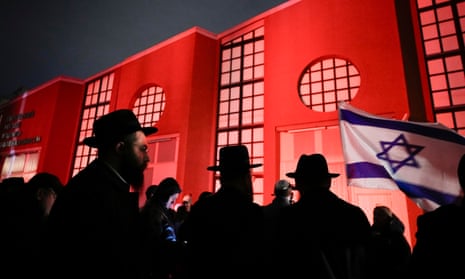
The Dagestan Riot was instigated by the Azerbaijan KGB: “Look at how we treat our (Mountain) Jews (“Tats”), and how they, “the Russian-Dagestani Azerbaijanis” do!
google.com/search?q=The+D
After Kolokoltsev’s visit to the area, the Deputy Interior Minister of Dagestan was jailed “for corruption”. It means, he was bribed by the Azerbaijani KGB to instigate these riots. Kolokoltsev knows what he is doing.
google.com/search?q=Deput
The amount of bribe for this operation was apparently about $1 Mil.:
“Телеграм-канал ВЧК-ОГПУ, предположительно связанный с российскими правоохранительными органами, называет сумму предполагаемой взятки, которую получил замминистра, – 100 миллионов рублей от одной из страховых компаний.”
kavkazr.com/a/u-zamglavy-m
It also means that hypocritical Aliyev 2 tries to expand his influence in Dagestan while kissing Putin’s ass.
They continue “the MULTIVECTOR POLICY”, practiced by the previous KGB Turk and Turkey – Aliyev 1.
It also confirms that the CORRUPTION in the Caucasus is limitless and omnipresent.
google.com/search?q=the+M
Now Putin has enough reasons to remove Aliyev 2, if he so chooses. If.
–
Russian Jews fear Israel-Hamas war awakening sleeping antisemitism
theguardian.com/news/2023/nov/
google.com/search?q=The+D
After Kolokoltsev’s visit to the area, the Deputy Interior Minister of Dagestan was jailed “for corruption”. It means, he was bribed by the Azerbaijani KGB to instigate these riots. Kolokoltsev knows what he is doing.
google.com/search?q=Deput
The amount of bribe for this operation was apparently about $1 Mil.:
“Телеграм-канал ВЧК-ОГПУ, предположительно связанный с российскими правоохранительными органами, называет сумму предполагаемой взятки, которую получил замминистра, – 100 миллионов рублей от одной из страховых компаний.”
kavkazr.com/a/u-zamglavy-m
It also means that hypocritical Aliyev 2 tries to expand his influence in Dagestan while kissing Putin’s ass.
They continue “the MULTIVECTOR POLICY”, practiced by the previous KGB Turk and Turkey – Aliyev 1.
It also confirms that the CORRUPTION in the Caucasus is limitless and omnipresent.
google.com/search?q=the+M
Now Putin has enough reasons to remove Aliyev 2, if he so chooses. If.
–
Russian Jews fear Israel-Hamas war awakening sleeping antisemitism
theguardian.com/news/2023/nov/
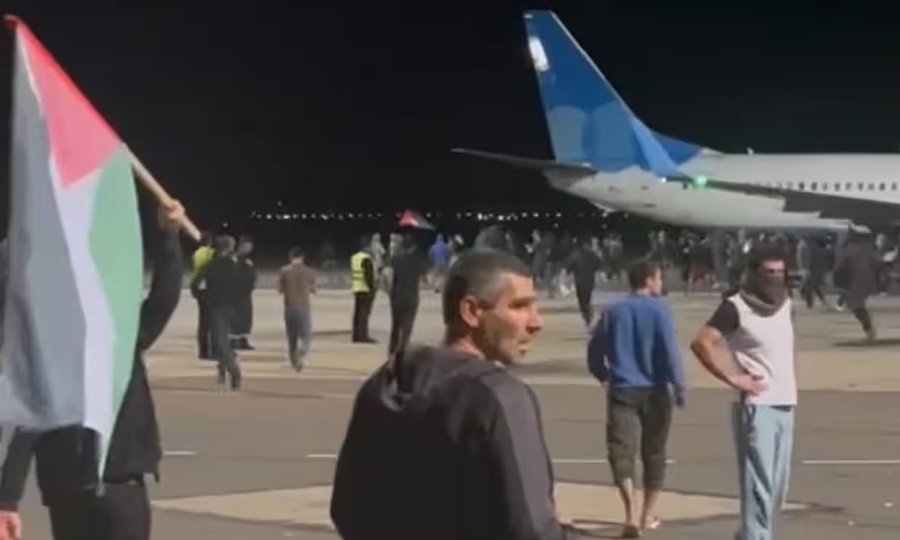
The Dagestan Riot was instigated by the Azerbaijan KGB: “Look at how we treat our (Mountain) Jews (“Tats”), and how they, “the Russian-Dagestani Azerbaijanis” do! https://t.co/wtsnHId85v
After Kolokoltsev’s visit to the area, the Deputy Interior Minister of Dagestan was jailed… pic.twitter.com/op7HOoPIwZ— Michael Novakhov (@mikenov) November 29, 2023
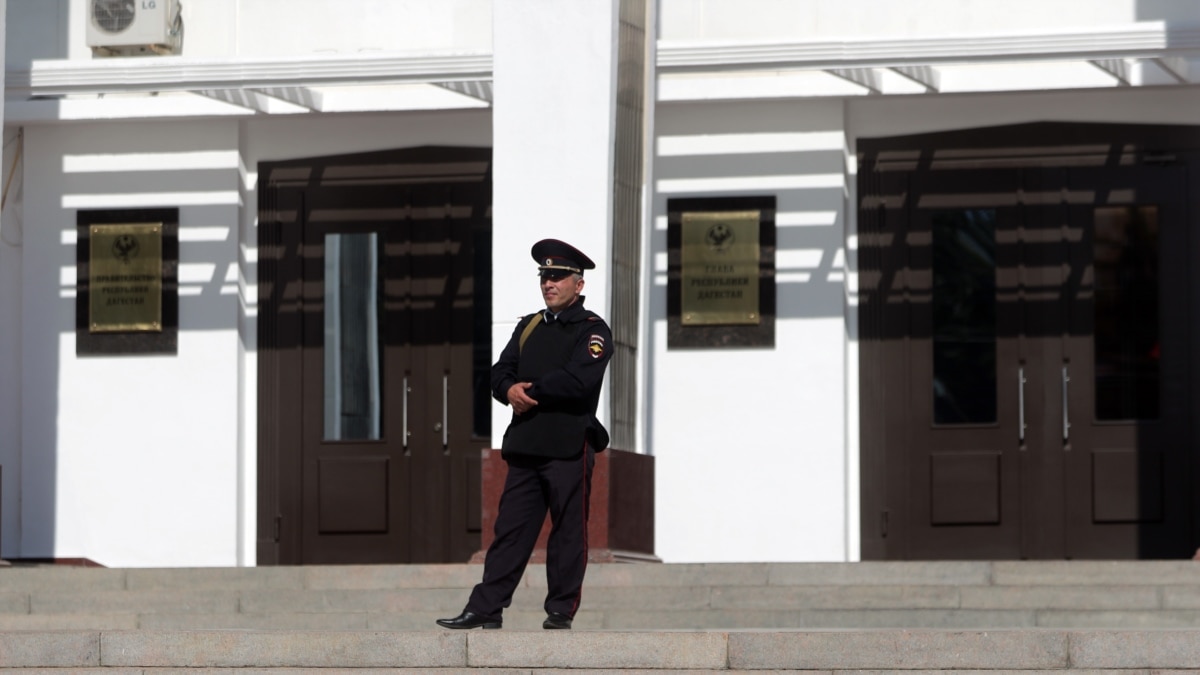
В Дагестане задержан заместитель министра внутренних дел по республике и начальник следственного управления ведомства Руфат Исмаилов, у него дома и на работе проходят обыски, сообщили российские государственные агентства ТАСС, “Интерфакс” и РИА “Новости” со ссылкой на источники.
По предварительным данным, Исмаилов подозревается в коррупции. Речь идет о получении взятки в крупном размере, высокопоставленного полицейского вывезли в Москву, утверждает член Общественной наблюдательной комиссии в Дагестане Шамиль Хадулаев. Телеграм-канал ВЧК-ОГПУ, предположительно связанный с российскими правоохранительными органами, называет сумму предполагаемой взятки, которую получил замминистра, – 100 миллионов рублей от одной из страховых компаний.
Ранее утром 7 ноября об обысках у Исмаилова сообщили дагестанские СМИ. “Работают ФСБ и приезжие сотрудники МВД”, – утверждал телеграм-канал “Молодёжка” со ссылкой на источник в правоохранительных органах. Телеграм-канал “Спросите у Расула” сообщал, что обыски также проходят у Далгата Абдулгапурова, заместителя Исмаилова – он тоже задержан и “вывезен” в Москву, утверждает Хадулаев.
МВД эти сведения не комментирует; задержание Исмаилова и Абдулгапурова и данные о возбуждении уголовного дела о коррупции подтвердило республиканское управление ФСБ России.
По информации газеты “Черновик”, Руфат Исмаилов родился в Дербенте в семье мирового судьи, окончил Нижегородскую академию МВД, работал заместителем начальника дербентского ГОВД по следственной работе, на должность замминистра внутренних дел Дагестана его назначили в 2019 году.
- В Дагестане сейчас расследуют беспорядки во время антисемитской акции в аэропорту Махачкалы 29 октября. Согласно последним данным МВД, всего за участие в акции были задержаны более 200 человек, большинство из них понесли административную ответственность, еще 11 человек проходят в качестве подозреваемых по уголовному делу.
- В начале октября обыск прошел в доме задержанного главы администрации Кизилюрта Магомеда Магомедова, подтверждающую видеозапись опубликовали СМИ. На кадрах показан четырехэтажный дом чиновника и якобы принадлежащие ему оружие и запасы икры.
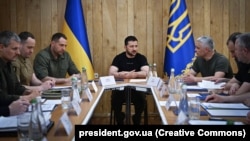
Among other things, Ukrainian President Volodymyr Zelenskiy (center) says he discussed the situation in the Black Sea with Odesa authorities. (file photo)
President Volodymyr Zelenskiy met on November 29 with civilian and military authorities in Ukraine’s southern region of Odesa, which has been a regular target for Russian strikes directed at its port installations critical for food exports.
“Many important questions…. The situation in the Black Sea, mine countermeasures and ensuring the safety of the ‘grain corridor.’ The work of the air defense…protecting Odesa, the infrastructure of the ‘grain corridor,’ and our brigades,” Zelenskiy said on Telegram.
Zelenskiy met with Ukrainian troops in the area and handed them medals and awards for bravery, he said.
The president also met with civilian authorities to discuss measures to bring life in Odesa and other southern regions back to normal after a spell of inclement weather that hit the area, leaving at least 12 people dead and 23 injured.
Meanwhile, Ukrainian Foreign Minister Dmytro Kuleba called on Kyiv’s allies to step up efforts to increase the production of armaments and munitions for Ukraine’s defensive war against Russia’s unprovoked invasion.
“In order to ensure the stability and security of the entire European region, its defense industry must increase production, coordinate, and work as one integral defense industry complex of the Euro-Atlantic community,” Kuleba said in introductory remarks at the first meeting of the NATO-Ukraine Council in Brussels on November 29.
The NATO-Ukraine Council, the joint body in which Kyiv and its allies sit as equal participants, was launched at the NATO summit in Vilnius in July.
Earlier this month, European diplomats told RFE/RL on condition of anonymity that the European Union was concerned that it will not be able to supply Ukraine with the 1 million artillery rounds by March next year as promised in spring by EU foreign policy chief Josep Borrell.
Earlier on November 29, Russian shelling of Ukraine’s Donetsk and Kharkiv regions caused casualties among civilians and damage to infrastructure, despite Ukrainian air defenses repelling a large drone attack on several parts of Ukraine.
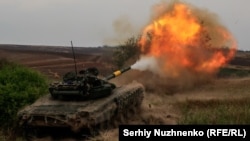
RFE/RL’s Live Briefing gives you all of the latest developments on Russia’s full-scale invasion, Kyiv’s counteroffensive, Western military aid, global reaction, and the plight of civilians. For all of RFE/RL’s coverage of the war in Ukraine, click here.
Seven civilians were wounded in Donetsk overnight, the acting head of the region, Ihor Moroz, said on November 29. Five residents were wounded in the industrial city of Toretsk and two in Severniy, Moroz said on Telegram.
In the Kharkiv region, Russian shelling caused extensive damage overnight to infrastructure, residential areas, administrative buildings, businesses, and educational facilities, Governor Oleh Synyehubov said.
The cities of Kharkiv, Chuhuyiv, and Kupyansk bore the brunt of the Russian bombardment, Synyehubov said. No casualties were immediately reported, he added.
Russia also unleashed a fresh wave of drones on Ukraine overnight, launching 21 Iranian-made unmanned aerial vehicles and three Kh-59 guided missiles, the Ukrainian Air Force said in a statement early on November 29.
“All the enemy’s attack drones were destroyed above the Odesa, Dnipropetrovsk, Kyiv, Kherson, Zaporizhzhya, and Khmelnytskiy regions. Also, two guided missiles were destroyed in the Mykolayiv region. A third one did not reach its target,” the air force said. No casualties or damage was immediately reported.
On the battlefield, Ukrainian forces were engaged in 87 close-quarter battles over the past 24 hours, the General Staff of Ukraine’s military said in its daily report on November 29.
Heavy fighting continued in Kharkiv and in Donetsk region where Russian forces have been incessantly attacking Ukrainian positions in the industrial city of Avdiyivka. Moscow’s troops have been unsuccessfully trying to encircle for several weeks at a heavy cost of human lives and equipment. Anton, an artilleryman from a brigade stationed near the southern flank of the embattled city, told an RFE/RL correspondent that the situation had become more “difficult and intense” since the beginning of the Russian offensive in the area on October 10. “I have long stopped counting the targets that we are destroying, and the Russians themselves don’t stop sending thousands [of their soldiers] to certain death,” he said. The costs have been high for Ukraine as well.
Oleksandr, a doctor heading a triage site close to Avdiyivka, said that wounded Ukrainian soldiers were arriving at his facility every few hours. As his team treated a soldier with the call sign “President” for a minor injury, he said he was seeing more and more soldiers come in with bullet wounds, indicating that more close-quarter combat is being fought in the area.
The military said that Ukrainian marines continue to hold bridgeheads on the left bank of Dnieper River after landing there earlier this month. The report could not be independently confirmed.
Russian troops one year ago withdrew eastward from Kherson city in the face of Ukrainian advances, crossing the Dnieper, but continuing to shell the city and its surroundings from the left bank.
On November 19, the Ukrainian military said it had pushed Russian forces some “3 to 8 kilometers” east of the Dnieper River as its forces secured bridgeheads on the eastern side of the waterway.
With reporting by Aleksander Palikot in the Donetsk region
The Dagestan Riot was instigated by the Azerbaijan KGB: “Look at how we treat our (Mountain) Jews (“Tats”), and how they, “the Russian-Dagestani Azerbaijanis” do! https://t.co/wtsnHId85v
After Kolokoltsev’s visit to the area, the Deputy Interior Minister of Dagestan was jailed… pic.twitter.com/fqflelfgyi— Michael Novakhov (@mikenov) November 29, 2023
For Vladimir Putin’s more than two-decade rule, he has promoted himself as a friend and protector of the Jewish community, and he launched an invasion last year with the ostensible goal to “denazify” Ukraine.
But the scenes of violence in Makhachkala, Dagestan, this week, as well as images of local people searching out Israeli passport holders in a hotel in the city of Khasavyurt, recalled darker moments in Russian history, when Cossacks rampaged through Jewish communities as local authorities looked on.
For some Russian Jewish leaders, the Kremlin’s recent geopolitical shift away from Israel – which has launched a ground invasion in Gaza – as well as nods toward antisemitism, played a direct role in last week’s events in Dagestan.
“By meeting Hamas last week and not condemning the massacres, the Kremlin might have given the green light to some elements in the Caucasus that the hunting season [against Jews] is on,” said Rabbi Pinchas Goldschmidt, a former chief rabbi of Moscow, who left in 2022 after Russia launched its full-scale invasion of Ukraine.
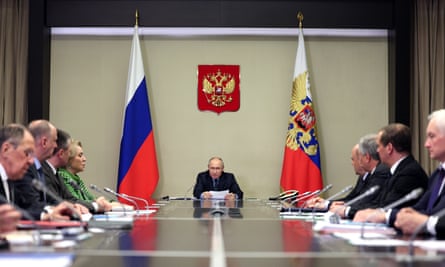
This week, Putin sought to show he was in control, convening his security council over the rioting and quickly shifting the blame for the attacks abroad. Others asked how a country with such top-down control could allow the riot to take place.
“I think that considering in Russia everything is tightly controlled by the government, it is inconceivable that these riots were not instigated or directed by governmental structure,” said Goldschmidt. “This is my belief and I am not the only one.”
Yet Dagestan, a poor region with striking mountain ranges on the southern tip of Russia, has consistently proved a challenge for the Kremlin to manage. Moscow spent decades attempting to quell an Islamic insurgency there, where more than 90% of the population identify as Muslim, and still struggles to find a solution for poverty and high unemployment.
The area has served as a focus for political protest. It hosted some of the country’s largest anti-mobilisation demonstrations last year, when Putin called up hundreds of thousands of troops for his invasion of Ukraine, and in 2020 had attracted conspiracy-tinged protests against coronavirus quarantines.
Earlier this summer, spontaneous protests broke out after electricity and water was cut off for more than a week to the city of Izberbash. Later, residents from Makhachkala protested, saying they had lost power for days or weeks at a time. The patternwas repeated in other cities.
“Dagestan is a territory with enormous problems, big infrastructure problems, and when the events in Gaza began, some of the local channels began to share two photographs: Gaza without electricity and [Dagestani city] Khasavyurt without electricity,” said Akhmet Yarlykapov, a senior researcher at the Centre for Caucasus Studies and Regional Security at the Moscow State Institute of International Relations. “Of course people are in solidarity with Gaza, with the Palestinians. They’re both Muslim. But the true reasons for these events are in Dagestan’s own internal problems.”
The war in Gaza has unleashed a wave of anger among Russian Muslims, in particular in the poorer North Caucasus. Ziyatdin Uvaisov, an activist and head of Patient Monitor, an NGO in Dagestan that advocates for medics and patients’ rights, said 95% of Dagestanis were “truly angry over the Israeli crimes taking place in Palestine” but that local authorities had prevented them from holding demonstrations.
“If there’d been some ordinary rally, it’s possible people would have calmed down, acted rationally, seen that there are limits … When it’s not approved within the bounds of the law, then you end up with a riot,” he said.
He said that he had not gone to Makhachkala airport because: “I understand that anything can happen with this mass gathering of disorganised people, that they could maybe do something wrong … people were getting really wound up.”
He argued that most people in Dagestan held anti-Israeli views not because they were antisemitic but because of the war, saying there was no violence against the region’s well-established Jewish community, which is largely based in the southern city of Derbent.
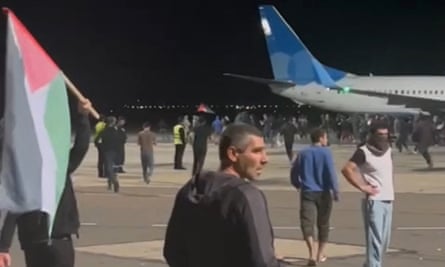
Yet vivid images of young Dagestani men chasing airport travellers they believed had arrived from Israel shocked the world, and members of the local Jewish community quickly voiced fears that they could be next.
As the attack unfolded, Ovadya Isakov, a prominent Jewish rabbi from the region and spokesperson for the Dagestani Jewish community, told the Russian news site Podyom that all 700 to 800 families, the last of Dagestan’s mountain Jewish community that traces its origins to the seventh century, may have to leave for other parts of Russia. But, he added: “Is it even worth leaving, since Russia is not our saviour, there have also been pogroms in Russia?”
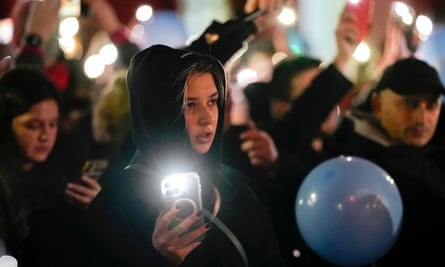
Grigory Shvedov, the editor of Caucasian Knot, a news website covering the region that recently published a timeline of attacks on local rabbis in Dagestan, said: “Antisemitism was always there.”
He added: “It is not something new. A lot of people, whole generations of Jews left, I know some people from the community and they’re saying that they always felt that antisemitism. We don’t still, thank God, have any stories about attacks against the local communities. Because that could happen any second.
“The most serious threat right now are not moods and actions connected to visitors from Israel,” he said, referring to events at Makhachkala airport. “The real threat is in a change of target from anti-Israel, to antisemitic. Both the national and regional security services would not be able to protect individual Jews from attacks.”
Rabbi Isakov knows this better than most. He barely survived an assassination attempt in 2013, when a gunman shot him in Derbent. And his house had also been vandalised in 2007.
As officials in Dagestan and Moscow sought to project an air of calm this week, Isakov disappeared from public. Calls to his office this week went unreturned.
Earlier he had said: “I don’t feel safe, although the synagogue is guarded.” He recalled how a local police officer had suggested to one of the rabbi’s congregants that she was complicit in the deaths of children in Palestine. “And at any time you can expect something worse.”
Researchers say they have seen a decline in antisemitism across Russia since the fall of the Soviet Union, with recorded attacks against Jewish people and places in Russia in single digits each year. But Denis Volkov, the director of the Levada Centre, an independent polling organisation, a “dormant antisemitism that also, especially in disenfranchised groups, can be activated when people are extremely agitated”.
In the Tsarist era, widespread antisemitism propelled pogroms, or anti-Jewish riots, against Jewish communities in cities such as Chișinău, Odesa and Białystok as authorities did little, or participated in the looting and killing.
There was official antisemitism during the Soviet era under Joseph Stalin and his successors, such as Leonid Brezhnev. The atmosphere sometimes reflected Soviet relations with Israel, becoming harsher when Moscow broke off diplomatic relations after the 1967 six-day war.
Yevgenia Albats, a Russian journalist based in the US, said casual antisemitism was “everyday life” in her childhood in the 1960s. Russians in the Moscow trams and shops would refer to her and her sister as zhidovochki, a pejorative term for Jewish girls, and schoolmates would snatch away the red “pioneer” scarves worn by the communist youth movement, telling them: “You Jews can’t be pioneers.”
Since the 7 October Hamas raid into Israel, she said she had seen a broad propaganda campaign on television of antisemitic content that she believed was meant to curry favour with Iran and other countries critical of Israel and the US.
“[Putin] is always trying to establish some sort of anti-American unity, just the way there was during the cold war,” she said. “Putin wants to become a leader of the global south. They decided that’s the right moment, the world is once again about to divide into two parts. That’s what drives Russian propaganda.”
As a child, the story goes, Putin had a friendly rapport with neighbours who were Orthodox Jews, and he has generally avoided antisemitic jokes. But that has changed in the past few years. When Anatoly Chubais, his former economic adviser, was rumoured to have received Israeli citizenship, he mockingly called him “some Moshe Israeilevich”.
“I think there is a direct relationship between such jokes and high-level officials and the perception of permissiveness as far as attacks against Jews are concerned,” said Tanya Lokshina, an associate director for Human Rights Watch’s Europe and Central Asia division.
Russian officials have allowed themselves far more aggressive rhetoric about Jews, with the foreign minister, Sergei Lavrov, saying last year that, “I could be wrong, but Hitler also had Jewish blood,” as he brushed aside a question about the Ukrainian president Volodymyr Zelenskiy’s Jewish background. “Wise Jewish people say that the most ardent antisemites are usually Jews,” he added.
Alexander Verkhovsky, the director of the Sova centre in Moscow, a non-governmental group that monitors extremism, said: “The authorities used to clamp down on antisemitic rhetoric, but we have seen a change since the war in Ukraine. We saw a similar jump in antisemitism in 2014 during the Donbas fighting. When state propaganda becomes more aggressive, antisemitism rises.”
Several days before the riots at Makhachkala airport, anonymous Telegram channels published the addresses of synagogues in Stavropol, Krasnodar, Sochi, Nalchik and Derbent, as well as photos of the rabbis, including Isakov.
Yet authorities still appeared to be taken by surprise when, days later, some of the same Telegram channels began to call on Dagestanis to intercept the arriving flight from Tel Aviv at the Makhachkala airport, setting the stage for the riots.
“The authorities were not ready. They have all the instruments to fight the religious dissidents, political dissidents, the foreign agents … but they are not prepared to fight against direct action,” said Shvedov, the Caucasian Knot editor. “I think for officials it is an absolute mistake in their work, this came out of the blue for them.”
Lokshina drew a parallel to the coup launched by Yevgeny Prigozhin, the Wagner leader, whose troops managed to seize the city of Rostov and begin a march on Moscow under the nose of the Russian military.
“It’s like little fires everywhere,” Lokshina said. “And where is the next fire going to be?”