
Prime Minister Benjamin Netanyahu held a private meeting today with UK Foreign Secretary, and former Prime Minister, David Cameron, at the Prime Minister’s Office in Jerusalem. pic.twitter.com/XHUNArASv2
— Prime Minister of Israel (@IsraeliPM) January 24, 2024
Month: January 2024
Israel is experiencing a leadership failure of historic proportions regarding the future of the occupation and the conflict, and a chilling moral and political vacuum of leadership at the heart of the war / @dahliasc https://t.co/aurkpIpOac
— Haaretz.com (@haaretzcom) January 25, 2024
Германия и Украина готовятся заключить соглашение о безопасности. Об этом говорили в телефонном разговоре канцлер ФРГ Олаф Шольц и президент Украины Владимир Зеленский. По словам Шольца, в настоящее время идет “интенсивная подготовка” к заключению такого соглашения, что может… pic.twitter.com/VQss23nTSE
— DW на русском (@dw_russian) January 25, 2024
Комитет Сената США одобрил закон о конфискации российских активов
В среду Комитет по международным отношениям Сената США одобрил законопроект, который поможет Соединенным Штатам конфисковывать российские активы и передавать их Украине на нужды восстановления страны, пострадавшей…
— bbcrussian (@bbcrussian) January 24, 2024
Prime Minister Benjamin #Netanyahu has bluntly spelled out his plan to ethnically cleanse and then seize #Gaza for Israel. https://t.co/saLVte3tlK
— World Socialist Web Site (@WSWS_Updates) January 23, 2024

While the Likud’s ministers and Knesset members (MKs) are projecting a united front in support of party leader Prime Minister Benjamin Netanyahu, a growing number of them believe that his days at the party’s helm are numbered, sources in the party said to the Jerusalem Post.
In addition to the catastrophic events of October 7 and a growing sense amongst the party’s base that the prime minister will not deliver on his promise to destroy Hamas and return all hostages, MKs have noted the party’s poor performance in most polls – between 16 and 18 seats, compared to its current 32.
If the Likud will no longer be the ruling party in a future election, nearly all of its current 18 ministers (not including Netanyahu) will be relegated to serve as opposition MKs – and most of its current MKs will be out of a job. Therefore, behind the scenes MKs have begun to gravitate toward possible successors, including Economy Minister Nir Barkat, Foreign Minister Yisrael Katz, Knesset Foreign Affairs and Defense Committee Chairman Yuli Edelstein, Defense Minister Yoav Gallant, and others, according to two sources, who spoke to the Post on condition of anonymity.
In fact, the plurality of potential successors is partly responsible for the fact that Netanyahu is still prime minister. Knesset protocol enables a procedure called a “constructive no-confidence vote,” where, instead of dispersing itself and heading to an election, a majority of the Knesset’s 120 members vote to institute a new government. National Unity and opposition parties Yesh Atid and Yisrael Beytenu would presumably support such a move – but their combined 42 seats would require at least 19 MKs from the Likud. The plurality of successors in the Likud and the failure to rally behind a single candidate mean that the votes don’t add up. Even if one of the potential successors managed to create a significant following within the party, 19 MKs is still unrealistically high, a source explained.
That leaves an election, which requires 61 MKs to vote in favor of the Knesset dispersing. The opposition currently numbers 56, and therefore it would be necessary for five MKs from the Likud to vote to topple the government, a more realistic number. Potential candidates are ministers Gallant, Edelstein, and Intelligence Minister Gila Gamliel, as well as MKs David Bitan, Eli Dallal, Galit Distal-Atbaryan, possibly Tally Gotliv, and others.
Israeli prime minister Benjamin Netanyahu attends a plenum session for Israelis held kidnapped by Hamas terrorists in Gaza, at the assembly hall of the Knesset, the Israeli parliament in Jerusalem, on December 25, 2023. (credit: YONATAN SINDEL/FLASH90)
Rather than crowning a successor from the Likud, however, such a move essentially brings down a Likud-led government – and therefore could be a step too far for the Likud’s base. This leads to a Catch-22 situation, whereby the five who vote to topple the government may no longer be welcome in the Likud – and may even join National Unity leader Benny Gantz in the next election.
Why has no one challenged Netanyahu?
In addition, no one in the Likud wants to be the first to challenge Netanyahu publicly during wartime, a source said, and therefore the timing of any political move, as well as a possible way out of the Catch-22, depends on two factors – Gantz, and protestors.
Advertisement
Gantz has said that his party will remain in the government only as long as it feels it is relevant in the war’s decision-making processes. The central decision shortly is whether or not to open another front on the Northern border – and Gantz wants to be part of that decision. However, should a northern front be avoided or Gantz decide that he is no longer relevant, his leaving the government would likely serve as a gong to signal that the political fight is on. That, coupled with an expected wave of mass protests, could be enough for five Likud MKs to move against Netanyahu – perhaps without having to give up their seats.
Another scenario, a source said, is that Netanyahu himself precedes the wave of protests by calling for an election himself – thereby avoiding the momentum that such a wave could create for his rivals.
In any case, several sources said they believed that a political eruption is closer to the surface than it seems, with one even estimating that it would happen in between two weeks to two months.
The Benjamin Netanyahu era is over, sources in Likud say
🖊️ @BreuerEliav#Netanyahu | #israelhttps://t.co/7ufllWP0iV
— The Jerusalem Post (@Jerusalem_Post) January 18, 2024
Sissi said to rebuff Israeli request for phone call with Netanyahuhttps://t.co/SJpOLKjpRw#Netanyahu @netanyahu @AlsisiOfficial #Egipto #Egypt #Hamas #Gaza #MiddleEast #Palestine #IDF @IDF #Israel
— Agencia AJN (@AgenciaAJN) January 24, 2024
WHEN I GOT BACK FROM VIETNAM some 50-plus years ago, all I wanted to do was get on with my life. My experience in the war as an Army intelligence case officer had dispelled any doubts that I’d had when I’d first arrived in Saigon that the war was not only a loser, but criminal. After a year there I’d firmly concluded that the wreckage we unleashed on that benighted country and its peoples far outweighed the lofty goals Washington claimed for continuing the war at its murderous rate.

Netanyahu has rebuffed US demands for scaling back the violence and pursuing a Palestinian state solution (MENAHEM KAHANA/AFP via Getty Image)
Now back home in Boston in 1970, I suppressed my rage and depression about the war and focused on finishing college, finding a mate and deciding on a career, possibly teaching world history to adolescents so that they might avoid the trap of knee-jerk patriotism and their own Vietnam.
Alas, two events soon upended my deliberate disinterest: The U.S. invasion of Cambodia, an insane expansion of the Indochina battlefield, and then publication of the Pentagon Papers, which confirmed my many suspicions about the criminal origins and prosecution of the war. But it was the devious Nixon administration’s backing of South Vietnam’s corrupt and compromised leadership, moreover, that was the main impediment to any kind of “win” in the war, much less any kind of peace, in the near future.
They both had to go.
So I reluctantly discarded my carefully tended stoicism and signed up with Vietnam Veterans Against the War. Writing, not the classroom, became my destination. I was good enough at it that it eventually set me on a path toward a career doing the kind of investigative journalism that probed the lies and deceptions in which too many top CIA and other national security officials, whether Republicans or Democrats, cocooned themselves.
The Thread
Where’s this leading? Here at SpyTalk, we’ve endeavored to hew closely to our self-declared franchise of reporting on “the intersection of intelligence, foreign policy and military operations,” as we like to say, and steering clear of the hyper-partisan politics and emotions ruling the day. Of course, that’s practically impossible when Donald Trump, the once and possibly future president, upends national security norms by, say, publicly favoring Vladimir Putin’s version of election interference over the findings of his own intelligence agencies, or sharing top secret intelligence with Russian officials in the Oval Office, or illegally squirreling away classified documents in his various homes, or prompting violent attacks on the FBI, prosecutors and judges, not to mention presidential electors and the U.S. Capitol.
Still, we don’t harp on them. We leave the shout fests to cable news shows and social media.
But the Israeli campaign in Gaza has pushed us to take a stand.
Israel’s pursuit of Hamas was initially righteous, we believe, in response to the Islamic extremists’ genocidal Oct. 7 rampage. But it’s turned into something else: the slaughter of Palestinian men, women and children without justification: the rescue or return of Israeli hostages and the effective eradication of Hamas. By its egregious actions, Israel has now ceded any moral high ground it possessed when its campaign in Gaza began. And for that Israel Prime Minister is almost solely to blame.
Not our issue? I wish it weren’t. Despite my reluctance to wade into such murky and complicated moral and political issues, I believe we have a mandate because of where the leading opposition to Netanyahu is centered: His own intelligence and security agencies.
And here’s why.
Netanyahu, who has always presented himself to the Israeli electorate as the only political leader who could guarantee the country’s security, has long had a fraught relationship with intelligence, military and security chiefs.
He began to come under criticism from his own handpicked Mossad chief Meir Dagan in 2011 over their opposing views on how to neutralize the threat posed by Iran’s nuclear program.
Until then, Dagan had favored continuing the intelligence agency’s clandestine program of targeted assassinations and sabotage that had already liquidated a half dozen of Iran’s nuclear scientists and heavily damaged some of its nuclear enrichment facilities. By using such methods, Dagan felt Israel could achieve its aim of halting the nuclear program while avoiding an all-out war with Iran. Such a war, he and many of Israel’s military chiefs argued, would be costly for Israel and still wouldn’t succeed in destroying Iran’s nuclear program since that would require repeated bombing sorties, which the Israeli air force was incapable of conducting at such a distance from Iran. Israel also lacked the bunker-busting munitions capable of destroying Iran’s deeply buried nuclear facilities.
But Netanyahu lost his faith in the utility of the Mossad’s clandestine measures and ordered the air force to begin practicing to deliver what he believed would be a one-time, knock-out punch to Iran’s nuclear aspirations. In response, Dagan, who was about to resign from the Mossad in protest, summoned reporters to the agency’s headquarters and publicly accused Netanyahu of leading the country into disaster.
“That someone is elected does not mean that he is smart,” Dagan said, according to Rise and Kill, author Ronen Bergman’s masterful 2018 history of Israel’s targeted assassination program.
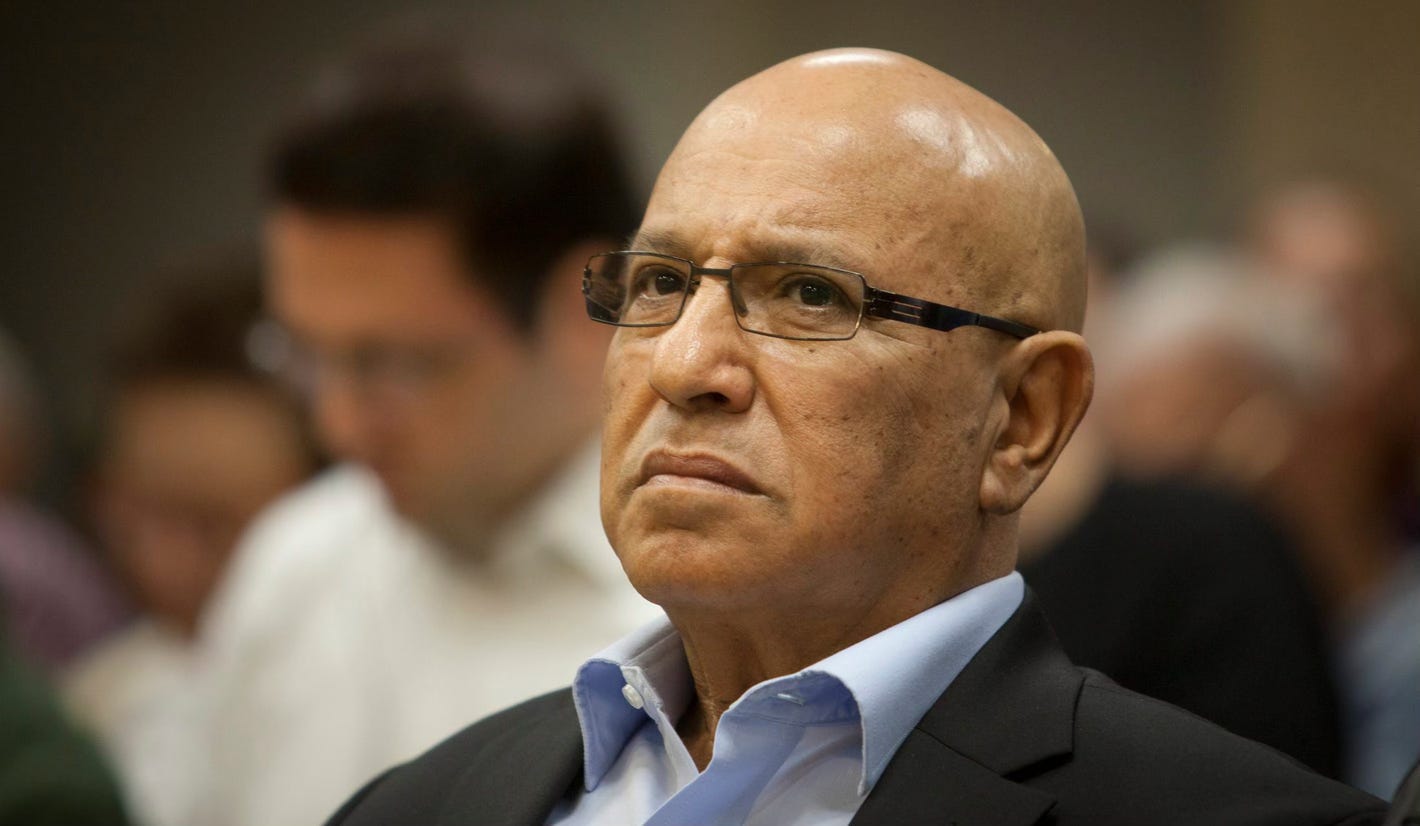
Mossad chief Meir Dagan was so opposed to Netanyahu’s plan to attack Iran in 2011 that he finally went public with his differences. (Haaretz—Moti Milrod)
Dagan even went so far as to brief then-CIA Director Leon Panetta about Netanyahu’s plans, which prompted President Barack Obama to warn Netanyahu not to attack Iran.
Many other top Israeli military and intelligence chiefs also made known their opposition to the attack, forcing Netanyahu to postpone it several times and, finally, to scrap it.
The next time Netanyahu butted heads with his intelligence and military chiefs occurred soon after his re-election in late 2022, when his coalition of ultra-rightwing and orthodox religious parties announced their plan to limit the authority of Israel’s Supreme Court, which would remove the only check on his government.
Netanyahu’s plan sparked massive protests, bringing hundreds of thousands of Israelis into the streets who charged that the judicial overhaul would destroy Israel’s democracy and geld the only institution that could block the government’s extremist policies from becoming law. While Israel’s top legal authorities, business leaders and military reservists led the protests, the Mossad and the Shin Bet domestic security service shockingly allowed its rank-and-file members to join the protests.
That’s not all.
Last September, after the protests and counter-protests by Netanyahu’s supporters threatened to erupt into civil war, a group of more than 180 former senior officials from the Mossad, Shin Bet, the military and police joined the protests, warning that the deep divisions in Israeli society caused by judicial overhaul debate were undermining Israel’s unity in the face of mounting threats from the West Bank, Lebanon and Iran. And in unprecedented statements of opposition to the country’s leadership, these former officials, all veterans of Israel’s wars, declared that Netanyahu’s policies were the biggest threat to the country’s future and well-being.
“We were used to dealing with external threats,” said Tamir Pardo, a former head of Israel’s Mossad intelligence agency and a leader of the new group. “We’ve been through wars, through military operations and all of a sudden you realize that the greatest threat to the state of Israel is internal.”
“Mr. Security”
The Oct. 7 attack by Hamas, in which some 1,200 Israelis were killed and 240 taken hostage, represented Israel’s worst military disaster since the 1973 Yom Kippur War, when Prime Minister Golda Meir and her army chiefs dismissed intelligence warning of a combined Egyptian and Syrian attack. In the wake of Hamas’ bloody campaign, Netanyahu, who had taken to calling himself “Mr. Security,” blamed his intelligence chiefs for not warning him—and indeed reports soon surfaced that his intelligence chiefs ignored warnings that Hamas was preparing for a full frontal invasion of Israel. But the prime minister’s attempt to shift blame to his intelligence chiefs drew a sharp rebuke from the head of his own war cabinet, Benny Gantz, who declared, “The prime minister must retract his statement and stop addressing this matter.”
Still, Netanyahu has managed to remain in office, promising a thorough investigation of how Hamas managed to pull off such a devastating attack—but only after the Israeli army has achieved “absolute victory” over Hamas and the war is over. As Israelis rallied to the government in response to the attack, calls for new elections were muted. But with the war now in its fourth month, with more than 100 hostages still being held, and with relations with the United States increasingly strained over Netanyahu’s refusal to consider the creation of a Palestinian state in the West Bank and Gaza Strip, patience with the Israeli leader is now wearing thin.
Opponents, charging that Netanyahu lacks a clear plan for how to get Israel out of Gaza, are now openly calling for new elections. They say personal and political considerations are guiding his decision-making, not the country’s best interest or the safe return of the hostages. They cite the three indictments that Netanyahu faces for corruption — charges that could send him to prison if he’s convicted.

Just one of repeated mass protests against Netanyahu’s proposed judicial overhaul legislation, in Tel Aviv Aug 19, 2023. (Avshalom Sassoni/Flash90)
“When the prime minister says ‘absolute victory,’ ’war until 2025,’ he knows that if that’s the case the hostages will die and return in coffins,” said Eyal Ben Reuven, a reserve Israeli general. “A long war in enemy territory is not a good thing.”
Last week, Gadi Eisenkot, a member of Netanyahu’s influential War Cabinet and a former military chief whose son and nephew were killed in the Gaza war, said that only a negotiated deal could free the remaining hostages. His remarks were a direct challenge to Netanyahu’s insistence that sustained military force is the best way to win their release. Even more importantly, Eisenkot also called for early elections to restore the public’s trust in their leaders.
The Gaza war, meanwhile, has inflamed the wider Arab world, generated new fronts in Yemen, Iraq, Syria and Lebanon, reinvigorated Islamist militants from the occupied West Bank to Africa, and—important to us— implicated the United States in a brutal Israeli assault on Palestinians that, if it’s not actual genocide, now looks very much like it. While it’s impossible to predict how the Gaza war will end, it’s clear to us at SpyTalk that any solution to the morass in the Middle East must begin with the removal of Netanyahu from office. And as the spearhead of that removal likely resides in Israel’s much respected intelligence services, we will cover it.
Jonathan Broder contributed deep reporting on Israel to this piece.
#Netanyahu Has Got to Go , by @SpyTalker https://t.co/VidNEx0k1P
— Barbara Slavin (@barbaraslavin1) January 25, 2024