
Russia and others target mostly Black and other minority groups Voters, which is in accordance with their pseudo-ideological, racist concept of America as the Third World country. This Prigozhin style of propaganda in 2016, in retrospect, was shown to be inefficient and… pic.twitter.com/b7Cc0pmZlL
— Michael Novakhov (@mikenov) March 3, 2024
Day: March 3, 2024
Russia and others target mostly Black and other minority groups Voters, which is in accordance with their pseudo-ideological, racist concept of America as the Third World country. This Prigozhin style of propaganda in 2016, in retrospect, was shown to be inefficient and… pic.twitter.com/DOehklFPSU
— Michael Novakhov (@mikenov) March 3, 2024
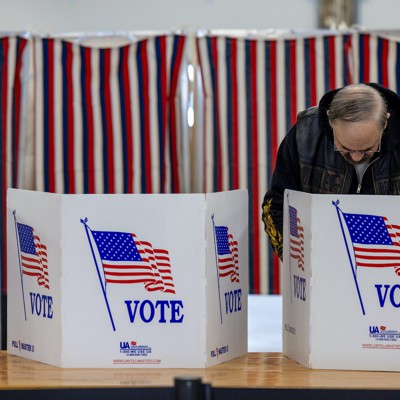
Domestic turmoil may be dominating headlines about the 2024 elections, but threats from abroad have not dissipated.
During the 2022 midterms, state actors from China, Russia, Iran, and elsewhere increased their attempts to influence the outcomes of midterm races and amplify divisions in American society, according to dual reports released last month by the U.S. national security apparatus. And hostile governments scanned state election websites and copied voter data, although they did not compromise the vote itself.
Americans should understand why foreign actors want to interfere in U.S. elections, how they do it, and what we can do to protect the integrity of our electoral process as we barrel into the 2024 primary season.
Authoritarian governments such as China, Russia, and Iran have three key motivations to interfere in the 2024 election: to diminish the credibility of our democracy, distract our country with internal issues to erode U.S. leadership overseas, and shift our policy to favor their interests. If Americans lack confidence in the integrity of a democratic election or if the country plunges into a political crisis, autocrats abroad can point a finger at us to distract their own citizens from the many shortcomings of their own authoritarian political systems. And American preoccupation with internal election turmoil could weaken our foreign commitments in places like Taiwan, Ukraine, and Israel, regions where these authoritarians have deep and abiding interests counter to our own.
These regimes favor certain political candidates, and in the midterms China (and even Cuba) sought to sway elections toward candidates who aligned with their agendas. A U.S. president less interested in maintaining strong American leadership overseas or supporting our allies would be a strategic win for these countries.
Nation-state actors use a variety of tools and tactics to influence our elections. They wage information-manipulation and online-influence campaigns; conduct cyber intrusions and attacks; put dirty money in our system; and contact candidates, campaigns, and diaspora communities either directly or through cutouts. The advent of generative artificial intelligence enables bad actors to conduct information campaigns and cyberattacks at unprecedented scale and volume.
AI-generated content has played a role in other democratic elections this year, including Slovakia and Argentina, where it was used to malign candidates and spread misleading information, like one viral (but fake) recording of a candidate promising to raise the price of beer.
Campaigns and political parties are experimenting and grappling with AI in the U.S. elections. Over the past week, a robocall featuring a faked voice of President Biden urged New Hampshire voters to skip Tuesday’s primary. State and local election officials are preparing for increased cyberattacks and more realistic false images, audio, and video that could stoke false claims about election rigging as the Federal Election Commission tries to regulate such misinformation.
To be clear, these challenges to election integrity are not posed exclusively by foreign actors. Whether in service of money, power, or chaos, anyone can use many of the tools and tactics nation-state actors have at their disposal to undermine the integrity of the election too, especially with AI at everyone’s fingertips. However, in many respects, the United States is a soft target for our foreign adversaries.
The United States is highly polarized. Tens of millions of Americans believe the lies that the election system is rigged already. Our free and open information environment leaves us susceptible to all sorts of campaigns that try to denigrate how the electoral process works. Furthermore, there are over 10,000 election jurisdictions in the country, and although elections are more secure than ever across the board, some jurisdictions still lack the resources to combat a viral image or video created in a basement, to say nothing of deterring a hostile intelligence service.
These vulnerabilities are serious but not insurmountable. Election officials and federal and state officials are working tirelessly to defend against interference in our elections. There are promising technologies that can help officials, media, and the public alike better differentiate between authentic and manipulated content. When appropriate, trusted military and defense leaders can communicate foreign adversaries’ intentions to undermine U.S. military readiness and national security, which is a key reason these adversaries are trying to destabilize democracy in the United States. Finally, if Americans are turned off by the political discourse, now more than ever is the time to participate in democracy directly. Volunteering as an election worker, for example, is an important way to see firsthand all the processes and procedures in place that safeguard the sanctity of the vote from all sorts of threats. By reinforcing our participatory democracy, we provide the best defense against authoritarians who have every interest in destabilizing the United States in 2024 and beyond.
David Salvo and Rachael Dean Wilson are co-Managing Directors of the Alliance for Securing Democracy at the German Marshall Fund of the United States
@8fbidirector testified before the House Committee on Homeland Security about what the Bureau is doing to protect Americans from terrorists and foreign intelligence threats. Read his statement for the record: https://t.co/EuzXyWCsk8 pic.twitter.com/Rx0cYXlmUA
— FBI Director Christopher Wray (@8fbidirector) November 16, 2023
https://t.co/vmSHfU9TaT – The News And Times Review#NewsAndTimes #NT #TNT #News #Times#World #USA #POTUS #DOJ #FBI #CIA #DIA #ODNI#Israel #Mossad #Netanyahu#Ukraine #NewAbwehr #OSINT#Putin #Russia #GRU #Путин, #Россияhttps://t.co/O0SIgLVWzMhttps://t.co/DO5LG3PY4T… pic.twitter.com/KgsZcZ3YEa
— Michael Novakhov (@mikenov) March 3, 2024
How susceptible are the American Voters to Foreign Influence and Interference? – Google Search https://t.co/UMkwVoyxWf – https://t.co/Fn6HcxmMXI
— Michael Novakhov (@mikenov) March 3, 2024
Not just #Russia #China #Iran working to meddle w/#Election2020
“We probably have 30 countries out there wanting to play in the influence game” per NCSC’s Evanina in interview w/@HearstTV
— Jeff Seldin (@jseldin) October 8, 2020

WASHINGTON —
U.S. security officials are bracing for an onslaught of fast-paced influence operations, from a wide range of adversaries, aimed at impacting the country’s coming presidential election.
FBI Director Christopher Wray issued the latest warning about attempts to meddle with American voters as they decide whom to support when they go to the polls come November, telling a meeting of security professional Thursday that technologies such as artificial intelligence are already altering the threat landscape.
“This election cycle, the U.S. will face more adversaries moving at a faster pace and enabled by new technology,” Wray said.
“Advances in generative AI [artificial intelligence], for instance, are lowering the barrier to entry, making it easier for both more and less sophisticated foreign adversaries to engage in malign influence while making foreign influence efforts by players both old and new, more realistic and more difficult to detect,” he said.
The warning echoes concerns raised earlier in the week by a top lawmaker and by the White House, both singling out Russia.
“I worry that we are less prepared for foreign intervention in our elections in 2024 than we were in 2020,” said Mark Warner, the chairman of the Senate Intelligence Committee, during a cybersecurity conference on Tuesday.
On Sunday, White House national security adviser Jake Sullivan told NBC’s “Meet the Press” there is “plenty of reason to be concerned.”
“There is a history here in presidential elections by the Russian Federation, by its intelligence services,” Sullivan said.
U.S. intelligence agencies concluded Russia sought to interfere in both the 2016 and 2020 elections.
But Russia has not been alone.
A declassified intelligence assessment looking at the 2022 midterm elections concluded with high to moderate confidence that Russia was joined by China and Iran in seeking to sway the outcome.
“China tacitly approved efforts to try to influence a handful of midterm races involving members of both U.S. political parties,” the report said.
“Tehran relied primarily on its intelligence services and Iran-based online influencers to conduct its covert operations,” it said. “Iran’s influence activities reflected its intent to exploit perceived social divisions and undermine confidence in U.S. democratic institutions during this election cycle.”
The United States has also alleged other adversaries, such as Cuba, Venezuela and Lebanese Hezbollah, have sought to influence elections, as have allies, such as Turkey and Saudi Arabia.
The warnings from Wray and others are encountering pushback from some lawmakers and conservative commentators who view such statements as an attempt to resurrect what they call the “Russia hoax” — saying the narrative that Russia interfered in the 2016 U.S. presidential election to help former President Donald Trump win is without merit.
Warner, however, dismissed that view in response to a question from VOA on the sidelines of Tuesday’s security conference. “Anyone who doesn’t think the Russian intel services have and will continue to interfere in our elections … I wonder where they’re getting their information to start with,” he said.
Wray on Thursday suggested the list of countries and other foreign groups seeking to influence U.S. voters is set to expand. “AI is most useful for what I would call kind of mediocre bad guys and making them kind of like intermediate,” he said.
“The really sophisticated adversaries are using AI more just to increase the speed and scale of their efforts,” he said. “But we are coming towards a day very soon where what I would call the experts, the most sophisticated adversaries, are going to find ways to use AI to be even more elite.”
Some private cybersecurity firms also see the danger growing.
This past September, Microsoft warned that Beijing has developed a new artificial intelligence capability that can produce “eye-catching content” more likely to go viral compared to previous Chinese influence operations.
Others agree.
“Whether it’s robocalls, whether it’s fake videos — all those things really even back to 2022, weren’t as prevalent,” Trellix CEO Bryan Palma told VOA. “You weren’t going to get any high-quality type of deepfake video.
“I think you’re going to see more and more of that as we get closer to the election,” he said.
WASHINGTON —
U.S. security officials are bracing for an onslaught of fast-paced influence operations, from a wide range of adversaries, aimed at impacting the country’s coming presidential election.
FBI Director Christopher Wray issued the latest warning about attempts to meddle with American voters as they decide whom to support when they go to the polls come November, telling a meeting of security professional Thursday that technologies such as artificial intelligence are already altering the threat landscape.
“This election cycle, the U.S. will face more adversaries moving at a faster pace and enabled by new technology,” Wray said.
“Advances in generative AI [artificial intelligence], for instance, are lowering the barrier to entry, making it easier for both more and less sophisticated foreign adversaries to engage in malign influence while making foreign influence efforts by players both old and new, more realistic and more difficult to detect,” he said.
The warning echoes concerns raised earlier in the week by a top lawmaker and by the White House, both singling out Russia.
“I worry that we are less prepared for foreign intervention in our elections in 2024 than we were in 2020,” said Mark Warner, the chairman of the Senate Intelligence Committee, during a cybersecurity conference on Tuesday.
On Sunday, White House national security adviser Jake Sullivan told NBC’s “Meet the Press” there is “plenty of reason to be concerned.”
“There is a history here in presidential elections by the Russian Federation, by its intelligence services,” Sullivan said.
U.S. intelligence agencies concluded Russia sought to interfere in both the 2016 and 2020 elections.
But Russia has not been alone.
A declassified intelligence assessment looking at the 2022 midterm elections concluded with high to moderate confidence that Russia was joined by China and Iran in seeking to sway the outcome.
“China tacitly approved efforts to try to influence a handful of midterm races involving members of both U.S. political parties,” the report said.
“Tehran relied primarily on its intelligence services and Iran-based online influencers to conduct its covert operations,” it said. “Iran’s influence activities reflected its intent to exploit perceived social divisions and undermine confidence in U.S. democratic institutions during this election cycle.”
The United States has also alleged other adversaries, such as Cuba, Venezuela and Lebanese Hezbollah, have sought to influence elections, as have allies, such as Turkey and Saudi Arabia.
The warnings from Wray and others are encountering pushback from some lawmakers and conservative commentators who view such statements as an attempt to resurrect what they call the “Russia hoax” — saying the narrative that Russia interfered in the 2016 U.S. presidential election to help former President Donald Trump win is without merit.
Warner, however, dismissed that view in response to a question from VOA on the sidelines of Tuesday’s security conference. “Anyone who doesn’t think the Russian intel services have and will continue to interfere in our elections … I wonder where they’re getting their information to start with,” he said.
Wray on Thursday suggested the list of countries and other foreign groups seeking to influence U.S. voters is set to expand. “AI is most useful for what I would call kind of mediocre bad guys and making them kind of like intermediate,” he said.
“The really sophisticated adversaries are using AI more just to increase the speed and scale of their efforts,” he said. “But we are coming towards a day very soon where what I would call the experts, the most sophisticated adversaries, are going to find ways to use AI to be even more elite.”
Some private cybersecurity firms also see the danger growing.
This past September, Microsoft warned that Beijing has developed a new artificial intelligence capability that can produce “eye-catching content” more likely to go viral compared to previous Chinese influence operations.
Others agree.
“Whether it’s robocalls, whether it’s fake videos — all those things really even back to 2022, weren’t as prevalent,” Trellix CEO Bryan Palma told VOA. “You weren’t going to get any high-quality type of deepfake video.
“I think you’re going to see more and more of that as we get closer to the election,” he said.
https://t.co/vmSHfU9TaT – The News And Times Review#NewsAndTimes #NT #TNT #News #Times#World #USA #POTUS #DOJ #FBI #CIA #DIA #ODNI#Israel #Mossad #Netanyahu#Ukraine #NewAbwehr #OSINT#Putin #Russia #GRU #Путин, #Россияhttps://t.co/O0SIgLVWzMhttps://t.co/DO5LG3PY4T…
— Michael Novakhov (@mikenov) March 3, 2024