If Benjamin Netanyahu had accepted defeat in June 2021, finally yielding the stage to a coalition of his opponents, he could have retired at the age of 71 with a decent claim to having been one of Israel’s more successful prime ministers.
He had already surpassed the time in office of Israel’s founder, David Ben-Gurion, becoming the country’s longest-serving prime minister in 2019. His second stretch in office, from 2009 to 2021, coincided with perhaps the best 12 years Israel had known since its founding in 1948. The country enjoyed relative security, with no major wars or prolonged Intifadas. The period was one of uninterrupted economic growth and prosperity. Thanks to its early adoption of widespread vaccination, Israel was one of the first countries in the world to emerge from the coronavirus pandemic. And toward the end of that span came three agreements establishing diplomatic relations with Arab countries; more were likely on the way.
Twelve years of Netanyahu’s leadership had seemingly made Israel more secure and prosperous, with deep trade and defense ties across the world. But this wasn’t enough to win him another term. A majority of Israelis had tired of him, and he had been tainted by charges of bribery and fraud in his dealings with billionaires and press barons. In the space of 24 months, Israel held four elections ending in stalemate, with neither Netanyahu nor his rivals winning a majority. Finally, an unlikely alliance of right-wing, centrist, left-wing, and Islamist parties managed to band together and replace him with his former aide Naftali Bennett in June 2021.
[Read: Netanyahu should quit. The U.S. can help with that.]
At that point, Netanyahu could have sealed his legacy. A plea bargain on offer from the attorney general would have ended his corruption trial with a conviction on reduced charges and no jail time. He would have had to leave politics, probably for good. Over the course of four decades in public life, including 15 years as prime minister and 22 as the Likud party’s leader, he had already left an indelible mark on Israel, dominating the second half of its history. But he couldn’t bear the thought of giving up power.
Within 18 months, he was back as prime minister for the third time. The unwieldy coalition that replaced him had imploded, and this time around, Netanyahu’s camp of far-right and religious parties ran a disciplined campaign, exploiting the weaknesses of their divided rivals to emerge with a small parliamentary majority, despite still being virtually tied in the vote count.
Nine months later, Netanyahu, the man who promised, above everything else, to deliver security for Israel’s citizens, presided over the darkest day in his country’s existence. A total breakdown of the Israeli military and intelligence structure allowed Hamas to breach Israel’s border and embark on a rampage of murder, kidnapping, and rape, killing more than 1,100 Israelis and taking more than 250 hostage. The calamities of that day, the failures of leadership leading up to it, and the traumas it caused will haunt Israel for generations. Even leaving completely aside the war he has prosecuted since that day and its yet-unknown end, October 7 means that Netanyahu will always be remembered as Israel’s worst-ever leader.
How does one measure a prime minister?
There is no broadly accepted ranking of the 13 men and one woman who have led Israel, but most lists would feature David Ben-Gurion at the top. Not only was he the George Washington of the Jewish state, proclaiming its independence just three years after a third of the Jewish people had been exterminated in the Holocaust, but his administration established many of the institutions and policies that define Israel to this day. Other favorites include Levi Eshkol, for his shrewd and prudent leadership in the tense weeks before the Six Day War, and Menachem Begin, for achieving the country’s first peace agreement with an Arab nation, Egypt.
All three of these men had mixed records and detractors, of course. Ben-Gurion had autocratic tendencies and was consumed by party infighting during his later years in office. After the Six Day War, Eshkol failed to deliver a coherent plan for what Israel should do with the new territories it occupied and the Palestinians who have remained under its rule ever since. In Begin’s second term, Israel entered a disastrous war in Lebanon, and his government nearly tanked the economy. But in most Israelis’ minds, these leaders’ positive legacies outweigh the negatives.
Who are the “worst prime ministers”? Until now, most Israelis regarded Golda Meir as the top candidate for that dismal title. The intelligence failure leading to the Yom Kippur War was on her watch. Before the war, she rejected Egyptian overtures toward peace (though some Israeli historians have recently argued that these were less than sincere). And when war was clearly imminent, her administration refrained from launching preemptive attacks that could have saved the lives of hundreds of soldiers.
[Read: The end of Netanyahu]
Other “worst” candidates have included Ehud Olmert, for launching the second Lebanon war and becoming Israel’s first former prime minister to go to prison for corruption; Yitzhak Shamir, for kiboshing an agreement with Jordan’s King Hussein that many believe could have been a significant step toward resolving the Israel-Palestinian conflict; and Ehud Barak, for spectacularly failing to fulfill his extravagant promises to bring peace with both the Palestinians and Syria.
But Benjamin Netanyahu now surpasses these contenders by orders of magnitude. He has brought far-right extremists into the mainstream of government and made himself, and the country, beholden to them. His corruption is flamboyant. And he has made terrible security decisions that brought existential danger to the country he pledged to lead and protect. Above all, his selfishness is without parallel: He has put his own interests ahead of Israel’s at every turn.
Netanyahu has the distinction of being the only Israeli prime minister to make a once reviled movement on the right fringe of the country’s politics into a government stakeholder.
Rabbi Meir Kahane, the founder of a Jewish-supremacist group called Kach, won a lone seat in the Knesset in 1984. He openly called for replacing Israeli democracy with a constitution based on the laws of the Torah and for denying Israel’s Arab citizens equal rights. During Kahane’s single legislative term, the entire Israeli political establishment shunned him. When he got up to speak in the Knesset, all of its members would leave the plenum.
In 1985, Likud joined other parties in changing election law so that those who denied Israel’s democratic identity, denied its Jewish identity, or incited racism could be barred from running for office. Under this provision, Kach was never allowed to compete in another election. Kahane was assassinated in New York in 1990. Four years later, a member of his movement killed 29 Muslims at prayer in Hebron, and the Israeli government proscribed Kach as a terror organization and forced it to disband.
But the Kahanists didn’t go away. With each Israeli election, they tried to rename their movement and adjust its platform to conform with electoral law. They remained ostracized. Then, in 2019, Netanyahu saw a roadblock on his path to reelection that they could help him get around.
Several Israeli parties had pledged not to serve in a government led by an indicted prime minister—quite possibly, enough of them to shut Netanyahu out of power. To prevent that from happening, Netanyahu needed to eke out every possible right-wing and religious vote for his potential coalition. The polls were predicting that the latest Kahanist iteration, the Jewish Power party, which is led by the thuggish but media-savvy Itamar Ben-Gvir, would receive only about 10,000 votes, well below the threshold needed to make the party a player on its own; but Netanyahu believed that if he could persuade the Kahanists and other small right-wing parties to merge their candidates’ lists into a joint slate, together they could win a seat or two for his potential coalition—just what he needed for a majority.
Netanyahu began pressuring the leaders of the small right-wing parties to merge their lists. At first the larger of these were outraged. Netanyahu was meddling in their affairs and, worse, trying to coerce them to accept the Kahanist outcasts. Gradually, he wore down their resistance—employing rabbis to persuade politicians, orchestrating media campaigns in the nationalist press, and promising central roles in future administrations. Media figures close to Netanyahu accused Bezalel Smotrich, a fundamentalist settler and the new leader of the religious Zionist party, of “endangering” the nation by making it easier for the hated left to win the election. Soon enough, Smotrich’s old-school national-religious party merged not only with Ben-Gvir’s Jewish Power but with an even more obscure, proudly homophobic party led by Avi Maoz.
Netanyahu did worry a bit about the optics. Throughout five stalemated election campaigns from 2019 to 2022, Likud coordinated closely with Jewish Power, but Netanyahu refused to be seen in public with Ben-Gvir. During the 2022 campaign, at a religious festival, he even waited backstage for Ben-Gvir to leave the premises before going up to make his speech.
Two weeks later, there was no longer any need to keep up the act. Netanyahu’s strategy succeeded: His coalition, merged into four lists, edged out its squabbling opponents with 64 of the Knesset’s 120 seats.
Netanyahu finally had the “right-wing in full” government he had often promised. But before he could return to the prime minister’s office, his allies demanded a division of the spoils. The ministries with the most influence on Israelis’ daily lives—health, housing, social services, and the interior—went to the ultra-Orthodox parties. Smotrich became finance minister; Maoz was appointed deputy minister in charge of a new “Agency for Jewish Identity,” with power to intervene in educational programs. And Ben-Gvir, the subject of numerous police investigations for violence and incitement over a period of three decades, was put in charge of a newly titled “Ministry of National Security,” with authority over Israel’s police and prison services.
As Netanyahu signed away power to the Kahanists, he told the international news media that he wasn’t forming a far-right government. The Kahanists were joining his government. He would be in control. But Netanyahu hadn’t just given Israel’s most extreme racists unprecedented power and legitimacy. He’d also insinuated them into his own formerly mainstream party: By March 2024, Likud’s candidates for local elections in a handful of towns had merged their slates with those of Jewish Power.
Likud long prided itself on combining staunch Jewish nationalism, even militarism, with a commitment to liberal democracy. But a more radical stream within the party eschewed those liberal values and championed chauvinistic and autocratic positions. For much of the past century, the liberal wing was dominant and provided most of the party’s leadership. Netanyahu himself espoused the values of the liberal wing—until he fell out with all the main liberal figures. By 2019, none was left to oppose the alliance with Ben-Gvir’s Kahanists.
Now more than a third of Likud’s representatives were religious, and those who weren’t preferred to call themselves “traditional” rather than secular. They didn’t object to cooperating with the Kahanists; indeed, many had already worked with them in the past. In fact, many Likud Knesset members by that point were indistinguishable from the Jewish Power ones. Israel’s worst prime minister didn’t just form an alliance of convenience with the country’s most irresponsible extremists; he made them integral to his party and the running of the state.
That Netanyahu is personally corrupt is not altogether novel in the history of the Israeli prime ministership. What makes him worse than others is his open contempt for the rule of law.
By 2018, Netanyahu was the subject of four simultaneous corruption investigations that had been in motion for more than a year. In one, known as Case 4000, Netanyahu stood accused of promising regulatory favors to the owner of Israel’s largest telecom corporation in return for favorable coverage on a popular news site. Three of the prime minister’s closest advisers had agreed to testify against him.
Investigations of prime ministers are not rare in Israel. Netanyahu was the subject of one during his first term. The three prime ministers who served in the decade between his first and second terms—Ehud Barak, Ariel Sharon, and Ehud Olmert—had all been investigated as well. Only in Olmert’s case did police deem the evidence sufficient to mount a prosecution. At the time, in 2008, Netanyahu was the leader of the opposition.
“We’re talking about a prime minister who is up to his neck in investigations and has no public or moral mandate to make fateful decisions for Israel,” Netanyahu said of Olmert. “There is a concern, I have to say real, not without basis, that he will make decisions based on his personal interest of political survival and not on the national interest.”
[Graeme Wood: Why the most hated man in Israel might stay in power]
Ten years later, Netanyahu would be the one snared in multiple investigations. Then he no longer spoke of corruption in high office but of a “witch hunt,” orchestrated by rogue police commanders and left-wing state prosecutors, and egged on by a hostile news media, all with the aim of toppling a right-wing leader.
Netanyahu was determined to politicize the legal procedure and pit his supporters against Israel’s law-enforcement agencies and judiciary. Never mind that the two previous prime ministers who had resigned because of corruption charges were from the center left. Nor did it matter that he had appointed the police commissioner and attorney general himself; both were deeply religious men with impeccable nationalist backgrounds, but he tarred them as perfidious tools of leftist conspiracy.
Rather than contemplate resignation, on May 24, 2020, Netanyahu became the first sitting Israeli prime minister to go on trial. He has denied all wrongdoing (the trial is still under way). In a courthouse corridor before one session, he gave a 15-minute televised speech accusing the legal establishment of “trying to topple me and the right-wing government. For over a decade, the left wing have failed to do this at the ballot box, and in recent years have come up with a new idea. Elements in the police and prosecutor’s office have joined left-wing journalists to concoct delusional charges.”
The law didn’t require Netanyahu to resign while fighting the charges against him in court. But doing so had seemed logical to his predecessors under similar circumstances—and to Israel’s lawmakers, who had never envisaged that a prime minister would so brazenly challenge the justice system, which he had a duty to uphold. For Netanyahu, however, remaining in power was an end in itself, one more important than preserving Israel’s most crucial institutions, to say nothing of Israelis’ trust in them.
Netanyahu placed extremists in positions of power, undermined confidence in the rule of law, and sacrificed principle to power. Little wonder, then, that last summer, tensions over the role of Israel’s judiciary became unmanageable. The crisis underlined all of these reasons that Netanyahu should go down as Israel’s worst prime minister.
For 34 of the past 47 years, Israel’s prime ministers have come from the Likud party. And yet many on the right still grumble that “Likud doesn’t know how to rule” and “you vote right and get left.” Likudniks complain about the lingering power of “the elites,” a left-wing minority that loses at the ballot box but still controls the civil service, the upper echelons of the security establishment, the universities, and the media. A growing anti-judicial wing within Likud demands constitutional change and a clamping-down on the supreme court’s “judicial activism.”
Netanyahu had once minimized these complaints, but his stance on the judiciary changed after he was indicted in 2019. Indeed, at the start of his current term, Likud’s partners demanded commitments to constitutional change, which they received. The ultra-Orthodox parties were anxious to pass a law exempting religious seminary students from military service. Such exemptions had already fallen afoul of the supreme court’s equality standards, so the religious parties wanted the law to include a “court bypass.” Netanyahu acceded to this. To pass the legislation in the Knesset, he appointed Simcha Rothman, a staunch critic of the court, as the chair of the Knesset’s Constitution Committee.
He also appointed Yariv Levin, another fierce critic of the court, as justice minister. Just six days after the new government was sworn in, Levin rolled out a “judicial reform” plan, prepared by a conservative think tank, that called for drastically limiting the court’s powers to review legislation and gave politicians control over the appointment of new justices.
Within days, an extremely efficient counter-campaign pointed out the dangers the plan posed, not just to Israel’s fragile and limited democracy, but to its economy and security. Hundreds of thousands of Israelis protested in the streets. Likud began to drop in the polls, and Netanyahu privately urged the leaders of the coalition parties to delay the vote. They refused to back down, and Levin threatened to resign over any delay.
Netanyahu’s motives, unlike those of his partners, were not ideological. His objective was political survival. He needed to keep his hard-won majority intact and the judges off-balance. But the protests were unrelenting. Netanyahu’s independent-minded defense minister, Yoav Gallant, pointed to the controversy’s dire implications for the Israel Defense Forces as hundreds of volunteer reserve officers threatened to suspend their service rather than “serve a dictatorship.”
Netanyahu wasn’t sure he wanted to go through with the judicial coup, but the idea of one of Likud’s senior ministers breaking ranks in public was unthinkable. On March 25 of last year, Gallant made a public statement that the constitutional legislation was a “clear and major threat to the security of Israel” and he would not be voting for it. The next evening, Netanyahu announced that he was firing Gallant.
[Anne Applebaum: Netanyahu’s attack on democracy left Israel unprepared]
In Jerusalem, protesters besieged Netanyahu’s home. In Tel Aviv, they blocked main highways. The next morning, the trade unions announced a general strike, and by that evening, Netanyahu backed down, announcing that he was suspending the legislation and would hold talks with the opposition on finding compromises. Gallant kept his post. The talks collapsed, protests started up again, and Netanyahu once again refused to listen to the warnings coming from the security establishment—not only of anger within the IDF, but that Israel’s enemies were planning to take advantage of the country’s disunity to launch an attack.
The debate over judicial reform pitted two visions of Israel against each other. On one side was a liberal and secular Israel that relied on the supreme court to defend its democratic values; on the other, a religious and conservative Israel that feared that unelected judges would impose incompatible ideas on their Jewish values.
Netanyahu’s government made no attempt to reconcile these two visions. The prime minister had spent too many years, and all those toxic electoral campaigns, exploiting and deepening the rift between them. Even when he belatedly and halfheartedly tried to rein in the radical and fundamentalist demons he had ridden back into office, he found that he could no longer control them.
Whether Netanyahu really meant to eviscerate Israel’s supreme court as part of a plot to weaken the judiciary and intimidate the judges in his own case, or whether he had no choice in the matter and was simply a hostage of his own coalition, is immaterial. What matters is that he appointed Levin as justice minister and permitted the crisis to happen. Ultimately, and despite his professed belief in liberal democracy, Netanyahu allowed Levin and his coalition partners to convince him that they were doing the right thing—because whatever kept him in office was right for Israel. Democracy would remain strong because he would remain in charge.
Trying to diminish the powers of the supreme court isn’t what makes Netanyahu Israel’s worst prime minister. The judicial reform failed anyway. Only one of its elements got through the Knesset before the war with Hamas began, and the court struck it down as unconstitutional six months later. The justices’ ruling to preserve their powers, despite the Knesset’s voting to limit them, could have caused a constitutional crisis if it had happened in peacetime. But by then Israel was facing a much bigger crisis.
Given Israel’s history, the ultimate yardstick of its leaders’ success is the security they deliver for their fellow citizens. In 2017, as I was finishing my unauthorized biography of Netanyahu, I commissioned a data analyst to calculate the average annual casualty rate (Israeli civilians and soldiers) of each prime minister since 1948. The results confirmed what I had already assumed. In the 11 years that Netanyahu had by then been prime minister, the average annual number of Israelis killed in war and terror attacks was lower, by a considerable margin, than under any previous prime minister.
My book on Netanyahu was not admiring. But I felt that it was only fair to include that data point in his favor in the epilogue and the very last footnote. Likud went on to use it in its 2019 campaigns without attributing the source.
The numbers were hard to argue with. Netanyahu was a hard-line prime minister who had done everything in his power to derail the Oslo peace process and prevent any move toward compromise with the Palestinians. Throughout much of his career, he encouraged military action by the West, first against Iraq after 9/11, and then against Iran. But in his years as prime minister, he balked at initiating or being dragged into wars of his own. His risk aversion and preference for covert operations or air strikes rather than ground operations had, in his first two stretches in power, from 1996 to 1999 and 2009 to 2021, kept Israelis relatively safe.
Netanyahu supporters on the right could also argue, on basis of the numbers, that those who brought bloodshed upon Israel, in the form of Palestinian suicide bombings and rocket attacks, were actually Yitzhak Rabin and Shimon Peres, the architects of the Oslo Accords; Ehud Barak, with his rash attempts to bring peace; and Ariel Sharon, who withdrew Israeli soldiers and settlers unilaterally from Gaza in 2005, creating the conditions for Hamas’s electoral victory there the following year. That argument no longer holds.
If future biographers of Israeli prime ministers undertake a similar analysis, Netanyahu will no longer be able to claim the lowest casualty rate. His 16th year in office, 2023, was the third-bloodiest in Israel’s history, surpassed only by 1948 and 1973, Israel’s first year of independence and the year of the Yom Kippur War, respectively.
[Read: This war isn’t like Israel’s earlier wars]
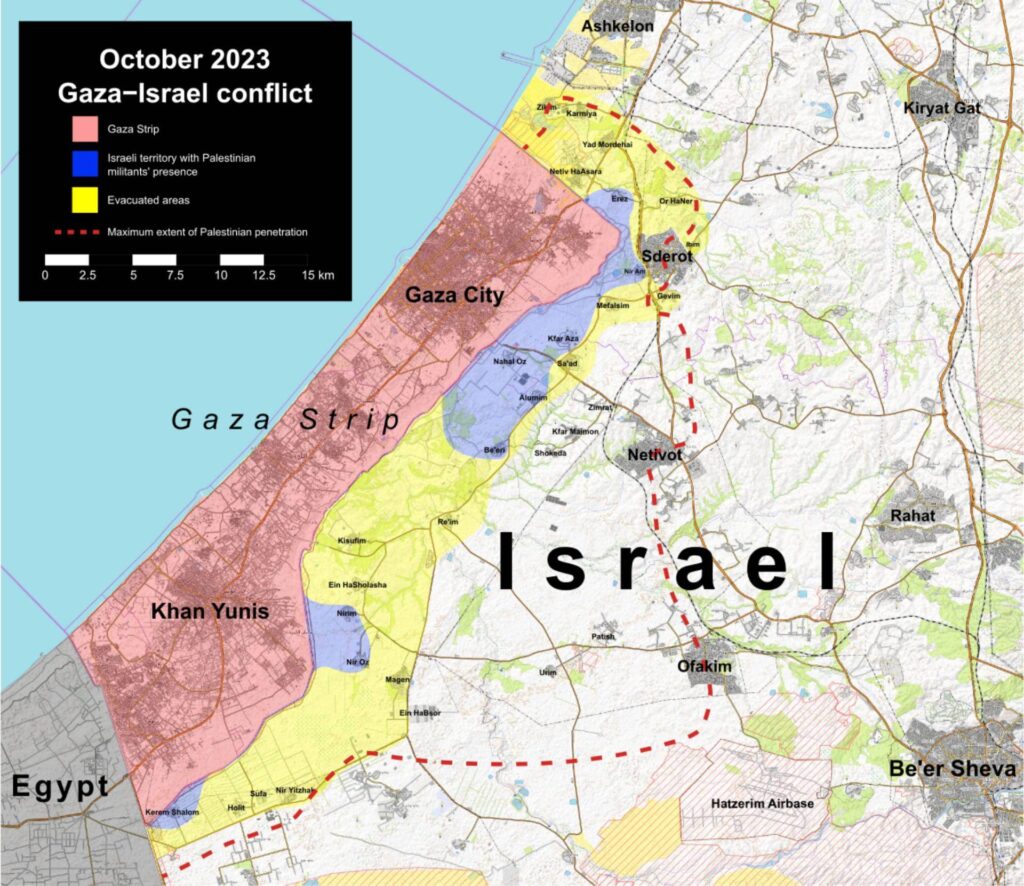
The first nine months of 2023 had already seen a rise in deadly violence in the West Bank and East Jerusalem, as well as terrorist attacks within Israel’s borders. Then came the Hamas attack on October 7, in which at least 1,145 Israelis were massacred and 253 kidnapped and taken to Gaza. More than 30 hostages are now confirmed dead.
No matter how the war in Gaza ends, what happens in its aftermath, or when Netanyahu’s term finally ends, the prime minister will forever be associated above all with that day and the disastrous war that followed. He will go down as the worst prime minister because he has been catastrophic for Israeli security.
To understand how Netanyahu so drastically failed Israel’s security requires going back at least to 2015, the year his long-term strategic bungling of the Iranian threat came into view. His mishandling didn’t happen in isolation; it is also related to the deprioritization of other threats, including the catastrophe that materialized on October 7.
Netanyahu flew to Washington, D.C., in 2015 to implore U.S. lawmakers to obstruct President Barack Obama’s nuclear deal with Iran. Many view this gambit as extraordinarily damaging to Israel’s most crucial alliance—the relationship with the United States is the very bulwark of its security. Perhaps so; but the stunt didn’t make subsequent U.S. administrations less supportive of Israel. Even Obama would still go on to sign the largest 10-year package of military aid to Israel the year after Netanyahu’s speech. Rather, the damage Netanyahu caused by presuming too much of the United States wasn’t to the relationship, but to Israel itself.
Netanyahu’s strategy regarding Iran was based on his assumption that America would one day launch an attack on Iran’s nuclear program. We know this from his 2022 book, Bibi: My Story, in which he admits to arguing repeatedly with Obama “for an American strike on Iran’s nuclear facilities.” Senior Israeli officials have confirmed that he expected Donald Trump to launch such a strike as well. In fact, Netanyahu was so sure that Trump, unlike Obama, would give the order that he had no strategy in place for dealing with Iran’s nuclear program when Trump decided, at Netanyahu’s own urging, to withdraw from the Iran deal in May 2018.
Israel’s military and intelligence chiefs had been far from enamored with the Iran deal, but they’d seized the opportunity it presented to divert some of the intelligence resources that had been focused on Iran’s nuclear program to other threats, particularly Tehran’s network of proxies across the region. They were caught by surprise when the Trump administration ditched the Iran deal (Netanyahu knew it was coming but didn’t inform them). This unilateral withdrawal effectively removed the limitations on Iran’s nuclear development and required an abrupt reversal of Israeli priorities.
Senior Israeli officials I spoke with had to tread a wary path here. Those who were still in active service couldn’t challenge the prime minister’s strategy directly. But in private some were scathing about the lack of a coherent strategy on Iran. “It takes years to build intelligence capabilities. You can’t just change target priorities overnight,” one told me.
[Read: A shocked and frazzled collective mind]
The result was a dissipation of Israeli efforts to stop Iran—which is committed to the destruction of Israel. Iran sped further than ever down the path of uranium enrichment, and its proxies, including the Houthis in Yemen and Hezbollah on Israel’s northern border, grew ever more powerful.
In the months leading up to October 7, Israel’s intelligence community repeatedly warned Netanyahu that Iran and its proxies were plotting a major attack within Israel, though few envisaged something on the scale of October 7. By the fall of 2023, motives were legion: fear that an imminent Israeli diplomatic breakthrough with Saudi Arabia could change the geopolitics of the region; threats that Ben-Gvir would allow Jews greater access to the al-Aqsa Mosque in Jerusalem and worsen conditions for Palestinian prisoners; rumors that the deepening tensions within Israeli society would render any response to an attack slow and disjointed.
Netanyahu chose to ignore the warnings. The senior officers and intelligence chiefs who issued them were, to his mind, conspiring with the law-enforcement agencies and legal establishment that had put him on trial and were trying to obstruct his government’s legislation. None of them had his experience and knowledge of the real threats facing Israel. Hadn’t he been right in the past when he’d refused to listen to leftist officials and so-called experts?
Hamas’s surprise attack on October 7 was the result of a colossal failure at all levels of Israel’s security and intelligence community. They had all seen the warning signals but continued to believe that the main threat came from Hezbollah, the larger and far better-equipped and trained enemy to the north. Israel’s security establishment believed that Hamas was isolated in Gaza, and that it and the other Palestinian organizations had been effectively deterred from attacking Israel.
Netanyahu was the originator of this assumption, and its biggest proponent. He believed that keeping Hamas in power in Gaza, as it had been for nearly two years when he returned to office in 2009, was in Israel’s interest. Periodic rocket attacks on Israeli communities in the south were a price worth paying to keep the Palestinian movement split between the Fatah-dominated Palestinian Authority in the West Bank enclaves and Hamas in Gaza. Such division would push the troublesome two-state solution off the global agenda and allow Israel to focus on regional alliances with like-minded Arab autocracies that also feared Iran. The Palestinian issue would sink into irrelevance.
Netanyahu’s disastrous strategy regarding Gaza and Hamas is part of what makes him Israel’s worst prime minister, but it’s not the only factor. Previous Israeli prime ministers, too, blundered into bloody wars on the basis of misguided strategies and faulty advice from their military and intelligence advisers.
Netanyahu stands out from them for his refusal to accept responsibility, and for his political machinations and smear campaigns since October 7. He blames IDF generals and nourishes the conspiracy theory that they, in alliance with the protest movement, somehow allowed October 7 to happen.
[Hillary Rodham Clinton: Hamas must go]
Netanyahu believes that he is the ultimate victim of that tragic day. Convinced by his own campaign slogans, he argues that he is the only one who can deliver Israel from this valley of shadows to the sunlit uplands of “total victory.” He refuses to consider any advice about ending the war and continues to prioritize preserving his coalition, because he appears incapable of distinguishing between his own fate, now tainted by tragic failure, and that of Israel.
Many around the world assume that Israel’s war with Hamas has proceeded according to some plan of Netanyahu’s. This is a mistake. Netanyahu has the last word as prime minister and head of the emergency war cabinet, but he has used his power mainly to prevaricate, procrastinate, and obstruct. He delayed the initial ground offensive into Gaza, hesitated for weeks over the first truce and hostage-release agreement in November, and is now doing the same over another such deal with Hamas. For the past six months, he has prevented any meaningful cabinet discussion of Israel’s strategic goals. He has rejected the proposals of his own security establishment and the Biden administration. He presented vague principles for “the day after Hamas” to the cabinet only in late February, and they have yet to be debated.
However one views the war in Gaza—as a justified war of defense in which Hamas is responsible for the civilian casualties it has cynically hidden behind, or as an intentional genocide of the Palestinian people, or as anything in between—none of it is Netanyahu’s plan. That’s because Netanyahu has no plan for Gaza, only one for remaining in power. His obstructionism, his showdowns with generals, his confrontations with the Biden administration—all are focused on that end, which means preserving his far-right coalition and playing to his hard-core nationalist base.
Meanwhile, he’s doing what he has always done: wearing down and discrediting his political opponents in the hope of proving to an exhausted and traumatized public that he’s the only alternative. So far, he’s failing. Polls show that an overwhelming majority of Israelis want him gone. But Netanyahu is fending off calls to hold an early election until he believes he is within striking distance of winning.
Netanyahu’s ambition has consumed both him and Israel. To regain and remain in office, he has sacrificed his own authority and parceled out power to the most extreme politicians. Since his reelection in 2022, Netanyahu is no longer the center of power but a vacuum, a black hole that has engulfed all of Israel’s political energy. His weakness has given the far right and religious fundamentalists extraordinary control over Israel’s affairs, while other segments of the population are left to pursue the never-ending quest to end his reign.
One man’s pursuit of power has diverted Israel from confronting its most urgent priorities: the threat from Iran, the conflict with the Palestinians, the desire to nurture a Westernized society and economy in the most contested corner of the Middle East, the internal contradictions between democracy and religion, the clash between tribal phobias and high-tech hopes. Netanyahu’s obsession with his own destiny as Israel’s protector has caused his country grievous damage.
Most Israelis already realize that Netanyahu is the worst of the 14 prime ministers their country has had in its 76 years of independence. But in the future, Jews might even remember him as the leader who inflicted the most harm on his people since the squabbling Hasmonean kings brought civil war and Roman occupation to Judea nearly 21 centuries ago. As long as he remains in power, he could yet surpass them.