
Month: March 2024
“Ущерб нанесен огромный. И судя по всему ущерб этот будет продолжаться, потому что для украинцев направить на НПЗ не очень дорогой дрон и вывести его из строя, это большая победа, достигнутая очень малыми средствами”. Удары дронов по нефтеперерабатывающим заводам в России, по мнению экспертов, оказались чувствительны для российской экономики.
“The gangs control so much of the city that large areas are just simply no go. You just can’t go there. If you did, you would either be robbed or killed if you attempted to get there without permission.”
Stig Abell speaks to Sky News’s Stuart Ramsay, one of the only foreign journalists in Haiti. He tells #TimesRadio that Haiti’s most powerful gang leader, known as Barbecue, has ambitions for a “gang coalition” to run the country.
📻 Listen to Times Radio – https://www.thetimes.co.uk/radio
📍 Subscribe to our channel – http://www.youtube.com/channel/UCTjDhFuGXlhx9Us0gq0VK2w?sub_confirmation=1
🗞 Subscribe to The Times https://www.thetimes.co.uk/subscribe/radio-3for3/
📲 Get the free Times Radio app https://www.thetimes.co.uk/radio/how-to-listen-to-times-radio/app
Empires don’t just fall like toppled trees. Instead, they weaken slowly as a succession of crises drain their strength and confidence until they suddenly begin to disintegrate. So it was with the British, French and Soviet empires; so it now is with imperial America.
Great Britain confronted serious colonial crises in India, Iran and Palestine before plunging headlong into the Suez Canal and imperial collapse in 1956. In the later years of the Cold War, the Soviet Union faced its own challenges in Czechoslovakia, Egypt and Ethiopia before crashing into a brick wall in its war in Afghanistan.
America’s post-Cold War victory lap suffered its own crisis early in this century with disastrous invasions of Afghanistan and Iraq. Now, looming just over history’s horizon are three more imperial crises in Gaza, Taiwan and Ukraine that could cumulatively turn a slow imperial recessional into an all-too-rapid decline, if not collapse.
As a start, let’s put the very idea of an imperial crisis in perspective. The history of every empire, ancient or modern, has always involved a succession of crises — usually mastered in the empire’s earlier years, only to be ever more disastrously mishandled in its era of decline. Right after World War II, when the United States became history’s most powerful empire, Washington’s leaders skillfully handled just such crises in Greece, Berlin, Italy and France, and somewhat less skillfully but not disastrously in a Korean War that never quite officially ended.
Even after the dual disasters of a bungled covert invasion of Cuba in 1961 and a conventional war in Vietnam that went all too disastrously awry in the 1960s and early 1970s, Washington proved capable of recalibrating effectively enough to outlast the Soviet Union, “win” the Cold War and become the “lone superpower” on this planet.
In both success and failure, crisis management usually entails a delicate balance between domestic politics and global geopolitics. President John F. Kennedy’s White House, manipulated by the CIA into the disastrous 1961 Bay of Pigs invasion of Cuba, managed to recover its political balance sufficiently to check the Pentagon and achieve a diplomatic resolution of the dangerous 1962 Cuban missile crisis with the Soviet Union.
America’s current plight, however, can be traced at least in part to a growing imbalance between a domestic politics that appears to be coming apart at the seams and a series of challenging global upheavals. Whether in Gaza, Ukraine or even Taiwan, the Washington of President Joe Biden is clearly failing to align domestic political constituencies with the empire’s international interests. And in each case, crisis mismanagement has only been compounded by errors that have accumulated in the decades since the Cold War’s end, turning each crisis into a conundrum without an easy resolution or perhaps any resolution at all. Both individually and collectively, then, the mishandling of these crises is likely to prove a significant marker of America’s ultimate decline as a global power, both at home and abroad.
Creeping disaster in Ukraine
Since the closing months of the Cold War, mismanaging relations with Ukraine has been a curiously bipartisan project. As the Soviet Union began breaking up in 1991, Washington focused on ensuring that Moscow’s arsenal of possibly 45,000 nuclear warheads was secure, particularly the 5,000 atomic weapons then stored in Ukraine, which also had the largest Soviet nuclear weapons plant at Dnipropetrovsk.
During an August 1991 visit, President George H.W. Bush told Ukrainian Prime Minister Leonid Kravchuk that he could not support Ukraine’s future independence and gave what became known as his “chicken Kiev” speech, saying: “Americans will not support those who seek independence in order to replace a far-off tyranny with a local despotism. They will not aid those who promote a suicidal nationalism based upon ethnic hatred.” He would, however, soon recognize Latvia, Lithuania and Estonia as independent states since they didn’t have nuclear weapons.
When the Soviet Union finally imploded in December 1991, Ukraine instantly became the world’s third-largest nuclear power, though it had no way to actually deliver most of those atomic weapons. To persuade Ukraine to transfer its nuclear warheads to Moscow, Washington launched three years of multilateral negotiations, while giving Kyiv “assurances” (but not “guarantees”) of its future security — the diplomatic equivalent of a personal check drawn on a bank account with a zero balance.
Under the Budapest Memorandum on Security in December 1994, three former Soviet republics — Belarus, Kazakhstan and Ukraine — signed the Nuclear Non-Proliferation Treaty and started transferring their atomic weapons to Russia. Simultaneously, Russia, the US and Great Britain agreed to respect the sovereignty of the three signatories and refrain from using such weaponry against them. Everyone present, however, seemed to understand that the agreement was, at best, tenuous. (One Ukrainian diplomat told the Americans that he had “no illusions that the Russians would live up to the agreements they signed.”)
Meanwhile — and this should sound familiar today — Russian President Boris Yeltsin raged against Washington’s plans to expand NATO further, accusing President Bill Clinton of moving from a Cold War to a “cold peace.” Right after that conference, Defense Secretary William Perry warned Clinton, point blank, that “a wounded Moscow would lash out in response to NATO expansion.”
Nonetheless, once those former Soviet republics were safely disarmed of their nuclear weapons, Clinton agreed to begin admitting new members to NATO, launching a relentless eastward march toward Russia that continued under his successor George W. Bush. It came to include three former Soviet satellites: the Czech Republic Hungary, and Poland (1999); three former Soviet Republics: Estonia Latvia, and Lithuania (2004); and then three more former satellites: Romania, Slovakia and Slovenia (2004). At the Bucharest summit in 2008, moreover, the alliance’s 26 members unanimously agreed that, at some unspecified point, Ukraine and Georgia, too, would “become members of NATO.” In other words, having pushed NATO right up to the Ukrainian border, Washington seemed oblivious to the possibility that Russia might feel in any way threatened and react by annexing that nation to create its own security corridor.
In those years, Washington also came to believe that it could transform Russia into a functioning democracy to be fully integrated into a still-developing American world order. Yet for more than 200 years, Russia’s governance had been autocratic, and every ruler from Catherine the Great to Leonid Brezhnev achieved domestic stability through incessant foreign expansion. So, it should hardly have been surprising when the seemingly endless expansion of NATO led Russia’s latest autocrat, Vladimir Putin, to invade the Crimean Peninsula in March 2014, only weeks after hosting the Winter Olympics.
In an interview soon after Moscow annexed that area of Ukraine, US President Barack Obama recognized the geopolitical reality that could yet consign all of that land to Russia’s orbit, saying: “The fact is that Ukraine, which is a non-NATO country, is going to be vulnerable to military domination by Russia no matter what we do.”
Then, in February 2022, after years of low-intensity fighting in the Donbass region of eastern Ukraine, Putin sent 200,000 mechanized troops to capture the country’s capital, Kyiv, and establish that very “military domination.” At first, as the Ukrainians surprisingly fought off the Russians, Washington and the West reacted with a striking resolve — cutting Europe’s energy imports from Russia, imposing serious sanctions on Moscow, expanding NATO to all of Scandinavia and dispatching an impressive arsenal of armaments to Ukraine.
After two years of never-ending war, however, cracks have appeared in the anti-Russian coalition, indicating that Washington’s global clout has declined markedly since its Cold War glory days. After 30 years of free-market growth, Russia’s resilient economy has weathered sanctions, its oil exports have found new markets, and its gross domestic product is projected to grow a healthy 2.6% this year. In last spring and summer’s fighting season, a Ukrainian “counteroffensive” failed and the war is, in the view of both Russian and Ukrainian commanders, at least “stalemated,” if not now beginning to turn in Russia’s favor.
Related Reading

Most critically, US support for Ukraine is faltering. After successfully rallying the NATO alliance to stand with Ukraine, the Biden White House opened the American arsenal to provide Kyiv with a stunning array of weaponry, totaling $46 billion, that gave its smaller army a technological edge on the battlefield. But now, in a move with historic implications, part of the Republican (or rather Trumpublican) Party has broken with the bipartisan foreign policy that sustained American global power since the Cold War began. For weeks, the Republican-led House has even repeatedly refused to consider President Biden’s latest $60 billion aid package for Ukraine, contributing to Kyiv’s recent reverses on the battlefield.
The Republican Party’s rupture starts with its leader. In the view of former White House adviser Fiona Hill, Donald Trump was so painfully deferential to Vladimir Putin during “the now legendarily disastrous press conference” at Helsinki in 2018 that critics were convinced “the Kremlin held sway over the American president.” But the problem goes so much deeper. As The New York Times columnist David Brooks noted recently, the Republican Party’s historic “isolationism is still on the march.” Indeed, between March 2022 and December 2023, the Pew Research Center found that the percentage of Republicans who think the US gives “too much support” to Ukraine climbed from just 9% to a whopping 48%. Asked to explain the trend, Brooks feels that “Trumpian populism does represent some very legitimate values: the fear of imperial overreach… [and] the need to protect working-class wages from the pressures of globalization.”
Since Trump represents this deeper trend, his hostility toward NATO has taken on an added significance. His recent remarks that he would encourage Russia to “do whatever the hell they want” to a NATO ally that didn’t pay its fair share sent shockwaves across Europe, forcing key allies to consider what such an alliance would be like without the United States (even as Russian President Vladimir Putin, undoubtedly sensing a weakening of US resolve, threatened Europe with nuclear war). All of this is certainly signaling to the world that Washington’s global leadership is now anything but a certainty.
Crisis in Gaza
Just as in Ukraine, decades of diffident American leadership, compounded by increasingly chaotic domestic politics, let the Gaza crisis spin out of control. At the close of the Cold War, when the Middle East was momentarily disentangled from great-power politics, Israel and the Palestine Liberation Organization signed the 1993 Oslo Accord. In it, they agreed to create the Palestinian Authority as the first step toward a two-state solution. For the next two decades, however, Washington’s ineffectual initiatives failed to break the deadlock between that Authority and successive Israeli governments that prevented any progress toward such a solution.
In 2005, Israel’s hawkish Prime Minister Ariel Sharon decided to withdraw his defense forces and 25 Israeli settlements from the Gaza Strip with the aim of improving “Israel’s security and international status.” Within two years, however, Hamas militants had seized power in Gaza, ousting the Palestinian Authority under President Mahmoud Abbas. In 2009, the controversial Benjamin Netanyahu started his nearly continuous 15-year stretch as Israel’s prime minister and soon discovered the utility of supporting Hamas as a political foil to block the two-state solution he so abhorred.
Not surprisingly then, the day after last year’s tragic October 7 Hamas attack, theTimes of Israel published this headline: “For Years Netanyahu Propped Up Hamas. Now It’s Blown Up in Our Faces.” In her lead piece, senior political correspondent Tal Schneider reported: “For years, the various governments led by Benjamin Netanyahu took an approach that divided power between the Gaza Strip and the West Bank — bringing Palestinian Authority President Mahmoud Abbas to his knees while making moves that propped up the Hamas terror group.”
Related Reading

On October 18, with the Israeli bombing of Gaza already inflicting severe casualties on Palestinian civilians, President Biden flew to Tel Aviv for a meeting with Netanyahu that would prove eerily reminiscent of Trump’s Helsinki press conference with Putin. After Netanyahu praised the president for drawing “a clear line between the forces of civilization and the forces of barbarism,” Biden endorsed that Manichean view by condemning Hamas for “evils and atrocities that make ISIS look somewhat more rational” and promised to provide the weaponry Israel needed “as they respond to these attacks.” Biden said nothing about Netanyahu’s previous arm’s length alliance with Hamas or the two-state solution. Instead, the Biden White House began vetoing ceasefire proposals at the U.N. while air-freighting, among other weaponry, 15,000 bombs to Israel, including the behemoth 2,000-pound “bunker busters” that were soon flattening Gaza’s high-rise buildings with increasingly heavy civilian casualties.
After five months of arms shipments to Israel, three U.N. ceasefire vetoes, and nothing to stop Netanyahu’s plan for an endless occupation of Gaza instead of a two-state solution, Biden has damaged American diplomatic leadership in the Middle East and much of the world. In November and again in February, massive crowds calling for peace in Gaza marched in Berlin, London, Madrid, Milan, Paris, Istanbul, and Dakar, among other places.
Moreover, the relentless rise in civilian deaths well past 30,000 in Gaza, striking numbers of them children, has already weakened Biden’s domestic support in constituencies that were critical for his win in 2020 — including Arab-Americans in the key swing state of Michigan, African-Americans nationwide, and younger voters more generally. To heal the breach, Biden is now becoming desperate for a negotiated cease-fire. In an inept intertwining of international and domestic politics, the president has given Netanyahu, a natural ally of Donald Trump, the opportunity for an October surprise of more devastation in Gaza that could rip the Democratic coalition apart and thereby increase the chances of a Trump win in November — with fatal consequences for US global power.
Trouble in the Taiwan Strait
While Washington is preoccupied with Gaza and Ukraine, it may also be at the threshold of a serious crisis in the Taiwan Straits. Beijing’s relentless pressure on the island of Taiwan continues unabated. Following the incremental strategy that it’s used since 2014 to secure a half-dozen military bases in the South China Sea, Beijing is moving to slowly strangle Taiwan’s sovereignty. Its breaches of the island’s airspace have increased from 400 in 2020 to 1,700 in 2023. Similarly, Chinese warships have crossed the median line in the Taiwan Straits 300 times since August 2022, effectively erasing it. As commentator Ben Lewis warned, “There soon may be no lines left for China to cross.”
After recognizing Beijing as “the sole legal Government of China” in 1979, Washington agreed to “acknowledge” that Taiwan was part of China. At the same time, however, Congress passed the Taiwan Relations Act of 1979, requiring “that the United States maintain the capacity to resist any resort to force… that would jeopardize the security… of the people on Taiwan.”
Related Reading
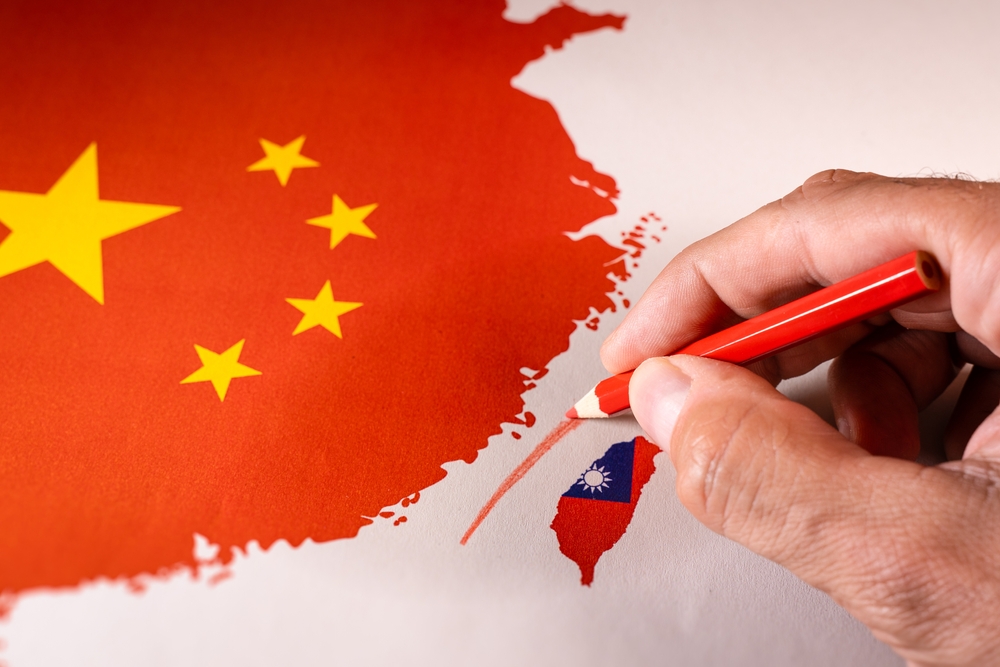
Such all-American ambiguity seemed manageable until October 2022 when Chinese President Xi Jinping told the 20th Communist Party Congress that “reunification must be realized” and refused “to renounce the use of force” against Taiwan. In a fateful counterpoint, President Biden stated, as recently as September 2022, that the US would defend Taiwan “if in fact there was an unprecedented attack.”
But Beijing could cripple Taiwan several steps short of that “unprecedented attack” by turning those air and sea transgressions into a customs quarantine that would peacefully divert all Taiwan-bound cargo to mainland China. With the island’s major ports at Taipei and Kaohsiung facing the Taiwan Straits, any American warships trying to break that embargo would face a lethal swarm of nuclear submarines, jet aircraft, and ship-killing missiles.
Given the near-certain loss of two or three aircraft carriers, the US Navy would likely back off and Taiwan would be forced to negotiate the terms of its reunification with Beijing. Such a humiliating reversal would send a clear signal that, after 80 years, American dominion over the Pacific had finally ended, inflicting another major blow to US global hegemony.
Make Sense of the World
Unique Insights from 2,500+ Contributors in 90+ Countries
I agree to receive emails and other content from Fair Observer. I understand that I may repeal my consent at any time. You can review our Privacy Policy and Terms of Use for further information…
Washington now finds itself facing three complex global crises, each demanding its undivided attention. Any one of them would challenge the skills of even the most seasoned diplomat. Their simultaneity places the US in the unenviable position of potential reverses in all three at once, even as its politics at home threaten to head into an era of chaos. Playing upon American domestic divisions, the protagonists in Beijing, Moscow, and Tel Aviv are all holding a long hand (or at least a potentially longer one than Washington’s) and hoping to win by default when the US tires of the game. As the incumbent, President Biden must bear the burden of any reversal, with the consequent political damage this November.
Meanwhile, waiting in the wings, Donald Trump may try to escape such foreign entanglements and their political cost by reverting to the Republican Party’s historic isolationism, even as he ensures that the former lone superpower of Planet Earth could come apart at the seams in the wake of election 2024. If so, in such a distinctly quagmire world, American global hegemony would fade with surprising speed, soon becoming little more than a distant memory.
[TomDispatch first published this piece.]
The views expressed in this article are the author’s own and do not necessarily reflect Fair Observer’s editorial policy.
The post Is the American Empire Now in its Ultimate Crisis? appeared first on Fair Observer.
Remarkable how poorly the Kremlin fails to develop a narrative about the Crocus City Hall massacre. They try to blame Ukraine, the US & the UK without any evidence whatsoever, while they don’t explain at all how their security could have failed so totally.
A lot is wrong here.— Anders Åslund (@anders_aslund) March 27, 2024
Surfside condo collapse investigators provide key insights into possible causes of the disaster. Here are the top takeaways https://t.co/WPXA3RDV6H via @YahooNewsAU
— Michael Novakhov (@mikenov) March 27, 2024

Federal investigators on Thursday shared updates on their probe into the cause of the catastrophic 2021 condominium collapse in Surfside, Florida, providing key insights into the factors that may have led to the deaths of 98 people under a mountain of rubble.
Investigators have identified hundreds of possible points of failure in the building, eventually narrowing down about two dozen hypotheses of what could have triggered the collapse, officials with the National Institute of Standards and Technology said in a presentation on their progress.
The probe has revealed that the building’s swimming pool deck – located at ground level above an underground parking garage – collapsed at least four minutes before the rest of the building, confirming earlier witness reports. Potential structural failures in the pool deck or columns supporting the tower are among the top issues now being looked at as teams probe the cause of the disaster, investigators said.
Part of the Champlain Towers South building crumbled to the ground in the pre-dawn hours of June 24, 2021, turning what was formerly a thriving residential building into a devastating scene as residents became crushed or trapped under a massive pile of twisted metal and concrete.
It took about a month for search and recovery crews to find and identify all 98 victims, who ranged in age from 1 to 92 years old. The tragedy affected families all over the world, including in Argentina, Paraguay and Colombia. In some cases, entire families were killed.
The tragedy may have been decades in the making. Investigators have determined Champlain Towers’ integrity had likely been compromised when it was being built in the 1970s, noting that the design and construction of some parts didn’t meet standard building code requirements at the time.
“It becomes clear that the design and construction did not meet all the safety standards of its day,” Surfside Commissioner Marianne Meischeid told CNN following the release of the preliminary report. “I would be most interested in knowing if this was a very isolated defect, or was it common to a particular era of development?”
But the search for answers is far from over, as investigators must continue to meticulously examine the evidence and rule out the long list of possible scenarios. Their final findings are expected to be released in a report next year.
The agency investigates major building failures and disasters – including that of the World Trade Center on 911 – but does not determine criminal culpability. Instead, it can recommend changes to building codes to improve future safety standards.
Surfside Mayor Shlomo Danzinger told CNN the findings are “a poignant reminder of the imperative need for proactive measures and continuous maintenance in the realm of condominium safety.”
“The tragic incident in Surfside, has brought into sharp focus the potential consequences of neglecting these crucial aspects, and underscores the call for a proactive stance in the realm of condominium safety,” Danzinger added.
Here are the key takeaways from Thursday’s investigation update.
Parts of original building weren’t up to code, investigators say
When construction of Champlain Towers finished in 1981, parts of its structural design didn’t meet the required building code, particularly in the pool deck and tower columns, investigators said in their presentation.
“We’ve discovered several places where the construction did not meet the requirements of the drawings, the building code or common practice,” said James Harris, one of the probe’s project leaders.
Deficiencies were found in the building’s steel reinforcement placements, concrete alignment and strength of the columns and floor concrete, according to the presentation. Officials noted several areas of the pool deck had “severe” strength deficiencies.
In the months leading up to the collapse, the building was also facing major structural repairs. Condo association president Jean Wodnicki described some of the issues in a letter to homeowners in April 2021, noting that the “concrete deterioration is accelerating.”
At the time of the collapse, the condo association had approved an assessment that detailed $15 million worth of repairs – a process they began more than two years after receiving a report about “major structural damage” in the building, CNN has reported.
Search and rescue personnel work after the partial collapse of the Champlain Towers South condo building on June 24, 2021 in Surfside, Florida. – Joe Raedle/Getty Images
Pool deck buckles minutes before tower collapse
Before the chaos erupted, one resident reported being woken up by a family member concerned about “metallic noises” reverberating in the building – and just moments later watched as the pool deck fell into the underground garage below it, said Emel Ganapati, who’s co-leading evidence collection efforts for the investigation.
The slab supporting the pool deck collapsed more than four minutes before the tower came crashing down, according to investigators. The connection between the slab and its support columns may have failed, causing the slab to drop into the garage, they said.
“There were indications of severe distress in the pool deck at least three weeks before the collapse,” investigators said in the presentation.
Residents had reported hearing “knocking” and “hammering” sounds leading up to the incident that may indicate the slab’s reinforcement had fractured, it said. Evidence also revealed the slab had been sagging, exposed to water and corroded in some areas.
Over time, the landscaping planters decorating the pool deck had also become weighed down with more filling and paving than originally designed, increasing the weight load on the slab, according to the presentation.
Together, all of these deficiencies created “critically low margins against failure” at the time of the collapse, it said.
Still, investigators noted, “while there is strong evidence that the collapse initiated in the pool deck, we have not yet ruled out a failure initiation in some part of the tower” that may have occurred before the pool deck collapse.
Failure of tower’s columns is also a possibility
Investigators said they have identified several scenarios in which the columns supporting the tower’s southern edge could have failed, forcing their load to be distributed elsewhere and triggering the collapse.
Signs of imminent disaster can be seen in video footage which shows “severe structural movements” in the tower before the drop, and roaring and rumbling sounds could be heard in one of the upper story corridors before the floor started to sag and warp, according to investigators.
The initial structure failures that caused the eastern part of the collapse likely happened below the third floor, investigators said, noting that video footage shows the facade of the building moving “uniformly downward” during the fall.
The tower columns could have been compromised in several ways, including corrosion, water exposure and poor installation, the presentation noted.
Dozens of hypotheses still remain
Search and rescue teams look for possible survivors and remains in the partially collapsed Champlain Towers South condo building on June 30, 2021 in Surfside, Florida. – Michael Reaves/Getty Images
Though investigators said they have identified strong evidence to support the most likely causes of the collapse, they must still meticulously rule out dozens of other hypotheses through extensive evidence analysis and testing.
Among the other possible – but less likely – causes are that the foundation settled unevenly or was build on topography that developed sinkholes or other weaknesses, officials said.
Once the probe is complete, the National Institute of Standards and Technology plans to release a multi-volume final report on its findings as well as an online presentation tailored to the public by fall 2025, it said.
“There are millions of high-rise condominium units in Florida alone, many of them aging structures near the ocean,” its website says. “While a NIST investigation is intended to identify the cause of the Champlain Towers South collapse, it could also uncover potential issues in other similar buildings nearby and throughout the nation.”
The report may also bring much-needed answers to victims’ families, who have seen safety legislation and hefty legal settlements but have been waiting years for clarity on why the tragedy happened in the first place.
CNN’s Jamiel Lynch, Nouran Salahieh and Joe Sutton contributed to this report.
For more CNN news and newsletters create an account at CNN.com
Surfside condo collapse investigators provide key insights into possible causes of the disaster. Here are the top … Yahoo News Australia
The post Surfside condo collapse investigators provide key insights into possible causes of the disaster. Here are the top … – Yahoo News Australia first appeared on The Condo Law.