Honored to receive @CommonSense‘s Champion for Kids Award for our nation-leading legislation to protect kids from addictive social media algorithms.
Our work isn’t done. Smartphones are distracting kids in the classroom, and we’re ready to confront this challenge head-on. pic.twitter.com/uhB3KN3Zwv
— Governor Kathy Hochul (@GovKathyHochul) September 18, 2024
Day: September 18, 2024
Spooky season is upon us, and so is the Brooklyn Horror Film Festival — almost.
The eight-day festival is set to return to Kings County on Oct. 17 with a frightening slate of films and events, all hosted at Nitehawk Cinema’s theaters in Williamsburg and Prospect Park.
The festival is bookended with a pair of chilling new movies. Indie comedy-horror “Dead Mail” will make its New York debut on opening night, and “The Rule of Jenny Pen,” starring period drama favorites John Lithgow and Geoffrey Rush, will close the festival out.
But the thrills will continue all week long. The lineup is packed with new films like Tiago Teixeira’s “Custom,” Sasha Rainbow’s “Grafted,” and Phillip Escott and Sarah Appleton’s new documentary “Generation Terror,” all making their North American debuts.

Another three horror flicks will make their world premieres at Brooklyn Horror Film Festival: “House of Ashes,” the first feature by director Izzy Lee; “Lilly Lives Alone,” an atmospheric ghost story; “Psychonaut,” a queer science fiction romp.
What’s old is new again as the festival celebrates an old scary movie favorite: vampires. The 1970s vampire classics “Vampyres” and “The Blood Spattered Bride” will be screened in 35mm, but perhaps the highlight of vampire programming is the Spanish version of “Dracula” with a live score by The Flushing Remonstrance. Stepping away from film, The Miskatonic Institute of Horror Studies will present a lecture by Dr. Leah Richards titled “Queer Vampires, Queer Liberation, Queer Futurity.”
Other festival highlights include the Turkish revenge flick “Sayara,” a screening of several episodes from the new horror anthology series “Tales from the Void,” and and a special presentation of prolific horror director Larry Fessenden’s 1995 vampire film “Habit,” followed by the presentation of the festival’s Leviathan Award and a Q&A with Fessenden and Jenn Wexler.
The Brooklyn Horror Film Festival runs from Oct. 17-24 in Williamsburg and South Slope. The full lineup and schedule of events is available online.
The City Council on Tuesday opened an ethics investigation into Brooklyn Council Member Susan Zhuang, who made headlines earlier this summer over her arrest for allegedly biting a cop during a protest against a new homeless shelter in her district.
City Council spokesperson Shirley Limongi confirmed the body’s Committee on Standards and Ethics launched the inquiry, first reported by the news site Gothamist, on Sept. 17. Limongi noted, however, that the matter is being “held in suspension” while Zhuang’s multiple charges from the Brooklyn District Attorney’s office play out in court.
“The committee opened the matter regarding Council Member Zhuang and has held it in suspension pending the resolution of the ongoing prosecution by the Brooklyn District Attorney, as it has in the past when a Council member was facing pending criminal charges,” Limongi said in a statement. “The committee will respect that process. The confidentiality rules that apply to the proceedings of the committee prevent further comment.”
However, another council spokesperson declined to confirm whether the ethics probe specifically concerns the alleged biting incident.
Oren Yaniv, a spokesperson for the Brooklyn DA’s office, told amNewYork Metro that the criminal case is still pending and Zhuang is expected back in court for a conference on Oct. 15. Zhuang previously pleaded not guilty to a litany of charges including assault, resisting arrest, obstructing government administration, unlawful assembly, disorderly conduct, and harassment.
The incident occurred on July 17, when Zhuang joined a protest at the site of a planned a homeless shelter slated to open in the Gravesend section of Brooklyn later this year.
The NYPD say Zhuang was arrested for allegedly preventing cops from reaching an elderly woman stuck under a barricade. Cops say she allegedly shoved the barricade against officers and bit one officer so hard it broke their skin when they tried to get her out of the way.
Zhuang — a conservative Democrat who won her seat on a fiercely pro-police platform — contends the cops were the aggressors and has accused them of excessive force. She insists that she was simply trying to remove the barricade that was on top of the elderly woman when two officers grabbed her from behind and handcuffed her, while pulling her hair and neck.
Shortly after Zhuang’s arrest, she held a town hall in her district, where hundreds of her constituents gathered to laud her actions against the homeless shelter.
After the July 17 incident, some pols — including City Council Member Justin Brannan (D), one of Zhuang’s southern Brooklyn political rivals — were quick to strongly condemn her actions.
Others, including Mayor Eric Adams, were far more measured in their responses, stopping far short of calling for her to be disciplined. Adams even invited Zhuang to a private meeting following her arrest — a level of grace that City Council Speaker Adrienne Adams charged probably would not have been shown to more left-leaning lawmakers.
Zhuang’s office did not immediately return a request for comment on the newly commenced ethics investigation.
With reporting by Kirstyn Brendlen.
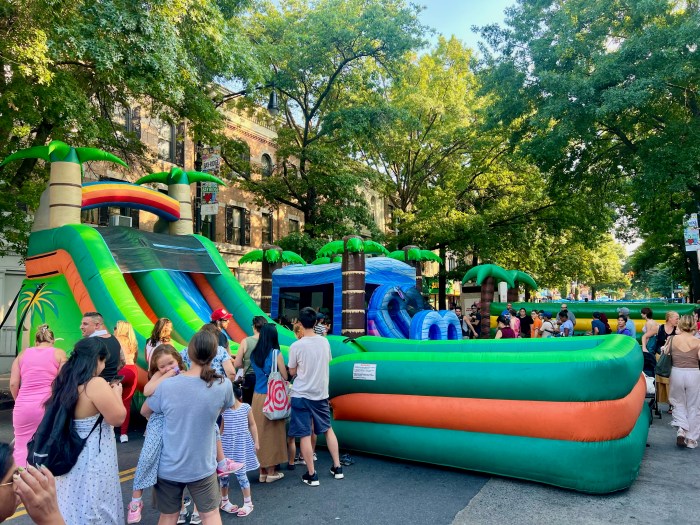
Bay Ridge residents gathered on familiar city streets over the weekend to bid farewell to another sweltering season at the End of Summer Block Party, hosted by the Fifth Avenue Business Improvement District.
The event drew families from across the neighborhood and brought the area to life with music, cheer, good food and shopping.
Elizabeth Lovejoy, executive director of the Bay Ridge Fifth Avenue BID, attributed the block party’s success to great weather and vibrant community spirit.

“The energy was incredible,” she told Brooklyn Paper. “We saw families, friends, and visitors from all over the neighborhood come together to enjoy live music, local food and fun activities.”
“The weather was on our side, and it felt like the perfect way to close out the summer season,” she added.
As attendees strolled the streets, Lovejoy said it was clear that the community’s spirits were high.
“We were really pleased with the turnout,” she said. “The avenue was bustling with activity.”
Children enjoyed festival games, while local musicians filled the air with captivating sounds, creating an unmistakable buzz that echoed throughout the neighborhood. Local creatives displayed their work during an art showcase. Merchants and eateries also enjoyed the spotlight and engaged with old and new customers alike.
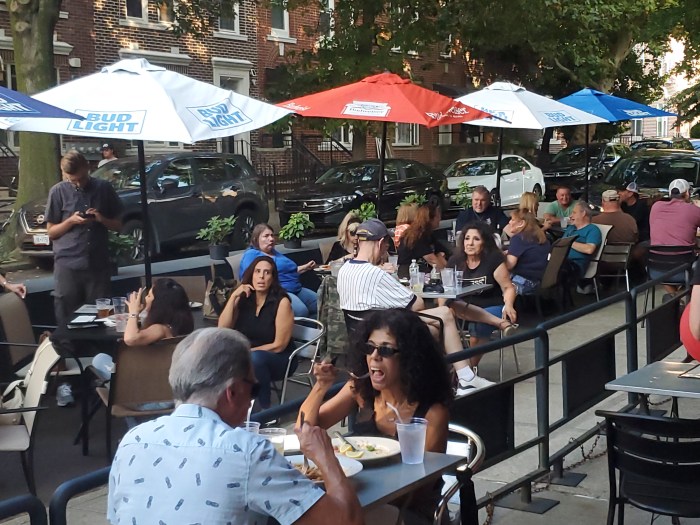
“This event brought new and existing customers to the avenue, increased foot traffic and provided local businesses with a platform to showcase what they offer,” Lovejoy said.
Although summer is ending, the BID says residents can look forward to more neighborhood events, including a Halloween Fest on Oct. 26.
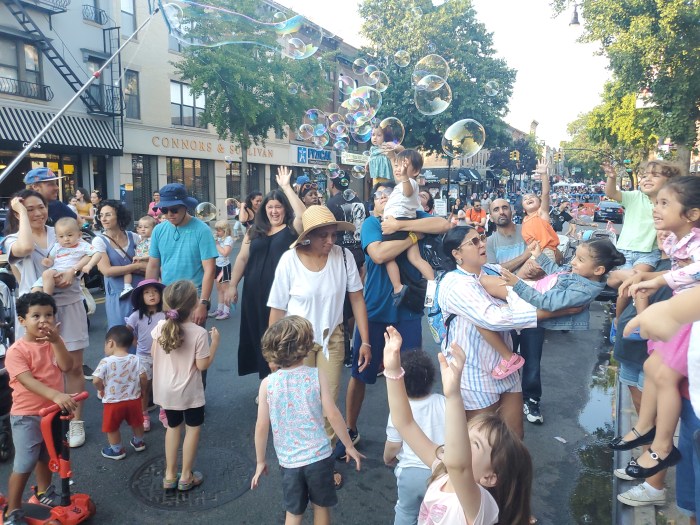
The Bay Ridge Fifth Avenue BID hosts events throughout the year to grow, promote, and improve the quality of life for the community and boost local businesses. Their activities include street festivals, public art walks, marketing workshops for business owners, and family-friendly events that connect merchants with potential customers.
“We’re already planning ahead for more events,” Lovejoy said. “We’re excited to keep the momentum going and continue creating vibrant experiences that bring the community together.”
The MTA released details of a $68.4 billion capital plan for 2025-2029 — even though how much of that plan will be paid for remains up in the air with Gov. Kathy Hochul’s ongoing pause of congestion pricing.
The plan, which represents a significant increase on the $54.8 billion capital plan for 2020-2024, proposes introducing a huge number of new railcars across the subway and commuter rail systems. It also aims to build at least 60 subway stations and six commuter rail stations, propose significant investment in signal modernization and fare gates, offer $9 billion in critical structure repairs, and offer another nearly $8 billion in station environment improvements.
The MTA board will vote on the capital plan on Sept. 25 before it is submitted to the State Capital Program Review Board on Oct. 1, as required by New York’s Public Authorities Law.
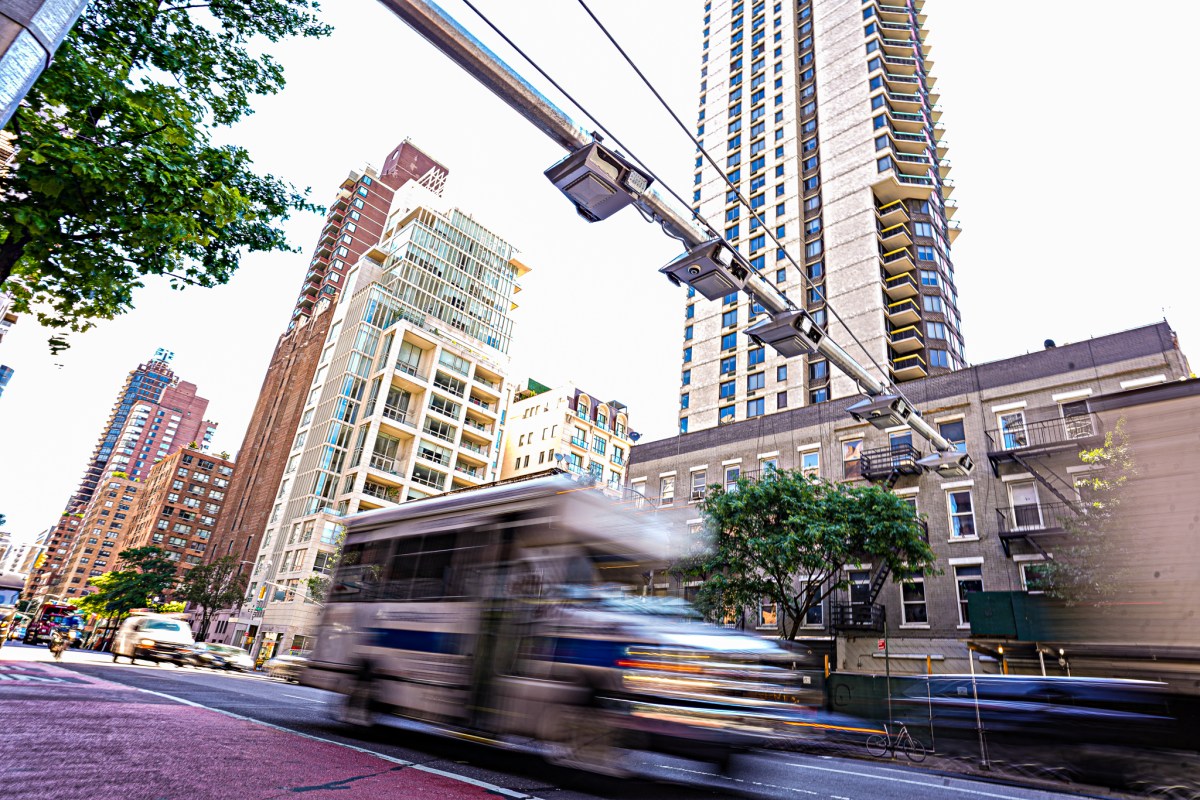
But that is only half the battle for the MTA; the other half comes in the form of funding. Hochul halted congestion pricing, which aims to reap $1 billion in funding every year for the MTA through tolls from drivers entering Manhattan, just weeks before it was scheduled to start on June 30.
Hochul’s decision immediately threw the MTA’s capital plans into uncertainty and blew open a $15 billion hole that needed to be filled. Despite the governor’s promises that alternative funding would be found, no such plans have yet been proposed from Albany.
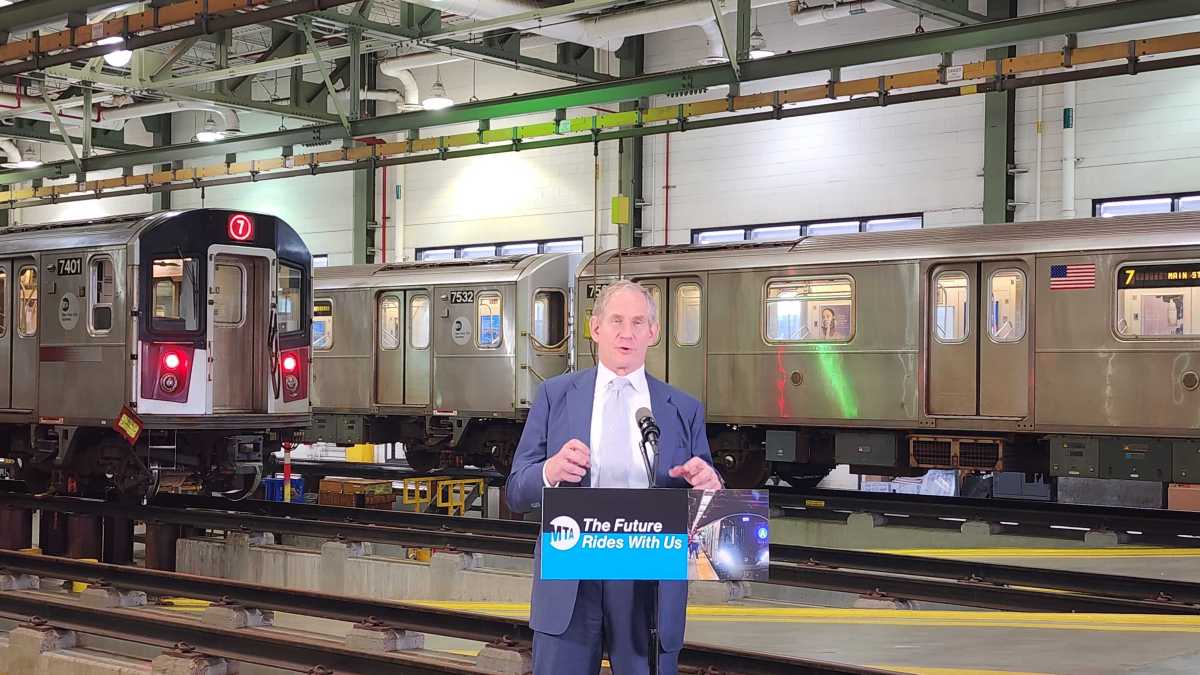
MTA Chief Financial Officer Kevin Willens said the authority would propose issuing $10 billion in MTA-issued bonds to help fund the 2025-2029 Capital Plan. He also said the MTA expects to receive around $21 billion from federal funding and state and city bonds but noted that the agency has not yet put forward specific numbers because funding sources have not been approved.
Even so, Willens added, the MTA is not proposing a complete funding package in the plan; rather, the agency was focusing on the projects and requirements it needs to address over the next five years.
Willens said there is currently a deficit of around $33 billion and acknowledged that the remainder of the funding sources need to be identified.
The MTA quoted a JP Morgan analysis that stated that annual capital expenditures ranging between $16 billion and $23 billion were required if the MTA was to match comparable peers. A separate independent review from the Office of the New York State Comptroller estimated that the total capital needed for the 2025-2029 plan ranged between $57.8 billion and $92.2 billion.
Inside the Capital Plan
The 2025-2029 Capital Plan draws on the MTA’s 20-Year Needs Assessment, a comprehensive blueprint published last year that outlines the MTA region’s transportation capital needs for the next generation.
Jamie Torres-Springer, President of MTA Construction & Development, said the MTA will order 2,000 new railcars at a cost of $10.9 billion over the next five years, including 1,500 new subway cars to replace the 1980s-era R62 and R68 fleets and 500 railroad cars to replace the remaining 1980s-era M3 fleets.
Torres-Springer said the introduction of new railcars will greatly improve reliability, with newer cars proving to be at least six times more reliable than cars 40 years old or older.
The MTA’s plan to introduce 60 ADA-compliant subway stations and six ADA-compliant railroad stations will cost an estimated $7.1 billion, according to the proposal.
Torres-Springer said the successful addition of 60 more ADA-compliant subway stations will make more than 50% of subway stations fully accessible, covering roughly 75% of all subway riders.
If completed, the capital plan will bring the total number of ADA-compliant subway stations across the city to 261. In 2022, a Manhattan judge approved a settlement in a class-action lawsuit that mandates that the MTA install elevators or ramps at 95% of its stations by 2055.
Signal modernization will cost an estimated $5.4 billion and include plans to replace the oldest and least reliable signals in the subway system. The capital plan outlines aims to upgrade more than 75 miles of subway signals, with a focus on the Broadway N, Q, R, W line, the Liberty and Rockaway A, S lines, and the Nassau J, Z line.
Torres-Springer noted that the candidate lines are not set in stone but added that the MTA had tentatively focused on those lines after rigorous analysis.
The MTA pointed to the success of signal modernization on the 7 line, stating that new signals have led to a 23% increase in on-time performance.

The MTA also aims to address existing bottlenecks at Nostrand and DeKalb Avenues, with Torres-Stringer noting that the average 2, 3, 4 or 5 train passenger traveling through Nostrand is delayed by 30 seconds per ride. He also referenced long delays for passengers at the DeKalb bottleneck before the Manhattan Bridge.
“Any Brooklynite who rides through there is very familiar with sitting there waiting to get onto the Manhattan Bridge because trains are crossing in front of you,” Torres-Springer said on Tuesday.
The MTA also plans to spend $1.1 billion on modern fare gates over the next five years in a bid to reduce fare evasion and improve accessibility at stations across the city.
The plan calls for modern fare systems at 150 stations, servicing 75% of subway riders.
MTA figures indicate that the transit agency loses around $300 million annually to fare evasion, with 52% of all fare evasions taking place via an exit gate and roughly 30% of all fare evaders jumping over or crawling under turnstiles.
The MTA has also outlined the need for significant investment in repairs to critical structures, calling for $9 billion to help rehabilitate over 40 railroad bridges and subway tunnels serving the A, C, B, D, F, G, N and R lines. The report states that exactly half of the elevated structures across the subway system have a high concentration of defects or are in poor or marginal condition compared to 29% of subway tunnels, 24% of LIRR viaducts, and 46% of Metro North bridges.
Torres-Springer said investment in structural repairs to elevated structures is crucial to avoid worst-case scenarios, such as debris falling from the tracks onto the street below.
“If we don’t do it, there’s a risk that we have to cut service,” Torres-Springer said. “In the worst case, something falls off of it, or it falls down, and we just can’t have that. We have to catch up and make an investment in structures.”
The plan calls for significant investment to modernize the Livonia and 240th Street shops, including centuries-old rail shops and yards, and maintenance facilities, including centuries-old rail shops and yards, will require $2 billion over the next five years.
The MTA argues that upgrading the two rail shops will improve the efficiency of the 1, 3 and shuttle trains.
“We cannot buy all of those new rail cars and service them buy unless we make major improvements to these two shops,” Torres-Springer said.
Power systems, crucial to avoiding “catastrophic disruptions” to the subway system, will require investments of $4 billion over the next five years. However, 36% of New York City Transit substations are currently in poor or marginal condition.
The MTA has outlined plans to renew or construct 32 substations as part of the five-year plan and to replace components at 48 other substations.
The plan also proposes a number of investments to help combat the effects of climate change, including a $700 million dollar investment to improve subway resilience by rehabilitating 14 pump rooms and implementing street-level mitigations to keep water out.
It proposes a further $800 million investment to improve resilience along Metro North’s Hudson Line, which is more than 50% vulnerable to sea level rise. The plan aims to protect over 20 miles of the Hudson Line by rehabilitating shore-line structures, addressing erosion hot spots, and upgrading drainage along the line.
The MTA additionally aims to purchase 500 new zero-emission buses and upgrade bus depots with charging infrastructure at a cost of $1.4 billion in a bid to reduce emissions and improve air quality over the next five years.
Meanwhile, the plan outlines a $2.75 billion investment to fully design and complete preliminary engineering for the Interborough Express, a rapid transit project that will connect currently underserved areas of Brooklyn and Queens. According to the MTA Capital Plan, the investment will also allow advance construction of the project.
Expansion of the Second Avenue subway, which will expand the Q train into East Harlem and Harlem, is not included in the 2025-2029 Capital Plan because it is fully funded between the two previous five-year capital plans, Torres-Springer said.
The money will come
Torres-Springer said he is confident that the state government will restore the $15 billion in funding that congestion pricing would have provided. However, he noted that the funding generated from congestion pricing was responsible for roughly 27% of the 2020-2024 capable plan and acknowledged that some projects are on hold until the funding is restored.
“There’s a series of projects that are on hold and being deferred until the funding is restored, but we’ve been assured that that funding is going to be restored,” he said.
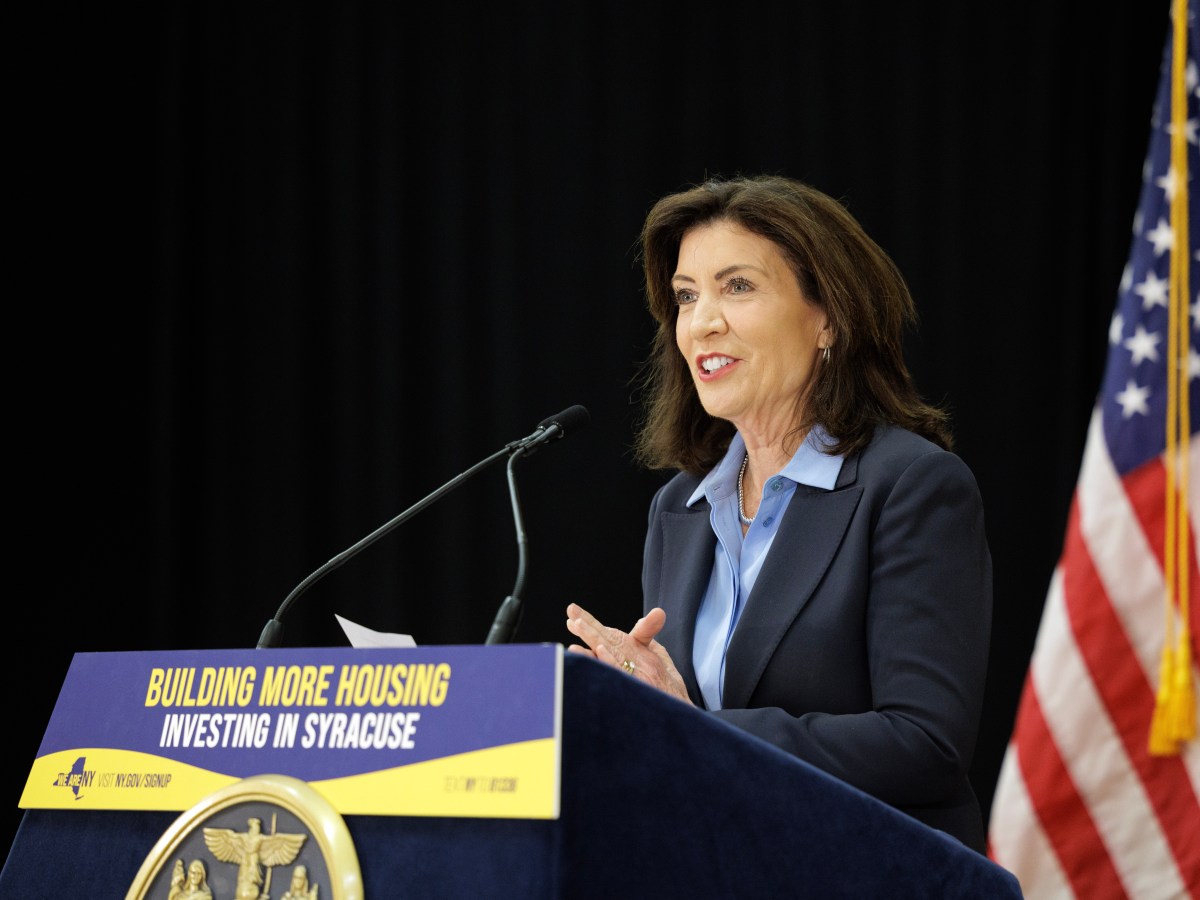
Hochul, for her part, pledged to review the MTA’s 2025-2029 Capital Plan and fight to secure as much funding as possible.
“That includes pressuring Washington to deliver additional infrastructure dollars and working with our partners in the Legislature and City Hall to determine priorities and capacity during the upcoming budget negotiations,” Hochul said in a statement.
However, Lisa Daglian, Executive Director of the Permanent Citizens Advisory Committee to the MTA, criticized Hochul for pausing congestion pricing and putting “a hole” in the MTA’s current capital plan.
“The FY25-29 plan shows that the MTA has smartly used the 20-year needs assessment as designed to rank projects, and while maintaining what we have in a State of Good Repair is critical, it isn’t enough,” Daglian said in a statement.
“State of Good Repair – the literal nuts and bolts of maintaining the system – should always come out on top, but we are wondering what’s left on the cutting room floor that would have benefited riders thanks to Governor Hochul’s pause?”