Just as the city is reawakening after months of winter, so are the delicate sprouts of native grasses and wildflowers in the micro-urban grasslands of Green-Wood Cemetery.
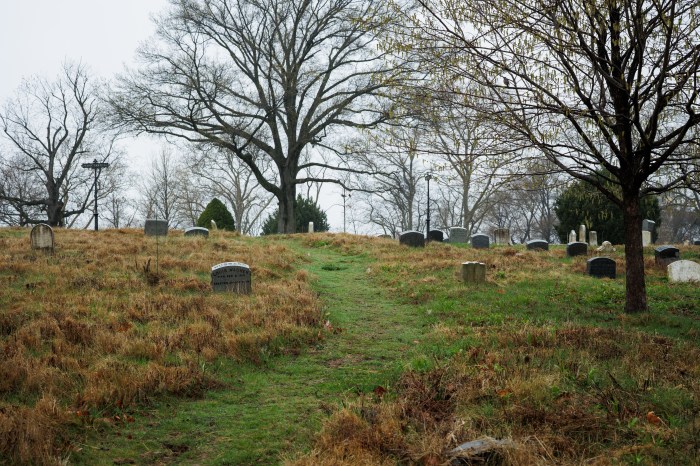
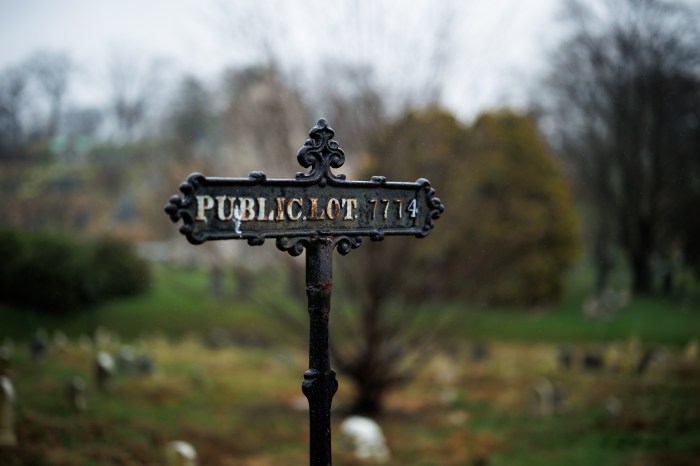
Visitors may notice a stark difference between grave plots along Green-Wood’s peaceful paths. Some public lots are almost entirely obscured by tall grasses, while just a few feet away, private ones sit surrounded by perfectly trimmed lawns.
The contrast of neat private lots with trimmed traditional grass next to public ones that look like nature has taken over has led to some strong reactions.
It’s all part of the Rethinking Urban Grasslands project, which started in 2017 in partnership with Cornell University. The project aims to curb the growth rampant, invasive, warm-weather-loving Bermuda grass while using fewer resources to manage the land and protect headstones against damage from lawnmowers. That effort includes regenerating plots that have been covered by the manicured grass for decades.
A wildflower Meadow at Green-Wood Cemetery in early spring. The area is part of the cemetery’s Urban Grasslands initiative that seeks to transition away from traditional mown lawns. Photo by Paul Frangipane
Bermuda grass was introduced in the U.S. in the 1700s and has since spread throughout the entire country, including to Green-Wood. While it’s popular for lawns and landscaping, the grass grows very quickly and can choke out native flora and damage local ecosystems while requiring constant maintenance and mowing.
The grass thrives from being “beat up,” and lawn mowing helped propagate the grass to other areas in the cemetery. The proliferation of this grass is aided by longer warm seasons due to climate change.
“It became pretty apparent that we would probably never be able to truly eradicate it,” said Sara Evans, the Director of Living Collections and Curator at the cemetery. “ So it evolved into rethinking the design of certain areas of the cemetery.”
The project ramped up in 2022 when the team selected an “aggregate of eight different public lots” to be cleared and reseeded with wildflowers and non-invasive grasses.
Public lots were created in the cemetery as an affordable option for families who wanted their loved ones to be buried at Green-Wood. Single private graves cost up to $28,000. According to Evans, public lots tended to have smaller headstones, are some of the oldest in the cemetery, and have fewer visitors.
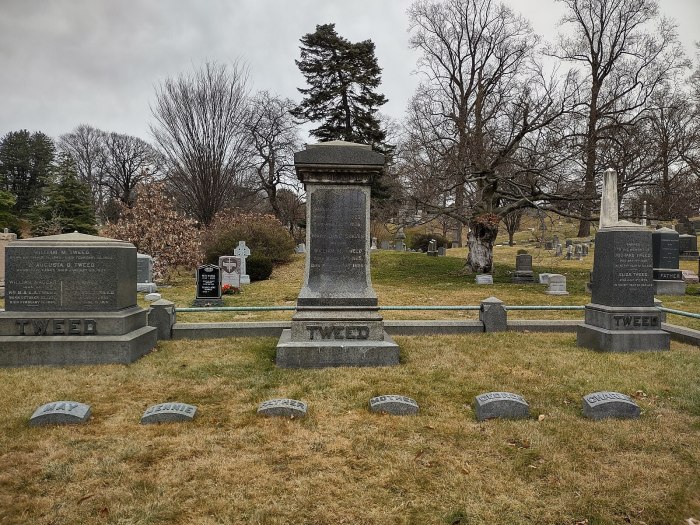
The Grasslands project has been implemented at Green-Wood’s public lots. Photo by Paul FrangipaneThe infamous Boss Tweed’s private family plot in Feb. 2024, with short grass. Photo courtesy of Jim.henderson/Wikimedia Commons
The graves in these areas are closer together than on larger private plots, and the headstones tend to be made of more delicate materials like brownstone and marble. Mowing between them graves can be difficult, leading to accidents that have damaged the headstones. Planners of the Urban Grassland Project hoped less mowing would support the preservation of the gravestones.
So the Green-Wood team started planting native flowers and grasses like bee balm, asters, and yarrow. The native plants are maintained carefully by hand — not with mowers — and grow longer and wilder than the old grass lawns.
After the first round of seeding, some visitors expressed pushback. Popular Science reported a son saying the change was disrespectful to his family; one person described it as “disheveled,” and another stated it “desecrates the final resting place of all lying in eternal [sic] slumber.”
Green-Wood did not notify the families of the plots chosen for the Urban Grassland Project. Evans stated that the cemetery was not obligated to share that information with the families and had “no way of contacting these families.”
Since the project began, two families have contacted the cemetery expressing their opposition, Evans said. For one family, the cemetery created a path for people to access the grave without “wading through the meadow.”
The other family, after learning about the change, requested the grave plot have the traditional lawn restored. The cemetery honored their request.
A sign at Green-Wood explains the meadow. Photo by Paul Frangipane
Three years in, the Green-Wood team is still experimenting with the density and height of the plants around the gravestones.
“ It’s kind of evolving as we’re experiencing it ourselves,“ stated Evans, “Meadows are not instant gratification, and because they do evolve over time, it’s very much an exercise in managing expectations of visitors.“
Xenia Adjoubei, an urban designer and professor at Pratt’s Graduate Architecture, Landscape Architecture, and Urban Design program, said landscapes that utilize meadows and native plants tend to be more resilient and self-sustaining. Even with the benefits, the transition to this type of landscape may need more input and involvement to get the public on board.
“ [Native species] can soak up more stormwater, alleviating the pressure on our utility systems. They support much greater biodiversity,” Adjoubei said. “ But they create this very different aesthetic, which can be seen as not prescribing to the rules.“
Adjoubei believes transparency around projects like this will lead to greater support around changes to what a cemetery traditionally looks like.
“ Some people might argue that it’s a lot more beautiful to have a wildflower meadow. And to some, it just looks unkept, and that appears to be disrespectful to the permanent residents,“ she said.“ It’s part of a process of our opinions changing. Like with many things, it’s about including people in the understanding of the benefits and better transparency for the kind of benefits that it brings for the cemetery.”
In some ways, the project has already been successful. Researchers have found new native plants previously not seen in the cemetery, according to a 2021 article by Popular Science, and surveys have found 62 native bee species at Green-Wood, most in the new meadows. Even some rare birds have started making more frequent appearances.
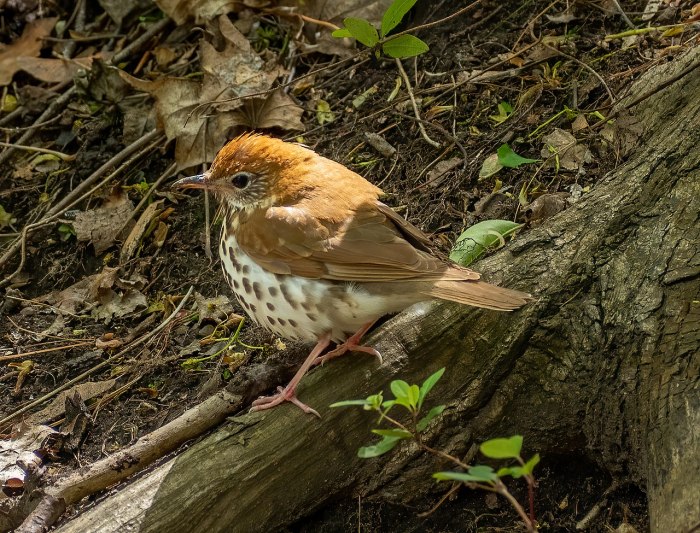
Local birders say ground-foraging migratory birds, like this Wood Thrush seen at Green-Wood in 2020, are more plentiful at the cemetery thanks to rewilding. Photo courtesy of Rhododendrites/Wikimedia Commons
One group that has overwhelmingly welcomed the changes in the landscape has been the Brooklyn Bird Club. Their members have enjoyed an increase in bird spottings since the start of the grassland project. Dennis Hrehowsik, a member of the club, has been going to Green-Wood to birdwatch for 15 years.
“ A third of all the migratory birds that come through New York City during spring migration, they can only forage on the grounds and up to about maybe three feet.And so a lot of these birds, they’re on the edge of starvation,“ he said.
Now, more grassland species frequented the cemetery’s green spaces.
“There’s more birds here in the winter than there are in the summer. When they say birds fly south for the winter. For all the arctic species, this is south for the winter, so we’re in this really, really vital native habitat,“ shared Hrehowsik.
In 2022, Brooklyn Bird Club donated $20,000 to support the planting of more native vegetation.
As spring and summer warm Green-Wood Cemetery, the wildflower meadows and native grasses will become more prominent. The spaces, which the Green-Wood team colloquially calls the perpetual meadow, will grow thick with plants reaching around and over the headstones.
Starting in the 80s, New York law enforcement fielded sexual abuse complaints from the patients of a pediatrician who ran his practice out of a basement.
The Tesla’s owner called 911 when he spotted the brick – with the hateful symbol and the word “Nazi written in chalk – on the bumper of his parked ride on Ditmas Avenue near Ocean Parkway in Kensington just after 8 p.m. Monday, according to authorities and photos.
The escalating series of tariffs between the United States and trading partners like China and the European Union, which Trump set off last week, sent the stock market into a volatile frenzy and caused widespread fear of soaring prices. Tariffs are a tax on foreign imports of everyday items, such as cars and computers, that typically get passed onto consumers.
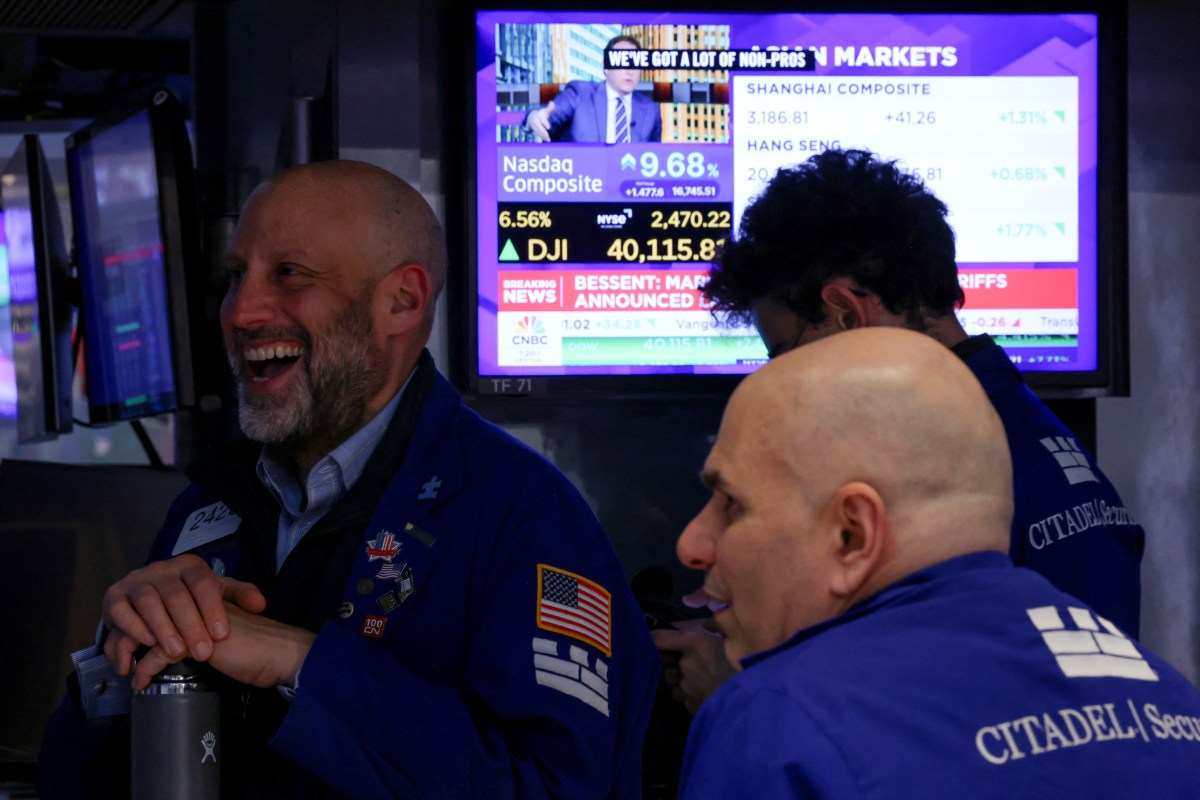
However, early on Wednesday afternoon, Trump announced a 90-day pause on his reciprocal tariffs on most countries—though he also bumped up reciprocal levies on China by 125%. Even so, news of the pause sent the stock market surging: the Dow Jones Industrial Average closed back above the 40,000 mark after seeing a nearly 3,000-point bump in afternoon trading; the S&P 500 also shot up 9.5% Wednesday, and NASDAQ surged 12.2%.
“Just days after announcing arbitrary worldwide tariffs, Trump’s reversal is yet another example of the constant chaos he is imposing on all of us,” said city Comptroller and mayoral candidate Brad Lander in a statement responding to Trump’s reversal.
“This level of uncertainty is bad for markets, bad for the economy, bad for investors, and bad for New York City,” he added.
‘Trump sabotaging our economy’
News of President Trump’s 90-day tariff pause sent the stock market surging: the Dow Jones Industrial Average closed back above the 40,000 mark after seeing a nearly 3,000-point bump in afternoon trading; the S&P 500 also shot up 9.5% Wednesday, and NASDAQ surged 12.2%. REUTERS/Brendan McDermid
City Council Speaker and another mayoral candidate Adrienne Adams, during an April 9 news conference before Trump’s announcement, said the president’s tariffs will hurt “small businesses, working families, and everyday New Yorkers.”
“Trump is sabotaging our economy with the largest tax hike in over 50 years,” the speaker said. “This continued chaos, if allowed to continue, will devastate New York City and the entire United States.”
The speaker said once the tariffs are fully implemented, New Yorkers could see spikes in prices for consumer goods like groceries and electronics. She also noted that the tariffs threaten over 260,000 jobs in the city.
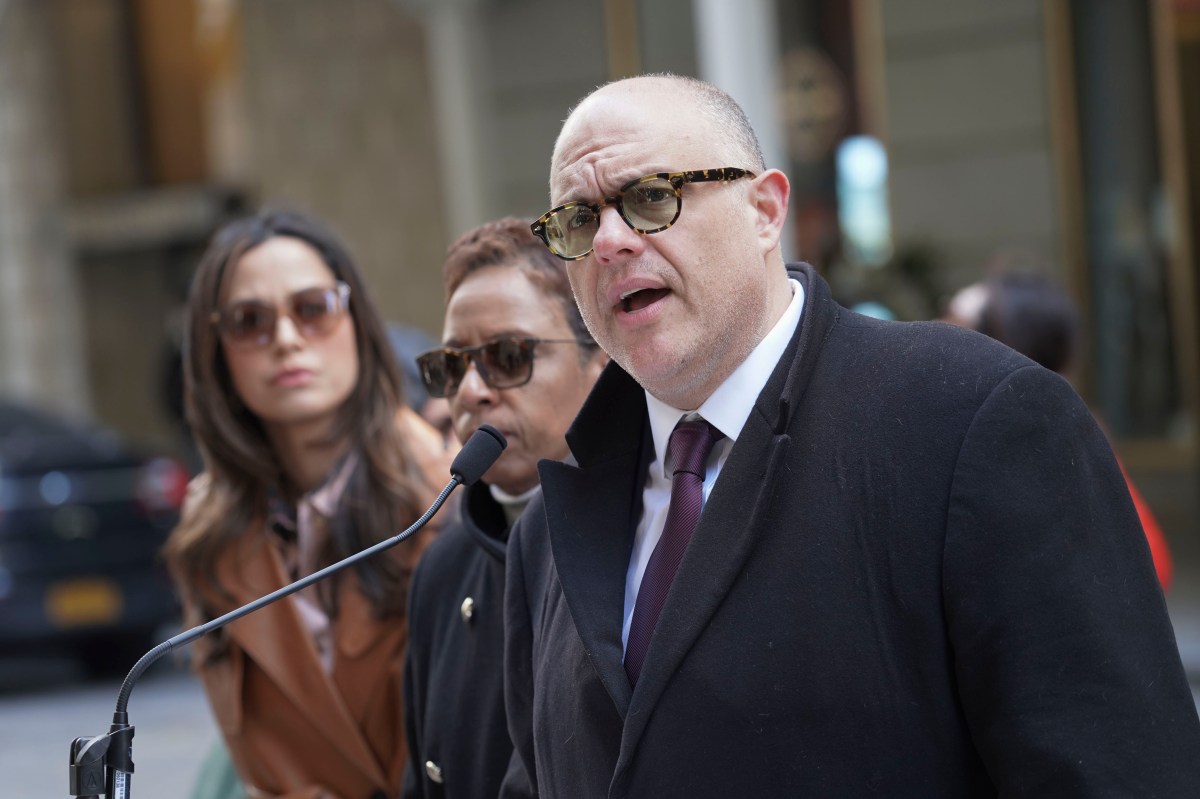
“Trump compares this chaos to a bitter pill that we all need to swallow; try telling that to a New Yorker that’s living paycheck to paycheck, try telling that to a family that is already drowning in rent and child care costs,” said City Council Finance Chair Justin Brannan, who was also present at the press conference.
The City Council called for setting aside nearly $2 billion in its Fiscal Year 2026 Preliminary Budget Response to prepare for Trump’s funding cuts. Brannan said the council wants to be ready to plug that money into any funding gaps created by Trump’s sweeping cuts to federal grants and other economic turmoil caused by his policies.
“Trump compares this chaos to a bitter pill that we all need to swallow; try telling that to a New Yorker that’s living paycheck to paycheck, try telling that to a family that is already drowning in rent and child care costs,” said City Council Finance Chair Justin Brannan, who was also present at the press conference.Gerardo Romo / NYC Council Media Unit
However, Speaker Adams said those funds would not be enough to mitigate the effects of Trump’s tariffs if they ultimately take full effect.
“This will be a self-inflicted injury so severe that no amount of fiscal management can contain it,” the speaker said. “Despite our preparation for economic risks on the city level, we can only do so much to blunt the most devastating consequences.”
Additionally, Brannan said the mayor’s budget office has not yet recognized the $2 billion in revenue, and he said they want to reset it aside. Disputes between the City Council and the mayor’s office over the projected revenue the city has at its disposal have dominated the last few budget cycles and could play a major role again this year.
‘Compromised if not continuing to collude’
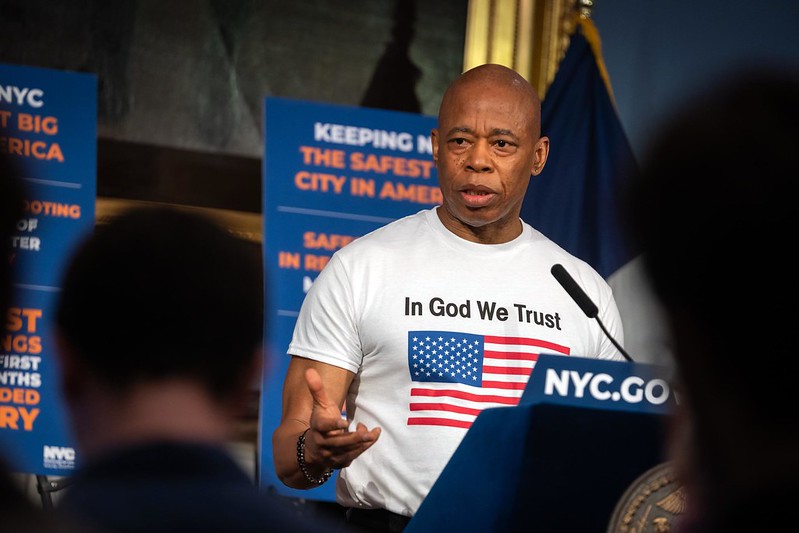
Mayor Eric Adams insisted his warm relationship with President Trump is benefitting New York City. Tuesday, April 8, 2025.Credit: Ed Reed/Mayoral Photography Office.
Both Speaker Adams and Brannan also criticized the mayor for his tepid comments on the tariffs over the past couple of days. Brannan charged that Mayor Adams is not adequately fighting back against the Trump administration’s aggressive actions targeting the city in the wake of the Justice Department dropping his criminal indictment.
“We have an administration at City Hall that is compromised if not continuing to collude with the federal government,” Brannan said.
The mayor’s reluctance to criticize Trump has become a frequent point of attack by his critics, who allege he is beholden to the Republican president.
For his part, the mayor has said he does not know enough about tariffs despite claiming that he spent much of last weekend reading about them. Nonetheless, he appeared to show general support for Trump’s attempt to shake up the status quo.
“There’s one thing I know: whatever we were doing, it was not working,” Adams said during a Tuesday news conference. “Affordability is an issue for everyday New Yorkers. Wealth has been accumulated in the highest level of people in the country. And I’m seeing low-income, working-class people struggling every day. And so whatever we were doing, we need to think differently.”