
On Wednesday, a judge granted a 90-day extension of a temporary restraining order that blocks the Trump administration from deporting Mahdawi, according to Mahdawi’s lawyers.
 The Ocean Avenue News - oceanavenuenews.com
The city officially launched its “Adopt-A-Catch Basin” pilot program in Greenpoint on Tuesday, hoping to deputize locals as volunteer storm drain supervisors.
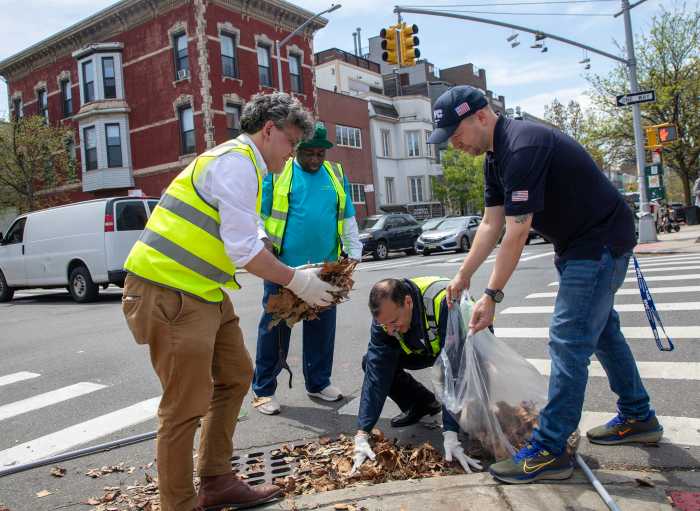
Greenpointers who sign up for the program will be responsible for cleaning debris — like leaves and trash — out of their assigned catch basin so rainwater can flow through it and into the sewers below.
“Clearing out catch basins helps reduce flooding and keeps our streets cleaner,” said Council Member Lincoln Restler, who partnered with the Department of Environmental Protection to create the program. “If we all do our part, we can make a major difference in strengthening resiliency on our block.”
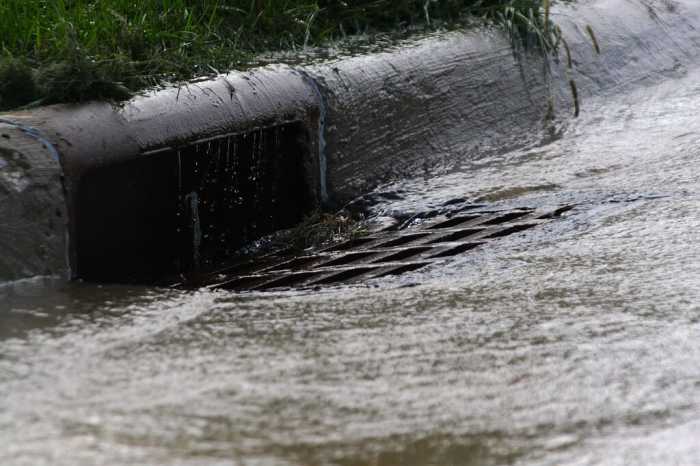
There are more than 150,000 catch basins — also known as storm drains — across New York City, according to DEP. When they’re clear, the basins are a critical part of preventing flooding.
But the street-level drains are often blocked by dead leaves and other debris, meaning water can’t drain through and instead backs up into the street.
DEP has a fleet of specialized catch basin-cleaning trucks that are deployed before major storms, but those vehicles are aging — during Storm Ophelia, which caused up to 11 inches of flooding in Brooklyn in September 2023 — two-thirds of those trucks were out of service, according to a 2024 report by the New York City Comptroller.
City officials and local clean-up groups have been urging locals to clean up their local catch basins ahead of storms for years, with mixed results. DEP hopes the Adopt-A-Catch Basin program will “empower community members in Greenpoint, Brooklyn, to take an active role in reducing local street flooding.”
Interested locals can fill out an interest form, including the location of the catch basin they’d like to adopt. DEP will assign each volunteer a specific catch basin and provide them with a reflective safety vest, garbage and recycling bags, gloves, a trash grabber, a rake, and other supplies.
Since the program was soft-launched last fall, 25 Greenpointers have adopted 90 catch basins, according to DEP.
Volunteers are asked to submit reports each time they clean or inspect the drain, and to call 311 if their catch basin still won’t drain after a cleaning. DEP is responsible for inspecting and cleaning all of the city’s basins, even those “adopted” in Greenpoint, but only visits each one every six months to every three years — depending on its condition.
“Every New Yorker with a rake or broom can help their neighborhood prevent flooding simply by clearing leaves and debris from a catch basin,” said Department of Environmental Protection Commissioner Rohit T. Aggarwala.
george papadopoulos in newly declassified files of Crossfire Hurricane – Google Search https://t.co/NL674XAt7D https://t.co/73cAXFCol8
— Michael Novakhov (@mikenov) April 23, 2025
george papadopoulos in newly declassified files of Crossfire Hurricane – Google Search https://t.co/NL674XAt7D https://t.co/73cAXFCol8
— Michael Novakhov (@mikenov) April 23, 2025
This increase among rental properties listed on Realtor.com continues the trend of the median asking price rising annually since Spring 2022, when it originally returned to pre-pandemic levels. Now, the city’s median asking rent is 18.1% higher than the $2,876 put up when the COVID-19 pandemic started in the first quarter of 2020.
Units with up to two bedrooms were in high demand during the first quarter of 2025, compared to those with at least three bedrooms. The greater demand for the smaller units led to a bigger increase in its price compared to the larger units. The median asking rent for units of up to two bedrooms rose 7.2% year-over-year, from $3,139 in 2024 to $3,365 in 2025. Units with at least three bedrooms, meanwhile, had a 1.2% increase, from $4,717 last year to $4,773 this year.
All four New York City boroughs examined in the study – Manhattan, Queens, Brooklyn and the Bronx – experienced growth from the previous year. Staten Island is not included in the study yet because its data is still being reviewed.
Manhattan led the boroughs with the sharpest increase in asking rent. It had a 5.5% jump year-over-year, from $4,260 in 2024 to $4,495 in 2025. Based on this monthly rental price and assuming tenants would need to devote 30% of what they earn a year towards rent, the annual income required for these units is $179,796, or $14,983 a month.
Brooklyn ranked second among the boroughs in asking price increases from the first quarter of 2024 to the first quarter of 2025. The borough experienced a 5% climb, from $3,570 last year to $3,748 this year. Tenants would need an annual income of $149,916 if they devote 30% of their earnings to paying rent, which amounts to $12,493 a month.
In Queens, the median asking rent increased by 4.3%, from $3,162 in the first quarter of 2024 to $3,298 in the first quarter of 2025. The annual income required here would be $131,916, equating to $10,933 a month.
There was very little change in the Bronx compared to the other boroughs in the study. Its median asking price just boosted by 0.7%, from $2,990 last year to $3,010 this year. The necessary annual income is $120,396, which translates to $10,033 a month.
The trends among these boroughs are much different when compared to the start of the COVID-19 pandemic. While the Bronx had the smallest increase in median asking rent year-over-year during the first quarter of 2025, it surged the most from the first quarter of 2020, having gone up 41.2%, from $2,132 to $3,010. Manhattan, meanwhile, went from first year-over-year to last from 2020, with just a 0.2% bump over that period of time, from $4,487 to $4,495.
Brooklyn ranked second over this period, too, with a 39.5% increase, from $2,687 to $3,748. Queens also maintained its third-place rank over this period, with its median asking rent having gone up 36.2%, from $2,422 to $3,298.
Newly permitted units had huge gains in 2024 compared to the average from 2019-2023, with the number increasing across the city from 25,081 during that five-year stretch to 26,021 in 2024. However, despite this notable leap in the number of units permitted for construction across the city, there is concern that the 25% tariffs on steel and aluminum being imported into the United States could result in less homes being put on the pipeline in 2025. Builders may be hesitant to start new projects, and developers may feel compelled to pause or even halt existing plans due to the higher costs for construction that these tariffs cause.


