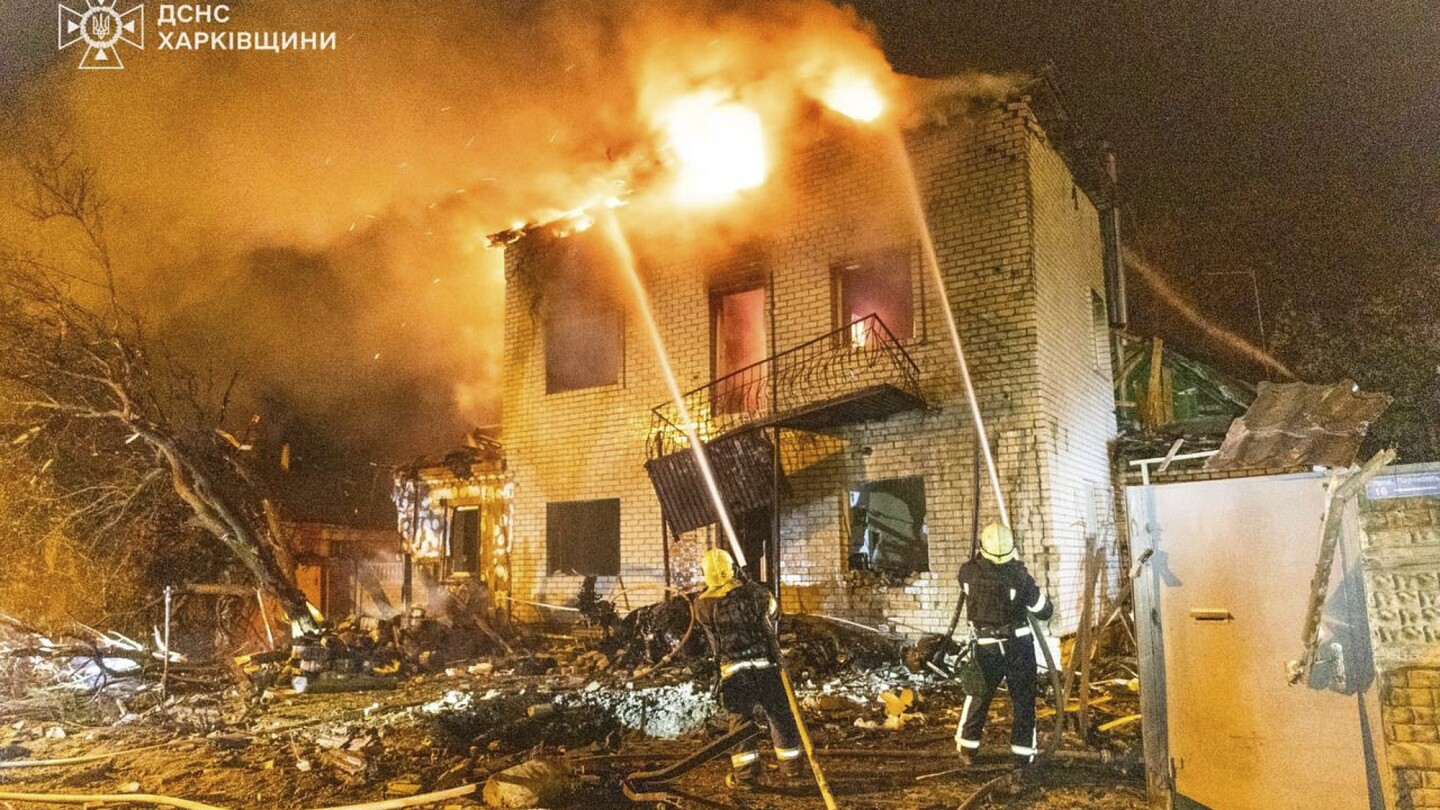
A senior Kremlin official says clinching a deal to end the war between Russia and Ukraine “is far too complex to be done quickly.”
 The Ocean Avenue News - oceanavenuenews.com
The post Where the Jets’ depth chart has improved — and declined first appeared on Brooklyn NY – bklyn-ny.com.
By: Hal C Clarke
A newly installed 5G tower on the Upper West Side is sparking outrage among locals — with some residents slamming it as a hideous blight on their neighborhood, while others spin government surveillance theories, The New York Post reported.
Standing at 32 feet tall between West 94th and 95th Streets on Columbus Avenue, the towering structure is part of the city’s broader Link5G initiative to boost high-speed internet access. But many longtime residents feel blindsided by its arrival.
“It looks monstrous,” Pam Gould, 58, told The New York Post. Gould, who has lived in the area for 20 years, criticized the tower for overwhelming the surrounding scenery. “It overshadows everything around it, like the trees. It doesn’t fit in with this neighborhood,” she said. “They just threw it here without any thought.”
The Link5G project aims to install about 2,000 towers citywide, with 200 already completed, according to The New York Post. Besides supporting 5G infrastructure, the towers offer USB charging ports and local Wi-Fi connectivity for passersby.
Still, that explanation isn’t enough for many Upper West Siders. Tara Fray, another resident of 20 years, said the towering addition felt alien. “When I first saw it, I thought, ‘What the heck is that?’” Fray told The New York Post, joking that it would look more at home in Dubai with its shiny, futuristic design. She questioned the necessity of the tower, observing that only homeless individuals seemed to be using it so far.
Others criticized what they see as excessive spending. “Charging your phone is pampering people. Do it at home,” said Marjan N., 65, a 27-year neighborhood resident. He called the project “an unbelievable waste” and even floated the idea that the towers could be used for surveillance.
Such suspicions aren’t uncommon. Since 5G technology began rolling out in 2019, conspiracy theories have swirled about its alleged health risks and potential government spying. One local, Michelle Watson, 64, referenced George Orwell’s 1984 when speaking to The New York Post, warning, “Those things are coming true.” She vowed to monitor the tower closely and dig deeper into its implications.
However, health organizations, including the World Health Organization, have confirmed that 5G signals are safe, debunking many of the lingering myths.
Meanwhile, the debate rages on. At least three additional 5G towers are in the pipeline for the Upper West Side, pending approval at locations along Broadway, The New York Post noted. City Council member Gale Brewer, whose district covers the area, has voiced concerns about preserving the neighborhood’s character amidst the city’s tech upgrades.
In 2022, similar protests broke out on the Upper East Side as residents tried unsuccessfully to block new tower installations. Still, not everyone is opposed to the modernization efforts.
“It’s great for any neighborhood; we are fortunate to have it,” said Allan Ripp, 71, who has lived in the area for 45 years. Ripp praised the tower’s design, telling The New York Post that it resembled a modern sculpture and fit the spirit of an evolving city.
Whether viewed as an eyesore, a futuristic convenience, or a looming Big Brother device, the Upper West Side’s newest 5G tower has certainly made its presence felt.
The post Upper West Siders Fume Over “Monstrous” 5G Tower, Some Suspect Sinister Motives appeared first on The Jewish Voice.


By: Matt Sedensky
Michael Montgomery used to check the balance on his retirement account once a week and smile. But lately, not wanting to get upset and question if he could retire in a few years, there was only one solution.
“I’m not looking,” says the 66-year-old professor from Huntington Woods, Michigan.
As the White House simultaneously injects turmoil into financial markets with its trade war and dismisses fears of a downturn, retired and near-retired Americans are anxiously looking on, worried about outliving their savings or having to put off entries on their bucket lists.
Keeping logged off his account has made Montgomery’s days less worrisome. He and his wife adjusted their portfolio after Election Day, including moving more money into bonds. But he’s not sure what more he can do if the entire world economy can be affected by Washington’s decisions.
“I hope like hell I don’t lose all my retirement savings,” he says. “But where else could you put the money that these people could not disorder? They can’t get into your mattress but that’s about it.”
Many experts warned U.S. stocks were overpriced and due for a correction even before President Donald Trump reclaimed the Oval Office. But a historic blanket of tariffs have injected new uncertainty into the market.
Though stocks rallied this week, the S&P 500 is down 10% from an all-time high reached in February. Losses in the Nasdaq and among small-cap stocks are steeper. Even bonds and the U.S. dollar have been volatile. Many economists are warning of a possible recession.
It has 71-year-old Jeanne Oats Estridge feeling so “paranoid” she called her financial planner with an idea.
“How about we put it all in cash?” Oats Estridge asked.
“I just don’t advise it,” she heard back.
Oats Estridge, who lives in Dayton, Ohio, retired from a job in software engineering and now writes books, including her latest, on four octogenarian women kidnapped by sex-trafficking aliens. Her account is down more than $40,000 and she gets angry thinking about how some in Washington have reacted to the market volatility, including Trump’s recent market assessment that it was “a great time to buy.”
“Where am I supposed to come up with the money to buy? My underwear drawer?” Oats Estridge asks.
Earlier this month, the Cboe Volatility Index, considered a “fear gauge” of investor pessimism, reached its highest level in five years. The index, known as VIX, has since retreated but is still in territory reflecting fearful investors. Another measure of market sentiment, the Cboe S&P 500 Left Tail Volatility Index, which tracks investor worry about so-called “black swan” events such as the 2008 housing crash that spurred the Great Recession, likewise has backed off from highs but remains elevated.
Trump has urged people to “be cool” in assessing the impact of tariffs on their investments. Asked about his own savings earlier this month, he chuckled and replied: “I haven’t checked my 401(k).”
Treasury Secretary Scott Bessent, meantime, brushed off the possibility that some might need to delay retiring, saying people “don’t look at the day-to-day fluctuations of what’s happening.”
That seeming nonchalance isn’t sitting well with some older investors.
Peter Rost, 72, retired from his software development job last year and planned to start tapping his retirement savings to supplement Social Security. But he doesn’t want to bake in his losses.
“I’m looking to take $2,000 and meanwhile the account drops by $30,000,” he says.
He’s been through serious downturns before, but those were different.
“I had the time to be patient and let it work its way back,” says Rost, who lives in New Hartford, Connecticut, “but now I’m retired and I need money from that account.”
At his age, he says, there’s one goal: “Make sure I don’t run out of money before I die.”
Americans’ retirement savings totaled about $44 trillion at the end of 2024, according to the Investment Company Institute. The composition of those savings has shifted increasingly toward stocks in the last couple decades as the 401(k) has become employers’ typical offering.
Among fund giant Vanguard’s nearly 5 million accounts, for example, the average investor puts three-quarters of their savings in stocks. Even older investors are still heavily steeped in equities: People 55 to 64 have 64% in stocks at Vanguard; those 65 and older have 49% in stocks.
With that exposure, financial advisers are getting an influx of calls amid the recent market uncertainty.
Tj Binkowski, who runs Narrow Road Financial Planning in Clarksville, Tennessee, says some clients find themselves obsessively checking their accounts and feel the emotional strain of worrying about their money. A downturn, he says, hits an older investor much differently.
“When you’re retired, paper losses aren’t just on paper anymore,” says Binkowski. “You’re locking them in every month that you take money out.”
Paul Duesterhaus, a 68-year-old retiree from Quincy, Illinois, is passing up an IRA withdrawal this year to avoid selling at a low. Instead, the retired manager at an air compressor manufacturing company will put off buying a new car as planned and cut back on things like eating out.
Still, he can’t help but feel bigger impacts of a trade war are ahead.
“I think there’s going to be longer lasting effects that are going to affect every American,” he says.
That angst is more common among older adults than younger people. An April poll by The Associated Press-NORC Center for Public Affairs Research found just under half of U.S. adults ages 45 and older said their retirement savings are a “major” source of stress for them right now, compared to about one-third of younger people. Older Americans were also more likely to say they’re stressed about the stock market.
For now, many older investors are taking the advice of many experts, to fine-tune investments if necessary but avoid dramatic moves. But it can be hard advice to swallow.
“The more things go up and down, the more nervous you get,” says Steve Turner, a 74-year-old from Chesterfield, Missouri, who runs a small public relations business. He now finds himself anxious when he goes to log on to his retirement account, wondering, “Gee, do I want to press the button?”
“You worry that things may work themselves out in the long run, but you don’t have as long,” says Turner. “You’re not 30, you’re not 40, you’re not 50, you’re not even 60.”
(AP)
The post Market Turmoil Has Many Afraid to Check Retirement Savings appeared first on The Jewish Voice.
