
The Atlanta Falcons need to get it together.
 The Ocean Avenue News - oceanavenuenews.com
#FBI: Full Text
FBI, national security agencies using polygraphs for ‘leak’ hunts – The Washington Post https://t.co/IKe9RTrIVs
National security agencies across the Trump administration are ramping up investigations into alleged leaks to the news media, in some cases using…— Michael Novakhov (@mikenov) April 30, 2025
#FBI
Do FBI agents lie; why, and how often? – Search https://t.co/RdDGhSvgic https://t.co/wKtVA0nh03
Copilothttps://t.co/fIG8Vqb9mL
FBI agents are expected to uphold integrity and follow the law, but there have been instances where agents have been accused of deception or…— Michael Novakhov (@mikenov) April 30, 2025
Do #FBI agents lie; why, and how often? – Google Search https://t.co/peTbUFxfeI
An AI Overview is not available for this search
FBI Defense Lawyer: What To Do
By contrast, the law does not prohibit agents from lying to you. Federal agents can deceive you, lie to you, trick you,… pic.twitter.com/bOMpHhyup9— Michael Novakhov (@mikenov) April 30, 2025
World Happiness Index 2025
Azerbaijan 🇦🇿 106 https://t.co/6ePq8WkbLs pic.twitter.com/jjd7z7Ah9B— Emin Bred (@emin_bred) April 30, 2025

Wanted: A holy man.
Job description: Leading the 1.4 billion-strong Catholic Church.
Location: Vatican City.
There are no official candidates for the papacy, but some cardinals are considered “papabile,” or possessing the characteristics necessary to become pope. After St. John Paul II broke the centuries-long Italian hold on the papacy in 1978, the field of contenders has broadened considerably.
When the cardinals enter the Sistine Chapel on May 7 to choose a successor to Pope Francis, the first pontiff from Latin America, they will be looking above all for a holy man who can guide the Catholic Church. Beyond that, they will weigh his administrative and pastoral experience and consider what the church needs today.
Here is a selection of possible contenders, in no particular order. The list will be updated as cardinals continue their closed-door, preconclave discussions.
Date of Birth: Jan. 17, 1955
Nationality: Italian
Position: Vatican secretary of state under Francis
Experience: Veteran Vatican diplomat
Made a cardinal by: Francis
The 70-year-old veteran diplomat was Francis’ secretary of state, essentially the Holy See’s prime minister.
Though associated closely with Francis’ pontificate, Parolin is much more demure in personality and diplomatic in his approach to leading than the Argentine Jesuit he served and he knows where the Catholic Church might need a course correction.
Parolin oversaw the Holy See’s controversial deal with China over bishop nominations and was involved — but not charged — in the Vatican’s botched investment in a London real estate venture that led to a 2021 trial of another cardinal and nine others. A former ambassador to Venezuela, Parolin knows the Latin American church well and played a key role in the 2014 U.S.-Cuba detente, which the Vatican helped facilitate.
If he were elected, he would return an Italian to the papacy after three successive outsiders: St. John Paul II (Poland), Pope Benedict XVI (Germany) and Francis (Argentina).
But Parolin has very little pastoral experience: He entered the seminary at age 14, four years after his father was killed in a car accident. After his 1980 ordination, he spent two years as a parish priest near his hometown in northern Italy, but then went to Rome to study and entered the Vatican diplomatic service, where he has remained ever since. He has served at Vatican embassies in Nigeria, Mexico and Venezuela.
He is widely respected for his diplomatic finesse on some of the thorniest dossiers facing the Catholic Church. He has long been involved in the China file, and he played a hands-on role in the Holy See’s diplomatic rapprochement with Vietnam that resulted in an agreement to establish a resident Vatican representative in the country.
Parolin was also the Vatican’s point-person in its frustrated efforts to end the wars in Ukraine and the Middle East. He has tried to make the church’s voice heard as the Trump administration began working to end Russia’s war in Ukraine.
“Let’s hope we can arrive at a peace that, in order to be solid, lasting, must be a just peace, must involve all the actors who are at stake and take into account the principles of international law and the UN declarations,” he said.
Parolin might find the geopolitical reality ushered in by the Trump administration somewhat unreceptive to the Holy See’s soft power.
— By Nicole Winfield in Vatican City

Date of Birth: June 21, 1957
Nationality: Filipino
Position: Pro-Prefect, Dicastery for Evangelization under Francis
Experience: Former archbishop of Manila, Philippines
Made a cardinal by: Benedict
Tagle, 67, is on many bookmakers’ lists to be the first Asian pope, a choice that would acknowledge a part of the world where the church is growing.
Francis brought the popular archbishop of Manila to Rome to head the Vatican’s missionary evangelization office, which serves the needs of the Catholic Church in much of Asia and Africa. His role took on greater weight when Francis reformed the Vatican bureaucracy. Tagle often cites his Chinese heritage — his maternal grandmother was part of a Chinese family that moved to the Philippines.
Though he has pastoral, Vatican and management experience — he headed the Vatican’s Caritas Internationalis federation of charity groups before coming to Rome permanently — Tagle would be on the young side to be elected pope, with cardinals perhaps preferring an older candidate whose papacy would be more limited.
Tagle is known as a good communicator and teacher — key attributes for a pope.
“The pope will have to do a lot of teaching, we’ll have to face the cameras all the time so if there will be a communicator pope, that’s very desirable,” said Leo Ocampo, a theology professor at the University of Santo Tomas in Manila.
That said, Tagle’s tenure at Caritas was not without controversy and some have questioned his management skills.
In 2022 , Francis ousted the Caritas management, including demoting Tagle. The Holy See said an outside investigation had found “real deficiencies” in management that had affected staff morale at the Caritas secretariat in Rome.
— By Jim Gomez in Manila, Philippines, and Nicole Winfield in Vatican City

Date of Birth: Jan. 24, 1960
Nationality: Congolese
Position: Archbishop of Kinshasa, Congo
Experience: President of the bishops conferences of Africa and Madagascar
Made a cardinal by: Francis
The 65-year-old Ambongo is one of Africa’s most outspoken Catholic leaders, heading the archdiocese that has the largest number of Catholics on the continent that seen as the future of the church.
He has been archbishop of Congo’s capital since 2018 and a cardinal since in 2019. Francis also appointed him to a group of advisers that was helping reorganize the Vatican bureaucracy.
In Congo and across Africa, Ambongo has been deeply committed to the Catholic orthodoxy and is seen as conservative.
In 2024, he signed a statement on behalf of the bishops conferences of Africa and Madagascar refusing to follow Francis’ declaration allowing priests to offer blessings to same-sex couples in what amounted to continent-wide dissent from a papal teaching. The rebuke crystalized both the African church’s line on LGBTQ+ outreach and Ambongo’s stature within the African hierarchy.
He has received praise from some in Congo for promoting interfaith tolerance, especially on a continent where religious divisions between Christians and Muslims are common.
“He is for the openness of the church to different cultures,” said Monsignor Donatien Nshole, secretary-general of the National Episcopal Conference of Congo, who has long worked with Ambongo.
An outspoken government critic, the cardinal is also known for his unwavering advocacy for social justice.
In a country with high poverty and hunger levels despite being rich in minerals, and where fighting by rebel groups has killed thousands and displaced millions in one of the world’s biggest humanitarian crises, he frequently criticizes both government corruption and inaction, as well as the exploitation of the country’s natural resources by foreign powers.
“Congo is the plate from which everyone eats, except for our people,” he said last year during a speech at the Pontifical Antonianum University.
Ambongo’s criticism of authorities has drawn both public admiration and legal scrutiny. Last year, prosecutors ordered a judicial investigation of him after accusing him of “seditious behavior” over his criticism of the government’s handling of the conflict in eastern Congo.
— By Mark Banchereau in Dakar, Senegal

Date of Birth: Oct. 11, 1955
Nationality: Italian
Current position: Archbishop of Bologna, Italy, president of the Italian bishops conference
Previous position: Auxiliary bishop of Rome
Made a cardinal by: Francis
Zuppi, 69, came up as a street priest in the image of Francis, who promoted him quickly: first to archbishop of the wealthy archdiocese of Bologna in northern Italy in 2015, before bestowing the title of cardinal in 2019.
He is closely closely affiliated with the Sant’Egidio Community, a Rome-based Catholic charity that was influential under Francis, particularly in interfaith dialogue. Zuppi was part of Sant’Egidio’s team that helped negotiate the end of Mozambique’s civil war in the 1990s and was named Francis’ peace envoy for Russia’s war in Ukraine.
He traveled to Kyiv and Moscow after Ukrainian President Volodymyr Zelenskyy appealed to the Holy See for help in winning the release of 19,000 Ukrainian children taken from their families and brought to Russia during the war. The mission also took him to China and the United States.
After making him a cardinal, Francis made clear he wanted him in charge of Italy’s bishops, a sign of his admiration for the prelate who, like Francis, is known as a “street priest” — someone who prioritizes ministering to poor and homeless people and refugees.
Zuppi would be a candidate in Francis’ tradition of ministering to those on the margins, although his relative youth would count against him for cardinals seeking a short papacy.
In a sign of his progressive leanings, Zuppi wrote the introduction to the Italian edition of “Building a Bridge,” by the Rev. James Martin, an American Jesuit, about the church’s need to improve its outreach to the LGBTQ+ community.
Zuppi wrote that building bridges with the community was a “difficult process, still unfolding.” He recognized that “doing nothing, on the other hand, risks causing a great deal of suffering, makes people feel lonely, and often leads to the adoption of positions that are both contrasting and extreme.”
Zuppi’s family also has strong institutional ties: His father worked for the Vatican newspaper L’Osservatore Romano, and his mother was the niece of Cardinal Carlo Confalonieri, dean of the College of Cardinals in the 1960s and 1970s.
— By Colleen Barry in Vatican City

Date of Birth: June 25, 1952
Nationality: Hungarian
Position: Archbishop of Esztergom-Budapest, Hungary
Past experience: Twice elected head of the umbrella group of European bishops conferences
Made a cardinal by: John Paul
Known by his peers as a serious theologian, scholar and educator, Erdő, 72, is a leading contender among conservatives. He has served as the archbishop of Esztergom-Budapest since 2002 and was made a cardinal by John Paul the following year. He has participated in two conclaves, in 2005 and 2013, for the selection of Benedict and Francis.
Holding doctorates in theology and canon law, Erdő, speaks six languages, is a proponent of doctrinal orthodoxy, and champions the church’s positions on issues like abortion and same-sex marriage.
Erdő opposes same-sex unions, and has also resisted suggestions that Catholics who remarry after divorce be able to receive communion. He stated in 2015 that divorced Catholics should only be permitted communion if they remain sexually abstinent in their new marriage.
An advocate for traditional family structures, he helped organize Francis’ 2014 and 2015 Vatican meetings on the family.
From 2006 to 2016, Erdő served as president of the Council of European Bishops’ Conferences, helping to foster collaboration among Catholic bishops across Europe and to address contemporary issues facing the church on the continent.
While careful to avoid taking part in Hungary’s often tumultuous political life, Erdő has maintained a close relationship with the country’s rightist populist government, which provides generous subsidies to Christian churches.
He has been reluctant to take positions on several of the government’s policies that divided society in Hungary such as public campaigns that villainized migrants and refugees and laws that eroded the rights of LGBTQ+ communities.
When hundreds of thousands of asylum-seekers entered Europe in 2015 fleeing war and deprivation in the Middle East and Africa, Erdő emphasized that the church had a Christian duty to provide humanitarian assistance to those in need, but stopped short of the full-throated advocacy for migrants that was one of Francis’ top priorities.
— By Justin Spike in Budapest, Hungary
Associated Press religion coverage receives support through the AP’s collaboration with The Conversation US, with funding from Lilly Endowment Inc. The AP is solely responsible for this content.
A collection of topical political cartoons from various artists curated by the Brooklyn Eagle editorial staff.
The post Cartoon Sketchbook: April 30 appeared first on Brooklyn Eagle.
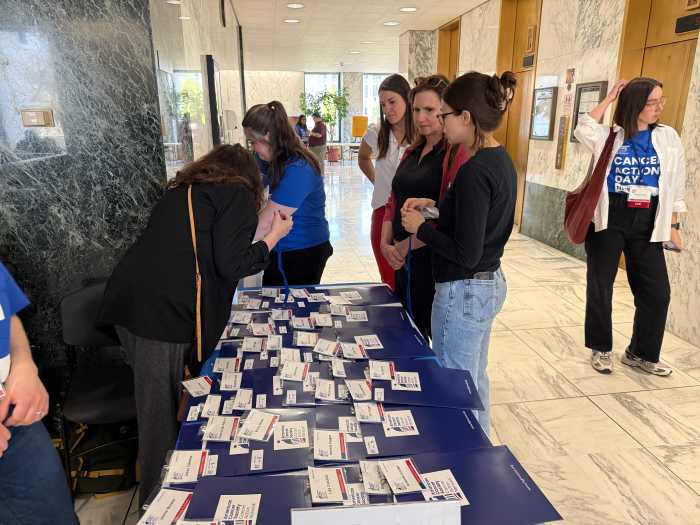
More than 130 passionate cancer advocates, including survivors, patients, and caregivers, converged on the state Capitol Tuesday for Cancer Action Day, an annual event hosted by the American Cancer Society Cancer Action Network (ACS CAN).
Armed with personal stories and powerful messages, they met with state lawmakers, urging them to take action on policies that could transform cancer care and help fight the disease.
“Cancer Action Day is a chance for patients and survivors to elevate their voices,” said Michael Davoli, senior government relations director for ACS CAN New York. “Our organization is committed to working with state lawmakers to help prevent, treat, and end the cancer burden as we know it – for all New Yorkers. Our message to lawmakers today is – you play a crucial role in that fight.”
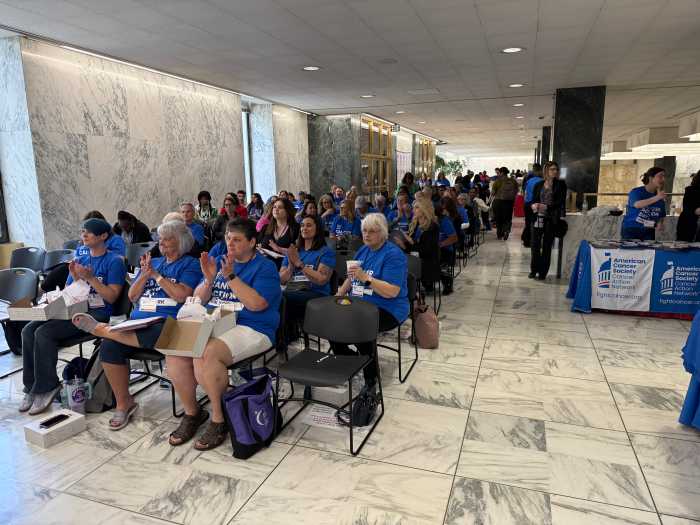
The focus of this year’s event was threefold: advocating for legislation that will improve the chances of survival for lung cancer patients, updating New York’s paid family and medical leave program, and expanding access to patient navigation services across the state.
Among the volunteers was Jacqueline Nesbit, a two-time lung cancer survivor, who shared her experience with the high out-of-pocket costs associated with lung cancer screenings. Nesbit attended Cancer Action Day to promote Senate Bill 2000, which recently passed unanimously in the Senate. If signed into law, the bill would eliminate cost-sharing for lung cancer screenings and follow-up tests for eligible New Yorkers insured through state-regulated health plans, including Medicaid.
“We need to do better in detecting lung cancer in New York. Screening is incredibly effective, but very few New Yorkers who are eligible for screening actually receive it,” Nesbit said. “This is often because the cost burden for follow-up care is too high and inhibits people from completing the lifesaving screening process.”
Stacey Betler, an advocate and survivor, recounted her harrowing experience of being diagnosed with breast cancer at just 27, while pregnant with her second child — and then losing her job in the midst of it all. Betler emphasized the need for improvements to the state’s paid family and medical leave programs, which she believes fail to meet the needs of cancer patients.
“Our state’s paid leave programs do not meet the needs of the people they aim to serve. It surely did not alleviate the near insurmountable burdens I faced as a cancer patient and sole provider for my kids. I was fighting for my life and my livelihood and looking to the state for real support,” said Betler. “Had the state’s paid leave programs enabled me to receive job protection, health insurance continuation, and a livable wage, I might’ve weathered the storm without half the trauma that I still carry with me today, 15 years later.”
Betler is advocating for Senate Bill 172 and Assembly Bill 84, which would provide crucial improvements to paid leave programs, including removing the $170-per-week cap on benefits and increasing the stipend to 67% of the state’s average weekly wage by 2029.
ACS CAN advocates also urged lawmakers to support Assembly Bill 6586 and Senate Bill 5565, which would expand access to patient navigation services, which help people navigate the country’s complex healthcare system.
Emily Tier, a palliative care social worker from Binghamton, highlighted the importance of patient navigation in transforming cancer care.
“Navigating the health care system can be immensely intimidating and confusing for patients, especially those coming into contact with the system for the first time. Patient navigators provide information and support to guide patients through appointments, treatments, and, ultimately, survivorship,” said Tier. “Where we can, we need to prioritize improving access to resources that we know can lead patients to more time doing what matters most to them with who matters most to them.”

The day also featured the presentation of ACS CAN’s “Distinguished Advocacy Award” to southeast Brooklyn state Sen. Roxanne Persaud and Assembly Member Pamela Hunter of Syracuse for their contributions to cancer care. The award, presented on behalf of the organization, recognizes their efforts to expand access to biomarker testing and remove barriers to cancer screening.
“Senator Persaud and Assemblywoman Hunter have been invaluable allies in our mission to reduce the cancer burden across New York,” said Davoli. “Their leadership in expanding access to biomarker testing and removing barriers to cancer screening have brought hope into patients’ lives and equity into conversations around cancer care.”
Persaud represents New York’s 19th Senate District, encompassing Canarsie, East New York, Brownsville, Sheepshead Bay, and parts of Flatlands and Bergen Beach.
Trump’s political personality assessments – Google Search https://t.co/FoxeFFB1q2 pic.twitter.com/j0SztHNshQ
— Michael Novakhov (@mikenov) April 30, 2025