Day: May 5, 2025

U.S. Dept. of Education’s plans to garnish the incomes of federal student loan borrowers has prompted a letter from Sen. Gillibrand (D-NY).
The post Sen. Gillibrand demands answers from Education Dept. on its plans to garnish borrowers’ wages appeared first on Brooklyn Eagle.
A HATZOLAH VOLUNTEER EMT early Sunday morning struck and critically injured a 19-year-old man while responding to a call in Midwood.
The post Hatzolah EMT driver strikes, critically injures pedestrian appeared first on Brooklyn Eagle.
If you believe the New York City government can — and should — work better for all of us, I urge you to join us this Tuesday, May 6th, from 5-7 p.m. at Restoration Plaza in Bed-Stuy. That’s when the City Council’s Charter Revision Commission (CRC), aka The Commission To Strengthen Local Democracy, of which I’m proud to be a member, is holding a public hearing. It’s your opportunity to speak directly to those of us reviewing and recommending changes to the City Charter —t he document that functions as NYC’s constitution.
When Brooklyn Borough President Antonio Reynoso appointed me to the Commission earlier this year, I was honored — but I also quickly realized how unfamiliar the CRC is to many New Yorkers. The most common reaction I’ve gotten is: “Congrats! So… what exactly does a Charter Revision Commission do?” It’s a fair question, so I’ll try my best to answer.
A CRC reviews the city’s foundational governing document and proposes updates that ultimately appear as ballot questions for voters to decide. The results of which have shaped the very structure of our city. In 1898, a Charter revision (more creation via revision of the state constitution ) led to the consolidation of the five boroughs — a move approved by Brooklyn voters by a mere 267 votes. Some, including myself at times, have jokingly referred to this as the “mistake of ’98,” but the point is this: Charter changes have lasting, wide-reaching impact.
A CRC in 1975 led to the creation of Community Boards and the Uniform Land Use Review Procedure (ULURP). In 2018, it led to Community Board term limits. In 2024, voters saw five CRC-generated ballot proposals — most of which expanded mayoral power — four of which passed. Yet most people hardly remember voting on them.
That disconnect — the quiet but powerful ways these changes shape our lives — is exactly why we need more public engagement and clearer priorities moving forward. For me, that means focusing on reforms that make our city more transparent, more inclusive, and more accountable.
I could go on forever on such matters, so I’ll keep it two things I’d want done. First, we need a comprehensive planning process to replace the current piecemeal, project-by-project approach that incorporates macro-scale needs instead of isolated interests. Second, to help achieve this goal, we should adopt Borough President Reynoso’s proposal for an independent Community Board Office that gives CBs the support and staffing to better serve the neighborhoods and city we share today, tomorrow, and beyond.
Whether you agree or disagree with such suggestions, I hope you attend, participate, and share your thoughts by attending Tuesday’s hearing or any other upcoming CRC hearings. The charter has shaped NYC for over a century; let’s work together to make our city more democratic and remember that, as Al Smith said, “All the ills of democracy can be cured by more democracy.”
Mike Racioppo is currently a Commissioner on the Commission to Strengthen Local Democracy as well as the District Manager of Brooklyn Community Board 6 and a former adjunct professor at Brooklyn College.
Democratic and independent candidates for New York City mayor attended a town hall on May 1 — the first day of Mental Health Awareness Month — at the First Baptist Church of Crown Heights to discuss how they would improve and reform mental health resources if elected.
The event was hosted by the New York City Mental Health Collective, a coalition of more than 30 mental health organizations and advocacy groups, and moderated by actor and mental health activist Chad Coleman.

Before the candidates shared their plans to address New York City’s mental health crisis, New York City Mental Health Collective founder Christina Sparrock underscored the urgency of tackling mental health issues as they relate to stable housing, education, public safety, employment and justice.
“It’s a health condition that we can manage with the right support,” Sparrock said. “Our mental health affects us, how we live, connect, and contribute to society.”
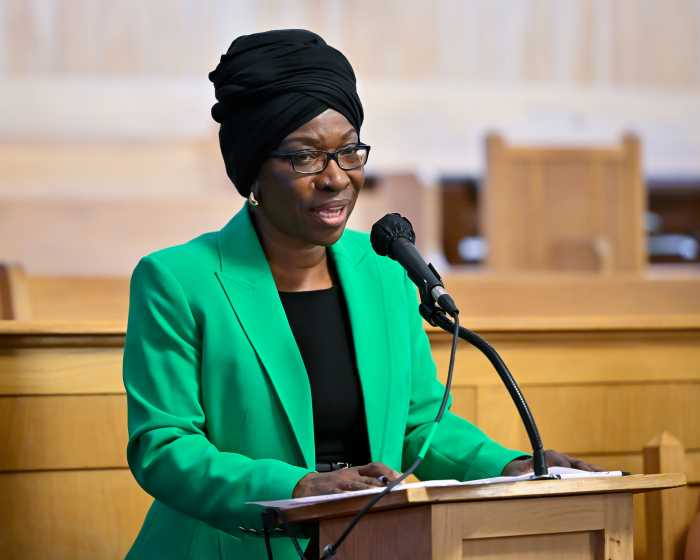
In 2024, the New York City Department of Health and Mental Hygiene released its first-ever report on the state of mental health among New Yorkers. The report found that 48% of teenagers and nearly one in four adults experience a mental health disorder, including depression, anxiety, schizophrenia, mood or personality disorders, ADHD and more.
However, due to a lack of insurance and adequate mental health resources — particularly in underserved areas — many individuals do not receive the treatment they need to lead productive lives.
Mayoral candidates Zohran Mamdani, Brad Lander, Scott Stringer, Dr. Selma Bartholomew, Michael Blake, Whitney Tilson and Jim Walden discussed proposals to improve and reform the city’s mental health system. Topics included expanding access to care, addressing Black and Brown maternal mental health, creating crisis intervention programs that don’t involve police, implementing comprehensive mental health education in schools, destigmatizing mental illness and therapy, supporting families, and rescinding Mayor Eric Adams’ executive order that paused the city’s ban on solitary confinement.
Research has shown that solitary confinement can have devastating mental health effects — both during and after incarceration. Most candidates said they would lift Adams’ executive order and abolish solitary confinement altogether; others said the policy should be overhauled.
Blake, a former Obama aide and state assembly member, said he wanted Rikers Island shut down “full stop,” citing the suicide of Kalief Browder, a 22-year-old Bronx resident who died by suicide in 2015 after spending 1,100 days — 800 of them in solitary confinement — on Rikers without being convicted of a crime.
“Rikers is actually the second largest mental health institution in America,” said Blake. “There is no business at all that we have a place that is not about trying to rehabilitate someone. It is effectively trying to keep people locked down, many of which have actually not been convicted of something.”
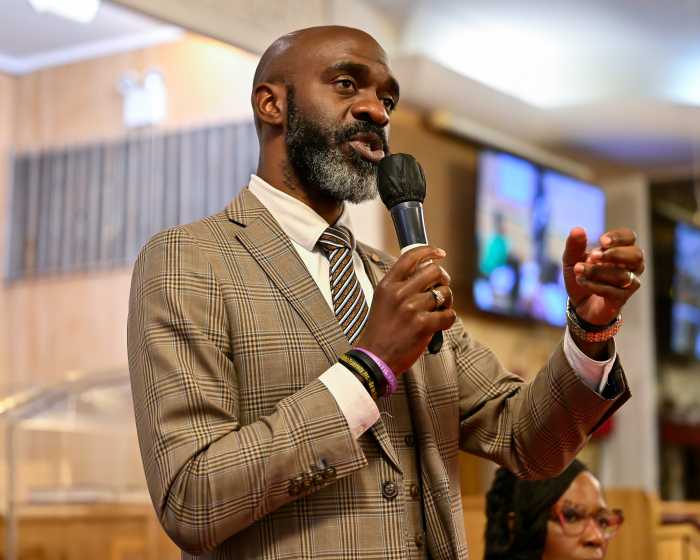
Lander and Mamdani both said they would rescind the mayor’s executive order on their first day in office.
Lander described solitary confinement as “torture.”
“I’ve been on Rikers a bunch of times, and I have gone each time to see people in involuntary protective custody or solitary. It is torture,” he said. “We are doing it right now, and I will end that executive order on day one.”
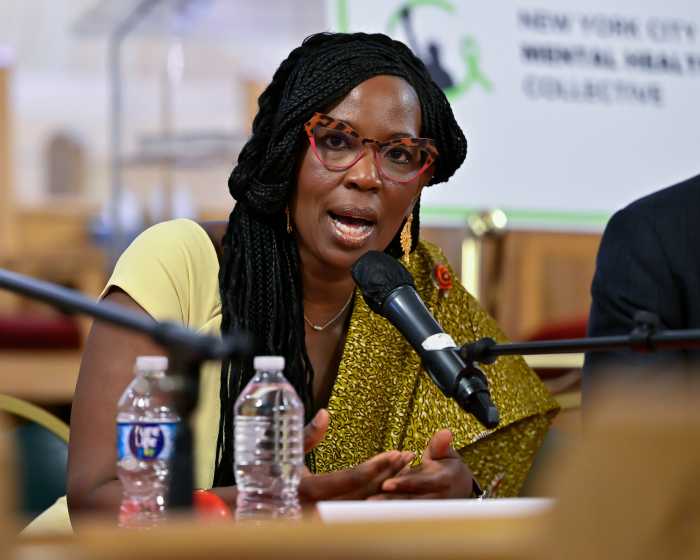
Bartholomew said the culture of passive violence in prisons — including overcrowding, poor food quality and inadequate medical care — must be addressed.
Tilson acknowledged that solitary confinement has been implemented “poorly” and should be reformed. However, he said the planned borough-based jails set to replace Rikers should include some form of solitary confinement.
“I think as part of those jails, there needs to be some area that is segregated for inmates that are very dangerous to themselves, to other inmates, and to corrections officers,” Tilson said.
Candidates also shared proposals to better integrate family engagement and support services into the city’s mental health system, including increased funding, training and care coordination.
Mamdani suggested expanding the number of Fountain House clubhouses, which offer support for individuals with severe mental illness.
“What we need to do as a city is to scale up these pilots that have been successful [and] ensure that every neighborhood has a clubhouse, ensure that we have community mental health navigators in every single neighborhood so that families are not the only place that New Yorkers who are struggling can find care,” he said.
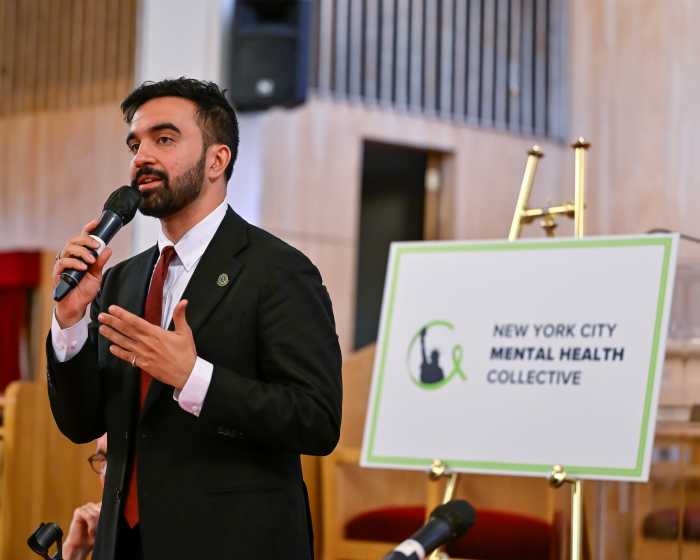
Candidates also agreed that the city’s mental health crisis response teams, known as B-HEARD, should include a team member with lived experience of mental illness. They noted that NYPD officers are not adequately trained to respond to individuals in mental health crisis.
“You want someone who actually has done the journey to be addressing [the mental health crisis] in real time,” Blake said.
ERIC ADAMS, Randy Mastro and Jessica Tisch announced a $1.6 million initiative to install “SilentShield” panic buttons.
The post 500 high-crime bodegas to get panic buttons appeared first on Brooklyn Eagle.
TOMATOES ARE THE LATEST PRODUCE TO BE RECALLED after a foodborne illness was found at a processing facility.
The post Tomatoes from Indiana recalled for salmonella; may have reached stores in NY appeared first on Brooklyn Eagle.
A NEWLY-LAUNCHED initiative aims to help MWBE complete their New York State MWBE Certification applications.
The post Hochul: New empowerment initiatives will help expedite certifications for AAPI entrepreneurs appeared first on Brooklyn Eagle.

( JNS) A senior Israeli official confirmed to N12 News on Monday night that Israel is conducting joint airstrikes with the United States against Houthi targets in Yemen, following Sunday’s ballistic missile attack near Ben Gurion Airport. According to Arabic media reports cited by N12, over 30 Israeli fighter jets are participating in the strikes on the port […]