Public school students in New York will no longer be allowed to use their phones during school hours starting in September, Gov. Kathy Hochul announced on Tuesday.
The governor said the looming ban on smartphones in schools will finally take effect this fall, in time for the 2025-2026 academic year. It applies to all kindergarten through grade 12 public schools in the state.
Hochul said New York will be the largest state in the nation to require a statewide, bell-to-bell restriction on smartphones in schools. Her victory was announced as part of the state’s FY2026 budget, and includes a $13.5 million allocation for schools that need assistance in purchasing storage space for the phones during the day.
“New York was the first state to target addictive social media feeds — and now we’re the largest state to restrict smartphones in schools throughout the entire school day,” Hochul said. “I know our young people succeed when they’re learning and growing, not clicking and scrolling — and that’s why New York continues to lead the nation on protecting our kids in the digital age.”
The policy applies to public and charter schools. It also requires schools to provide parents with a way to contact their children during the day when necessary.
Governor Hochul’s school cellphone ban includes a $13.5 million allocation for schools that need assistance in purchasing storage space for the phones during the day. Photo via Getty Images
Hochul said she enacted the policy after speaking with teachers, parents and students statewide to gather information for her report, “More Learning, Less Scrolling: Creating Distraction-Free Schools.”
Per the report, the governor found that smartphones distract students and inhibit learning and creativity. She has previously said in media reports that phone-free environments “do not compromise” student safety and help support mental health of both students and staff.
“This isn’t about being anti-phone or anti-technology, it’s about being pro-childhood,” NYS United Teachers President Melinda Person said. “We’re giving students seven hours a day free from distractions so they can focus on learning, access their creativity, and make real human connections. Tackling social media and technology use as a public health issue will take continued partnership, education, and courage, and New York is ready to lead the way.”
Parents and teachers react to the school cellphone ban: ‘fighting a losing battle’
Parents and teachers have mixed feelings about the new policy.
Veronica Miller, a mom from Staten Island, said she supports the ban to help keep kids free from distraction as they are learning.
“I also believe the children’s 24/7 exposure to 5G radiation via EMF and blue light led exposure is detrimental to their health,” she said.
But Christine Crispino of the same borough feels differently..
“I would want my child to have their phone to contact me in case of an emergency, such as a school shooting,” she said. “Very scary times we live in.”
Audra, an NYC public high school teacher, said she is “fighting a losing battle” to get her teenage students to put their phones away.
“As a high school teacher, cell phone use is literally the main disciplinary concern I have among my students,” she said. “Asking these students to put their phones away even for 10 minutes is like asking the to remove a limb.”
She said the ban is a “great idea,” but has concerns about implementation.
“Because even though the expectation is that students don’t use their phones, currently there’s really not much that can be done about it,” she explained. “We teachers can’t take their phones away from them, administration doesn’t take the phones away from them.”
It is not yet clear how schools will store the phones. However, the new policy allows schools to develop their own plans for storing phones during the day, giving administrators and teachers the flexibility to “do what works best for their buildings and students,” according to a press release from the governor’s office.
An investigation found that a modified Jeep used to push vehicles aboard the vessel overheated and ignited, while critical safety failures worsened the outcome.
A number of South Brooklyn residents are protesting the city’s plans to build a shelter for homeless families in the neighborhood.
The plan for 2134 Coyle St. in Sheepshead Bay has sparked significant opposition, with locals particularly frustrated after initial plans to build affordable housing at the site fell through. Protests against the shelter began in March, and have drawn attendees across the political aisle, including politicians, community leaders and everyday residents.
More than a month later, protesters continue to gather on Coyle Street daily, and have camped out on the site to block construction workers and equipment from entering. At least two protesters were arrested and charged with disorderly conduct during a demonstration last week.
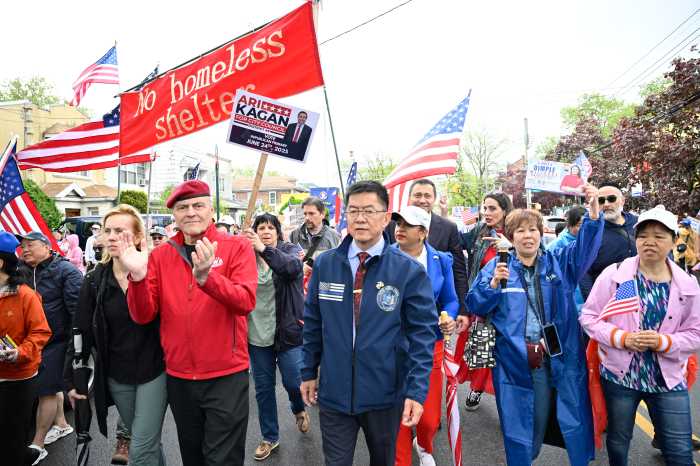
This growing momentum culminated in a march along Coney Island Avenue on May 4, where close to 1,000 people — including several local elected officials — took to the streets in opposition to the shelter.
Curtis Sliwa and State Sen. Stephen Chan lead a protest march in opposition to a city shelter plan they say lacks transparency — one of countless demonstrations held at the Coyle Street site since early this year, many of them also led by the duo.Photo by Lloyd Mitchell
Republican state Sen. Stephen Chan — who represents nearby State Senate District 17 — and mayoral candidate Curtis Sliwa led the march. Both took aim at Mayor Eric Adams for moving forward with the homeless shelter plan and vowed to do everything in their power to stop it.
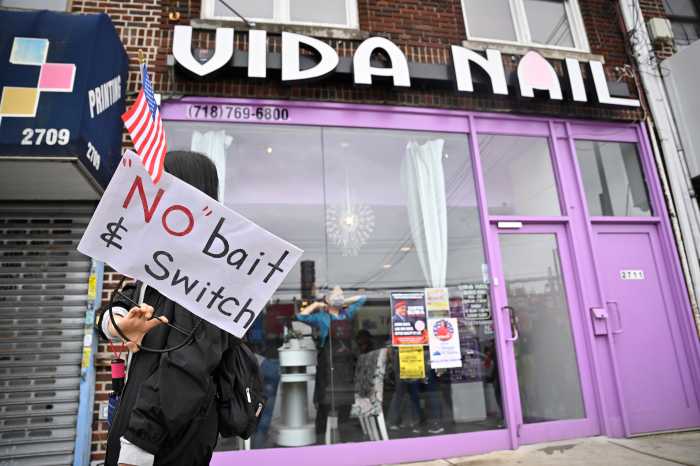
‘Bait and Switch’ accusation
Originally approved for affordable housing, the property was quietly repurposed as a homeless shelter after the developer reportedly backed out — leading residents to accuse the city of a “bait and switch.” Republican Council Member Inna Vernikov and Democratic Council Member Mercedes Narcisse have since called on the Department of Social Services and Mayor Adams to cancel the shelter contract.
“At no time was a shelter proposed or presented to the Community Board or the City Council prior to the vote on approval for this project,” Vernikov said.
A DHS spokesperson said the city informed the community about the plan in July 2023.
Sliwa, addressing the crowd at a recent rally, denounced the city’s actions: “This is how they operate. They promise affordable housing, then suddenly, at the last minute, it becomes a homeless shelter — without any meetings, no town halls, and no input from the people who live here.”
Protesters, including Council candidate Ari Kagan (far right), rally outside the planned shelter site on Coyle Street earlier this year.Photo by Robert Pearl
At a Community Board 15 meeting in March, Jim Coughlin — COO of the organization that will operate the shelter, Westhab Inc., asserted that the community “needs” the shelter. According to WestHab’s website, the company’s transitional housing facilities provide residents with case managers and services to help them find jobs and permanent housing.
The vacant building is located near a Dollar Tree, across from Thrifty Beverage Center, and close to several daycare centers and schools. While residents acknowledge the homelessness crisis, they argue that a large-scale shelter in a quiet, family-oriented neighborhood is not a viable solution.
“These places don’t address the root causes — mental health issues, addiction, and substance abuse,” a local resident named John, who asked to be identified by first name only, told Brooklyn Paper. “They just provide a bed for the night. That changes nothing.”
A spokesperson for the city’s Department of Homeless Services said Council District 46 doesn’t have any long-term shelters. The Coyle Street shelter will have space for 169 families with children, they said, “prioritizing placement of those who fall on hard times in the community.”
The nonprofit shelter will offer counseling, housing assistance, medical and mental health services, life skills workshops, children’s services, and more, the representative said. WestHab will also provide 24/7 security with at least five security officers on shift at any given time, and 125 security cameras. The organization will also maintain an open line for community members to contact with complaints or concerns.
“While these protesters have every right to publicly express their views and opinions, they must do so peacefully and in a manner which complies with the law,” the spokesperson said. “In accordance with a recently issued court order, the developer is allowed to enter the property free of any impediments to access. We will continue to maintain open lines of communication with all stakeholders and elected officials from the area in order keep them apprised of the status of this project.”
Demonstrators hold signs opposing the city’s homeless shelter plan, which they say was quietly substituted for affordable housing.Photo by Lloyd Mitchell
But community members monitoring the site over the course of the protests said that trust was already broken when construction reportedly began on the site without a visible permit.
An online petition opposing the shelter — and calling on officials to honor the city’s original plan — has so far amassed more than 4,000 signatures. Some locals have filed a lawsuit in an attempt to halt construction, according to CBS News, and are due in court on May 7. A judge has ruled that protesters cannot prevent WestHab from entering the construction site.
Protesters said they don’t plan to back down.
“We stopped this on 86th Street, we stopped it at 50th and 10th Avenue, and we will stop it here,” Sliwa said at a recent rally, referring to long-term protests against a shelter planned for 86th Street in Gravesend — though the city has not announced plans to cancel that project.
Protest organizers said Sunday they plan to escalate their efforts by bringing their case directly to City Hall in Manhattan this Wednesday, May 7. The protest comes in the wake of a critical court hearing regarding the shelter plan, which is set to take place at 360 Adams St. in Downtown Brooklyn.
‘This is not Tiananmen Square’
After weeks of protesting, tensions at the site reached a boiling point on April 30.
Protesters formed a human blockade as construction trucks attempted to enter the site with a police escort. As Captain Joseph Antonio, commanding officer of the 61st Precinct, assessed the situation, the crowd grew, and the protests grew louder.
Some protesters lay down or stood in the middle of the street with signs reading, “No homeless shelter.”
“This is not Tiananmen Square,” noted one onlooker, as residents and police were locked in a standoff for several hours. They were later given a final warning to disperse or face arrest.
Hundreds march along Coney Island Avenue on May 4, protesting the city’s plan to convert a former affordable housing site into a family homeless shelter in Sheepshead Bay.Photo by Lloyd Mitchell
Officers set up metal barricades, forcibly removed protesters and their tents from in front of the site, and arrested several — including seniors — and injured at least two people. One elderly woman was pushed to the ground, and a man reportedly suffered a serious arm injury. Later that night, a “level one” police mobilization was activated, with squads of officers arriving and low-flying NYPD helicopters circling overhead. The scene, which some described as resembling a war zone, rattled nerves.
“This is a community — not a battlefield,” one witness said.
Chan could not be at the April 30 demonstration but was blunt in a dispatch from Albany: “What the f–k is going on in South Brooklyn? Our mayor is locking up hardworking citizens for trying to protect their homes?”
Marching forward
On May 4, hundreds marched from the shelter site along Avenue U to Coney Island Avenue and back. Sliwa and Chan again led the crowd, with the NYPD acting as escorts, as demonstrators remained peaceful and no arrests were made.
Democratic Assembly Member Jaime Williams — who represents neighboring District 59 and is a regular presence at protests on Coyle Street — said she felt compelled to support South Brooklynites in the fight against the shelter.
“Because this can happen in any district,” she said. “Today it’s Sheepshead Bay. Tomorrow, it could be yours.”
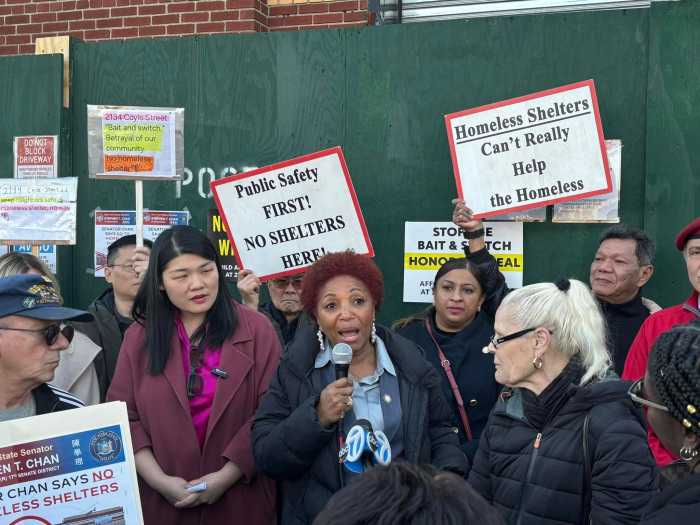
Democratic Council Member Mercedes Narcisse speaks at a recent protest outside the planned Coyle Street shelter, joining a growing number of local officials calling on the city to cancel the contract and honor its original plan for affordable housing.Photo by Robert Pearl
City Council candidates Ari Kagan and Dimple Willabus marched on May 4, with Willabus emphasizing transparency. Community organizer Lina Chan has been key in organizing the protests.
Council Member Susan Zhuang, who was arrested last year at a similar demonstration in Gravesend, and local officials like Assembly Member Michael Novakhov and Community Board 15 Chairperson Theresa Scavo have also voiced opposition.
Additional reporting by Lloyd Mitchell and Kirstyn Brendlen