#Mossad #Kadyrov #October7
Allegations regarding more direct connections to the events of October 7th have surfaced … – AI Report
Attention Mossad: Ramzan Kadyrov’s ties with Middle East and his hypothetical complicity in October 7 attack on Israel – Google Search… pic.twitter.com/nfPVsv9LnP— Michael Novakhov (@mikenov) May 12, 2025
Day: May 12, 2025


Attention Mossad: Ramzan Kadyrov’s ties with Middle East and his hypothetical complicity in October 7 attack on Israel – Google Search https://t.co/z6oFMzX2UI pic.twitter.com/f3JYVSAwkB
— Michael Novakhov (@mikenov) May 12, 2025
Almost anyone who works in a group home in New York will say that it is a labor of love.
They do it for the smiles they get from bringing their developmentally disabled clients out for a sparkly manicure or whipping up their favorite meals at night. They do it for a ‘thank you’ they hear from a mostly nonverbal resident after helping them get dressed in the morning.
One thing they do not do this critical work for is a competitive salary. According to politicians, caregivers and other advocates, the money simply is not there—a nonprofit funding shortfall that has led to low pay, high turnover and staffing shortages.
Caregivers who work in group homes provide much-needed help for people of all ages who have mental illness or intellectual/developmental disabilities (I/DD). Despite their important roles, direct support professionals (DSPs) face ongoing salary challenges that stem in part from a lack of funding.
Critical care, but not enough help

DSPs help vulnerable patients with their everyday needs and care. They provide assistance with personal care, skills development, job coaching, and sometimes even fighting for the rights of those with disabilities. But the salaries in New York are not as rewarding as the work itself—at least not for those who work for non-profit organizations rather than state-run residences.
Tarina Webb, a residential coordinator for AHRC NYC who works in several group homes in Gramercy Park, the East Village, and the West Village, knows about this salary disparity all too well. The homes she works in have nine to twenty residents. The largest program is designed to have 12 staffers, but it does not always work out that way.
“So we have intermittent shortages,” she said. “We’re having issues with retention right now. It’s a big issue.”
Webb’s group homes are co-ed and provide housing for adults who function at different levels, many needing help with everyday tasks.
“It could be anything that you and I do at our homes, like meal preparation, eating, cleaning,” she explained. “Some need assistance with showers, dressing and undressing.”
Staff work in shifts around the clock. The ratio is usually three residents to one DSP.
“But when there are staff shortages, you take on more because you don’t have the people that you need,” Webb said.
As much as her staff loves their work—helping people is their passion—the turnover rate is very high. Other group home workers told amNewYork that many DSPs only stay in the field for about one to two years before leaving. The disparity between the pay and work, many say, is enough to keep them quitting.
Group homes in New York: The pay
According to the job site Indeed, the average starting salary in New York for DSPs in the nonprofit sector is around $18.34 an hour, though many are as low as $17 an hour — only 50 cents higher than NYC’s minimum wage. But those wages jump to around $25 an hour for positions in state-operated community residences, which are managed by the NYS Office of Mental Health (OMH).
NYS recognizes the staffing shortage. In March 2024, it launched a recruitment campaign, More Than Work, jointly with voluntary providers. State sources said the campaign has driven nearly 55,000 potential job candidates to the 234 participating service providers advertising open positions to date.
Fixing the toilet to avoid a hospital visit
Meanwhile, research from the Council of Nonprofits shows funding and support for nonprofits are ongoing issues. In fact, according to the council, seven out of 10 nonprofits anticipated charitable giving to decrease or remain flat in 2023. Couple that with low pay and hard work that includes physical labor, and it’s a recipe for a staffing shortage.
Monifa Walcott is a DSP who was recently promoted to assistant supervisor at a group home in Queens managed by the nonprofit YAI. She does “boots on the ground” work with staff caring for eight adult residents ranging in age from 27 to 80. In addition to providing one-on-one care and managing administrative tasks such as scheduling, she’s also the home’s handywoman.
“After we finish this call, I have to go fix the toilet,” she said. “The toilet seat broke. I have to see if we can get a new one because it’s on the first floor. We have two residents who are unable to ambulate by themselves, so they need support from us. If the toilet is not secure, it could be a very serious situation.”
A serious situation that could even lead to a hospital visit, creating more problems not only for the injured resident but everyone left behind at home.
“It would bring staff out of the house, which would then be lacking support,” she explained.
Despite the staffing issues, Walcott and her team still ensure time to make life as fun for the residents as possible.
“We do their hair. Sometimes we take them out to get their nails done. We take them to the salon. We have two females in here and we try to keep them as girly as possible,” she said with a chuckle.
Birthday parties are part of the fun, too.
“It warms my heart to make them happy,” Walcott said.
‘Essential’ workers
Shayne Tavares, a supervisor at the same YAI group home, said DSPs are essential. In fact, the organization has advocated for the workers by pushing for Medicaid rate increases with the state legislature and governor, and has consistently “mobilized hundreds” of staff, families and other supporters to rally for DSP wages.
“DSPs are essential,” Tavares said. “They are the foundation of the work that we do as a whole. They are the ones who are hands-on engaging with the people, giving support, making sure their needs are being taken care of.”
But as needed as they are, the staffing crisis is alive and well at YAI.
“It has been difficult as of late especially because the cost of living has went up,” Tavares added. “And the field doesn’t pay competitively. It’s a crisis because there are people who want to get into the field to work as a DSP or in the I/DD field in general, but they may not be as interested because it does not pay as much as something else.”
Funding for nonprofit group homes
Families do not pay to place their loved ones in group homes. In fact, many residents do not even have family available to care for them. Their medical needs are typically paid for by government programs such as Medicaid, which provides health insurance and access to long-term care for nearly 7 million New Yorkers.
Manhattan Assembly Member Rebecca Seawright, chair of the assembly’s aging committee and former chair of the people with disabilities committee, said retaining staff at nonprofit-run group homes would be improved if the salaries were higher.
Last month, she reintroduced A7604, a bill to provide wage enhancements for DSP workers.
“New York’s delicate infrastructure of care for people with disabilities and/or older adults rests on the shoulders of nonprofit direct service professionals,” she said, adding that they deliver 85% of services to most New Yorkers with I/DD.
Seawright explained that most nonprofit-based DSPs earn 30% less than their government-funded peers and echoed what many others in the nonprofit sector have said: Low pay and hard work have led to a turnover rate of nearly 30%.
“This disparity goes against our values of equity and fair play while degrading the quality of care for our most vulnerable loved ones and neighbors,” she said. “I also advocated for a cost-of-living adjustment and will continue to fight for our DSPs, the compensation they deserve, and to stabilize the system of care.”
Walcott, of YAI, said she understands why the low salary forces compassionate workers out of a field that they love.
“We have lives outside of here,” she said. “We have bills and stuff like that. A lot of us keep coming back because we enjoy working with each other and making the people happy. But we get a quick turnover because the money is not making ends meet.”
How NYS is helping
Jennifer O’Sullivan, director of communications for the NYS Office for People with Developmental Disabilities (OPWDD), said that the state’s DSPs are the heart of the agency’s service system, supporting 130,000 people with developmental disabilities every day.
“Under Gov. Kathy Hochul’s leadership, the OPWDD remains focused on growing the number of direct support professionals statewide and improving retention,” she said.
Since 2022, she explained, NYS has made more than $3.9 billion available to nonprofit providers to support investments in the workforce and decrease pay disparity. This funding includes about $1.4 billion in one-time federally-approved bonuses, nearly $1.3 billion through four consecutive initiatives that recognize inflationary pressures, and over $340 million through state-funded bonus initiatives.
“Most recently, the governor has invested $850 million to fund rate increases for certified providers, the bulk of which are intended to be used to increase salaries,” O’Sullivan said.
Every morning, tens of thousands of working-class New Yorkers crowd onto Flatbush Avenue’s B41 bus, hoping for a reliable ride to work, school, doctor’s appointments, and family. Instead, what we get is delay, frustration, and disrespect.
Flatbush Avenue is one of the busiest corridors in Brooklyn, with more than 130,000 daily bus riders — many of them from Black, Latino, Caribbean, and immigrant communities. Yet despite our essential role in this city, we continue to be treated like an afterthought.
Last year, Riders Alliance and the Pratt Center joined forces with Flatbush riders, local community groups and cultural institutions to develop a clear, community-driven plan to fix this problem: a center-running bus lane that would allow buses to finally move reliably and fairly along the corridor. DOT acknowledged the overwhelming local support and promised to deliver a new design. A year later, nothing has happened. Buses on Flatbush still crawl at less than 4 miles per hour in some sections — slower than a person can walk.
The story of Flatbush Avenue is not unique. Across New York, the communities that depend most on public transit — Black, Latino, immigrant, and working-class riders — are the ones forced to wait the longest for long promised improvements. It’s the same unacceptable pattern again and again: city leaders make bold statements about equity, but when it’s time to act, our neighborhoods are left behind.
Mayor Adams has repeatedly said he stands with working people. But after years of delays and broken promises, working-class communities are still waiting. Flatbush Avenue riders, like so many others across the city, deserve more than words — they deserve action. If Mayor Adams won’t deliver, we need new leadership that will finally put working New Yorkers first.
Flatbush riders have done our part. We’ve organized. We’ve shown up at community meetings. We’ve built broad support from local institutions, unions, small businesses, and faith groups. We have done everything the city has asked us to do — and yet, we are still waiting for the basic dignity of a reliable ride.
Enough waiting. Mayor Adams and DOT must move forward immediately with the center-running bus lane on Flatbush Avenue — and send a real message that working-class communities matter.
Transit justice is racial justice. Transit justice is immigrant justice. Transit justice is economic justice. And its long overdue. It’s time for Mayor Adams to deliver it — starting here.
Mayra Aldás-Deckert is the lead organizer of the Riders Alliance

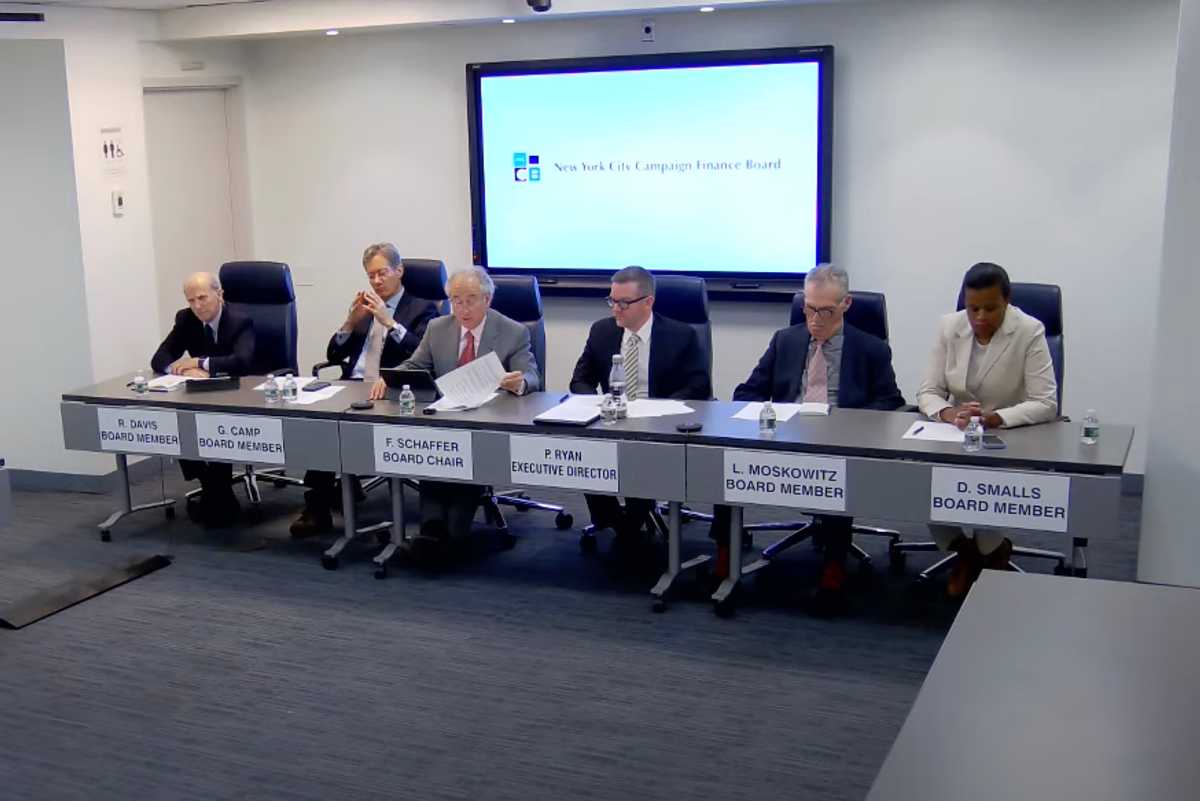
Former Gov. Andrew Cuomo learned Monday that the city’s Campaign Finance Board (CFB) would give his campaign $1.5 million in public matching funds — but chose to withhold another $622,000 over a super PAC supporting his mayoral campaign.
The CFB awarded the 2025 mayoral frontrunner Cuomo public matching funds on May 12 after his campaign resolved clerical errors that prevented him from earning a payout last month. However, the panel decided in the same vote to withhold an additional $622,000 in matching funds that Cuomo would have received because it had “reason to believe” there was “improper coordination” between his campaign and a super PAC supporting it, known as “Fix the City.”
CFB member Richard Davis said the amount the board is withholding matches the sum Fix the City spent on a May 4 ad because the board believes the ad was not “independent of the campaign.”
“Expenditures made in coordination with a campaign are considered in-kind contributions that undercut New York City’s strict spending and contribution limits,” Davis said in announcing the preliminary results of the board’s ongoing investigation.
Cuomo, the former governor who resigned in 2021 amid multiple sexual harassment allegations that he denies, received the $1.5 million in matching funds after the board declined to provide his campaign with any matching funds last month in a blow to his bid. The board cited errors with at least 20% of the paperwork Cuomo’s campaign filed and not meeting the threshold for eligible donations, which can be overlapping issues, in its decision last month.
Cuomo campaign ‘redboxing’ with PAC?
The CFB’s ruling comes after state Sen. Zellnor Myrie (D-Brooklyn), who is running against Cuomo, filed a formal complaint with it on May 5 alleging improper coordination between the former governor’s campaign and Fix the City. The decision also followed an email from the board on the same date notifying campaigns that it had adopted stricter rules outlawing coordination between campaigns and PACs in November.
Davis said the board believes that Cuomo’s campaign may have violated city campaign finance rules by making “strategic information or data” publicly available to entities it “knew or should have known” would utilize it—a practice known as “redboxing.” In effect, that means the board suspects Cuomo’s team messaged Fix the City on how to boost his campaign in violation of CFB rules.
The Cuomo campaign appeared to engage in redboxing when it launched a page on its website in late April titled “message for voters,” according to reports by Politico and the New York Times. The page, which the campaign has since taken down, included video clips of Cuomo that could be placed into ads, polling data, and ways to message to specific communities, reports indicate.
Cuomo spokesperson Rich Azzopardi insisted in a statement that the campaign is in “full compliance” with campaign finance law and rules.
“Everything on our website was reviewed and approved by our legal team in advance of publication,” Azzopardi said. “We look forward to making that clear when we respond to the Board’s preliminary ruling and receiving the full matching funds to which the campaign is entitled.”
Azzopardi argued that other candidates for public office this cycle, including Brooklyn City Council Member Justin Brannan, who is running for comptroller, have engaged in similar practices. He added that while the campaign lost out on $622,000, it has now raised $3.5 million in private funds and secured $1.5 million in matching funds on Monday.
Myrie, in a statement, claimed the board’s decision confirms that “Andrew Cuomo is for sale,” slamming Fix the City for raising millions of dollars from ultra-wealthy donors.
“While Donald Trump works to dismantle democracy on the national stage, Cuomo and his billionaire backers are trying to buy City Hall,” Myrie said. “New Yorkers need a leader who defends democracy and fights for working people — not one who sells power to the highest bidder.”
Categories
Cartoon Sketchbook: May 12
A collection of topical political cartoons from various artists curated by the Brooklyn Eagle editorial staff.
The post Cartoon Sketchbook: May 12 appeared first on Brooklyn Eagle.