Categories
Brooklyn News

2025 Elections: Who are the four Democrats running for NYC comptroller in the June 24 primary?


The race to replace Mayor Eric Adams has swallowed much of the oxygen in the lead-up to this year’s June 24 Democratic primary. But as New Yorkers begin heading to the polls for early voting in a couple of weeks, there will be several other races on their ballots, including the heated contest to replace city Comptroller Brad Lander.

The comptroller is the city’s independent fiscal watchdog, charged with auditing the finances and performance of its agencies, managing its five pension funds, and examining its $115 billion budget. The comptroller oversees 800 employees, including accountants and economists, as well as budget, financial, and investment analysts.

The role often functions as a check on the mayoral administration, conducting audits that can expose issues with the city’s finances or inefficiencies in its agencies. Lander, who decided to vie for the mayoralty instead of seeking another term as comptroller, has spent the past three-plus years in the position, locking horns with Mayor Adams over issues from City Hall’s repeated budget cuts to its emergency contracting practices during the migrant crisis.

Now, two candidates are leading in the Democratic primary for comptroller: Brooklyn City Council Member Justin Brannan and Manhattan Borough President Mark Levine. The Manhattan beep has led Brannan in the limited public polling that has come out thus far, but both candidates have attracted their fair share of notable endorsements. A recent Emerson College poll showed nearly 30% of voters are still undecided.

Brooklyn state Sen. Kevin Parker and Ismael Malave Perez, an employee of the Department of Citywide Administrative Services, are also vying for the position.

While Brannan and Levine are mostly aligned on their policy positions, they have traded blows over their respective approaches to Mayor Adams and how they would fight against President Trump.

Below ,amNewYork looks at each of the candidates running in this year’s Democratic primary for comptroller.

Justin Brannan

Brannan has served in political office since 2018, after being elected to a southern Brooklyn City Council seat the previous year. His district covers areas including Bay Ridge, the neighborhood where he was born and raised, and Coney Island, which was added to it during a 2022 redistricting.

Prior to entering politics, Brannan traveled the world as a punk rocker with his band “Indecision.” 

During his time on the council, Brannan unsuccessfully bid to become its leader—a position known as speaker—in 2021. He was then appointed chair of the body’s powerful Finance Committee, from which he has waged many heated battles with Mayor Adams over Hizzoner’s repeated city agency cuts.

Brannan — known for a brash, in-your-face style — says his experience negotiating the city budget and fighting Adams has prepared him to both provide oversight of the city’s finances and fight back against looming funding cuts from President Trump. He is campaigning on plans to divest the city’s pension funds from the Elon Musk-owned electric car company Tesla, crack down on government corruption, and help make free child care universal.

The council member has raised $3.4 million in private donations and public matching funds combined. He currently has $2.6 million in his campaign account, according to Campaign Finance Board (CFB) records.

Mark Levine

Levine was elected Manhattan borough president in 2021 after spending eight years in the City Council. He represented District 7, which covers part of the Upper West Side up through West Harlem, and chaired the body’s Committees on Parks and Health. 

As Manhattan beep, Levine has championed initiatives like identifying sites across Manhattan where new affordable housing can be built, partnering with the Hebrew Free Loan Society to offer low-interest loans to small businesses, and launching a campaign to plant one million more trees in Manhattan — according to his office’s website.

Prior to entering elected office, Levine was a bilingual math and science teacher in the South Bronx and founded the Neighborhood Trust Federal Credit Union, which serves families and businesses in Upper Manhattan and the Bronx. According to his campaign, he speaks Spanish and Hebrew fluently and is learning Greek and French.

Levine, who has a more reserved style, is also running on using the comptroller’s office authority to tackle some of the city’s most pressing issues. He has proposed plans to invest $2.5 billion from the city’s pension fund in building affordable housing, place an additional $2 billion in the city’s reserves as a safeguard against President Trump’s sweeping budget cuts, and audit the Department of Education’s use of outside consultants.

CFB records show that Levine has led the field in fundraising, having raised $4.8 million in private donations and public matching funds. He has $3.4 million cash on hand.

Kevin Parker

Parker was first elected to Albany’s upper chamber in 2002. He represents central and southern Brooklyn neighborhoods, including Flatbush, Midwood, Flatlands, Canarsie, and Mill Basin. He is the Democratic conference’s majority whip and chairs the state Senate’s Energy and Telecommunications Committee. 

Parker claims on his campaign website to be the “most prolific” state lawmaker currently in the legislature, having passed over 70 bills during his time in Albany.

Prior to being elected to the state Senate, Parker held several jobs in state and city government. He was a special assistant to former Manhattan Borough President Ruth Messinger, an aide to former City Council Member Una Clarke, and a special assistant to former Assembly Member Nick Perry.

Compared to Brannan and Levine, Parker’s comptroller campaign has barely been visible.

Parker’s campaign website lists pledges including social value investing, affordable housing, a NYCHA new deal, universal after-school, an economic justice panel, and expanding public health. However, it does not provide any details on those proposals or how he would enact them.

According to the CFB, Parker has only raised $73,458 in private donations, has not received public matching funds, and has just $16,164 in his campaign account. He did not meet the matching funds threshold to qualify for either of the CFB-organized comptroller debates.

Ismael Malave

Malave is a long-time city employee who currently works as an “administrative procurement analyst” at the Department of Citywide Administrative Services, according to his LinkedIn profile. He has worked for DCAS since 2014 and previously served in the city comptroller’s office as a “senior investment analyst” and in its public affairs division.

According to his LinkedIn, prior to joining the city comptroller’s office, Malave worked as an executive assistant for the state comptroller.

According to Malave’s campaign website, he says he will use the comptroller’s office to root out “waste and inefficiency” in city government, uphold the city’s prevailing wage standards, and fix issues with its pension system.

Malave has raised $103,646 in private donations, but has not qualified for public matching funds. He has $20,488 in his campaign account and has not made the debate stage.


Categories
Brooklyn News

Symposium spotlights bold ideas to address Brooklyn’s affordability crisis and economic gaps


Brooklyn residents and leaders from the business, nonprofit, higher education and political sectors gathered last week to tackle a pressing question: What policy ideas can make Brooklyn more affordable and better positioned for future growth?

The symposium, held at NYU Tandon School of Engineering at MetroTech Center, was based on a March 2024 report by the nonpartisan think tank Center for an Urban Future. The report, “50 Ideas for a Stronger and More Equitable Brooklyn,” highlights the borough’s booming tech and creative economy and notes that Brooklyn is outperforming the city’s other boroughs in the post-pandemic recovery.

brooklyn bridge
The symposium centered around making Brooklyn more equitable for all Brooklynites. Photo courtesy of Chris6d/Wikimedia Commons 

Still, high living costs and a lack of in-demand job skills are keeping many residents from benefiting from that growth. The report found that more than 500,000 Brooklynites live below the poverty line and that the racial wealth gap is continuing to widen. Nearly 80% of residents in Park Slope and Carroll Gardens have a college degree or higher, compared to just 20% in East New York.

Those disparities were central the June 3 discussion, which featured a range of ideas to address them — from how nonprofits can help close the economic gap, to reimagining community spaces for affordable housing or local businesses, to investing in youth development and long-term community infrastructure to ensure Brooklyn’s continued progress.

“Brooklyn residents are not only passionate about this borough,” said Jonathan Bowles, executive director of the Center for an Urban Future, during his introductory remarks. “But also really determined to create a better and fairer borough. And also hungry for ideas on how to get there.”

Hearing from local leaders

Between panel discussions and audience participation, individual borough leaders were given three minutes each to pitch their ideas for improving Brooklyn.

Among the pitches that drew the most interest from the few hundred Brooklynites in attendance was one from Lurie Daniel Favors, executive director of the Center for Law and Social Justice at Medgar Evers College, who proposed offering free legal advice to homeowners facing foreclosure.

Reuben Ogbonna, co-founder of The Marcy Lab School, a tech-focused trade school, called for creating a support system for students in job training programs, similar to what’s offered at CUNY colleges.

Vivian Liao, co-founder of the development firm Totem, urged a revision of the city’s housing lottery system, noting that it’s highly competitive and leaves many applicants without an apartment, time and again.

Lorena Kourousias, executive director of Mixteca, calls for community mental health centers tailored to migrants, saying the current system “was not built for them.” Photo by Megan McGibney

Prospect Park Alliance President Morgan Monaco received the loudest cheers when she said, “Prospect Park is not a sanctuary; it is a solution.” She pitched using the park as a frontline for health equity by hosting wellness walks and deploying mobile health clinics near the park’s meadow.

“Health should not depend on your ZIP code,” Monaco said. “Yet in Brooklyn, it often does. In neighborhoods like South Crown Heights, Prospect Lefferts GardenFlatbu, and Flatbush, hypertension affects over a third of residents. And yet, just across in Park Slope, that number is cut in half.”

Brooklyn’s migrant communities were not overlooked at the symposium. Lorena Kourousias, executive director of Mixteca, a Sunset Park–based nonprofit, proposed creating community mental health centers for migrants, noting that they often lack access to counseling because the system “was not built for them.”

“Often solutions are rooted in privilege,” Kourousias said, “We hear things like, ‘take a self-care day,’ ‘unplug’ or ‘invest in self-care.’ But this advice assumes that people have what many migrants and working-class people don’t have: paid time off, affordable therapy, and a place to sleep.”

What the panel had to say

A panel of five nonprofit leaders took the stage to speak with Eli Dvorkin, editorial and policy director at the Center for an Urban Future, about what makes Brooklyn great — and how to preserve and improve it.

Panelists included Jocelynne Rainey, president and CEO of Brooklyn Org; Jimmy Chen, founder and CEO of the Propel app; Michelle de la Uz, executive director of the Fifth Avenue Committee; Blondel Pinnock, president and CEO of the Bedford-Stuyvesant Restoration Corporation; and Gregg Bishop, executive director of the Joe and Clara Tsai Foundation’s Social Justice Fund.

“Some of the things we need to figure out is,” Bishop said. “How we can continue focusing on creating an environment where entrepreneurs feel welcomed, want to start a business in this borough. There’s a lot of … young people in Brooklyn and how do we get them the necessary support. I’m looking forward to the conversation in ways of how we can continue the growth of Brooklyn without leaving individuals out.”

brooklyn small business
Speakers said many locally-owned businesses are struggling in the face of rising costs and inflation. File photo by Gabriele Holtermann

The five panelists praised Brooklyn’s strong sense of community — from neighbors supporting one another to the many businesses and nonprofits committed solely to the borough. They also highlighted the creative energy that draws people from a variety of sectors.

But they were quick to point out the challenges as well. Affordability continues to strain residents across income levels, and high rents are hurting businesses — particularly Black-owned ones. Mental health concerns persist in every corner of the borough, and panelists warned that proposed budget cuts under a potential second Trump administration could make matters worse.

De la Uz noted that while the homelessness crisis is already severe, it could be exacerbated by Trump’s “Big Beautiful Bill.

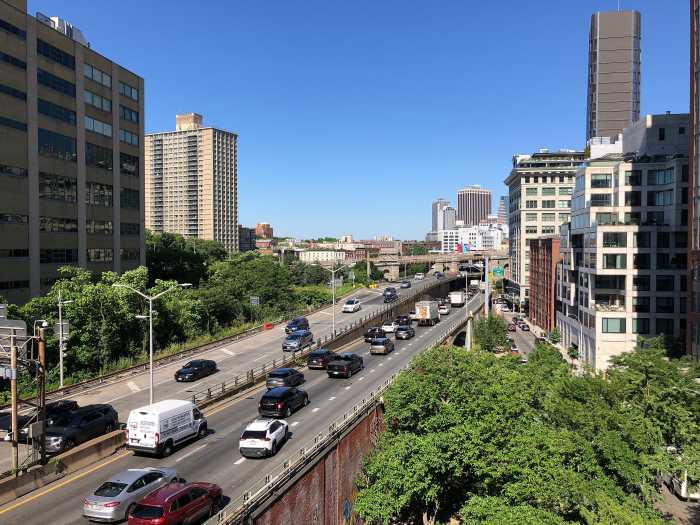
De la Uz suggested dismantling the Brooklyn-Queens Expressway to create more space in the borough, citing Syracuse’s removal of Interstate 81 as a model. She also encouraged land banking, using Brooklyn’s bus depots as an example — though she acknowledged those sites are currently located above gas stations.

brooklyn-queens expressway
One panelist suggested dismantling the BQE to create more space in the borough. Photo courtesy of Famartin/Wikimedia Commons

Rainey called on the government to invest more in nonprofits and allow them to take the lead on community service work, rather than relying on government officials and agencies. She also advocated for better salaries and hourly wages.

Chen highlighted the need to address SNAP benefit theft by modernizing EBT cards with security chips, similar to those found in debit and credit cards.

But Pinnock urged both the panel and the broader symposium not to overlook Brooklyn’s middle-class residents, who are leaving the borough in large numbers.

“You cannot build an economy without the middle class,” Pinnock said, as several audience members applauded. “The greatest way to close the racial wealth gap is homeownership. There must be true thought leadership, investment, and incentives in homeownership.”

Talking politics

Eli Dvorkin closed out the symposium with a conversation featuring City Council members Crystal Hudson  and Rita Joseph, along with Brooklyn Borough President Antonio Reynoso. He posed the same question that had guided the day’s discussions — how to create a stronger and more equitable Brooklyn — but with a more political lens.

The trio spoke about Brooklyn’s role within New York City and how citywide policies, in turn, affect the borough. In addition to discussing business and housing opportunities, the panel raised political concerns they believe are holding Brooklyn back — including the level of funding the NYPD receives compared to investments in business development and affordable housing.

They also addressed this year’s city elections and what the next mayor must do to help Brooklyn reach its full potential.

Without naming Mayor Eric Adams directly, Reynoso said his election — during a period of heightened concern about crime — shifted the city’s focus away from investing in economic opportunities that could have benefited the borough. He also voiced frustration with voters’ tendency to elect representatives who fail to deliver meaningful change.

exterior of Sunset Park Library
Local elected officials said more money should be invested for affordable housing and business development. File photo courtesy of the Brooklyn Public Library

“We’ve just got to elect better people, and we don’t,” he said. “We have people that are the same. It’s all sameness all the time. We just continue the same patterns, and at some point, it just becomes our fault. At the same point, you just wake up or keep doing it. I just think we’ve got to be more bold and think differently.”

Hudson emphasized the need for affordable housing for older Brooklynites, such as Baby Boomers, who will require accessible features in the homes they’ve lived in for decades.

“No one wants to talk about older adults,” she said. “Not everybody gets the opportunity to grow old. And if you’re extra lucky, then you get to do so right here in New York City. But it’s difficult to do that.”

On the topic of business development, Joseph called for a digital literacy plan and proposed teaching artificial intelligence to all public school students. Borough President Reynoso urged the city to revisit outdoor dining, noting its popularity among diners and the success it brought to restaurants.

The crowd speaks up

Between panels, 45 minutes were set aside for audience members to pitch their ideas for businesses, nonprofit initiatives, and community-based incentives to help build a stronger Brooklyn.

Suggestions included transforming block parties into opportunities for community symposiums, connecting residents with local nonprofits for resources, and developing new neighborhood programs. One woman proposed helping migrants get their college degrees from their home countries verified, so they can work in their trained fields instead of being relegated to low-wage jobs. Another speaker criticized City Council members for prioritizing corporate interests over the needs of residents, particularly Black Brooklynites.

Juan Serraty, a Bushwick resident who isn’t a business owner but hopes to become more active in his community, pitched the idea of creating more coworking spaces. He said he’s noticed many people working on laptops in coffee shops, which can discourage others who just want a place to meet with friends. Still, he acknowledged that coworking spaces are often too expensive for many Brooklynites.

“The city needs to help fill the gap and subsidize coworking space,” Serraty said. “They can be low-cost, city-owned spaces that are open to the community and support and partner with other businesses.”

What comes next

The symposium’s thoughtful discussion left Flatbush resident Kalilah Moon feeling inspired. As executive director and CEO of Drive Change, a nonprofit that provides job training for formerly incarcerated people, she saw hope in the ideas shared and a path forward for Brooklyn’s future.

“There are great conversations on how to improve our great borough,” she said. “I’m glad people are not shying away on how we can grow as a borough. We need to imagine more. There’s so much I took away from this.”

Jonathan Knowles told Brooklyn Paper he felt inspired by the symposium and is looking forward to the next steps in making Brooklyn a better place to live and work.

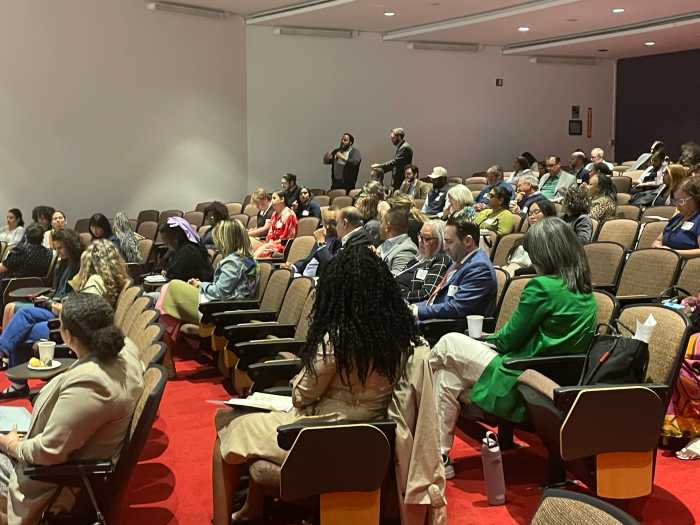
Attendees listen intently as Brooklyn leaders, advocates, and residents pitch bold ideas for building a stronger, more equitable borough at Tuesday’s symposium hosted by the Center for an Urban Future. Photo by Megan McGibney

“I’m optimistic about the borough’s future,” he said. “This borough is full of smart people with innovative ideas. Now we need to get the ideas in front of the government. We’re going to figure out and select the ideas and then meet with electeds and civic foundations.”

Knowles clarified he was referring to city, state and federal governments, to which the Center for an Urban Future will present these proposals for Brooklyn’s future.

“This is a good start,” he said. “There are so many to choose from, there’s no shortage of good ideas. Now let’s try to advance them.”


Categories
Brooklyn

Brynn Whitfield first Real Housewife of NYC to exit amid cast shakeup rumors


According to Andy Cohen, “Bravo execs met with 10 potential new Real Housewives of New York” — so Whitfield may not be the only current cast member leaving.

Categories
Brooklyn

NYPD to install more cameras around Upper Manhattan with security funding from Espaillat


Categories
Brooklyn

At least 24 arrested at ICE protest inside Manhattan’s Trump Tower


The protesters, expected to be charged with trespassing, started gathering around noon inside the famed Fifth Ave. tower, police said.

Categories
(@mikenov) / Twitter

US Counterintelligence: Problems and Solutions


US Counterintelligence: Problems and Solutions – Google Search google.com/search?q=US+Co…

Categories
Brooklyn News

Brooklyn educator becomes first NYC educator to win Tony for Theatre Education


A Brooklyn teacher made Broadway history this weekend — not for directing a show or performing on stage, but for shaping the next generation of artists in a Bed-Stuy classroom. 

On June 8, Gary Edwin Robinson, longtime head of the theatre arts program at Boys and Girls High School, became the first New York educator to receive the Tony Award for Excellence in Theatre Education.

The prestigious national honor, presented annually by the Tony Awards and Carnegie Mellon University, recognizes a K-12 theatre educator “who embodies the highest standards of the profession and demonstrates a positive impact on the lives of students, advancement of the theatre profession and a commitment to excellence.”

Established in 2014, the award is selected by a panel of representatives from the American Theatre Wing, the Broadway League, Carnegie Mellon and other industry leaders. Past recipients have come from across the country — but never from New York, the home of Broadway itself.

Robinson, who goes by Edwin, is a beloved mentor to generations of students. His classroom is known not only for its performances, but for its commitment to real-world industry exposure. According to Playbill, he regularly connects students with professionals for shadowing opportunities and arranges trips to “see shows on Broadway and Off-Broadway, feature films and college tours.”

Gary Edwin Robinson, longtime head of the theatre arts program at Boys and Girls High School in Brooklyn, was honored Sunday, June 8 with the Tony Award for Excellence in Theatre Education.REUTERS/Jeenah Moon

In a statement, Carnegie Mellon President Farnam Jahanian praised Robinson’s work.

“Edwin’s dedication to empowering the next generation of artists, both on and off the stage, is both profound and inspiring,” Jahanian said. “Carnegie Mellon University is thrilled to help recognize his impact in arts education and to celebrate his record of equipping students with the skills, confidence and community needed for lifelong success.” 

For Robinson, the honor came as a surprise. 

“When they told me [about the award], I was shocked,” he said backstage at the ceremony. “I am so honored to receive this, and shocked that I’m getting an award for going to work and enjoying what I do.” 

In addition to national recognition, the award includes a $10,000 grant for the theatre program at Boys and Girls High School and a masterclass taught by Carnegie Mellon drama professors for his students.

“Theatre is what propels me to get up everyday and go into school,” he said. “The base is all about theatre and passing my passion on to the students.” 


Categories
Brooklyn

Broadway is BACK! Our theatre community embodies the spirit of New York: Bold, brilliant, unforgettable. Congrats to all of this season’s @TheTonyAwards nominees and winners! pic.twitter.com/WR3padLdaW


Categories
Brooklyn News

Longtime Brooklyn Heights resident and civic activist wins kudos for revival of Randall’s Island


Randall’s Island bloomed thanks in part to Diane “Pinky” Keehner, who led its revival and recently a novel about restoring two statues there.

The post Longtime Brooklyn Heights resident and civic activist wins kudos for revival of Randall’s Island appeared first on Brooklyn Eagle.


Categories
Brooklyn

Judge dismisses Justin Baldoni’s $400M countersuit against Blake Lively


A judge dismissed Justin Baldoni’s lawsuits against Blake Lively, Ryan Reynolds and the New York Times on Monday.