Categories
Brooklyn News

‘Daylighting’ savings time in NYC: DOT to redesign intersections to limit vehicle parking and improve cyclist safety


The NYC Department of Transportation (DOT) will redesign intersections throughout the city to improve pedestrian and cyclist safety, the agency said on Wednesday.

The design will incorporate a new “hardened daylighting” approach, featuring physical structures such as barriers, granite blocks and planters in the street to prevent vehicle parking near corners. 

DOT officials say nearly 50% of all traffic fatalities occur in intersections, so the new design aims to improve visibility between pedestrians, cyclists and turning vehicles. 

“Redesigning our streets under Vision Zero has helped us reduce traffic deaths to historic lows—but we are always looking for new ways to keep people safe,” NYC DOT Commissioner Ydanis Rodriguez said. “Using barriers to clear space at the intersection will help ensure pedestrians, cyclists and turning vehicles can see each other and enhance safety. We look forward to rolling out the design at high-crash locations starting this year.”

Rollout in Brooklyn
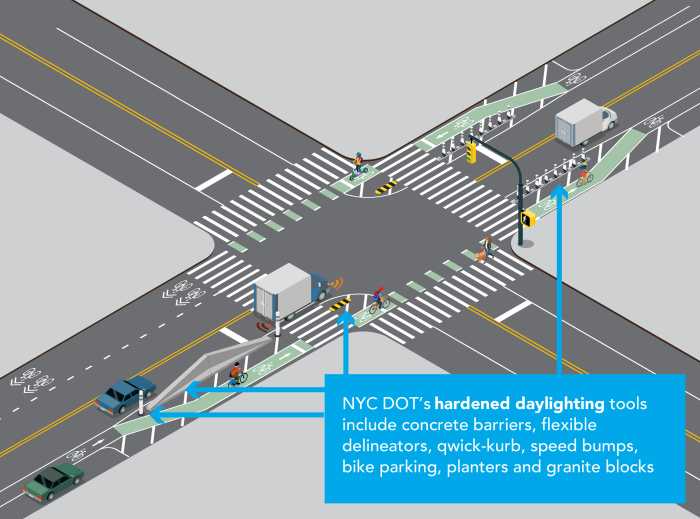
DOT plans to incorporate a new hardened daylighting design for high-crash intersections along new and existing conventional bike lanes.Credit: NYC DOT

The agency plans to roll out the plan at a limited number of specific high-crash intersections along new and existing conventional bike lanes across the city starting in 2025. Initial locations are in Brooklyn and include:

  • Ocean Avenue at Church Avenue
  • Ocean Avenue at Avenue J
  • Ocean Avenue at Cortelyou Road
  • Ocean Avenue at Foster Avenue
  • Avenue J at Bedford Avenue
  • Rugby Road and Foster Avenue

The locations were chosen based on several criteria, including in Tier 1 and Tier 2 priority investment areas as defined by the city’s Streets Plan. These are areas that have seen “historic underinvestment” in safe street infrastructure, new or existing conventional bike lanes with a history of turning crashes, or locations with a high number of truck turns.

The agency explained that the plans will be “context-specific” and have limitations based on the layout of the intersection.

The DOT’s daylighting study from Jan. 17 showed safety benefits tied to hardened daylighting, though the agency said it will monitor installations for efficacy and safety.

amNewYork reached out to several transportation safety organizations for their comments on the plan.

Jackson Chabot, director of advocacy and organizing at Open Plans, applauded DOT’s effort, but said more needs to be done in terms of passing legislation to add more safety measures at intersections. 

“We always like to see DOT rethinking intersections, especially the very dangerous ones. And any project that builds in daylighting is going to be a win for us,” Chabot said. “But what’s really on our wish list is Intro 1138, which would mandate 1,000 hardened intersections a year. That pace is going to get us there much quicker. Again, this is a great first step or option for some areas. But we’d love to see some simpler hardening at a quicker pace. Our hope is that Intro 1138 can provide a way to achieve that.”

But Janet Schroeder, co-founder of the NYC e-Vehicle Safety Alliance, said the DOT should focus more on the safety of those who are hit by e-bikes “as they do on grabbing up as much street space as possible,” citing “block-long” Citi Bike racks and bike lane expansion.

“None of this changes the egregious rider behavior of e-vehicle riders who continue to ride with complete impunity,” she said. “DOT should also stop quoting completely skewed e-vehicle crash statistics because the majority of e-vehicle crashes with injuries aren’t reported.”

Meanwhile, according to the NYPD, collisions involving all vehicles, including bikes and motorized two-wheelers, are down year to date, from 39,350 in 2024 to 35,110 this year. 

Categories
Brooklyn News

Ranked-choice voting: A refresher on how the system works ahead of the June 24 primary in NYC


What exactly is ranked-choice voting? How does it work? And how do I get the most out of it?

If you have found yourself asking any of these questions with the June 24 primary election less than two weeks away, and early voting kicking off this Saturday, then you have come to the right place.

This year’s high-stakes Democratic and Republican primaries will once again utilize the city’s little-tested ranked-choice voting system. The races include those for mayor, city comptroller, public advocate, borough president, and City Council.

What is ranked-choice voting?

Ranked-choice is only used in city primaries and special elections, while the general election still employs the plurality model — where the candidate who nabs the most votes wins outright. It also does not apply to state-level positions, including district attorneys and judgeships.

Voters approved the model via a 2019 citywide ballot referendum that was advanced by that year’s City Charter Review Commission. This will only be the second citywide and third City Council elections to utilize the voting method.

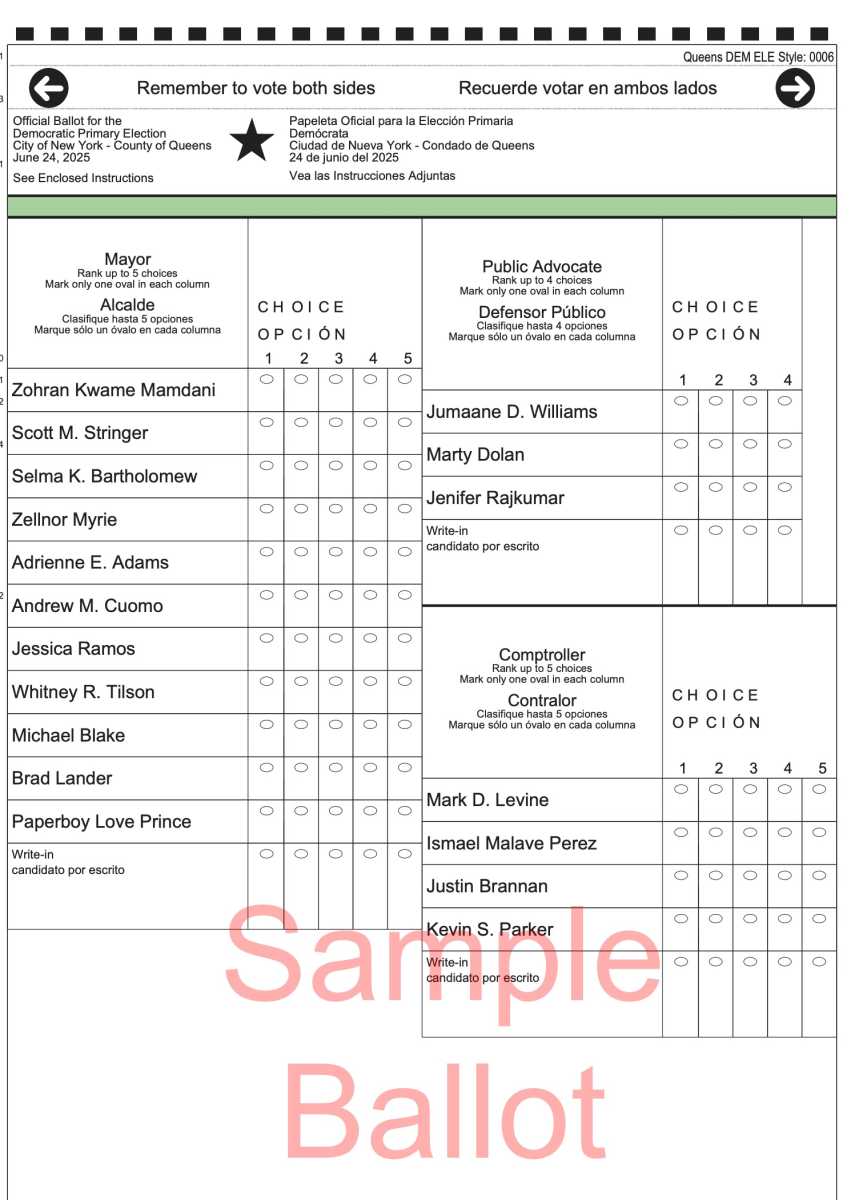
Sample of a ranked-choice voting ballot in the 2025 Democratic primary for NYC.

What is the purpose?

Ranked-choice was intended to make elections more Democratic, by eliminating what is known as vote-splitting — whereby candidates who share some similarity draw votes away from one another. It was also aimed at cutting costs by avoiding runoff elections, a second election that is held when no candidate cracks 40%.

How does it work?

The system allows voters to rank up to five candidates in their order of preference, with number one being their top pick and number five their bottom choice. Voters can fill in as many of the five spots as they prefer and are not required to rank more than one candidate. If you don’t want a particular candidate, do not rank them.

If any candidate nabs over 50% of the votes received by Election Night — including Election Day, early, and some mail-in votes — they will automatically win. However, if no contender reaches a majority of first-place ballots in round one, the contest goes to additional stages of vote tallying.

At the end of each round, the lowest vote-getter is dropped from consideration and their votes go to whoever was put second on ballots cast for them. That process continues until one candidate crosses the 50% threshold.

Will we know who wins right away?

Not necessarily. According to the city BOE, RCV tabulations will not commence until one week after Election Day if no candidate wins outright. They will continue to be conducted as more mail-in and affidavit ballots are received and cured. The BOE will not declare a winner until it has received and counted all of the ballots.

How have people used ranked-choice voting? 

Many elected officials and organizations have embraced ranked-choice this cycle — endorsing ranked slates of candidates instead of picking just one.

For instance, those opposed to frontrunner mayoral candidate Andrew Cuomo, including the New York Working Families Party, have released ranked-rosters of candidates in an effort to shut the former governor out. The so-called “Don’t Rank Evil Andrew for Mayor” (or DREAM) campaign is simply urging voters not to rank Cuomo, while not backing a particular slate.

Ranked-choice also allows for like-minded candidates to form alliances by encouraging their voters to select rivals second. In 2021, then-candidate Andrew Yang told his supporters to rank former city Sanitation Commissioner Kathryn Garcia second, though Garcia did not return the favor.

This year, the only candidate to cross-endorse thus far is state Sen. Jessica Ramos — who told her voters to cast their ballots for Cuomo. However, Ramos is essentially throwing all of her support behind Cuomo, even though she will still be on the ballot, and the former governor did not endorse her in return.


Categories
Brooklyn News

Interfaith Pride Service at historic synagogue canceled; low enrollment and conflict over Zionism are blamed


The cancellation of a Pride interfaith service is being blamed on lack of involvement and on disagreements on the Israel-Palestine conflict.

The post Interfaith Pride Service at historic synagogue canceled; low enrollment and conflict over Zionism are blamed appeared first on Brooklyn Eagle.


Categories
Brooklyn

RT by @mikenov: BREAKING: U.S. orders evacuation of family members and non-essential personnel from its embassies in Iraq, Bahrain, and Kuwait. pic.twitter.com/BC1eoCVNON


Categories
(@mikenov) / Twitter

RT by @mikenov: BREAKING: U.S. orders evacuation of family members and non-essential personnel from its embassies in Iraq, Bahrain, and Kuwait. pic.twitter.com/BC1eoCVNON


Categories
Brooklyn News

Two men sentenced to prison for aggravated identity theft and computer hacking crimes


Two men got prison time for hacking a federal law enforcement portal, stealing personal data and extorting victims through a doxing scheme.

The post Two men sentenced to prison for aggravated identity theft and computer hacking crimes appeared first on Brooklyn Eagle.


Categories
Brooklyn

The Civilian Complaint Review Board is tasked with investigating police misconduct. brooklyneagle.com/articles/2025/…


Categories
Brooklyn News

Beloved $2.99M Brooklyn Victorian that appeared multiple times on film and TV seeks its next act


What do “Blue Bloods” and “Boardwalk Empire” have in common? They, and more, have shot at 500 E. 18th St.

Categories
Brooklyn

Trump’s $45M military parade on track despite GOP grumbles about cost


The Army expects up to 200,000 people could attend and says the parade could cost up to $45 million.

Categories
Brooklyn News

FARE ACT, now in effect, bars landlords from passing broker fees onto tenants


THE FAIRNESS IN APARTMENT RENTAL EXPENSES (FARE) ACT, WHICH prohibits landlords from passing broker fees on to tenants, is now in effect.

The post FARE ACT, now in effect, bars landlords from passing broker fees onto tenants appeared first on Brooklyn Eagle.