khamenei – Google Search https://t.co/fMO3LgAlvB
AI Mode
khamenei
second and current Supreme Leader of Iran, a position he has held since 1989. He is considered the highest political and religious authority in the country. He also served as the third President of Iran from 1981…— Michael Novakhov (@mikenov) June 18, 2025
Day: June 18, 2025

us iran talks – Google Search https://t.co/FWsk6xzXrD https://t.co/dXlC6b98Fg
— Michael Novakhov (@mikenov) June 18, 2025
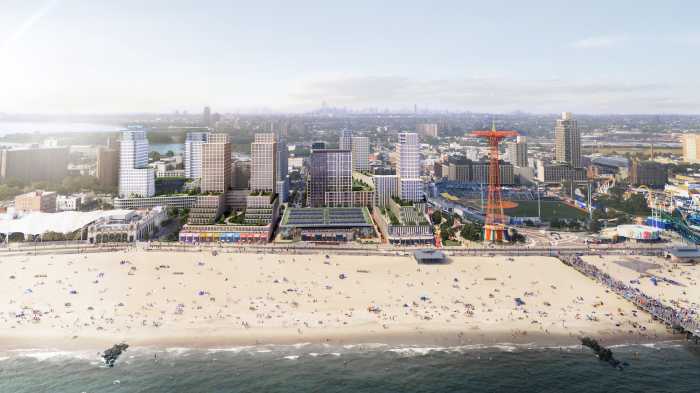
Coney Island will soon get around 700 new affordable homes as part of a sweeping plan to revitalize the area, Mayor Eric Adams announced Tuesday.
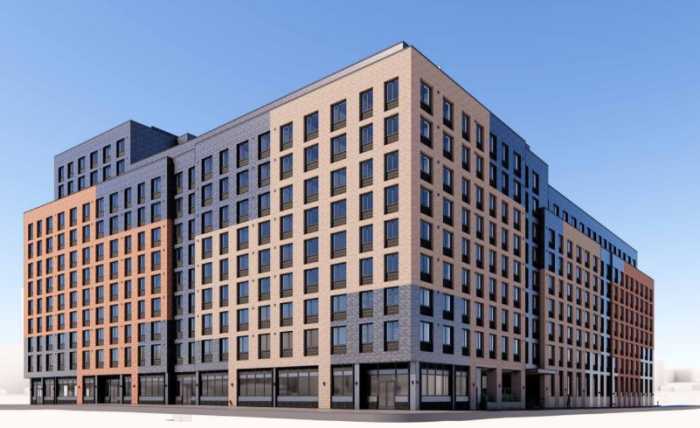
The city is partnering with a private developer to build 420 homes, supported by a $90 million subsidy from the Adams administration and a $116 million loan from the Housing Development Corporation. It will also work with the nonprofit Settlement Housing Fund to develop 178 affordable and supportive housing units as part of the Coney Landing project.
The announcement is the third phase of Adams’ vision for Coney Island, which aims to build approximately 1,100 homes in the area and reinvigorate public infrastructure within the next three years. As part of that vision, the city is investing in new streets, sewers and public realm improvements on the peninsula, including a $42 million renovation of the Abe Stark Sports Center.
He said in a statement that the development aims to invite more families into the “iconic” area.
“Along with tens of millions of dollars for new streets, sewers, and a renovated ice rink, these homes will make sure that Coney Island is not only a great place for families to spend time together but also a great place to live as well,” Adams said.
The NYC Economic Development Corporation will also find a developer to build 500 homes — including 125 affordable units — on a city-owned lot on Surf Avenue.
The first two phases of Coney Island’s revitalization included affordable housing units alongside office buildings for city agencies and open retail space.
Settlement Housing president Judy Herbstman said the partnership will help tackle the city’s lack of affordable housing.
“Settlement Housing Fund is incredibly proud to partner with HPD and HDC on this impactful project, which will bring 178 much-needed affordable and supportive homes to Coney Island, replacing a surface parking lot with a resilient new 15-story development,” Herbstman said.
“This project stands as a powerful response to the strong need for more affordable housing across New York City,” she added.
Debates over affordable housing have dominated the mayoral race, with many Democratic primary candidates running on it as a top issue and often criticizing Adams’ housing record.
In a statement Tuesday, Adolfo Carrion Jr., deputy mayor for housing, economic development and workforce, defended the Adams administration’s housing achievements.
“These are more than just numbers in a press release,” Carrion said. “These are real homes where families will develop and grow. They are the reason this work is so important and the reason we are proud to call ourselves the most pro-housing administration in New York City history.”
Ahmed Tigani, acting commissioner of the NYC Department of Housing Preservation and Development (HPD), said the housing is
“Today, our administration is not just making progress — we’re building momentum,” Tigani said. “From Inwood to Coney Island, HPD and the entire Adams administration is driving forward with a deep commitment to creating a fairer, more accessible city across every zip code.”
Former Gov. Andrew Cuomo is still the frontrunner in the June 24 Democratic primary to replace Mayor Eric Adams amid early voting and with Election Day fast approaching.
Cuomo, who is seeking a political revival after stepping down in 2021 following nearly a dozen sexual misconduct allegations that he denies, has dominated the packed Democratic primary field since entering the race on March 1. But he is facing a serious challenge from Queens Assembly Member Zohran Mamdani, a Democratic socialist polling who has been consistently polling in second place for weeks.
Mayor Adams is not participating in the Democratic primary, opting to run as an independent in the general election instead. He and Cuomo are likely to face off in the next leg of the election.
The moderate Cuomo has led by double digits in most public and private polls, swept up support among institutional elected officials and labor unions, and attracted millions of dollars in campaign donations. Cuomo says he is the only candidate with the experience to “save a city in crisis,” often pointing to his record of building massive infrastructure projects, such as the redevelopment of LaGuardia Airport, over his 11 years as governor.
Yet Cuomo’s primary opponents, along with many progressive politicians and organizations, say he has no business being mayor. They argue that the scandals preceding his resignation, which also include his handling of COVID-19 in nursing homes and many of his policies as governor that they say hurt rather than helped the city, should be “disqualifying.”
Cuomo also faced significant criticism during his campaign for only recently moving back to the city for the first time in decades, accepting contributions from many deep-pocketed donors—several of whom also give to President Trump—and preliminary findings of illegal coordination between his campaign and the super PAC supporting it, “Fix the City.” His campaign says it followed campaign finance law.
Several members of the amNewYork team sat down with Cuomo at the Lafayette Grand Cafe for a June 16 interview to get a better sense of how he would tackle some of the key issues affecting the city as mayor — from immigration to the city’s housing crisis.
Immigration and Trump
Amid the aggressive escalation in President Trump’s push to deport undocumented immigrants, and Mayor Adams’ pledge to work with the feds on criminal probes involving new arrivals, Cuomo pledged to uphold the city’s Sanctuary laws. The statutes bar the city from cooperating with federal Immigration and Customs Enforcement (ICE) on most non-criminal matters.
Cuomo said he would do away with Mayor Adams’ executive order allowing ICE to reestablish offices on Rikers Island for criminal investigations. The City Council challenged the order in court and has so far succeeded in stopping it from taking effect.
“You cannot pass an executive order that is inconsistent with the law,” Cuomo said, referring to the order potentially violating the city’s Sanctuary laws.
Cuomo repeated widespread allegations that Adams has “made a deal with Trump” — contending he agreed to cooperate with the president’s immigration crackdown in exchange for the Justice Department dropping his federal corruption case. Adams denies the allegation and insists he only works with the Trump administration on criminal probes and not most deportation cases, which are largely civil matters.
Trump’s administration has also begun arresting undocumented immigrants inside federal immigration courts in the city when new arrivals attend mandated court hearings. Similar ICE actions in Los Angeles have sparked mostly peaceful protests there, prompting Trump to call in the National Guard and several hundred US Marines to quell those demonstrations.
Trump has threatened to take similar actions in New York and other Democratic-run cities where protests against ICE detainments have escalated.
Without going into many specifics, Cuomo said he doesn’t believe Trump would be able to do the same thing in New York if he is elected mayor. He charged that Trump is picking fights with Democratic-run cities over immigration simply to score “political points.”
But Cuomo insisted that if he is elected mayor, Trump will not be able to run roughshod over New York like he did with LA.
Cuomo argued that is because he knows how to fight Trump from the times the two clashed amid the COVID-19 pandemic during the president’s first term while he was still governor. However, he said it will require waging “a real legal, PR war” against the president.
“I had wars with him every day on COVID. I did that briefing in the morning. He would then call me up. ‘You did this, you said this, you said this,” Cuomo said, referring to Trump calling him after his daily televised briefings during the early months of the pandemic in 2020.
Cuomo’s rivals, however, contend that he would not stand up to Trump, given the large contributions both his campaign and Fix the City have received from Trump donors. Additionally, they criticize Cuomo for being more reluctant to criticize Trump than most other candidates in the early days of the election.
They also allege that Cuomo could be compromised in a similar way to Adams by a Trump DOJ investigation into whether he lied to Congress last fall about his role in editing a report that undercounted COVID-19 nursing home deaths.
Cuomo said that would not happen because it is a “silly charge.”
Housing
The city is in a generational housing crisis that has seen rents skyrocket and left just 1.4% of apartments available to lease. The issue has become one of the central focuses of local elected officials in recent years and has taken center stage in the mayor’s race.
One area where mayors can exert a great deal of influence over the cost of housing is through their appointments to the Rent Guidelines Board, a nine-member independent panel that votes annually on rent increases for the city’s roughly one million stabilized tenants. Mamdani, along with some of Cuomo’s other progressive challengers, have committed to freezing rents for stabilized tenants if they are elected by appointing board members who would vote in that direction.
The RGB has voted for rent freezes three times, all under former Mayor Bill de Blasio. The current mostly Adams-picked board has opted to raise rents every year that he has been in office.
Cuomo instead said he wants to appoint “fair people who understand the industry.” While he has not yet “thought through” who he would specifically appoint to the board, he indicated looking to housing experts from academic institutions, who will make their decisions based on the costs for tenants and landlords.
“There are credible organizations that know housing and know economic development…that can make a fair determination,” Cuomo said.
Cuomo, who served as US Secretary of Housing and Urban Development under former President Bill Clinton, has pledged to build 500,000 new units of housing over the next decade as mayor without specifying how many would be “affordable.”
To meet that goal, Cuomo said he will find ways to circumvent the city’s byzantine land-use process. One avenue for doing so, he said, would be bypassing the city Department of Housing Preservation and Development (HPD)—an agency charged with financing affordable housing construction, enforcing tenant protections, and administering some rental assistance programs—and instead running housing development directly through the mayor’s office.
“I would just take control of it directly and make it a massive initiative,” Cuomo said. “[For] every city-owned piece of property, put out an RFP (request for proposals) that says, ‘Whatever you have, come talk to me about it. Let’s see if we can make a deal.'”
He did not specify exactly how he would build housing through the mayor’s office instead of HPD, which he has argued has too much red tape that slows the pace of building desperately needed units.
Tenants advocates are skeptical of Cuomo’s stance on housing.
According to a published report, he recently drew the ire of some elected officials and advocates by saying he wants to significantly reconfigure HPD during the first Democratic mayoral debate earlier this month. They argue the move would be a gift to the real estate industry and could lead to the erosion of tenant protections and rent regulations.
The former governor has also been slammed by housing advocates as “your landlord’s favorite mayoral candidate,” due to the large sums that real estate titans and landlord groups have contributed to Fix the City.
Antisemitism
Antisemitism in the five boroughs, home to the largest Jewish population outside of Israel, has become another pivotal issue in the mayor’s race.
The topic has become especially prominent in the wake of the nearly two-year Israel-Hamas war. The conflict, which has killed over 1,200 Israelis and at least 50,000 Palestinians, has sparked numerous protests against Israel’s bombardment of Gaza. Those demonstrations have, in turn, drawn accusations of antisemitism against pro-Palestine protesters.
Cuomo and Mayor Adams have both framed antisemitism as one of the greatest threats currently facing the city and are jockeying to be seen as the candidate fighting hardest on behalf of the city’s Jewish population. The former governor called antisemitism “the most serious and the most important issue” of the campaign during an April speech at an Upper West Side synagogue, and Adams is running on the “EndAntisemitism” ballot line in November.
Both have slammed Mamdani for his past support of the “boycott divestment and sanctions” (BDS) movement as well as his use of the term “genocide” to describe Israel’s military offensive in Gaza. Mamdani has countered those attacks by saying he plans to invest more in combating hate crimes, including antisemitic incidents, than any other candidate.
When it comes to Adams, Cuomo argued the current mayor is all talk and has taken little action on antisemitism. Adams recently launched a new office, staffed by one person, devoted specifically to combating antisemitism and signed an executive order adopting the controversial International Holocaust Remembrance Alliance’s definition of antisemitism.
But Cuomo waved away those actions as performative and said Adams should be more aggressively going after pro-Palestine protesters at Columbia University. He claimed that some of their actions have risen to the level of hate crimes that should be prosecuted, even though prosecuting crimes is not a power afforded to the mayor.
“Politically, it is very sensitive because there are mixed opinions on all of this, obviously, but it’s not about the politics; it’s about the law,” Cuomo said.
“I think he says the right things, but it’s about what you do,” he said of Adams. “And enforcing the law is a start.”
The former governor pointed to his record on the issue as governor.
“I was the most aggressive governor in the United States on behalf of Israel,” Cuomo said. “I passed an executive order saying, ‘if you boycott Israel, New York boycotts you.’ Every time Israel was attacked, I went. I passed the strictest hate crimes law in the United States.”
Cuomo, who has recently received the backing of several prominent Brooklyn and Queens Orthodox Jewish groups, said he is not concerned about having to fight with Adams for their support in the general election if he wins the primary.
“No, because I think Jewish New Yorkers get it,” Cuomo said. “Yes, he (Adams) has said the right things, but what has he done?”