Categories
Brooklyn News

Tall order: Brooklyn’s Smith-9th Streets station, city’s highest, to get elevators


New York City’s tallest subway station will soon have elevators, ending the daunting climb to the platform, state officials announced Friday.

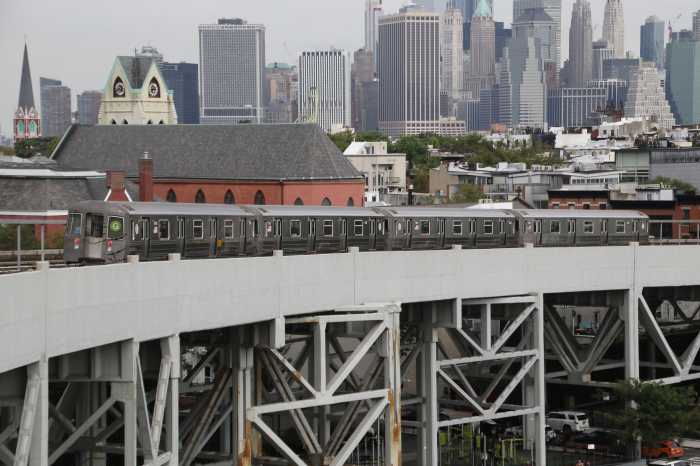
The Smith-9th Street stop in Gowanus — the tallest station in the city and one of the tallest in the world — rises nearly 90 feet above ground. It lacks elevators and efficient escalators, making accessibility difficult for many New Yorkers, including people with disabilities, seniors and commuters carrying packages.

That’s about to change. State Sen. Andrew Gounardes, who represents the area, said Aug. 8 the station will get elevators as part of the Metropolitan Transportation Authority’s approved $68.4 billion capital plan for 2025-2029.

“Every day, New Yorkers hike the stairs up this station like they’re climbing Mount Everest, struggling to catch the train on time. And if you use a wheelchair, push your child in a stroller, travel with luggage or simply struggle climbing the stairs, forget about it,” Gounardes said. “With elevators coming to the Smith-9th Street station, that’s finally going to change.”

The MTA did not say when the elevators would open at the 92-year-old station. The announcement comes a month after the July 8 opening of the fully ADA-accessible Bay Ridge-95th Street station in Brooklyn.
g train cars
An aerial view shows the Smith-9th Street subway station towering over Gowanus. Photo courtesy of Mtattrain/Wikimedia Commons

Assembly Member Jo Anne Simon praised the MTA for making accessibility a priority in its capital plan, noting that Smith-9th Street has a “long history” of escalators breaking down.

“Adding elevators to the station is a huge win for transit equity and for the thousands of riders who rely on this stop every day,” Simon said. “Climbing the tallest station in the system shouldn’t be an endurance test. I commend the MTA for making accessibility a priority in the Capital Plan, especially at tough stations like Smith-9th that present greater challenges than most.”

Officials said the upgrades will push the subway system to more than 50% accessibility.

“No station better demonstrates the need for accessibility than Smith-9th Street, the highest point in the entire subway system, and we’re excited to start work there and throughout the borough soon,” said MTA Chief Accessibility Officer Quemuel Arroyo.

The MTA has to meet a court-approved settlement to ensure that 95% of NYC’s subway stations are ADA-accessible by 2055.

A version of this story first appeared on Brooklyn Paper’s sister site amNewYork


Categories
Brooklyn

Tall order: Brooklyn’s Smith-9th Street station, NYC’s tallest, to get elevators


The Smith-9th Street stop in Gowanus — the tallest station in the city and one of the tallest in the world — rises nearly 90 feet above ground. It lacks

Categories
Brooklyn News

Tall order: Brooklyn’s Smith-9th Street station, NYC’s tallest, to get elevators


New York City’s tallest subway station will soon have elevators, ending the daunting climb to the platform, state officials announced Friday.

The Smith-9th Street stop in Gowanus — the tallest station in the city and one of the tallest in the world — rises nearly 90 feet above ground. It lacks elevators and efficient escalators, making accessibility difficult for many New Yorkers, including people with disabilities, seniors and commuters carrying packages.

That’s about to change. State Sen. Andrew Gounardes, who represents the area, said Aug. 8 the station will get elevators as part of the Metropolitan Transportation Authority’s approved $68.4 billion capital plan for 2025-2029.

“Every day, New Yorkers hike the stairs up this station like they’re climbing Mount Everest, struggling to catch the train on time. And if you use a wheelchair, push your child in a stroller, travel with luggage or simply struggle climbing the stairs, forget about it,” Gounardes said. “With elevators coming to the Smith-9th Street station, that’s finally going to change.”

The MTA did not say when the elevators would open at the 92-year-old station. The announcement comes a month after the July 8 opening of the fully ADA-accessible Bay Ridge-95th Street station in Brooklyn.

g train cars
An aerial view shows the Smith-9th Street subway station towering over Gowanus.Photo courtesy of Mtattrain/Wikimedia Commons

Assembly Member Jo Anne Simon praised the MTA for making accessibility a priority in its capital plan, noting that Smith-9th Street has a “long history” of escalators breaking down.

“Adding elevators to the station is a huge win for transit equity and for the thousands of riders who rely on this stop every day,” Simon said. “Climbing the tallest station in the system shouldn’t be an endurance test. I commend the MTA for making accessibility a priority in the Capital Plan, especially at tough stations like Smith-9th that present greater challenges than most.”

Officials said the upgrades will push the subway system to more than 50% accessibility.

“No station better demonstrates the need for accessibility than Smith-9th Street, the highest point in the entire subway system, and we’re excited to start work there and throughout the borough soon,” said MTA Chief Accessibility Officer Quemuel Arroyo.

The MTA has to meet a court-approved settlement to ensure that 95% of NYC’s subway stations are ADA-accessible by 2055.

A version of this story first appeared on Brooklyn Paper’s sister site amNewYork


Categories
Brooklyn News

Inside Government with PoliticsNY: A Q&A with Assembly Member Simcha Eichenstein


Today we are launching our newest series, Inside Government with PoliticsNY! Inside Government is a Q&A series that will give New Yorkers a glimpse inside the role of the elected officials who represent them. Our first Q&A features Assembly Member Simcha Eichenstein. Assembly Member Eichenstein represents the 48th Assembly District in Brooklyn which includes the neighborhoods of Borough Park and Midwood.

Q: What piece of legislation are you most proud to have passed this legislative session?

A: I’m proud of my role in leading the effort to clearly define substantial equivalency for non-public schools in the state budget. As a proud yeshiva graduate, this issue is deeply personal to me. After years of advocacy and near breakthroughs, we were finally able to bring it across the finish line. With non-public schools under increasing scrutiny, securing their autonomy, while providing a quality education, was a top priority of mine from day one.


Q: How does your office work to support your constituents in their day-to-day lives?

A: While legislation is a major part of my role as an assembly member, I also focus on helping constituents navigate government bureaucracy. My team and I work daily to resolve people’s issues and sometimes just a phone call or guidance can make a huge difference. I’m especially proud when a constituent stops me on the street just to say thank you. That personal connection is the most rewarding part of public service.


Q: What is the most prevalent issue facing your constituents and how are you working to resolve it?

A: The most prevalent issue facing my constituents is the alarming rise in antisemitism. This is deeply disturbing and frightening, especially for my Jewish constituents. While there’s no simple solution, I work closely with law enforcement and have brought Holocaust survivors to local schools to promote education and tolerance. Combating hate requires ongoing effort, and I’m committed to using every available resource to raise awareness and ensure the safety of the people I represent.


Q: What do you hope to accomplish by the end of 2025?

A: In 2025, I hope to see my bill (A2693) signed into law. This legislation protects New Yorkers, including Sabbath observers, from unjust sanitation fines for placing their trash out on Friday afternoon. The bill passed both houses and I’m optimistic the Governor will sign it. It will represent a win for Sabbath observers as well as all New Yorkers who go away for the weekend and deserve to return home without incurring costly penalties.


Q: What is the proudest moment of your political career?

A: Thankfully, there have been many. While I’m very proud of my numerous legislative accomplishments, that’s not necessarily what comes to mind first. Rather, I’m reminded of the moment when a mother came to thank me for helping save her baby’s life, after we arranged an emergency transfer to a specialized out-of-state hospital better equipped to treat the child’s serious condition. It’s a moment I’ll always cherish – and a powerful reminder of why I do this work.


Categories
Brooklyn

Mayor Adams and NYPD Commissioner Tisch Expand Quality of Life Teams Across All of Queens Following


Categories
Brooklyn

Whom do the AI search results and chats legally belong to: the searchers or the engine? – Google Search google.com/search?q=Whom+do+… AI Overview . Here’s a breakdown:When it comes to legal ownership of AI search results and chats, the situation is complex and evolving, particularly regarding copyright protection1. CopyrightabilityUS Position: Current US copyright law requires human authorship for a work to be eligible for copyright protection. Therefore, works generated solely by an AI without human creative input are not considered copyrightable and are in the public domain. Human Involvement: If a human provides significant creative input, such as editing, arranging, or modifying the AI-g


Whom do the AI search results and chats legally belong to: the searchers or the engine? – Google Search google.com/search?q=Whom+do+…
AI Overview
. Here’s a breakdown:When it comes to legal ownership of AI search results and chats, the situation is complex and evolving, particularly regarding copyright protection1. CopyrightabilityUS Position: Current US copyright law requires human authorship for a work to be eligible for copyright protection. Therefore, works generated solely by an AI without human creative input are not considered copyrightable and are in the public domain.
Human Involvement: If a human provides significant creative input, such as editing, arranging, or modifying the AI-generated output, the human-authored elements might be eligible for copyright protection, according to the University of South Florida. However, the AI-generated parts themselves would still not be copyrightable.
International Variations: Some other jurisdictions, like the UK, have legal frameworks for computer-generated works that may offer some protection for AI outputs under specific circumstances.
2. Ownership based on terms of serviceMany AI companies address the ownership of AI-generated content in their terms of service (TOS) or end-user license agreements (EULAs).
OpenAI’s TOS, for instance, state that as between the user and OpenAI, the user owns the inputs they provide and the outputs generated by the service. However, this contractual ownership doesn’t override copyright law, meaning the output still may not be copyrightable in the US without human intervention.
It’s important to carefully review the specific terms of service of any AI search engine or chatbot you use to understand the ownership provisions regarding inputs and outputs.
3. Data privacy and usageThe data you provide as inputs to AI tools or generated through your interactions with them might be collected and used by the companies to train future models.
Some platforms might allow users to opt out of having their data used for training purposes, but this depends on the specific service’s policies.
Data privacy and responsible data handling are crucial considerations when using AI tools, especially for businesses dealing with sensitive or proprietary information.
4. Legal battles and future developmentsSeveral lawsuits are ongoing regarding the use of copyrighted materials to train AI models and the potential infringement of copyrights by AI-generated outputs, highlighting the need for clearer legal guidance.
Legislators and policymakers are actively discussing potential reforms to copyright law and the regulation of AI technologies to address these issues.
In conclusionWhile contractual agreements with AI providers might grant you ownership or licenses to use the AI-generated content, the ability to obtain full copyright protection for AI-generated works in the United States currently hinges on demonstrating sufficient human creative input. The legal landscape is constantly evolving, so staying informed about the latest developments and carefully reviewing the terms of service of the AI tools you use is important.

Categories
(@mikenov) / Twitter

Whom do the AI search results and chats legally belong to: the searchers or the engine? – Google Search google.com/search?q=Whom+do+… AI Overview . Here’s a breakdown:When it comes to legal ownership of AI search results and chats, the situation is complex and evolving, particularly regarding copyright protection1. CopyrightabilityUS Position: Current US copyright law requires human authorship for a work to be eligible for copyright protection. Therefore, works generated solely by an AI without human creative input are not considered copyrightable and are in the public domain. Human Involvement: If a human provides significant creative input, such as editing, arranging, or modifying the AI-g


Whom do the AI search results and chats legally belong to: the searchers or the engine? – Google Search google.com/search?q=Whom+do+…
AI Overview
. Here’s a breakdown:When it comes to legal ownership of AI search results and chats, the situation is complex and evolving, particularly regarding copyright protection1. CopyrightabilityUS Position: Current US copyright law requires human authorship for a work to be eligible for copyright protection. Therefore, works generated solely by an AI without human creative input are not considered copyrightable and are in the public domain.
Human Involvement: If a human provides significant creative input, such as editing, arranging, or modifying the AI-generated output, the human-authored elements might be eligible for copyright protection, according to the University of South Florida. However, the AI-generated parts themselves would still not be copyrightable.
International Variations: Some other jurisdictions, like the UK, have legal frameworks for computer-generated works that may offer some protection for AI outputs under specific circumstances.
2. Ownership based on terms of serviceMany AI companies address the ownership of AI-generated content in their terms of service (TOS) or end-user license agreements (EULAs).
OpenAI’s TOS, for instance, state that as between the user and OpenAI, the user owns the inputs they provide and the outputs generated by the service. However, this contractual ownership doesn’t override copyright law, meaning the output still may not be copyrightable in the US without human intervention.
It’s important to carefully review the specific terms of service of any AI search engine or chatbot you use to understand the ownership provisions regarding inputs and outputs.
3. Data privacy and usageThe data you provide as inputs to AI tools or generated through your interactions with them might be collected and used by the companies to train future models.
Some platforms might allow users to opt out of having their data used for training purposes, but this depends on the specific service’s policies.
Data privacy and responsible data handling are crucial considerations when using AI tools, especially for businesses dealing with sensitive or proprietary information.
4. Legal battles and future developmentsSeveral lawsuits are ongoing regarding the use of copyrighted materials to train AI models and the potential infringement of copyrights by AI-generated outputs, highlighting the need for clearer legal guidance.
Legislators and policymakers are actively discussing potential reforms to copyright law and the regulation of AI technologies to address these issues.
In conclusionWhile contractual agreements with AI providers might grant you ownership or licenses to use the AI-generated content, the ability to obtain full copyright protection for AI-generated works in the United States currently hinges on demonstrating sufficient human creative input. The legal landscape is constantly evolving, so staying informed about the latest developments and carefully reviewing the terms of service of the AI tools you use is important.

Categories
Brooklyn

The school year is just around the corner, and so are distraction-free schools! I’m in the Hudson Valley with teachers and students to hear their plans for the year ahead. Join us live: governor.ny.gov


The school year is just around the corner, and so are distraction-free schools! I’m in the Hudson Valley with teachers and students to hear their plans for the year ahead. Join us live: governor.ny.gov

Categories
Brooklyn

Hurricane Henriette unexpectedly gains strength near Hawaii, winds…


Categories
Brooklyn

Israeli strikes kill journalists and aid-seekers as Australia backs Palestinian statehood


Israeli ground and air strikes have hit northern and southern Gaza, killing aid-seekers and those sheltering in tents and homes.