In pictures: Trump and Melania meet the royals at Windsor bbc.com/news/articles/c4gqd7…
— Michael Novakhov (@mikenov) Sep 17, 2025
Day: September 17, 2025
HOME GOODS SHOP Fishs Eddy is expanding beyond its Union Square flagship with a new outpost in DUMBO this fall
The post Fishs Eddy returns to Brooklyn with a store in DUMBO appeared first on Brooklyn Eagle.
In the turbulent months following Hamas’ barbaric assault on Israel on October 7, 2023, New York City became an epicenter of agitation. Pro-Hamas rallies, anti-Israel encampments, and marches that often veered into intimidation were a routine feature of campus lawns and public squares. Jewish students lived in fear, commuters were accosted, and the city was regularly brought to a standstill by chants of “From the river to the sea.”
And yet, for several months now, the noise has stopped. The encampments have vanished, the rallies have ceased, and the once relentless tide of anti-Israel protest has all but disappeared from New York’s streets. At first glance, many might welcome the quiet. But to see it as peace is dangerously naïve.
The timing of this silence coincides too neatly with the rise of Zohran Mamdani, the Democratic Socialist assemblyman from Queens who now leads the mayoral race by double digits. It is impossible to ignore the implication: the organizations that orchestrated these disruptive protests have paused their activities not out of conscience, but out of calculation. They have chosen silence now so that Mamdani can consolidate power without frightening voters—only to roar back with greater ferocity should he claim City Hall.
Mamdani’s record leaves little room for doubt. He has refused to condemn the slogan “Globalize the Intifada,” a chilling rallying cry steeped in blood and violence. He has embraced the Boycott, Divestment, and Sanctions (BDS) campaign, a movement widely denounced for its antisemitic undertones. Most shockingly, he has vowed to arrest Israeli Prime Minister Benjamin Netanyahu should he step foot in New York City, citing the authority of the International Criminal Court—a body the United States does not even recognize.
This is not the rhetoric of a mainstream reformer. It is the rhetoric of a candidate openly aligned with radical activists. That the same activists have suddenly ceased their demonstrations at the very moment Mamdani surges in the polls suggests a bargain has been struck: keep the streets quiet now, deliver Mamdani to power, and then resume the campaign of chaos under the protection of a sympathetic mayor.
For over a year, New Yorkers endured a steady rhythm of agitation. Demonstrations were not spontaneous but carefully choreographed, backed by networks of radical student groups and progressive nonprofits. These groups did not disband. Their silence today is strategic—a calculated effort to soften Mamdani’s image for moderates while maintaining their ability to mobilize once he is in office.
The New York Post has noted repeatedly that Mamdani’s support rests heavily on younger and more radical voters. These are precisely the constituencies that fueled last year’s wave of pro-Hamas demonstrations. Their fervor has not abated; it has been banked, like embers awaiting oxygen.
Mamdani has pledged to defund the NYPD, replacing trained officers with social workers to manage unrest. It is difficult to overstate how reckless this would be in practice. When the next round of pro-Hamas demonstrations paralyzes Times Square or overwhelms Columbia’s campus, there will be no robust police presence to ensure order. Instead, New Yorkers will be told to trust in “community dialogue” overseen by a cadre of leftist social workers as antisemitic chants fill the air.
For Jewish New Yorkers—the largest Jewish community outside Israel—the implications are stark. Already facing record levels of antisemitic incidents, they would find themselves living in a city led by a mayor who sympathizes with their tormentors, weakens their protectors, and provides tacit license for hostility to flourish.
The absence of protests today is not a sign of peace but a sign of politics. It suggests that the city has been deliberately lulled into complacency to protect Mamdani’s candidacy. New Yorkers have been spared the frightening spectacle of mobs chanting “Intifada” in their streets—not because those voices have gone silent, but because they have been temporarily silenced to aid a candidate’s campaign.
If Mamdani takes office, that silence will end. The demonstrations will return with greater ferocity, this time unrestrained by a mayor willing to stand against them.
The idea that activists may be holding demonstrations in abeyance until their preferred candidate secures power is more than cynical; it is a betrayal of civic responsibility. New Yorkers deserve transparency and security, not political gamesmanship that sacrifices both. What we are witnessing is the quiet phase of a deal struck at the expense of Jewish communities and public safety alike.
The New York Post has rightly emphasized Mamdani’s troubling rhetoric and associations. His refusal to denounce violent slogans, his commitment to BDS, and his astonishing pledge to arrest the leader of Israel should have disqualified him in a city that prides itself on tolerance. Instead, he has been allowed to frame himself as a reformer, aided by the deliberate retreat of his activist allies.
If the polls hold, Mamdani will soon control City Hall. And if that happens, the silence of recent months will be revealed for what it is: not a reprieve, but a trap. The activists’ bargain will have paid off, and New York will find itself governed by a man openly hostile to its Jewish citizens, willing to gut its police force and replace them with agenda driven social workers and thus allow radical Jew hating demonstrators to dictate the city’s rhythm.
New Yorkers must ask themselves whether they are prepared for that future. The choice is not between noise and quiet, but between order and chaos. The silence in our streets today is the silence before the storm. And unless voters awaken to what is unfolding, Election Day may bring not relief but upheaval, not stability but surrender.
The city has been deceived by calm. The truth is far more dangerous: the storm is waiting.
The post The Silence Before the Storm — Has Mamdani Struck a Deal with Pro-Hamas Demonstrators? appeared first on The Jewish Voice.


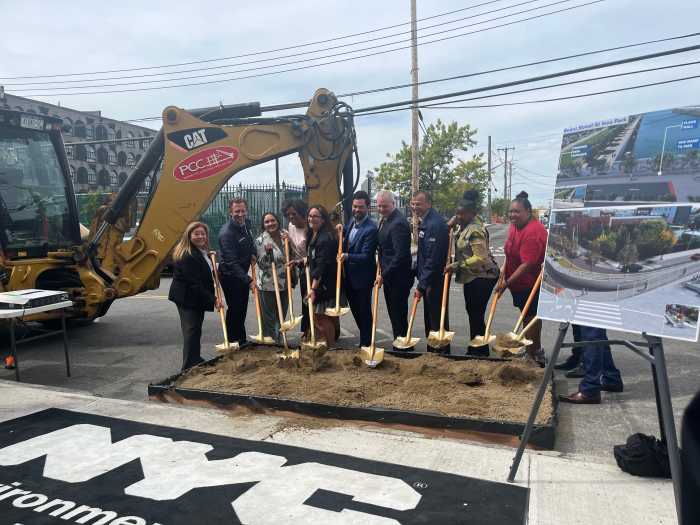
Officials on Tuesday broke ground on the years-in-the-making Red Hook Coastal Resiliency Project, a series of flood walls and other measures meant to protect the low-lying neighborhood from coastal flooding.
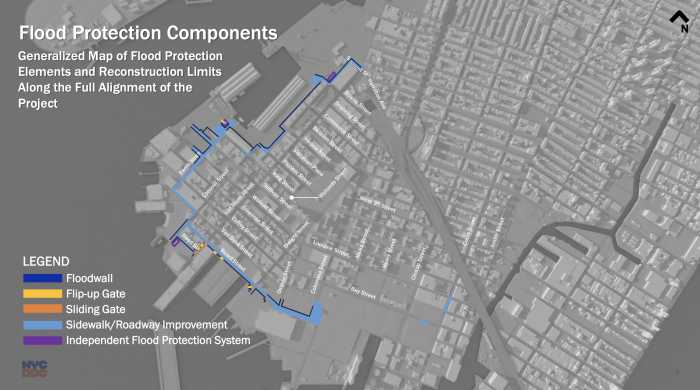
The $218 million project will line the outer edges of the neighborhood, with almost 1.5 miles of flood walls and eight deployable flood gates along parts of Columbia and Ferris streets near Atlantic Basin and on Beard and Reed streets. A number of local streets will be re-graded and raised up to three feet, an effort to provide passive flood mitigation in a neighborhood that sits only a few feet above sea level at its lowest point.
“The Red Hook Coastal Resiliency Project will deliver meaningful protection against storm surges caused by climate change,” DEP commissioner Rohit Aggarwala said at Tuesday’s groundbreaking ceremony. “It’s designed to improve stormwater management and sustainability while maintaining Red Hook’s neighborhood character.”
Surrounded by water on three sides, Red Hook is vulnerable to both stormwater flooding and coastal storm surge.
The area was devastated by Superstorm Sandy in 2012 as floodwaters inundated most of the neighborhood, killing 44 people and destroying dozens of homes and businesses. In 2021, Hurricane Ida wreaked havoc on Red Hook, as did the remnants of Hurricane Ophelia in 2023.
As climate change causes sea levels to rise and brings more frequent, more intense storms, the issue is only expected to worsen. RHCR was not designed to hold back flooding from a storm as intense as Sandy, a “100-year-storm” with a 1% chance of occurring in any given year, but to protect against the more frequent, less severe “10-year storms.”
Where implemented, the project will protect against floodwaters up to ten feet above sea level. “Passive” elements — the street regrading and flood walls, which will rise up to five feet tall, will provide constant protection against flooding up to eight feet above sea level.

The flood gates, tucked away when not in use, will be deployed during larger storms, and can hold back flooding at up to ten feet above sea level. New York City Emergency Management and the mayor will work to determine when the gates need to be used on a storm-by-storm basis, Aggarwala told Brooklyn Paper, and will deploy DEP crews to Red Hook to manually raise or roll out the gates.
“There is no more important time than now to do this,” Aggarwala said. “A couple of years ago, the federal government reclassified New York City from the coastal temperate climate zone to the subtropical climate zone — a reminder that while we’ve stayed in the same place, our climate has changed to the extent that it’s basically moved us several hundred miles to the south.”
The project was first pitched by then-mayor Michael Bloomberg in 2013, after Sandy, and was officially commissioned by Bill de Blasio in 2015. Design, community outreach, and layers of approvals took years. In 2021, the city hoped construction on the RHCR would start in 2024.
In addition to flood protection, the RHCR will add 1.2 miles of protected bike lanes to the Brooklyn Waterfront Greenway, upgrade the waterfront park at IKEA, and overhaul Todd Triangle near the Red Hook ball fields. Sewers will also be upgraded with additional capacity for stormwater.
Construction is expected to be completed in 2028.
Karen Blondel, a longtime Red Hook resident and president of the Red Hook Houses West tenant association, said the project is a “vital investment” in the safety and stability of the neighborhood.
“This project is more than just flood protection,” she said. “It is about safeguarding our homes, our businesses, and our families. It’s about building stronger infrastructure, creating a more sustainable future, and ensuring that Red Hook is prepared for the challenges ahead.”
But some residents are skeptical. Though the project surrounds large parts of the neighborhood, the areas outside the flood walls — like Van Brunt Street beyond Reed Street and the Food Bazaar supermarket — will be left largely unprotected.
“There’s nothing going on on this street,” said local artist Deborah Ugoretz, gesturing down Van Brunt Street at the large brick buildings that house dozens of businesses and artists’ studios.
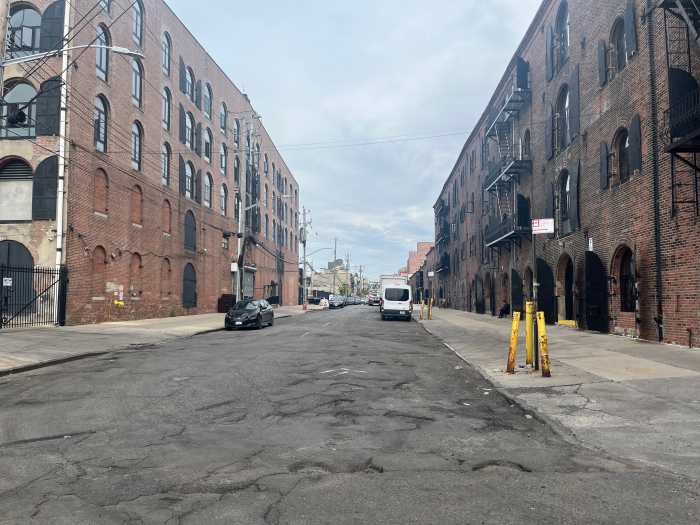
She felt the city was “totally ignoring an area that desperately needs new flood mitigation.” Some locals fear that businesses outside the floodwall will get flooded more severely because water will be stopped by the wall and back up toward the shoreline.
Aggarwala said the project had to balance the neighborhood’s desire for waterfront access with its need for flood protection. There are areas left unprotected, he said, but they had to be considered in context with the needs of the entire neighborhood.
“I think it is the reality of climate change, and particularly coastal resilience,” he said. “We are not going to be able to protect every single location in New York City.”
To that end, the city has previously offered a voluntary buyout and relocation program for properties damaged by Hurricane Sandy, and plans to launch another similar program as part of PlaNYC.
“The world is changing around us, and some things are just in the wrong place,” Aggarwala said.
The MTA started deploying unarmed gate guards across New York City’s expansive subway system in 2022 in an effort to shut down a “superhighway of fare evasion” — emergency exit gates.
Since then, the agency has expanded the program as part of a broader effort to enhance safety and deter turnstile-jumpers, which costs the agency around $800 million a year.
MTA officials said that the primary role of guards, all contracted through a private security company called Allied Universal, is to provide a visible security presence that acts as a deterrent to farebeaters.
The guards are deployed to 264 of the 472 subway stations throughout the NYC subway system. They are assigned to work outside emergency exit gates, as farebeaters often walk right through when the door is open for paying customers.
But beyond being a gatekeeper stopping gatecrashers, what exactly are the guard’s duties while on patrol?
Unlike their deputized law enforcement counterparts, the guards are not authorized to make arrests or carry firearms. Instead, they are expected to report incidents to uniformed MTA staff or NYPD personnel when necessary.
Essentially, the 957 active guards are the “eyes and ears” of fare evasion for the MTA, agency staff told amNewYork.
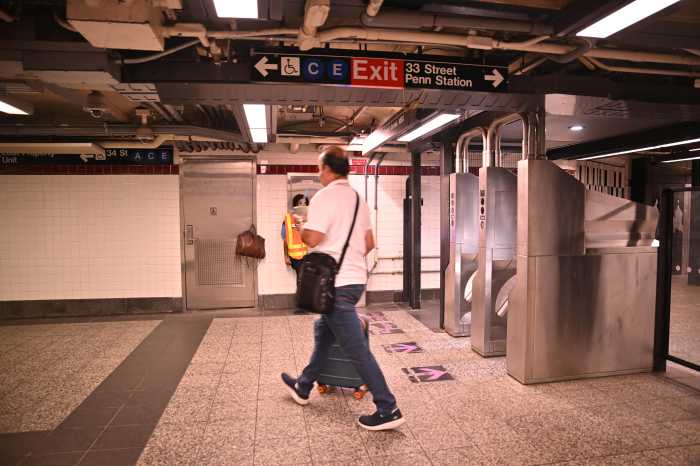
With nearly 1,000 gate guards on the job, amNewYork asked the MTA how many reports the guards have made since the program started three years ago. The MTA has yet to provide a response.
According to a report in The City last year, several gate guards told the online news outlet that they had been told to avoid confrontations with possible fare beaters.
However, the MTA says otherwise. The agency wrote in its 2022 Blue Ribbon Panel report, which addresses fare and toll evasion, that civilian guards are to direct customers to turnstiles, instead of exiting the station through the gates.
“If a customer approaches who has an apparent reason to exit via the emergency exit gate – a wheelchair, a stroller, a large suitcase – then the guard stands aside and lets the customer exit, closing the gate as soon as the passenger has exited,” the report states. “If the customer does not have an apparent reason to exit through the gate, then the guard asks the customer to step over to the turnstile and exit there instead. The emergency exit gate stays closed.”
The strategy is designed to keep the emergency exit closed as much as possible.
“The gate guards pilot is a way of deterring fare evasion with a civilian nudge rather than a police intervention,” the report continues.
Have gate guards been successful in combating fare evasion?
The MTA says yes.
“Overall, subway fare evasion is down 29% this year, and where there are gate guards at stations, it’s down 36%,” MTA Chief Financial Officer Jai Patel told amNewYork in a statement last week. “Evasion rates on buses have also fallen in every quarter since the second quarter of 2024 despite rising ridership. We have no plans to let up on this crusade any time soon.”
Patel is likely onto something. amNewYork conducted an unscientific observation of the gate guards in action at Midtown’s Penn Station on a recent Monday.
During the 30-minute visit to America’s busiest transit hub, countless New Yorkers — and likely tourists — traversed through the turnstiles at the 34th Street and 8th Avenue entrance.
Everyone paid, no one beat the fare, as two diligent guards watched the throng of commuters enter the system.
A similar scenario rang true at a smaller, community station in Queens. On that same Monday, amNewYork visited the 61st Street-Woodside 7 train and Long Island Rail Road station. Using the same allotted time of 30 minutes, no one beat the fare as a gate guard stood by the turnstiles.
However, the station this year has proven to be a hotspot for fare evasion. Turnstile hoppers were spotted on multiple occasions beating the fare. Though the MTA took action by installing anti-evasion barriers on the station’s turnstiles last month, it did not seem to slow down the evaders, per amNewYork observations.
Criticism of the $5 million-a-month gate guard program
The idea for gate guards sprang from the Blue Ribbon Panel that prioritizes education, equity, enforcement, and environment — what the MTA panel calls “the four E’s” when it comes to fare and toll evasion.
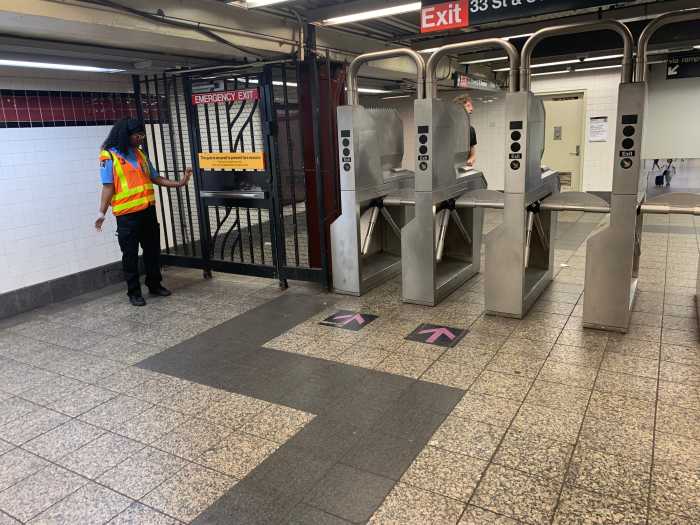
According to the MTA, the civilian gate guards cost the agency around $5 million a month. Allied Universal won the contract through a competitive bid.
Although it is not clear how much the guards themselves get paid, the New York Post reported in May that they make up to $25 an hour. Security guards citywide are historically underpaid, according to a recent study that found most make roughly 40% of the city’s area median income.
amNewYork contacted Allied Universal for comment on this story, but is awaiting a response.
Meanwhile, transit users across the city expressed skepticism and criticism about the effectiveness of unarmed personnel in deterring evasion.
“They stand around and do nothing,” commuter Andy said. “Yet, they are being paid. Not cost-effective.”
But another commuter, named Ed from Queens, said he supports the guard program.
“Anything that helps with fare evasion is a plus,” he said. “A guard might just be enough to stop some people.”
Meanwhile, as New Yorkers go along their daily commutes, the unarmed gate guards continue to be a visible component of the MTA’s continuous effort to battle fare evasion.