Here’s How Much The Trump Kids Have Made Because Of The Presidency https://t.co/S7sLAKho9t (Illustration: Louis Fishauf for Forbes) pic.twitter.com/Xt3VgtQ5KI
— Forbes (@Forbes) September 22, 2025
Day: September 22, 2025
Here’s How Much The Trump Kids Have Made Because Of The Presidency https://t.co/S7sLAKho9t (Illustration: Louis Fishauf for Forbes) pic.twitter.com/Xt3VgtQ5KI
— Forbes (@Forbes) September 22, 2025
Judaism – at this penitential season – reminds us that it is human nature to change human actions. But Jewish tradition is clear: a genuine transformation does not happen overnight or for convenience. It requires contrition, confession, and change. Without all three, there is no teshuvah or repentance, only posturing.
As the Jewish community enters the Days of Awe with Rosh Hashanah on Monday evening, followed by Yom Kippur, we are reminded that transformation begins with accountability. We reflect, we acknowledge, we confess, and then we commit to a new path. This is the framework we should expect not only of ourselves, but of those who seek to lead us.
Zohran Mamdani, the Democratic nominee for mayor of New York City, has repeatedly stated that his views have “evolved.” But what he presents is not regret. It is repositioning. The first step in acknowledging your mistakes is to express regret for past actions.
Consider his record. In 2020, during the protests over George Floyd’s murder, Mamdani declared on social media that the NYPD was “racist, anti-queer & a major threat to public safety,” adding: “Defund it. Dismantle it. End the cycle of violence.” Today, he vows to maintain the current police headcount and even keep the active commissioner. He went as far as recently saying that he owes NYPD officers an apology, but he has expressed no meaningful contrition for his past statements.
He once pushed to decriminalize prostitution, yet when asked by The New York Times if he still supports the idea, he refused to answer. He has expressed no contrition for his past statements.
He argued that New York’s specialized high-school entrance exam should be abolished, but now says he will keep it. He embraced the Democratic Socialists of America, then tried to distance himself from the group once it became politically costly. He has expressed no contrition for his past statements.
On matters that affect Jewish New Yorkers, Mamdani has never condemned the antisemitic slogan, “globalize the intifada,” and recently said he would not use the International Holocaust Remembrance Alliance (IHRA) definition of antisemitism.
At the same time, he continues to accuse Israel of “genocide,” as noted in the Associated Press. These contradictions do not reflect growth. They reflect calculation. He has expressed no contrition for his past statements.
Recently at Brooklyn College, Mamdani denounced the “repression” of pro-Palestinian faculty. He neglected to acknowledge that Jewish students there have endured harassment from some of those same faculty and allies since October 7th. One student wrote that professors have singled out Jewish students, that Students for Justice in Palestine shouted down a Jewish mourning vigil, and that protest-driven hostility has made her feel unsafe. Mamdani cast faculty as victims, all while ignoring the intimidation Jewish students continue to face. He has expressed no contrition for his past statements.
The High Holy Days demand of us a genuine process of introspection and self-evaluation. By not expressing his contrition and confession, Mamdani has failed miserably at this test.
Contrition, confession, and change are not optional processes. They are prerequisites for a genuine transformation.
It is acceptable and encouraged to change your positions based on past mistakes. But to measure one’s sincerity and dedication to meaningful change, you must go through a process of expressing remorse for one’s past actions and wrongdoings.
Rosh Hashanah is the universal new year, marking the anniversary of the creation of humankind. These three principles of self-examination apply not only to Jews, but to all of humanity.
In the marketplace of politics, voters have to distinguish between conviction and convenience. New Yorkers do not have the luxury of waiting years to see if this candidate’s “new agenda” is genuine. The election is just weeks away. The city’s future is on the line.
Rabbi Marc Schneier is one of New York’s most prominent rabbinical leaders.
A coalition of parents, advocates and a prominent education lawyer is suing New York state, accusing lawmakers of quietly gutting standards for religious schools and denying tens of thousands of Hasidic and Haredi children a basic education.
On Sept. 18, Michael Rebell, lead counsel and professor emeritus of law and educational practice at Teachers College, Columbia University, joined by the firm Quinn Emanuel Urquhart & Sullivan, LLP and the Youth Advocacy and Policy Lab at Harvard Law School, announced the class-action lawsuit in Kings County Supreme Court.
Filed on behalf of four plaintiffs and an estimated 100,000 Hasidic and Haredi students, the suit names Gov. Kathy Hochul, Assembly Speaker Carl Heastie, Senate Majority Leader Andrea Stewart-Cousins and the state of New York as defendants. It challenges a provision added to the state’s $237 billion fiscal year 2026 budget that rolls back education standards for nonpublic schools, including yeshivas.
New York’s Education Law Section 3204 requires that nonpublic school students, including those at religious schools, receive an education “substantially equivalent” to what public schools provide. That includes instruction in core subjects such as English, math and history. The New York State Education Department (NYSED) spent years drafting regulations to enforce those standards.
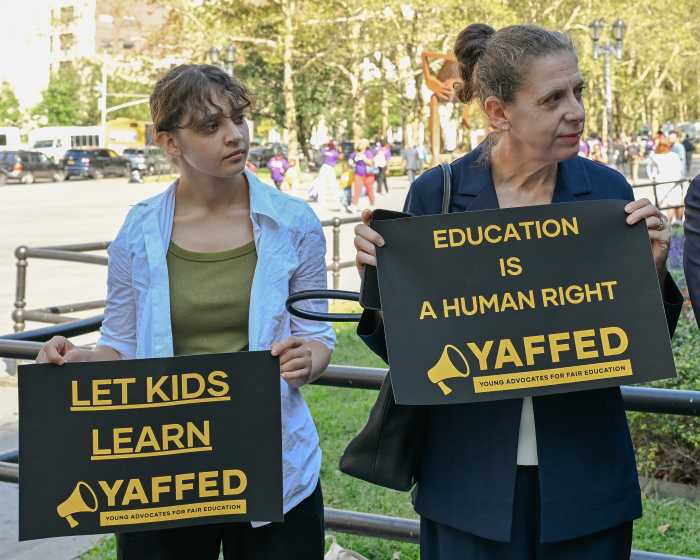
Advocates say the new changes weaken those standards — particularly for yeshivas, which primarily focus on religious instruction in Hebrew and Yiddish — and limits the state’s ability to enforce compliance, stripping away testing requirements. Schools can now pick their own assessments, switch them at will and remain in compliance simply by offering the exams to a minimum number of students, regardless of how students score.
At a news conference outside Brooklyn Supreme Court, Rebell — who in 1993 led the landmark Campaign for Fiscal Equity case that secured recognition of the constitutional right to a “sound basic education” — called the carveout “outrageous.”
“It is outrageous that the governor and state legislative leaders absolved yeshivas from teaching basic American history, civics, science and other subjects to tens of thousands of students,” Rebell said.
“The Constitution requires that the state ensure all children, including those in nonpublic religious schools, are provided the opportunity for a sound, basic education,” he added. “New York’s highest court has emphasized that all students in the state need to receive such an education in order to function productively as capable citizens.”
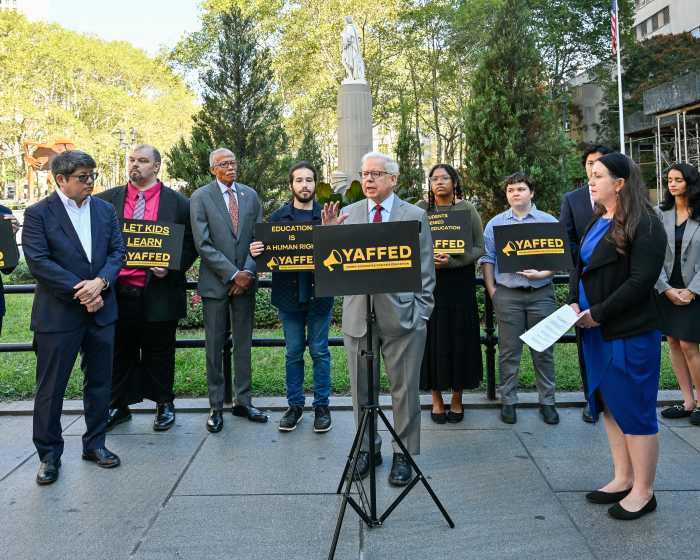
Rebell alleged the provision was added to curry favor with a politically powerful voting bloc.
“The leaders of this Hasidic sect are the same people who deny their kids a decent education that prepares them in any way for the world,” he said. “They are politically very savvy, and they go to the leading political leaders, and they make a deal with them, ‘You support whatever legislation we want, and we’ll deliver a big block of votes to you.’ And they can deliver, and they have, and they do.”
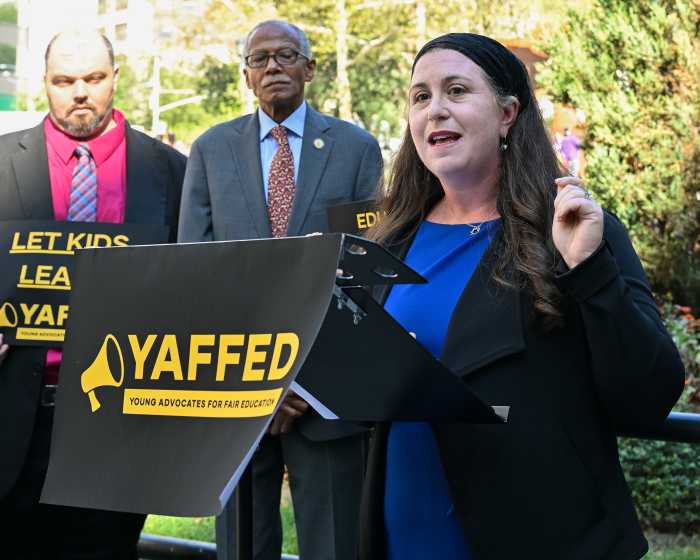
Adina Mermelstein Konikoff, executive director of Young Advocates for Fair Education (YADDED), said the lawsuit seeks to uphold every child’s right to a sound education. The nonprofit was founded by people raised in Hasidic and Haredi communities and advocates for higher educational standards in yeshivas.
“But too many Hasidic and Haredi children are being denied an education because the state has refused to guarantee it,” she said. “This lawsuit is about guaranteeing this right — and that means reversing the disastrous dismantling of substantial equivalency. We cannot accept a law that shirks the state’s responsibility to educate our students.”
YAFFED previously filed a complaint in 2015 alleging that 39 yeshivas in Brooklyn failed to provide state-mandated instruction. That complaint led to new regulations designed to strengthen oversight. In 2019, more than 1,000 students at a single Hasidic yeshiva failed state exams in reading and math.
A YAFFED report released in April linked inadequate education to persistent poverty in Hasidic communities, where 13% of Hasidic male youth did not speak English. The report found that 63% of the community lives below or near the poverty line and that Hasidic men earn 30% less than their non-Hasidic peers.
Scott Kessler, 25, a former yeshiva student, has spoken publicly about his experience and advocates for children denied what he calls a civil right to basic education.
Kessler said he received about eight hours of secular instruction per week, though many yeshivas provided none. He said teachers were often unqualified.
“Our teachers didn’t know their subjects,” Kessler said. “For example, I had a math teacher who didn’t know the math he was teaching. The teacher was learning it on the go. He would grade our test wrong, and I would have to teach him how to do the math in order for him to grade the test correctly.”
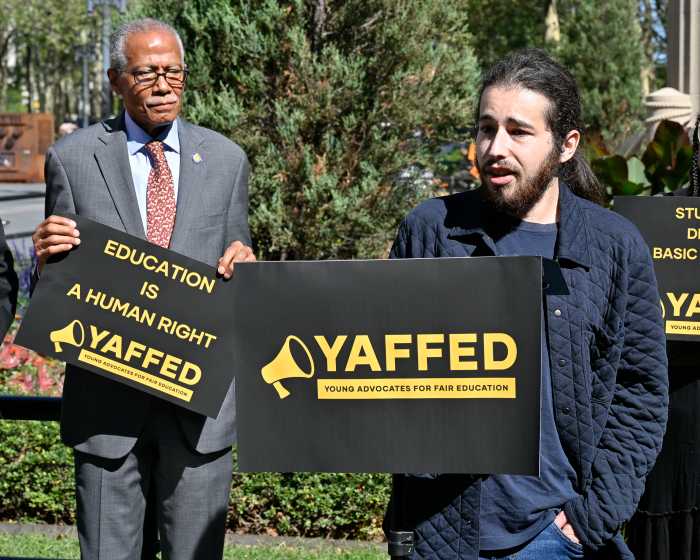
“This is New York City in 2025, and kids are not being taught arithmetic, they’re not being taught biology, they’re not being taught American history or any history,” he added. “It’s just shameful.”
Kessler said his life changed when he transferred to public school at 16.
“Public school was one of the most important things to ever happen to me,” he said. “It shouldn’t be like that. Kids should be able to go to yeshiva and get a real quality education.”
State Sen. Robert Jackson, a Democrat who represents Washington Heights, Fort George and Inwood, said the lawsuit carries implications beyond the courts.
“It’s about whether New York State will honor its commitment to all of our children. That’s what this is about,” Jackson said. “Educational justice is the foundation for democracy, the doorway to opportunity, and the measure of whether we believe in fairness, not only in words, but in action. Action speaks louder than words, and until every child in every school has a fair chance to succeed, our work remains unfinished.”
Reps for Hochul, Heastie and Stewart-Cousins did not return a request for comment.


No more waiting.
No more excuses.
No more kicking the can down the road.
To solve the housing crisis, we need to build more housing. nytimes.com/2025/09/22/reale…
— Governor Kathy Hochul (@GovKathyHochul) Sep 22, 2025
Putin issued fresh war threats and criticized Trump’s “Golden Dome” project
In his statement, the Kremlin leader declared that Russia would respond “to any potential threats with military force.” He accused the West of taking “destructive steps” that “undermined the foundations… pic.twitter.com/4L8A6wYyZA
— Visegrád 24 (@visegrad24) September 22, 2025
Putin issued fresh war threats and criticized Trump’s “Golden Dome” project
In his statement, the Kremlin leader declared that Russia would respond “to any potential threats with military force.” He accused the West of taking “destructive steps” that “undermined the foundations… pic.twitter.com/4L8A6wYyZA
— Visegrád 24 (@visegrad24) September 22, 2025