Nearly 1.8 million New York City residents could lose access to food assistance this week as the U.S. Department of Agriculture confirmed it will stop issuing Supplemental Nutrition Assistance Program (SNAP) benefits starting Nov. 1, citing a lack of federal funding during the ongoing government shutdown.
The potential impact cuts across every congressional district. Data from the state shows that more than 1.8 million city residents rely on SNAP, including 272,857 in the Bronx’s 15th District, the highest total in the state. Brooklyn’s 8th District follows with 201,200 recipients, while Manhattan’s 13th District, covering Harlem and Upper Manhattan, counts 220,555 people enrolled.
Other districts with significant numbers include the 9th District in Central Brooklyn (171,678), the 14th District in Queens and the Bronx (159,636), and the 7th District, which spans parts of Brooklyn, Queens, and Manhattan (146,306).
Even the city’s smallest totals, 28,015 in the 3rd District and 40,337 in the 12th District, represent tens of thousands of households that are now uncertain about how they’ll afford groceries next week.
The USDA claimed on Monday that “the well has run dry,” blaming Senate Democrats for the budget impasse in Washington that has pushed the shutdown into its 27th day.
“At this time, there will be no benefits issued on Nov. 1,” the agency wrote in a statement that included false claims that Democrats were prioritizing healthcare for undocumented people.
Undocumented individuals are not eligible for federal healthcare programs, and the Democrats’ proposal does not seek to change that policy.
Senate Democrats have so far withheld support for a spending plan as they press to renew Affordable Care Act tax credits set to expire at the end of the year. A lapse in those tax credits could cost middle- and lower-income families thousands of dollars in higher premiums.
The Senate is scheduled to vote again this week on a government reopening plan passed by the House, after having rejected the continuing resolution 12 times. Senate Minority Leader Chuck Schumer criticized President Trump on the Senate floor Monday, saying he is creating a SNAP crisis rather than cooperating with Democrats to end the government shutdown.
In a bid to mitigate the crisis in New York, Gov. Kathy Hochul announced $30 million in emergency state funds to support an estimated 16 million meals statewide, supplementing the $11 million in food bank aid she approved last week.
“While I’ve said repeatedly that no state can backfill these devastating cuts, I am committed to ensuring New Yorkers do not go hungry this holiday season and am taking action to support the families suffering the consequences of Republicans’ cruelty,” Hochul said at a rally in Harlem on Monday. Since SNAP is a federal program, states cannot unilaterally backfill the program without federal approval.
She also launched a state website, ny.gov/federalcuts, for residents to share how the funding freeze is affecting them. Statewide, nearly 3 million New Yorkers could be affected by the cuts.
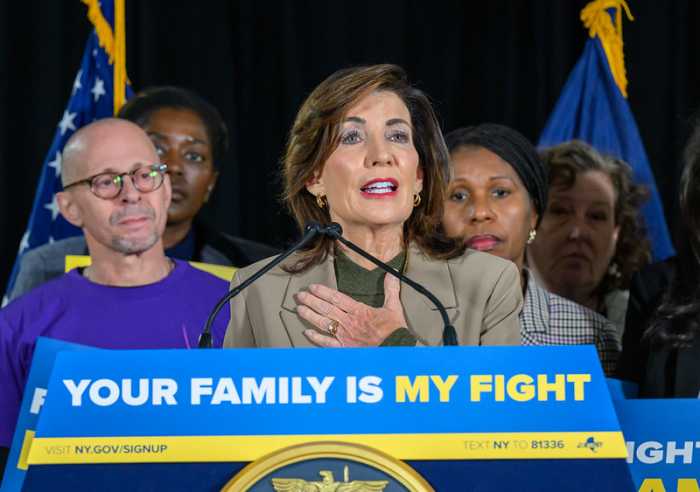
Gov. Kathy Hochul speaks at a rally in Harlem on Monday, announcing $30 million in emergency state funds to help New Yorkers affected by the SNAP funding freezePhoto by Susan Watts/Office of Governor Kathy Hochul
Hochul urged Congress to immediately reopen the government or authorize contingency funds to ensure November benefits are issued. “All we’re saying is just unfreeze the SNAP funding. You can do this. Get back to work. Stop the shutdown. Stop taking away health care, stop taking away food. Just start looking out for the American people,” she said.
Queens State Sen. James Sanders called on Hochul to convene an emergency session of state lawmakers to expand the state’s response. “No one should go hungry because of Washington’s dysfunction,” he said. “The Trump administration’s refusal to release these essential funds is not only irresponsible — it’s an assault on basic human decency. … We cannot wait while millions of New Yorkers face empty plates and growing fear.”
The Governor’s office did not immediately respond to queries regarding Sanders’ plea for a special session; lawmakers in Albany are due to reconvene in January.
‘A true hunger crisis’
Additionally, on Monday, Legal Aid filed a class action lawsuit challenging a separate USDA decision to end a longstanding waiver that shields about 100,000 NYC recipients, categorized as “Able-Bodied Adults Without Dependents (ABAWDs), from strict work requirements.
“Millions of New Yorkers rely on SNAP each month to keep food on the table and their pantries stocked, including seniors, people with disabilities, children, and working families. SNAP is essential to keeping New Yorkers safe, nourished, and their communities strong,” said Adriene Holder, Chief Attorney of the Civil Practice at The Legal Aid Society.
Holder urged the USDA to immediately release the federally authorized contingency funds needed to allow states, including New York, to issue November SNAP benefits.
The lawsuit argues the agency acted unlawfully by terminating the waiver months before it was due to expire in February 2026, forcing the city’s Human Resources Administration to rush implementation and risk widespread benefit loss.
“Terminating the ABAWD waiver months before it was set to expire is not only unlawful, but unnecessarily cruel during a time of historic unaffordability,” said Laboni Rahman, an attorney with Legal Aid’s Civil Law Reform Unit. “The rushed implementation of the ABAWD work requirement will undoubtedly lead to confusion and administrative chaos, resulting in more New Yorkers losing subsistence-level benefits that may be the only thing standing between them and food insecurity.”
Helen Strom, director of the Benefits and Homeless Advocacy Unit at the Urban Justice Center, said the new rules “set up an impossible deadline,” warning that “tens of thousands of people contacting the city about the new work requirements will only exacerbate” already overburdened SNAP offices.
“People receiving SNAP in NYC already face hours-long waits on understaffed phone lines and at SNAP offices just to maintain their benefits,” Strom continued. “The tens of thousands of people contacting the City about the new work requirements will only exacerbate these issues, and many will not be able to get through at all.”
At the city level, Legal Aid said Human Resources Administration officials are scrambling to prepare for potential funding gaps while facing “immense administrative burdens” from the USDA’s decision.
Advocates warn that even with $41 million in state emergency aid, food banks and community pantries will be quickly overwhelmed if federal SNAP payments stop. “We are facing a true hunger crisis in New York City with 1.8 million people at risk of losing their November benefits and tens of thousands at risk of losing their benefits indefinitely due to ABAWD cuts.”
The nonverbal pre-teen – identified by cops as Jacob Pritchett – was nowhere to be found when child welfare officials, and later police, swept the Howard Avenue home in late September and early October, the sources said.
As tensions rise between the US and Venezuela over an apparent impending military conflict, desperate regional leaders have now offered themselves as mediators, urging both sides to talk before it is too late.
And caught in the middle of all this is the federation of Trinidad and Tobago, where the USS Gravely, a US guided missile destroyer docked in Trinidad on Sunday, moored in a local port just about 20 miles from the Venezuelan coast. This means that this is the closest known position of a US military vessel to Venezuela since Washington recently began its military build-up and threats of regime change in the Southern Caribbean, presumably to eradicate international narco trafficking and possible regime change in oil and gas-rich Venezuela.
Local authorities say the destroyer with more than 300 sailors on board is on the island for joint training exercises with Venezuelan authorities. However, Venezuelan authorities are making it clear that they believe that the administration of Prime Minister Kamla Persad Bissessar is facilitating the US with its military ambitions against Venezuela. They also contend that the visit is a provocation against the South American nation, facilitated by a government that has taken the side of the US in its alleged war against narco trafficking.
The U.S. Navy destroyer USS Gravely (DDG-107) approaches Port of Spain, Trinidad and Tobago on Oct. 26, 2025. REUTERS/Andrea De Silva
“The government has renounced the sovereignty of T&T to act as a military colony subordinate to US hegemonic interests, turning its territory into a US aircraft carrier for the war throughout the Caribbean against Venezuela, Colombia, and all of South America,” a Venezuelan government statement noted. “By folding to Washington’s militaristic agenda, Persad-Bissessar not only intends to attack Venezuela – a country that has always maintained a policy of energy co-operation, mutual respect, and Caribbean integration – and break our historic bonds of brotherhood,” the statement noted.
Countering the Venezuelan position and interpretation of the situation, PM Persad Bissessar argued that her federation’s closeness to Venezuela places it in a unique position, forcing it to act in its own national interest. She has no plans to back off.
“Historically and geographically, we are closest to where the drugs are coming from, the narco-trafficking, human trafficking, and gun running. The other islands are further north – we are more southern and closest to the South American mainland. Their experience may be different from ours in T&T. “They are entitled to their view on the whole issue of a zone of peace, but in T&T, there is clearly no zone of peace. As I always say: T&T first. We have to take care of our people first. We are the most affected by this,” she told reporters at the weekend.
And while hundreds gathered at the port to watch the moored vessel, desperate regional leaders asked to be at the negotiating table before it was too late. Leading the charge for peace were Dominican Prime Minister Roosevelt Skerrit and Mia Mottley of Barbados, with the visiting Dominican sharing a political platform in Barbados with Mottley over the weekend.
“Of course, we in Barbados and Dominica, and indeed the wider Caribbean, offer ourselves as intermediaries so that we can bring the two forces together and let us understand that there can be common sense and agreement, and disagreement — but we have to ensure that we do not have a situation of our region descending into turmoil,” he said.
Mottley spoke of judicial and military overreach with the string of high-sea attacks by the US on alleged narco vessels.
“We have to speak up. I believe that the time has come for us, therefore, to be able to ensure that we do not accept that any entity has the right to engage in extra-judicial killings of persons that they suspect of being involved in criminal activities. If there are conflicts and disputes that are in need of resolution, then the place that needs to be taken for such resolution is the UN. The methodology that must be deployed for the resolution is one of negotiation and peaceful actions taken in order to ensure that we can settle disputes,” she said.
Their remarks follow a plea by nearly a dozen former heads of government, asking the US to pull back from military action in an area that has long paraded itself as a zone of peace. Bishops from the Antillean Episcopal Conference also called for peace and good sense to prevail.
Venezuelan authorities, meanwhile, hurled stinging criticism at Trinidad in a statement, alleging that the government there is helping the US with its war plans.
As the region monitors developments, including the deployment of the US’s largest and most powerful warship, attention is also being paid to neighboring Grenada. The US has asked Grenada to allow it to set up a military radar station at the main airport, just about 100 miles from the Venezuelan mainland. PM Dickon Mitchell has promised an update to his nation, which the US had invaded back in 1983, this week.