The post VOA Newscasts first appeared on The News And Times – thenewsandtimes.com.
Day: September 22, 2023
The post Penn on filming Ukraine documentary: ‘Surreal’ and ‘heartbreaking’ first appeared on The News And Times – thenewsandtimes.com.

The increased frequency of China’s military activities around Taiwan recently has raised the risk of events “getting out of hand” and sparking an accidental clash, the island’s defence minister said on Saturday.
Taiwan has said that the past two weeks has seen dozens of fighters, drones, bombers and other aircraft, as well as warships and the Chinese carrier the Shandong, operating nearby.
China, which views democratically governed Taiwan as its own territory, has in recent years carried out many such drills around the island, seeking to assert its sovereignty claims and pressure Taipei.
Asked by reporters on the sidelines of parliament whether there was a risk of an accidental incident sparking a broader conflict given the frequency of the Chinese activities, Taiwan Defence Minister Chiu Kuo-cheng said: “This is something we are very worried about”.
Warships from China’s southern and eastern theatre commands have been operating together off Taiwan’s east coast, he added.
“The risks of activities involving aircraft, ships, and weapons will increase, and both sides must pay attention,” Chiu said.
China has not commented about the drills around Taiwan, and its defence ministry has not responded to requests for comment.
Chiu said that when the Shandong was out at sea, which Taiwan first reported on Sept. 11, it was operating as the “opposing force” in the drills. Ministry spokesman Sun Li-fang added that China’s Eastern Theatre Command forces were the “attacking force”, simulating a battle scenario.
Taiwan’s traditional military planning for a potential conflict has been to use its mountainous east coast, especially the two major air bases there, as a place to regroup and preserve its forces given it does not directly face China unlike the island’s west coast.
But China has increasingly been flexing its muscles off Taiwan’s east coast, and generally displaying its ability to operate much further away from China’s own coastline.
China normally performs large-scale exercises from July to September, Taiwan’s defence ministry has said.
On Saturday the ministry said China had largely dialled back its drills, reporting that over the previous 24 hour period it had only spotted two Chinese aircraft operating in its air defence zone.
Taiwan has frequently said that it would remain calm and not escalate the situation, but that it won’t allow “repeated provocations” from China, whose forces have so far not entered Taiwan’s territorial seas or airspace.
The post Taiwan raises concerns about situation “getting out of hand“ with China drills first appeared on The News And Times – thenewsandtimes.com.
Hussein Sheikh Ali, national security adviser for Somali President Hassan Sheikh Mohamud, wrote to the United Nations requesting a 90-day delay in the second phase of the departure of African Union Transition troops in Somalia.
Somalia “formally requests a technical pause in the drawdown of the 3,000 African Union Transition in Somalia uniformed personnel by three months,” the letter read.
According to the letter, if continued under the current plan, the pullout would mean the departure of 3,000 troops by the end of September.
A diplomatic source in the government who requested anonymity because of a lack of authority to comment on the issue confirmed to VOA the authenticity of the letter. The source said the government wants to buy time for its effort to have an arms embargo lifted — a campaign supported by Ethiopia and Uganda, two regional powers.
“Somalia believes its campaign for lifting the U.N. arms embargo depends on proving that it can take the responsibility for its security without the dependence of AU peacekeepers, so it can better fight al-Shabab terrorists. At the same time, it does not want ATMIS [the African Transition Mission in Somalia] with its stronger military hardware to leave the country in the middle of unpredictable war with al-Shabab,” the diplomat said. “It is buying a time.”
Appeal to General Assembly
In an exclusive interview with VOA, Somali Prime Minister Hamza Abdi Barre said he would appeal to the U.N. General Assembly this weekend about removing an international arms embargo, so Somalia could be capable of eliminating al-Shabab, a U.N.- and U.S.-designated terrorist organization that has fought the Somali government for 16 years.
A U.N. resolution calls for the ATMIS force to be reduced to zero by the end of next year, surrendering security responsibility fully to the Somalia’s national army and police forces.
The Somali government had repeatedly said it would be ready to take over security responsibilities from ATMIS when those troops withdrew from the country, in line with U.N. Security Council Resolution 2687.
Mohamud, who is in central Somalia to command the government fight against al-Shabab, said on August 18 that he believed the government would “eliminate” the jihadists by the end of the year.
According to the government letter to the United Nations, during the ongoing military offensive against the al-Qaida-affiliated al-Shabab militant group in central Somalia, the government had “managed to re-liberate towns, villages and critical supply routes.”
The government military gains, however, did not prevent the militant group from waging deadly counterattacks on government bases.
The government letter said the military operation had suffered.
“Several significant setbacks” have occurred since late August, the letter said, following a deadly dawn attack by the militants on a newly captured base in the village of Cowsweyne, Galguduud region, in central Somalia.
As a result of the attack, the Somali military suffered heavy losses, forcing other military units to retreat from towns and villages captured in recent months in the same region.
“This unforeseen turn of events has stretched our military forces thin, exposed vulnerabilities in our front lines, and necessitated a thorough reorganization to ensure we maintain our momentum in countering the al-Shabab threat,” the letter said.
“We hold firm in our belief that this technical pause will, in the long run, contribute to the enduring peace, stability and prosperity of Somalia,” it said, adding that the government remained fully committed to the complete ATMIS drawdown by the end-of-2024 deadline.
Security experts in Somalia said al-Shabab militants have been withdrawing from towns and villages and retreating into the bush with the intention of prosecuting a prolonged guerrilla war.
The government request to the United Nations came days after ATMIS announced it had kicked off the second phase of the drawdown, with the projected departure of 3,000 troops by the end of September.
Since the beginning of the ATMIS drawdown, 2,000 AU troops had left by the end of June, and six bases have been handed over to Somali forces.
Before the troop reductions began, ATMIS was made up of about 20,000 uniformed personnel drawn from Burundi, Djibouti, Ethiopia, Kenya and Uganda.
Some information for this report came from Agence France-Presse.
The post Somalia Seeks Delay of AU Peacekeepers’ Drawdown first appeared on The News And Times – thenewsandtimes.com.
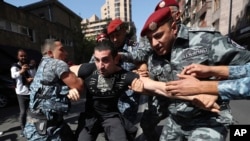
Police officers detain a demonstrator during a protest against Prime Minister Nikol Pashinyan in Yerevan on September 22.
YEREVAN — Dozens of people have been detained as anti-government protests continued in the Armenian capital on September 22.
Armenian police said after noon local time that 84 people had been detained and charged with disobeying police orders. Armenian opposition groups later claimed some 350 supporters had been detained.
The developments came after opposition leaders called for street blockades and other protest actions to be held on September 22 in an effort to force Prime Minister Nikol Pashinian from power.
Protesters have vowed to continue their action until Pashinian is removed and have said they plan to disrupt a meeting of his cabinet expected later in the day.
Police, who have used stun grenades during clashes with demonstrators since protests began in Yerevan on September 20, had warned that they would implement “special measures” if the clashes continued.
Police reportedly detained one of the protest organizers, Andranik Tevanian, during the demonstrations on September 22. The former parliamentarian was released after being questioned by the Investigative Committee.
Tevanian said during demonstrations on September 21 that “with disciplined and united efforts” Pashinian’s ouster as prime minister “will happen in a very short time, even within days.”
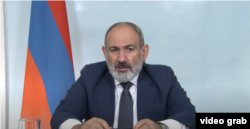
Embattled Armenian Prime Minister Nikol Pashinian
A son of Armenia’s former President Robert Kocharian, Levon Kocharian, was among the detained protesters. His lawyer said law enforcement officers “severely beat” his client during his apprehension.
Pashinian has come under criticism for the government’s response to Azerbaijan’s lightning offensive earlier this week against Nagorno-Karabakh, an Azerbaijani territory that has a large ethnic Armenian population.
Azerbaijan has claimed that the offensive, which it describes as an “anti-terrorist operation,” has brought the breakaway region back under its control.
Pashinian told his government on September 22 that Yerevan would accept an influx of ethnic Armenians if they chose to leave Nagorno-Karabakh, but that such a massive resettlement would only occur if it became impossible for them to remain there.
Demonstrators have decried what they call inadequate government support for the ethnic Armenians in Nagorno-Karabakh, while opposition leaders have announced plans to initiate impeachment proceedings against Pashinian.
As anti-government demonstrators blocked roads and assembled in Yerevan’s central Republic Square on the morning of September 22, Pashinian expressed hope that ethnic Armenians living in Nagorno-Karabakh can remain there.
WATCH: Thousands of ethnic Armenians gathered at Nagorno-Karabakh’s only airport where Russian peacekeepers are based. They were seeking protection and possible transit to Armenia following two days of fighting.
Azerbaijan, meanwhile, has reportedly indicated it envisages an amnesty for Armenian fighters in Nagorno-Karabakh who give up their arms amid a tentative cease-fire that stopped the fighting, which broke out when Azerbaijani forces launched a 24-hour military offensive on September 19-20.
“Even with regard to former militaries and combatants, if they can be classified in such a way, and even for them we are envisaging an amnesty or alluding to an amnesty as well,” Hikmet Hajiyev, a foreign policy adviser to Azerbaijani President Ilham Aliyev president, told Reuters.
Hajiyev also said that ethnic Armenians in Nagorno-Karabakh have asked for humanitarian aid, which he said would begin to arrive on September 22. Media reports said at least four trucks with aid were seen headed toward Nagorno-Karabakh along the Agdam corridor that runs through Azerbaijan.
Hajiyev said that Baku seeks the peaceful reintegration of Karabakh Armenians.
The ethnic Armenian leadership of Nagorno-Karabakh said on September 22 that an agreement had also been reached for humanitarian aid to be trucked in from Armenia. The leadership said, however, that there had been no deal on security guarantees sought by Karabakh Armenians in exchange for giving up their weapons, or regarding a possible amnesty proposed by Baku.
On September 21, representatives of Azerbaijan and the ethnic Armenian leadership of the breakaway region failed to reach a breakthrough during closely watched “reintegration” talks in the western Azerbaijani city of Yevlax.
The two sides exchanged accusations and denials over reports of gunfire and apparent cease-fire violations in Nagorno-Karabakh’s de facto capital, Stepanakert, but more meetings are expected.
Separatist leaders in Nagorno-Karabakh said in a statement following the meeting that they were ready to continue talks with Azerbaijani authorities.
“The parties especially stressed the need to discuss all existing issues in a peaceful environment, noting the readiness to continue meetings,” the statement said.
Pashinian said on September 22 that the situation remains tense in Nagorno-Karabakh, internationally recognized as part of Azerbaijan but which has enjoyed de facto independence since breaking away in a war in the 1990s.
Photo Gallery:
During a short but bloody war in 2020, Azerbaijan recaptured much of the territory as well as seven surrounding districts that had been controlled since the 1990s by ethnic Armenians with Yerevan’s support.
Some 120,000 ethnic Armenians live in Nagorno-Karabakh, and Pashinian on September 22 expressed optimism that they can get a real opportunity to return to their homes. At the same time, Pashinian noted a dire humanitarian crisis continues in Nagorno-Karabakh.
In a nationwide address on September 21, Aliyev declared victory in the offensive launched by his forces on September 19 after Baku accused “Armenian sabotage groups” for two separate deadly explosions in areas of Nagorno-Karabakh that are under the control of Russian peacekeepers.
The same day, UN Security Council members including the United States, Turkey, Russia and France called for peace, while Armenian and Azerbaijani officials traded barbs.
Armenian Foreign Minister Ararat Mirzoian, who called for the emergency meeting, accused Baku of an “unprovoked and well-planned military attack” and said Azerbaijan was likely to use force against civilians in Nagorno-Karabakh again unless prevented by global powers.
Azerbaijani Foreign Minister Jeyhun Bayramov countered by accusing Yerevan of spreading misinformation, insisting that Baku had carried out an anti-terrorism operation against Armenian forces.
The offensive was halted on September 20 after Karabakh’s ethnic Armenian leadership accepted a cease-fire proposal by the Russian peacekeeping mission, although sporadic fighting has been reported.
Nagorno-Karabakh human rights ombudsman Gegham Stepanian has said that at least 200 people, including 10 civilians, were killed and more than 400 others were wounded in the fighting.
RFE/RL could not independently confirm the casualty figures.
Azerbaijan’s Prosecutor-General’s Office on September 21 said six Russian peacekeepers had been killed during Baku’s military offensive, five “by mistake” by Azerbaijani forces and one by Karabakh Armenian fighters.
With reporting by Reuters and TASS

The post Top Russian Officer Among Troops Killed During Azerbaijan’s Attack On Nagorno-Karabakh first appeared on The News And Times – thenewsandtimes.com.
Police officers detain a demonstrator during a protest against Prime Minister Nikol Pashinyan in Yerevan on September 22.
YEREVAN — Dozens of people have been detained as anti-government protests continued in the Armenian capital on September 22.
Armenian police said after noon local time that 84 people had been detained and charged with disobeying police orders. Armenian opposition groups later claimed some 350 supporters had been detained.
The developments came after opposition leaders called for street blockades and other protest actions to be held on September 22 in an effort to force Prime Minister Nikol Pashinian from power.
Protesters have vowed to continue their action until Pashinian is removed and have said they plan to disrupt a meeting of his cabinet expected later in the day.
Police, who have used stun grenades during clashes with demonstrators since protests began in Yerevan on September 20, had warned that they would implement “special measures” if the clashes continued.
Police reportedly detained one of the protest organizers, Andranik Tevanian, during the demonstrations on September 22. The former parliamentarian was released after being questioned by the Investigative Committee.
Tevanian said during demonstrations on September 21 that “with disciplined and united efforts” Pashinian’s ouster as prime minister “will happen in a very short time, even within days.”
Embattled Armenian Prime Minister Nikol Pashinian
A son of Armenia’s former President Robert Kocharian, Levon Kocharian, was among the detained protesters. His lawyer said law enforcement officers “severely beat” his client during his apprehension.
Pashinian has come under criticism for the government’s response to Azerbaijan’s lightning offensive earlier this week against Nagorno-Karabakh, an Azerbaijani territory that has a large ethnic Armenian population.
Azerbaijan has claimed that the offensive, which it describes as an “anti-terrorist operation,” has brought the breakaway region back under its control.
Pashinian told his government on September 22 that Yerevan would accept an influx of ethnic Armenians if they chose to leave Nagorno-Karabakh, but that such a massive resettlement would only occur if it became impossible for them to remain there.
Demonstrators have decried what they call inadequate government support for the ethnic Armenians in Nagorno-Karabakh, while opposition leaders have announced plans to initiate impeachment proceedings against Pashinian.
As anti-government demonstrators blocked roads and assembled in Yerevan’s central Republic Square on the morning of September 22, Pashinian expressed hope that ethnic Armenians living in Nagorno-Karabakh can remain there.
WATCH: Thousands of ethnic Armenians gathered at Nagorno-Karabakh’s only airport where Russian peacekeepers are based. They were seeking protection and possible transit to Armenia following two days of fighting.
Azerbaijan, meanwhile, has reportedly indicated it envisages an amnesty for Armenian fighters in Nagorno-Karabakh who give up their arms amid a tentative cease-fire that stopped the fighting, which broke out when Azerbaijani forces launched a 24-hour military offensive on September 19-20.
“Even with regard to former militaries and combatants, if they can be classified in such a way, and even for them we are envisaging an amnesty or alluding to an amnesty as well,” Hikmet Hajiyev, a foreign policy adviser to Azerbaijani President Ilham Aliyev president, told Reuters.
Hajiyev also said that ethnic Armenians in Nagorno-Karabakh have asked for humanitarian aid, which he said would begin to arrive on September 22. Media reports said at least four trucks with aid were seen headed toward Nagorno-Karabakh along the Agdam corridor that runs through Azerbaijan.
Hajiyev said that Baku seeks the peaceful reintegration of Karabakh Armenians.
The ethnic Armenian leadership of Nagorno-Karabakh said on September 22 that an agreement had also been reached for humanitarian aid to be trucked in from Armenia. The leadership said, however, that there had been no deal on security guarantees sought by Karabakh Armenians in exchange for giving up their weapons, or regarding a possible amnesty proposed by Baku.
On September 21, representatives of Azerbaijan and the ethnic Armenian leadership of the breakaway region failed to reach a breakthrough during closely watched “reintegration” talks in the western Azerbaijani city of Yevlax.
The two sides exchanged accusations and denials over reports of gunfire and apparent cease-fire violations in Nagorno-Karabakh’s de facto capital, Stepanakert, but more meetings are expected.
Separatist leaders in Nagorno-Karabakh said in a statement following the meeting that they were ready to continue talks with Azerbaijani authorities.
“The parties especially stressed the need to discuss all existing issues in a peaceful environment, noting the readiness to continue meetings,” the statement said.
Pashinian said on September 22 that the situation remains tense in Nagorno-Karabakh, internationally recognized as part of Azerbaijan but which has enjoyed de facto independence since breaking away in a war in the 1990s.
Photo Gallery:
During a short but bloody war in 2020, Azerbaijan recaptured much of the territory as well as seven surrounding districts that had been controlled since the 1990s by ethnic Armenians with Yerevan’s support.
Some 120,000 ethnic Armenians live in Nagorno-Karabakh, and Pashinian on September 22 expressed optimism that they can get a real opportunity to return to their homes. At the same time, Pashinian noted a dire humanitarian crisis continues in Nagorno-Karabakh.
In a nationwide address on September 21, Aliyev declared victory in the offensive launched by his forces on September 19 after Baku accused “Armenian sabotage groups” for two separate deadly explosions in areas of Nagorno-Karabakh that are under the control of Russian peacekeepers.
The same day, UN Security Council members including the United States, Turkey, Russia and France called for peace, while Armenian and Azerbaijani officials traded barbs.
Armenian Foreign Minister Ararat Mirzoian, who called for the emergency meeting, accused Baku of an “unprovoked and well-planned military attack” and said Azerbaijan was likely to use force against civilians in Nagorno-Karabakh again unless prevented by global powers.
Azerbaijani Foreign Minister Jeyhun Bayramov countered by accusing Yerevan of spreading misinformation, insisting that Baku had carried out an anti-terrorism operation against Armenian forces.
The offensive was halted on September 20 after Karabakh’s ethnic Armenian leadership accepted a cease-fire proposal by the Russian peacekeeping mission, although sporadic fighting has been reported.
Nagorno-Karabakh human rights ombudsman Gegham Stepanian has said that at least 200 people, including 10 civilians, were killed and more than 400 others were wounded in the fighting.
RFE/RL could not independently confirm the casualty figures.
Azerbaijan’s Prosecutor-General’s Office on September 21 said six Russian peacekeepers had been killed during Baku’s military offensive, five “by mistake” by Azerbaijani forces and one by Karabakh Armenian fighters.
With reporting by Reuters and TASS
The post Top Russian Officer Among Troops Killed During Azerbaijan’s Attack On Nagorno-Karabakh first appeared on The News And Times – thenewsandtimes.com.
My Opinion: Russian peacekeepers look at these duties as the extended vacation (see video). UNSC mandated peacekeepers would be more preferable for both sides. They will be needed for a while. And there is no reason, why both sides, Armenian and Azeri, could not say to the Russians: “Thank you for your help, from now on we will manage by ourselves. Good By.” Russians may be happy to use these forces somewhere else. M.N.
Т. Зульфугаров: То, что произошло выгодно как Азербайджану, так и Армении
В традиционном выпуске программы Дипломатия с Тофиком Зульфугаровым поговорили о новых реалиях в регионе, которые соответственно требуют новых подходов и оценок.
The post My Opinion: Russian peacekeepers look at these duties as the extended vacation (see video). UNSC mandated peacekeepers would be more preferable for both sides. They will be needed for a while. And there is no reason, why both sides, Armenian and Azeri, could not say to the Russians: “Thank you for your help, from now on we will manage by ourselves. Good By.” Russians may be happy to use these forces somewhere else. M.N. first appeared on The News And Times – thenewsandtimes.com.
Watch the full event
Peace and security are “not free of charge,” Sigrid Kaag, the Dutch deputy prime minister and finance minister, said Friday.
“If we lose the war in Ukraine, we’re all lost. No peace and security on this continent,” she argued. “This is something we have to keep financing.”
At the Transatlantic Forum on GeoEconomics in Berlin, hosted by the Atlantic Council and Atlantik-Brücke, Kaag said that Russia’s war in Ukraine is part of a trend of international conflicts “increasingly being fought on economic terrain.” That, she added, has brought a geoeconomic awakening for the European Union (EU).
Before, the EU had previously focused closely on markets and trade, “but it didn’t spread its political wings,” Kaag explained. Now, the EU “needs to assert itself on the international stage,” to ensure liberal democracies come out on the winning side.
Below are more highlights from her conversation with Atlantic Council President and CEO Frederick Kempe, which touched upon how the EU should navigate a geoeconomically fragmented world and a future response to Russia’s aggression.
Wide awake
- Kaag said that the EU needs to assert itself in part because the international playing field has become more complex, for three reasons: first, technology such as artificial intelligence; second, the declining importance of the West; and third, a retrenchment of globalization, spurred by public backlash.
- For the EU to assert itself, Kaag recommended using economic tools such as trade agreements, access to markets, and foreign investments. “Geoeconomics is a source of our strength,” she said. And, she added, the EU should use these tools “in a collaborative way with its partners.”
- As the EU undergoes this awakening, it needs to “take a good look” at itself, Kaag said, to make member economies “more competitive, innovative, and resilient to shocks,” and to solve its own internal fiscal policy and political problems.
- One way the bloc is “getting our own act together,” she said, is the EU’s Green Deal Industrial Plan, a “follow-up” to the US Inflation Reduction Act.
A fragmented world
- Kaag argued that in facing today’s geoeconomic challenges, the EU should employ “a mix of defensive and open policy instruments.” Defensive measures, she noted, “remain important” because they can help countries avoid creating dependencies on other countries, which “can all too easily be weaponized” by leaders with ill intentions.
- But those instruments have drawbacks. Kaag warned that fragmentation could cost 7 percent of the global gross domestic product; it would also impede “our ability to address global issues such as climate change” and poverty, she added.
- While Kaag said it is vital to focus on strengthening and enhancing global economic cooperation, she acknowledged that multilateral cooperation “is not always… effective” when alliances are shifting and countries are changing. That means working with countries beyond the “usual suspects,” even when it’s difficult and there’s less common ground. “We consider a new approach to the Global South essential,” she said.
- Cooperation is central to “open strategic autonomy,” a concept that Spain and the Netherlands promote in strategic autonomy discussions at the EU and which calls for cooperating whenever possible, while ensuring that the bloc can cope on its own when it must. “We see our security also strengthened through an investment in shared prosperity.”
Keeping up resolve
- With elections approaching on both sides of the Atlantic—and with some politicians calling for an end to supporting Ukraine—Kaag said she is not “entirely optimistic” about the ability of the EU, its member countries, and the United States to continue their military and financial support until the war’s end.
- She explained that it will depend on countries’ abilities to foster economic growth and support their citizens’ purchasing power. There’s a “false choice” between financing the war in Ukraine and keeping costs of living from spiraling at home, Kaag argued.
- Sanctions have had “a significant effect” on the Russian economy already, Kaag explained, pointing to Russia’s declines in consumer spending and arms production, coupled with rising inflation. But sanctions are really “long-haul” mechanisms, she said.
- “Sustain the pace,” Kaag told the audience of financial policymakers and experts. “Look for loopholes to avoid sanctions diversion,” to find ways the Russian economy is still accessing “financial avenues.”
- “We will always find new packages, more sharper and so-called ‘smarter’ sanctions” to disrupt Russia’s procurement of the instruments of war, Kaag said. She noted that the Netherlands is willing to explore additional sanctions, in addition to having discussions about using frozen Russian assets to assist in Ukraine’s reconstruction. “We should not leave any avenue unexplored,” she said.
Katherine Walla is an associate director of editorial at the Atlantic Council.
Watch the full remarks
The post Financing Ukraine’s defense is a down payment for peace in Europe, says Dutch deputy prime minister appeared first on Atlantic Council.
The post Financing Ukraine’s defense is a down payment for peace in Europe, says Dutch deputy prime minister first appeared on The News And Times – thenewsandtimes.com.
CHICAGO (NewsNation) — Throughout the nation, one can spot aging, abandoned churches falling into despair, with some even bearing graffiti inside.
However, on any given day, you could pass by an unassuming building like Soul City Church in Chicago without realizing that hundreds of Gen Z’ers gather there to worship.
What becomes evident is American spirituality isn’t fading away; rather, it’s undergoing a transformation.
YouTubers are also providing virtual tours of these dilapidated, graffiti-covered old churches, offering viewers a glimpse inside.
These churches, once community cornerstone, now have empty pews. However, what might not be immediately evident is the vibrant gathering of young people, often in modest surroundings, uniting to worship.
Pastor Jarrett Stevens of Soul City Church in Chicago is very aware of the dechurching trends, but appears to have found a solution.
“The average age of our church right now is 27; I definitely feel like I’ve aged out of our church,” Stevens said. “What they don’t see is when you create a space for people to have an authentic experience when you give them a voice a seat at the table, they’ll want to not just be involved, they’ll want to shape the church.”
However, the new generation’s church experience is different from that of their parents.
When asked if they prayed daily, only two of the three members of the congregation that NewsNation spoke to raised their hands.
When asked if they’d describe themselves as “religious,” two raised their hands., however, Hannah Gronowski Barnet said she doesn’t relate to the term.
“That probably would differ depending on how you talk about religion,” said “For me, religion is actually not something I relate to at all, the term religion. So, for me, it’s more of I’m actively following God.”
“When I was growing up in a highly religious family, it felt inauthentic because it felt like I was having to compartmentalize myself,” said Kayla Eastman. “Certain parts of me weren’t welcome at church, but other parts were, and the parts of me that struggled with mental health.”
“Many people don’t know this, but many theologians who have studied the lives of these disciples,” Barnet said. “Many people believe they were actually in their late teens or early 20s.”
This particular age group is now at the forefront of a modern movement, and this phenomenon isn’t limited to urban centers like Chicago.
For example, a revival at the University of Kentucky went on for 11 consecutive days, eventually needing to be shut down. A 1,400-person auditorium was packed to capacity after word spread on social media.
Similarly, at Oklahoma University, the “Fill The Stadium” event drew thousands of young participants.
However, for some, their faith exists beyond the confines of a traditional house of worship.
“People often ask what my beliefs are now that I’ve deconstructed,” Donnell McLchlan wrote in a TikTok post. “I currently don’t practice organized religion but I am a religious pluralist.”
McLachlan, the “TikTok theologian,” has amassed a following of 266,000 followers keen on following his journey of “deconstruction” as he reevaluates the beliefs he was raised on.
“I’m not coming across as anti-Christian because I’m not anti-Christian. I’m pro-religion and pro-people hanging onto ideas that ultimately help them grow into better people,” he said.
McLachlan is one example of an influencer who has transformed his relationship with the church.
Recent statistics indicate many Americans are undergoing a process known as “de-churching,” wherein those who used to attend church at least once a month now go less than once a year.
New polling data from Gallup shows nearly half of Americans now identify as religious, while a third say they are spiritual but not religious.
Among the 82% of Americans who do hold some sort of belief system, 47% said they were religious, 33% said they were spiritual but not religious and just 2% identified as both spiritual and religious.
Over the last 25 to 30 years, this shift has led to 40 million people ceasing their regular church attendance.
“It’s the largest shift in religiosity in America over the last 200 years,” said Ryan Burge, an Eastern Illinois State University associate professor of political science. “There’s actually more people (who) left religion than joined religion during the first Great Awakening, the Second Great Awakening, and all of a Billy Graham crusades combined.”
Yet, not every part of America has experienced a decline in religious faith.
Burge, co-author of the book “The Great Dechurching,” notes nearly 80% of Americans still express some level of belief in God.
“I think spirituality is just shifting, I don’t think spirituality will ever die,” McLachlan said.
When asked if he’s hopeful about the future for Gen Z and religion, Burge said: “Look we’re talking about a faith that has prevailed for over 2000 years, I’m not worried about that, I’m worried and concerned about the hands that try to hold on too tightly to it rather than entrusting them to people who are coming up behind them.”
The post ‘The Great Dechurching’ hitting cities across America first appeared on The News And Times – thenewsandtimes.com.
Rabbi Angela Buchdahl wants you to know that she did not skip out on singing “Hatikvah” at this morning’s rally for Israeli democracy outside the United Nations because of the backlash from some of her more conservative congregants.
It’s not that there wasn’t backlash. Buchdahl, senior rabbi of Manhattan’s mammoth Central Synagogue, got a number of very tough emails challenging her decision to protest outside the U.N. of all places, saying it would only embolden Israel’s enemies. There were plenty of nasty comments online, too, after her Rosh Hashanah sermon saying American Jews “cannot walk away” from this fight went a little viral on YouTube (34,000 views and counting).
But Rabbi Buchdahl responded to each of those emails with strong counter-arguments. Then on Wednesday night, she tested positive for COVID-19.
“I didn’t not show up because people were mad about it, because that is not how I roll,” she told me by phone.
“These days are days that you discern what really matters and what you care about and how we want to behave in this coming year,” Buchdahl said of this period between Rosh Hashanah and Yom Kippur, known as the Days of Awe. “Here is a first opportunity for those who want to see a thriving Israel to act on that.
“This feels like a real act of teshuvah,” she added of the protest, using the Hebrew word for “return” and repentance. “It feels like a kind of return to our Israeli brothers and sisters, who’ve been crying out for the last nine months and we’ve been mostly silent.”
|
|
|
|
|
|
SPECIAL REPORT A FREE PRINTABLE MAGAZINE OF SOME OF OUR BEST JOURNALISM |
|
|
|
|
|
|
The post (Some) U.S. Jews (finally) take a stand for Israeli democracy appeared first on The Forward.
The post (Some) U.S. Jews (finally) take a stand for Israeli democracy first appeared on The News And Times – thenewsandtimes.com.