
An immigration judge in Louisiana ruled Friday the Trump administration can deport Mahmoud Khalil, a Palestinian activist who served as a negotiator on behalf of his classmates at Columbia Universi…
 The Ocean Avenue News - oceanavenuenews.com
First Deputy Mayor Randy Mastro went on the attack against City Council Speaker Adrienne Adams on Friday, charging that she “misused” her office by booting two council members off her budget team after they endorsed her mayor’s race rival Andrew Cuomo.
The first deputy mayor’s comments re-ignite tensions between himself and the speaker. The pair appeared to be trying to reconcile, following Mastro’s recent appointment as first deputy mayor, after the speaker effectively killed his nomination to be the city’s top attorney last year.
Mastro, in a Friday statement, accused the speaker of acting improperly by kicking Council Members Selvena Brooks-Powers (D-Queens) and Lynn Schulman (D-Queens) off her Budget Negotiating Team, a development first reported by the news site City & State on Thursday night. The move came after both members endorsed Cuomo, the former governor and current front-runner in this year’s Democratic mayoral primary in which the speaker is also participating.
Mastro framed the speaker removing two “experienced” council budget negotiators from her team as detrimental to the “extremely important” ongoing negotiations over the city’s Fiscal Year 2026 spending plan. The two sides of City Hall must pass a budget for the next fiscal year by a July 1 deadline.
“The speaker has misused her city position for her own personal interest,” Mastro said. “This is not the way responsible parties should be conducting themselves. It places politics ahead of process. The appearance of impropriety should have no place in these budget negotiations.”
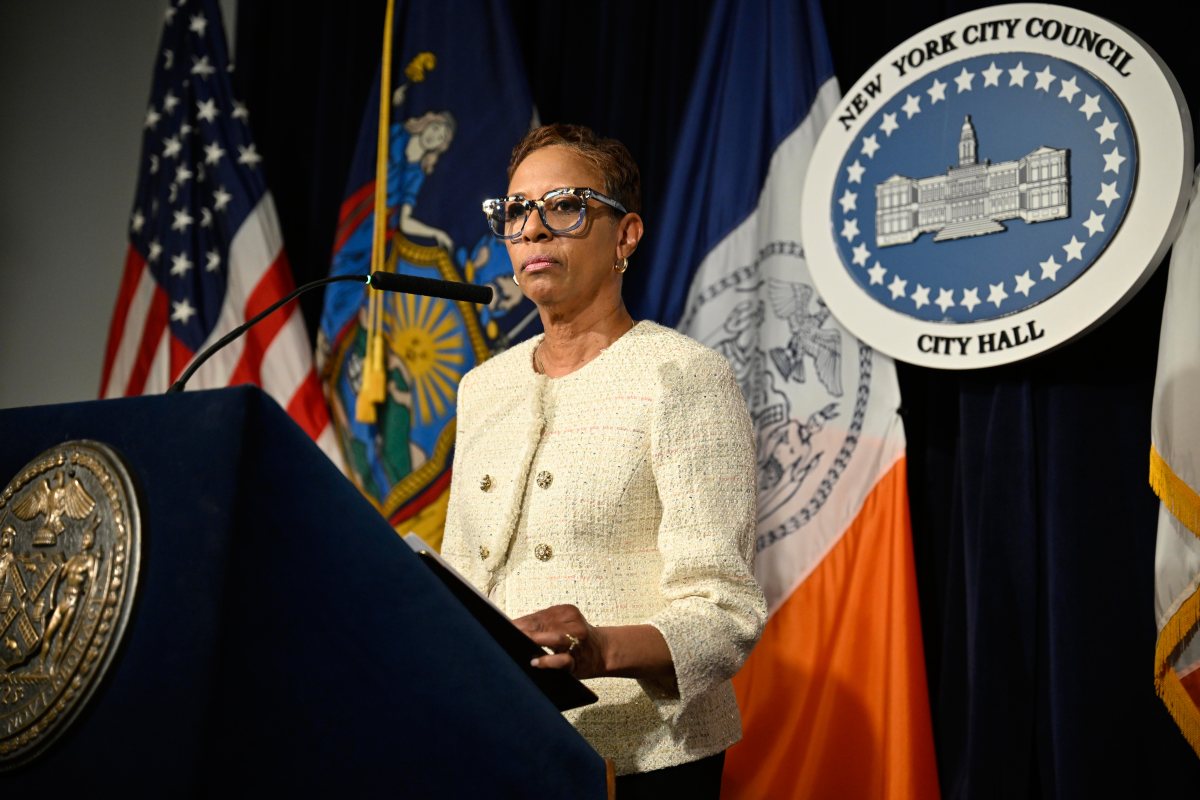
Mastro’s comments come after the council voted on Thursday to empower Speaker Adams to sue City Hall over potential violations of the city’s sanctuary laws. The council argues the action was necessary following Mastro signing an executive order, after Mayor Adams recused himself, allowing federal immigration authorities to operate on Rikers Island for the first time in over a decade.
Council spokesperson Mara Davis responded by accusing Mastro of trying to “distract” from the body taking action to block Mayor Adams’ administration from assisting with Trump’s immigration crackdown. The speaker has charged Adams made the move as part of a quid pro quo with the Trump administration to drop his criminal indictment — a request granted by a federal judge last week.
Davis also blasted Mastro for reportedly continuing to represent Madison Square Garden as a private attorney while holding the post of first deputy mayor.
“The council acted in unity this week to stop the Mayor and his Deputy from illegally handing City Hall’s power to the Trump administration,” Davis said in a statement. “If Randy Mastro wants to distract from that by turning the office of First Deputy Mayor into a political attack machine while representing special interests like MSG—that’s fine. We’re not backing down.”
Davis also took aim at the high amount of turnover in Mayor Adams’ administration over his nearly three and a half years in office. Mastro is Adams’ fourth first deputy mayor, he is on his fourth police comissioner, and third deputy mayor for public safety.
“We’ll pass on taking advice about Council matters from an administration already on its fourth round of deputy mayors,” she said.
Here is a breakdown of some of what has happened so far and what is ahead on the immigration front. https://t.co/7ZiDDJXRH6
— Brooklyn Eagle (@BklynEagle) April 11, 2025
A self-proclaimed progressive prosecutor, Brooklyn District Attorney Eric Gonzalez is heading into his bid for reelection unopposed in the June Democratic primary. After two successive state and federal election cycles heavily focused on crime, why is Gonzalez cruising to another term without facing the blowback that his colleague in Manhattan Alvin Bragg has been up against?
Gonzalez believes it’s about his pragmatic vision of reform.
Unlike Bragg and Philadelphia District Attorney Larry Krasner, Gonzalez has not built up much of a national profile for his status as a progressive prosecutor. Though he has embraced a system that considers non-jail resolutions at every juncture of a criminal case, and expanded a conviction integrity unit — which targets faulty NYPD investigations that resulted in false convictions — Gonzalez maintains he’s not an ideologue.
“It’s not coming from an ideological place. It’s coming from trying to be smart on crime, trying to be pragmatic about how we do this work,” Gonzalez said.
A fundamental departure from the approach of other progressives is that Gonzalez avoids categorical promises about how he’s approaching different cases. This strategy stands in stark contrast to the way that Bragg, for instance, started his tenure with a “Day One Memo” distributed to his office indicating he would stop prosecuting a host of low-level crimes and would not seek bail for others. Swift backlash ensued.
Gonzalez said he takes an individual approach on each case.
“We have to make individual determinations about whether or not the prosecution of the case improves public safety and is consistent with how we as law enforcement want to interact with our community,” Gonzalez told amNY Law. “I did not join other progressives when they had the day one memos, or the ‘I will never prosecute this’ and I’ve been critical of that approach. Because my law enforcement strategy has always been about the individual being accused before the court. Are they a driver of crime?”
A case-by-case basis:
This approach also means it can be hard to pin down exactly where Gonzalez draws the line on certain types of crimes. Take fare evasion, for example. The head of the Metropolitan Transportation Authority recently called on district attorneys to aggressively prosecute fare beaters. When he first took office in 2017, Bragg’s predecessor Cyrus R. Vance Jr., announced that the Manhattan DA’s office would no longer pursue criminal cases against most people arrested over fare evasion. Gonzalez told reporters at the time he would pursue a similar policy.
Gonzalez told amNY Law there are considerations that would make him less likely to prosecute fare evaders but stopped short of making guarantees.
“If someone is a first time offender and the first time they’ve ever been arrested, or they’re a young person, I think the approach should be different towards them. As it relates to fare evasion, I don’t have a per se policy that I never prosecute,” he said. “In fact, the policy of the DA’s office is that we do prosecute people for fare evasion who are repeat offenders. And we do prosecute the sort of the transit recidivist who are causing havoc in our subways.”
He added that if there’s evidence that the fare evasion was a crime of poverty that would also be a consideration to dismiss the charges. But beyond the moral angle, a considerable part of his thinking on this issue is the bottom line of bringing fare evasion cases forward, Gonzalez said. Each one costs around $1,000 in police, court and DA resources, all together.
“From a real fiscal standpoint, New Yorkers also have to understand that is a tremendous money-suck if it’s not gonna keep you safe,” he said.
Another progressive practice that Gonzalez originally unveiled in 2017 that has become increasingly important as federal authorities have cracked down on immigration is a policy safeguarding some immigrants charged with misdemeanors or nonviolent crimes from deportation when possible. Gonzalez said he was among the first DAs in the country to hire immigration attorneys to advise his staff on how to avoid charging and prosecuting immigrants with legal status with crimes that could automatically lead to deportation.
The fundamental question, Gonzalez said, is whether there is “any way we can work out something that would at least give [the legal immigrant] a fighting chance in immigration court?”
But like fare evasion, the moves that Gonzalez’s office takes to help reduce deportations is case-based. “If we can, we can,” he said. “If we can’t, we can’t.”
It also offers no promise to undocumented immigrants. “If you have no legal status in the United States at all, my collateral consequence policy does not protect you because the government can choose to deport you whenever they want to because you don’t have status,” Gonzalez said.
Brooklyn state of mind:
Gonzalez came to the Brooklyn District Attorney’s Office immediately after law school as a junior prosecutor in the ‘90s and has been working there since. The fact that he has spent his entire career at the same office watching his predecessors operate has informed his thinking.
“I’m a career prosecutor,” he said. “So I’ve been in the trenches. I’ve done every job in this office. I started as an intern. I was a paralegal… Again, never thinking that I was gonna be elected district attorney but I’ve spent a lot of years working to keep people safe. So I have a real record of working closely with law enforcement to prosecute cases.”
He lives in East New York, the neighborhood where he grew up — another part of his background that he said has helped him build trust with Brooklynites who are most impacted by the work of the Brooklyn District Attorney’s office.
“This concept of understanding the need to feel safe is what motivated me to join the DA’s office. But really, it is a fundamental understanding of the role — of what I need to do in this office,” he said.
Gonzalez became Brooklyn’s first Latino district attorney after the 2016 death of his predecessor Ken Thompson, who was the first African American elected to the office three years earlier. Gonzalez had served as chief assistant district attorney to Thompson, who abruptly died from cancer shortly after he announced that he would have to take a leave from the office. Gonzalez was then appointed the acting replacement, with the blessing of Thompson’s widow, and won the next year’s election, by a large margin.
“I believe that people who had lived life experiences in difficult neighborhoods needed to be in law enforcement institutions, that people who actually had lived in those communities and had skin in the game needed to be in these roles. I never imagined being a district attorney. That’s a different thing, but I knew that I would have some input and some influence as a prosecutor,” he said.
A holistic view of law enforcement as starting with an investment in community services has been beneficial for his office, Gonzalez said. In January he sent out a press release trumpeting that 2024 was the safest year for gun violence in Brooklyn’s history, with the fewest shooting incidents and shooting victims besting previous lows from 2019.
He attributes this success to two factors: a targeted approach toward violent crime and coordination with community organizations.
“One percent of our population is responsible for 60 percent of the violence in our city,” he said. “So when I do a gang take down, I’m not trying to arrest every kid who lives in the housing development. I’m trying to arrest the people who are engaged in the violence.”
But when shootings began to skyrocket after the Covid rippled through the city, Gonzalez said that he was confident that continuing to use the community resources tactics he had been implementing.
“I don’t think all of the reasons why Brooklyn is doing well is just because of enforcement and prosecution. We have a lot of community stakeholders and not-for-profits… It’s the violence interrupters. We have a lot of people who are engaged in moving us forward in ways that keep us safe. And I think all of those things matter and why things shot up during Covid is because none of those other things were happening,” he said.
This budget season Gonzalez has found himself in the position of joining a coalition consisting of Governor Kathy Hochul and every DA in the state to soften reforms of New York’s discovery laws, one of the sweeping criminal justice areas that the New York Legislature reformed in 2019. Across the city’s DA offices, the case dismissal rate increased from 42% in 2019 to 62% in 2023.
Hochul has proposed changing the discovery reform that required prosecutors to share evidence with defense lawyers on an accelerated timeline or face sanctions including the possible dismissal of the case. Though on the surface the effort is an instance of prosecutors uniting to scale back a criminal justice reform, Gonzalez insisted that the reforms would be a “smoothing out” of a law that he said was initially drafted too rigidly.
No DA in the five boroughs, he said, is ”looking to go back to pre-2019 era discovery laws where things were not required to be turned over [until] right before trial. We all agree that this information must be exchanged as quickly as possible.”
His push here relates to a talk Gonzalez said that he gave to new assistant district attorneys, some of whom, he said, seek out the Brooklyn office because of its reputation for reform: “You’re not here to be advocates. You’re here to do justice. Make the best decision you can on the case,” he tells the new ADAs.
And while this philosophy may not speak to those on the left as going far enough, Gonzalez said his electability is a sign that his approach is working.
“You look at some of the most progressive prosecutors across the United States,” he said. “A lot of them have lost their jobs or their offices are no longer doing these things. Brooklyn has continued to do things that are meaningful.”
For Sammi Katz and Olivia McGiff, bringing “Spirited Women” to life was a true labor of love.
Building on the success of their 2023 book, “Cocktails in Color: A Spirited Guide to the Art and Joy of Drinkmaking,” the duo recently released “Spirited Women: Makers, Shakers, and Trailblazers in the World of Cocktails” — a vibrant celebration of the women who aren’t just behind the bar, but are shaking up the beverage industry.
“We were able to sign a two-book deal, so we knew we’d have a second book to work on,” said Katz, the book’s author and a seasoned bartender. “It really gave us time to think about what we were really passionate about, what we would want to spend years working on. And so not only is this a passion — both of ours — but I think it allowed us to collaborate with so many cool ladies that throughout my career in the industry, I’d met and learned about.”
“Spirited Women” highlights the work of 45 groundbreaking women, including figures like Lynnette Marrero, co-founder of Speed Rack; Chockie Tom, an Indigenous hospitality advocate; and Yola Jimenez, Founder of Yola Mezcal. Through engaging profiles, cocktail recipes and colorful cartoons, the book showcases the diverse range of women reshaping the world of spirits and cocktails.
“I think there are more and more books on the market about women in spirits, but they’re a bit more historical,” said McGiff, the book’s illustrator and Katz’ friend since college. “The opportunity to talk to living women in the industry who are leading their fields was really exciting and gave us also the opportunity to put ourselves out there and meet those women.”

The project, born out of the pair’s shared passion for cocktails, also tackles the issue of sexism in the industry, shining a light on the barriers women have historically faced in a traditionally male-dominated field.
When she started bartending a decade ago, Katz said, she was the only woman on the bar team.
“But now, if you walked into a bar and there were no women on staff, that’s unacceptable … and other people would be like, ‘That’s not cool!” she said. “That’s just not how it is anymore.”
McGiff’s vibrant illustrations further enhance the book’s accessibility, breaking away from the intimidating aesthetic often associated with cocktail culture.
“My illustration style, I think, allows our approach to cocktailing to feel really accessible and approachable and friendly,” she said. “I love honoring the cocktail and the stem wear and the glass, the bottle that the product is in, treating all of that with beauty and respect.”
McGiff often refers to the illustrations in “Spirited Women” as “Still Lives.”
“I try to incorporate as much of the raw ingredients that you find in the cocktail to style the illustration in a way so that you can know by looking at the illustration exactly the flavors, the textures, the mood that you’re going to imbibe if you were to make that cocktail at home,” she said.

“I think oftentimes when cocktail books are photographic, they’re beautiful, and they’re stately, but they’re also fairly intimidating,” McGiff went on. “If you don’t have this perfect meticulous stem wear, or you don’t know how to spritz the lemon twist with backlighting, it can feel a little bit like a buttoned-up boys club, honestly. It reminds me of a lot of more old-school cocktail bars. My inability to draw a perfect oval for the stem wear and everything hopefully makes things feel more approachable and homey and fun.”
But “Spirited Women” is more than just a collection of profiles and recipes, the creators said — it’s a celebration of the women who are shaping the future of spirits.
“We’ve been able to talk to so many women around the world who work in this industry in different facets of it — distillers, blenders, educators, authors — from the far reaches of the world to our local Brooklyn,” Katz said. “It was very cool to be able to understand a more global scope of women in the industry and also to be able to share stories of ladies who people who might not have ever heard of before.”
“Spirited Women: Makers, Shakers, and Trailblazers in the World of Cocktails” is available anywhere books are sold.