
It’s the end of an era. [ more › ]
 The Ocean Avenue News - oceanavenuenews.com
By: Jerome Brookshire
As Trenton finalizes the contours of New Jersey’s Fiscal Year 2026 state budget, a controversial provision buried within the proposal has triggered immediate backlash, particularly from stakeholders in the real estate sector and faith-based advocacy groups. Chief among the voices raising alarm is Shlomo Schorr, Director of Legislative Affairs for Agudath Israel of America’s New Jersey office, who took to social media this week to warn of the proposed expansion of the so-called “mansion tax”—a fee levied on the sale of high-value residential properties.
According to Schorr, the revised measure would double the real estate transfer fee on homes valued at over $1 million, increasing it from the current 1% to 2%. Even more steeply, homes that sell for $2 million or more would be hit with a 3% fee—effectively tripling the cost of the transfer tax for some of the state’s most sought-after properties.
“This means a minimum of $10,000 in additional fees for homes sold over $1 million,” Schorr wrote, highlighting the disproportionate burden the hike could place on families in densely populated and rapidly gentrifying regions—many of which include large Orthodox Jewish communities in towns like Lakewood, Teaneck, and Passaic.
Though frequently characterized as a “luxury tax,” the proposed hike has reignited a debate over whether such policies, aimed at taxing the wealthy, end up penalizing the middle class in high-cost-of-living states like New Jersey. With home prices in many suburban communities regularly crossing the $1 million mark, particularly in northern counties and shore-adjacent neighborhoods, critics argue that the mansion tax expansion is not limited to the ultra-rich.
As Schorr and others have pointed out, the additional $10,000—or more in some cases—could be especially burdensome to large families seeking to upsize in growing communities, including those aligned with religious and cultural groups whose demographic trends lean toward larger households.
“What’s being sold as a tax on the rich is, in practice, a penalty on growing families and upward mobility,” one Lakewood-based real estate professional told this reporter. “These are not hedge fund executives buying $5 million condos in Hoboken. These are teachers, small business owners, and communal leaders trying to buy a five-bedroom house for their kids.”
The mansion tax debate is not new in New Jersey. First introduced in 2004 under then-Governor Jim McGreevey, the original tax applied a 1% levy on property sales over $1 million. Supporters at the time touted it as a fair mechanism for funding affordable housing and infrastructure improvements. Over the years, however, critics have increasingly described it as an outdated model that fails to adjust for inflation and local market dynamics.
In high-demand areas like Bergen and Ocean counties, $1 million no longer buys a sprawling estate, but a modest family home. As the housing market has surged post-pandemic, more and more New Jerseyans are being swept into a tax bracket originally intended for the wealthiest.
Schorr’s intervention on the issue reflects broader concern within the Orthodox Jewish advocacy landscape, which has become increasingly vocal on state-level fiscal policies that impact religious institutions, school funding, housing affordability, and transportation.
“Agudath Israel is committed to protecting the financial interests and dignity of our communities,” Schorr said in a statement following his post. “This proposed expansion of the mansion tax is neither equitable nor justifiable in the context of today’s real estate realities.”
The Fiscal Year 2026 budget, which is still under negotiation in the New Jersey Legislature, is projected to exceed $55 billion—an historic high for the state. The proposed mansion tax hike is expected to generate hundreds of millions of dollars in new revenue, earmarked for affordable housing initiatives, public transit upgrades, and educational investments. But detractors argue that it amounts to a regressive tax masquerading as progressive reform.
Governor Phil Murphy, a longtime advocate for “tax fairness,” has not publicly commented on the specific mansion tax proposal in recent days. However, his administration has repeatedly framed similar proposals in terms of equity and fiscal responsibility.
The measure’s passage is far from guaranteed. Legislative leaders from districts with high home values—many of them Democrats—have expressed reservations, suggesting that the final budget may need to scale back or revise the tax to secure majority support.
For groups such as the Agudath Israel, the mansion tax issue is not just about money—it is about policy priorities and whose voices are being heard in Trenton.
“This is an opportunity for the Jewish community, and others similarly affected, to engage vigorously with the legislative process,” said one Agudah representative. “We must remind our elected officials that affordability, family sustainability, and community continuity matter. We cannot allow sweeping fiscal reforms to push working- and middle-class families to the margins of the housing market.”
As New Jersey lawmakers race toward the June 30 budget deadline, the fate of the expanded mansion tax remains uncertain. What is clear, however, is that the debate has struck a nerve—particularly among communities for whom housing is not simply a financial transaction, but a cornerstone of religious life, education, and identity.
Whether the final budget reflects those concerns remains to be seen. But as Shlomo Schorr’s post makes clear, the conversation is far from over.
The post NJ’s Proposed Budget Sparks Outcry Over Mansion Tax Hike: Orthodox Community Voices Concern appeared first on The Jewish Voice.

For two decades, Maimonides Cancer Center has been more than a hospital.
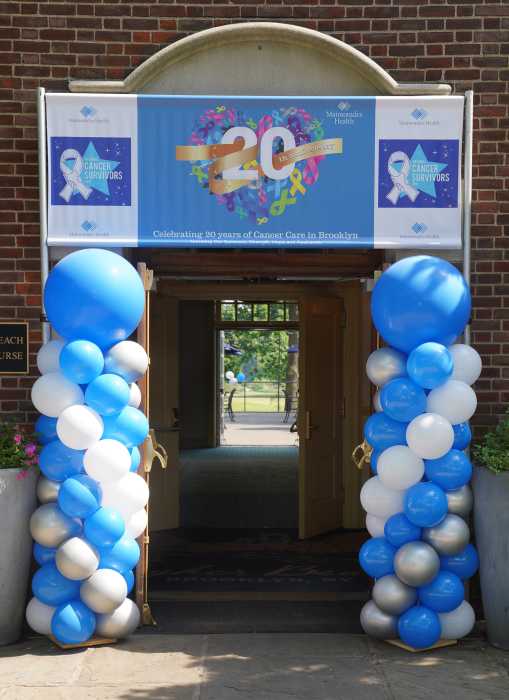
It’s been a home base in Brooklyn for those battling cancer, their families and the larger community that no longer has to travel long distances for top-notch treatment. This month marks 20 years since Maimonides opened Brooklyn’s first “fully accredited cancer center.” Each year, more than 30,000 patients turn ot the center for comprehensive cancer care.
“If Brooklyn were its own city, its population would rank among the largest in the country, so it’s hard to imagine that 20 years ago, there was no dedicated cancer center here,” Dr. Parick Borgen, the center’s founder and director, who also serves as Maimonides’ chair of the department of surgery. “Maimonides saw that need and fulfilled it, in the name of providing Brooklynites with the world-class cancer care this community deserves.”
Borgen left his job at Memorial Sloan Kettering to found the center in 2005.
Twenty years later, the Maimonides Cancer Center spans 18 oncology specialties, from breast and lung cancer to prostate and blood cancers. It’s the only place in Brooklyn offering lifesaving treatments like Pluvicto for metastatic prostate cancer and Hepatic Artery infusion for colorectal and bile duct cancers that have spread to the liver.
They have also built first-in-borough programs, such as the Maimonides Breast Center in 2011, Brooklyn’s only breast center accredited by the National Accreditation Program for Breast Centers, which “now conducts nearly 10,000 screenings annually.” In 2015, the Maimonides Prostate Center was created as Brooklyn’s “only full-service facility” of its kind.
Beyond the programs and cutting-edge treatments, Maimonides is defined by its people-centered approach.
“We get to know [patients] throughout their care, tailoring every treatment to their clinical success and comfort level,” Chair of the Department of Radiation Dr. David Berlach said.
“We know our community well, and our mission is not only to connect them to the best possible treatment, but to meet them where they are in terms of language, cultural practices, socioeconomic factors and more components that contribute to the most successful treatments and experiences,” he continued.
For Ken Gibbs, president and CEO of Maimonides Health, the commitment to locality is key.
“No one should have to leave Brooklyn to get top-tier cancer care,” he said. “We’ve built our strategy around keeping care within reach.”
That strategy has earned wide recognition. Maimonides is consistently named a high-performing hospital by U.S. News and World Report for lung, colon and blood cancer care. It’s only one of two centers in New York State to earn a perfect score from the Commission on Cancer of the American College of Surgeons. And its staff lead groundbreaking clinical trials that continue to shape the future of oncology.
The center has also expanded care into different neighborhoods, creating partnerships with systems like SUNY Downstate and opening infusion centers in Maimonides Midwood Community Hospital to reduce patient travel times.
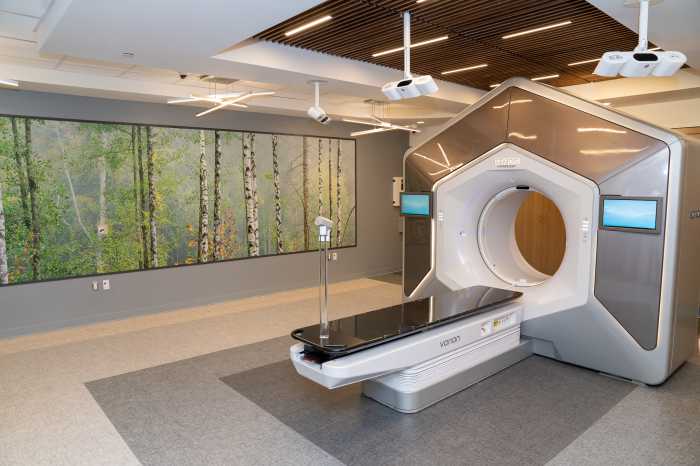
Last month, the center introduced an advanced adaptive radiation therapy system that “allows for providers to scan patients more often and adjust treatment plans in real time.” In 2024, they were designated as a Robotic Center of Excellence by the Surgical Review Corporation, something they said “highlights their commitment to excellence in roboticsurgery and high-quality patient care.”
Despite their numerous accolades, Maimonides is celebrating the people who brought them here. Events like their annual Cancer Survivor’s Day and Pink Runway fashion show put faces and stories behind the statistics.
“Every time a patient walks through our doors, it’s the start of a new relationship,” Dr. Berlach said. “Our team goes the extra mile, so our patients don’t have to. That is the key to our mission of saving lives and promoting healing.”


