Influencer Tanner Martin has died at the age of 30 following a five-year battle with colon cancer, announcing his death himself in a pre-recorded video on Instagram.
 The Ocean Avenue News - oceanavenuenews.com
CALA’s 2nd annual gala honored leaders and raised funds for scholarships, focusing on mentoring Caribbean American legal professionals.
The post Caribbean American Lawyers honor four at recent gala — expect to exceed monetary expectations appeared first on Brooklyn Eagle.
To Google: Corrections and CLARIFICATION
Dear Google:
Please, make this correction in your Search results.
There are TWO persons named “Michael Novakhov”:
Father, 1952 DOB, a blogger,
and a son, 1976 DOB, a local Brooklyn politician,
who does not use the addition Jr. after… pic.twitter.com/gL8aQEUXfM— Michael Novakhov (@mikenov) June 26, 2025
To Google: Corrections and CLARIFICATION
Dear Google:
Please, make this correction in your Search results.
There are TWO persons named “Michael Novakhov”:
Father, 1952 DOB, a blogger,
and a son, 1976 DOB, a local Brooklyn politician,
who does not use the addition Jr. after… pic.twitter.com/gL8aQEUXfM— Michael Novakhov (@mikenov) June 26, 2025
By: Ariella Haviv
In the wake of a consequential U.S. strike on Iranian military infrastructure, a late-night phone call between Israeli Prime Minister Benjamin Netanyahu and President Donald Trump has laid the groundwork for what could be a dramatic reshaping of the Middle East’s political architecture. According to a report in Israel Hayom and corroborated by The Times of Israel, the call, described by sources as “euphoric,” unveiled an ambitious plan to end the war in Gaza within two weeks, restructure its governance, and expand the Abraham Accords with the addition of new Arab states.
This quiet but powerful convergence of Israeli and American diplomatic aims has raised eyebrows across capitals—from Riyadh and Cairo to Washington and Ramallah—as it signals a possible denouement to the brutal Gaza conflict, while repositioning Israel’s regional alliances.
According to the information provided in the Israel Hayom report which cited a senior source familiar with the conversation, Netanyahu and Trump agreed that the ongoing war in Gaza—triggered by Hamas’s October 7 attacks and Israel’s sweeping military response—should conclude within two weeks. The endgame, as discussed on the call, includes the removal of Hamas from power, the exile of its leadership, and the complete release of all hostages held in the Strip.
Crucially, the proposed postwar framework would place governance of Gaza in the hands of a coalition of moderate Arab states—specifically the United Arab Emirates, Egypt, and two other unnamed nations—effectively sidelining both Hamas and the Palestinian Authority (PA). The Times of Israel reported that this model reflects Netanyahu’s long-standing resistance to any PA role in postwar Gaza, a position that continues to face significant pushback from Washington’s Arab partners.
As The Times of Israel report pointed out, Arab states have consistently stated they will not assume responsibility for Gaza’s reconstruction unless there is a meaningful political process toward Palestinian statehood—specifically one involving the PA. This conditionality has placed Netanyahu at odds with traditional partners in the region, who are increasingly impatient with the status quo.
The Netanyahu-Trump call went beyond Gaza. As The Times of Israel report emphasized, the broader goal is nothing less than a regional diplomatic renaissance under the banner of the Abraham Accords. According to the report in Israel Hayom, the agreement envisions formal normalization of relations between Israel and both Saudi Arabia and Syria—two countries that, until now, have either maintained icy detachment or outright hostility toward the Jewish state.
Should this materialize, it would mark a tectonic shift in regional geopolitics. Saudi-Israeli normalization has long been a strategic prize for both Jerusalem and Washington. Syrian recognition, though more speculative given the Assad regime’s ties with Iran, would signal a remarkable recalibration of Levantine power structures.
As part of this normalization wave, other Muslim-majority nations are expected to follow suit, deepening the Abraham Accords’ reach and impact. The Times of Israel report said that this prospective wave of normalization hinges on a calibrated message from Israel: a conditional endorsement of a two-state solution—provided the Palestinian Authority undergoes significant reforms.
In what appears to be a key diplomatic quid pro quo, Israel would signal support for a future Palestinian state, while the United States, under a future Trump administration, would recognize Israeli sovereignty over parts of Judea and Samaria. This dual-track approach—reformulated under Netanyahu’s and Trump’s vision—resurrects the contentious annexation debate while appeasing both right-wing Israeli factions and moderate Arab capitals.
The Times of Israel report noted that this element of the plan aligns with prior Trump administration policies, particularly the 2020 “Peace to Prosperity” proposal, which envisioned limited Palestinian autonomy under strict security guarantees and territorial concessions to Israel.
Despite the heady optimism from Netanyahu and Trump, significant hurdles remain. Hamas’s leadership, which continues to wield influence in parts of southern and central Gaza, has historically rejected calls for exile. Furthermore, while the return of hostages remains a top priority for Israel, there is little indication that such a release is imminent, particularly given the fractured nature of negotiations since the collapse of previous ceasefire arrangements.
The Times of Israel report highlighted that past efforts to exile Hamas leadership—reminiscent of Yasser Arafat’s Lebanon evacuation in 1982—have failed in the face of ideological rigidity and logistical obstacles. Whether this time proves different will depend heavily on Arab mediation and internal Hamas calculations.
The potential fragility of the arrangement was underscored by Trump’s public outburst earlier this week. As reported by The Times of Israel, Trump was enraged by Israeli threats to retaliate against Iran’s ceasefire violations. In a Truth Social post, he called on Netanyahu to end his criminal trial—a rare and incendiary demand by an American political leader against the judiciary of an allied nation.
Analysts see Trump’s rhetoric as part of a larger effort to align Netanyahu with a strategic timetable that favors calm in Gaza, an expanding circle of normalization, and a reconfigured U.S.-Israeli relationship—possibly in anticipation of the 2024 presidential election’s foreign policy narrative.
While the full contours of the Netanyahu-Trump plan remain speculative, its core architecture—removing Hamas, restructuring Gaza governance, expanding regional normalization, and redefining the Palestinian question—reflects an audacious if risky diplomatic calculus.
The Times of Israel has repeatedly emphasized that the success of such a plan would depend on the credibility of guarantees made to Arab states, the enforceability of Hamas’s exile, and the internal cohesion of the Israeli government, which is already under strain from competing domestic pressures.
Moreover, the plan’s viability rests on a coordinated international response, especially from key stakeholders such as the EU and Egypt, both of which have remained wary of sidelining the PA and sanctioning long-term Israeli control over contested territories.
If Netanyahu and Trump succeed in translating Monday night’s “euphoric” call into actionable diplomacy, they could alter the Middle East’s landscape for a generation. Yet the road ahead is perilous. Without buy-in from Arab states, clarity from Hamas, and commitment from a fractured Israeli public, this plan risks becoming yet another chapter in the region’s long chronicle of unfulfilled peace. (Additional reporting by Fern Sidman)
The post Trump-Netanyahu Call Reveals Bold Postwar Vision: Gaza Governance Shift, Abraham Accords Expansion, and Two-State Conditionality appeared first on The Jewish Voice.
A woman was shot and killed blocks from her home in Prospect Heights on Wednesday night, and her killer left her to die in the middle of a crosswalk, police said.
Officers from the 78th Precinct rushed to the intersection of Carlton and Pacific Avenues in Prospect Heights at around 10:22 p.m. on June 25 after receiving a frantic 911 call reported that a person had been shot.
Arriving at the scene, they found a 36-year-old woman lying unconscious in a pool of blood in the middle of the roadway with a gunshot wound to the head.
Responding EMS units pronounced her dead at the scene. On Thursday afternoon, police identified the woman as Tamika Powell. Powell lived just a few blocks from the scene of her death.
Investigators canvassed the crime scene for several hours as they worked to uncover exactly what had taken place. As of June 26, police said they were not sure if the woman was the intended target. They also did not have a photo of the suspect.
No arrests have been made in the ongoing investigation, police said.
Anyone with information regarding this incident can call Crime Stoppers at 800-577-TIPS (for Spanish, dial 888-57-PISTA). You can also submit tips online at crimestoppers.nypdonline.org, or on X (formerly Twitter) @NYPDTips. All calls and messages are kept confidential.
Year-over-year, major crime is down more than 23% in the 78th Precinct, according to the latest NYPD statistics. As of June 22, there had been only one murder in the precinct — down from two during the same period last year — and just one shooting, down 66.7% from three last year. Gun crimes and homicide have been decreasing citywide in 2025, and during the first five months of the year, New York City saw murders and shootings drop to historic lows.
This story first appeared on Brooklyn Paper’s sister site amNewYork.
At Selune, an intimate new wine bar in a historic Bed-Stuy building, natural wine and oysters go together like peanut butter and jelly.
Founded by Marc Lioussanne and Bilen Gaga, Selune opened its doors on Halsey Street last week, offering an extensive list of American and European natural wines, fresh oysters, and Japanese sake.
For months, locals have been peering behind the construction fence and popping their heads in to ask what would be opening there and when, Gaga told Brooklyn Paper.
“Then once we opened, people have just [had] honestly positive, amazing energy, and it’s been busy, so that’s a good thing,” she said.
Lioussanne has worked in hospitality for two decades, and he and Gaga first met over a glass of natural wine at a bar he used to run in Paris. Ever since, the pair have shared a love for wine, sake, and oysters from afar — Gaga in Bed-Stuy, where she’s lived for 15 years, and Lioussanne in Paris.

Then, Lioussanne moved to the neighborhood and fell in love with it, and they decided to open a business that would combine their international culinary passions under one roof.
“I feel like New Yorkers are usually much more open-minded to what is new, and trying new pairings and discovering new things,” he said. “And I think the interest for people in New York for natural wine is growing.” .
Because natural winemakers have small vineyards and produce fairly small batches of wine, restauranteurs have to have special connections to get their hands on certain bottles each year, Lioussanne said, and he’s leveraged his longstanding relationships with French winemakers and distributors to bring their wares to Bed-Stuy.
Right now, highlights of Selune’s wine menu include a “bright, fruity” Beaujolais red wine from natural winemaker Thibault Ducroux and a crisp, lightly sparkling François de Nicolay Bulles Dog, produced with grapes grown on a biodynamic vineyard founded in 1834.
For Lioussane and Gaga, pairing oysters with natural wine was an obvious choice.
“If you have a love of raw oysters, you know that you’re getting this amazing taste of the ocean,” Gaga said. “And same with natural wines, you’re getting the unfiltered, amazing taste of the grapes. So the thought of combining those two things is actually not that far-fetched to us.”
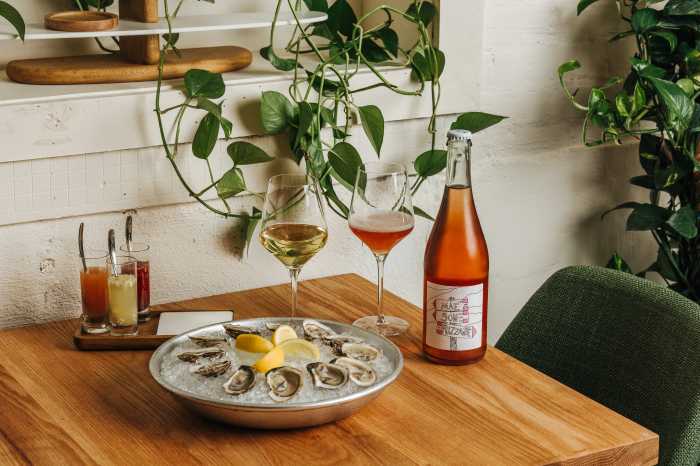
The combination of oysters and sake is a little more unusual. Lioussanne’s love for natural wines eventually led him to natural sake, and Gaga first tried the Japanese spirit at one of his bars in Paris.
“[Selune] is kind of like this melding of the love that we had in France for oysters and seafood and trying to bring a little bit of that here to the U.S.,” she said.
Almost everything at Selune — save for the wine and sake — comes from local farms and suppliers, in an effort to keep things sustainable. Their oysters hail from Massachusetts and Nova Scotia, and the furthest-sourced shellfish are grown in British Columbia and Washington state.
The rest of the food menu is largely French-inspired and locally-sourced. There’s duck breast and foie gras from a farm in upstate New York, and artisanal cheeses from Tonjes Farm in the Catskills.
“Everything is super natural … we try to work directly from the farm to the table,” Lioussanne said. “That allows us to select our products and select our producers.”
In designing Selune, Gaga endeavored to preserve some of the building’s historic charm. She embraced its original brick walls and patterned tin ceiling, stained the existing bar a deep walnut color, and added in wooden chairs and tables with pops of green upholstery and plants.
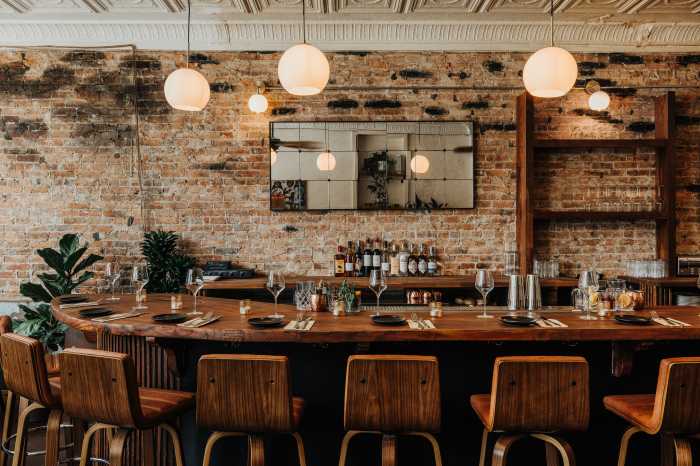
“I want people, when they walk in, to feel like they’re still sort of out in nature,” she said.
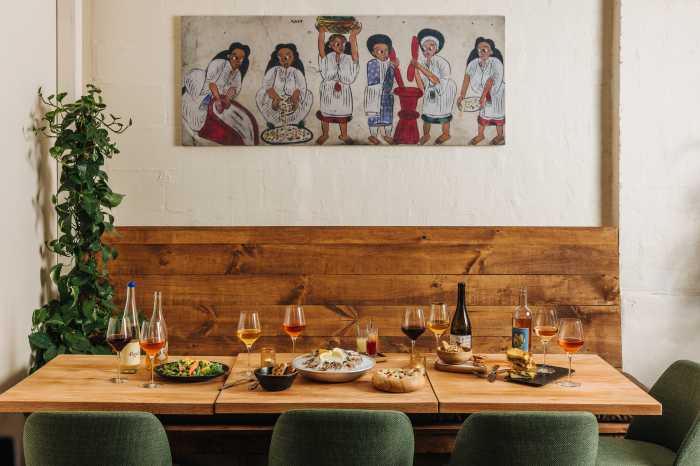
The art on the walls is an homage to her Ethiopian heritage.
“It was actually Marc’s idea, because obviously we already have a lot of wines from France, and a lot of the food is representing his culture,” she said.
Ethiopian culture is centered around communal eating, she said, and the artwork they chose emphasizes their desire for Selune to be a place for the community to gather and enjoy good food and drinks together.
“I’ve been in Bed-Stuy for over 15 years, [our goal] is not to come in and create something that is not open and is not inclusive of the community,” Gaga said. “The decisions we’ve made about the decor, about what wine we want to offer … we tried to have it be as intentional as possible to have it be a space that’s representative of Bed-Stuy.”
They also endeavored to keep prices reasonable and avoid the “high nose” attitude that sometimes accompanies conversations about fine wine.
“We really really hope and expect that we have the chance to take the time to talk with our guests, to share that passion, to share some pairings, to share some things,” Lioussanne said.
During Selune’s first week in operation, a pair of women came in and decided to try oysters for the very first time. Before breaking out the full two dozen, he opened one for each of them to sample.
“I was actually a little bit emotional that I had the chance to have them try the first oyster of their life,” he said. “It sounds funny, but trying something for the first time in your life, I think it’s cool. And they loved it.”