
A Catholic school deacon admitted to molesting four girls and was released from custody after accepting a plea deal.
 The Ocean Avenue News - oceanavenuenews.com
A NYC urban planning research group published a study about train operation, calling on the MTA to make a driverless system for its planned Interborough Express (IBX) rail line through Brooklyn and Queens.
As part of its study, NYU’s Marron Institute of Urban Management reviewed more than 400 trains in dozens of countries and found that fewer than 6.25% of the systems have two staffers on board.
But the researchers, who have written extensively about IBX land-use topics, are specifically advocating for MTA’s most anticipated projects to be built as a fully automated system, eliminating the need for on-board staff, including train operators, to optimize the light-rail’s speed and efficiency.
“Ideally, IBX will be fully automated when it opens so that it can operate the most robust service possible,” researchers wrote in the study.
Eric Goldwyn is a program director and clinical assistant professor at Marron who contributed to the Nov. 13 study. He told amNew York that the IBX should “absolutely” be automated to enhance speed and service.
“When you have a subway, the most important thing is reliability and frequency,” the researcher said. “And the way you have the highest frequency is through automated operations.”
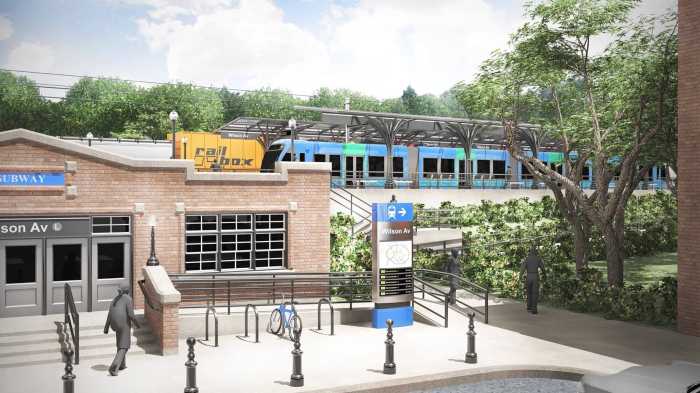
A fast ride is a strong selling point for the IBX. The MTA has promised that a full one-way ride on the proposed 14-mile, 19-stop light-rail will take about 33 minutes—a far cry from the nearly two-hour commute on most trains to the outer boroughs that have to run through Manhattan.

Goldwyn suggested that train headway (the amount of time between consecutive trains) can be shortened with automation, thus supporting a quick commute.
“There are train lines in the world that run every 90 seconds,” he said. “And with the IBX, that should be our goal.”
Goldwyn might be on to something. Vancouver’s SkyTrain uses fully automated, driverless trains. A glance at its schedule reveals that some trains run as frequently as every two minutes during peak hours.
According to an article in Railway News, these driverless trains are expected to “play a central role in enabling more frequent and dependable operations on the expanding network.”
Back home in the Big Apple, the possibility of a fully automated train does not appear far-fetched. The MTA is on a roll, modernizing its century-old infrastructure with “Communications-based Train Control” (CBTC) technology, which relies heavily on computers and wireless communications between trains and track equipment to improve service.
And it is similar to the technology used in Vancouver.
“The CBTC system is expected to help manage rising passenger demand,” the Railway News article notes. “On an average weekday in 2025, the SkyTrain network has recorded approximately 481,000 boardings. The enhanced automation is designed to improve reliability, reduce the frequency of headways between trains, and provide a consistent travel experience for users.
But some New Yorkers caution that the removal of human staff carries a deeper risk, pointing to a potential “darker side,” so to speak, of automation: The displacement of transit workers and the loss of security and safety that a human presence helps provide.
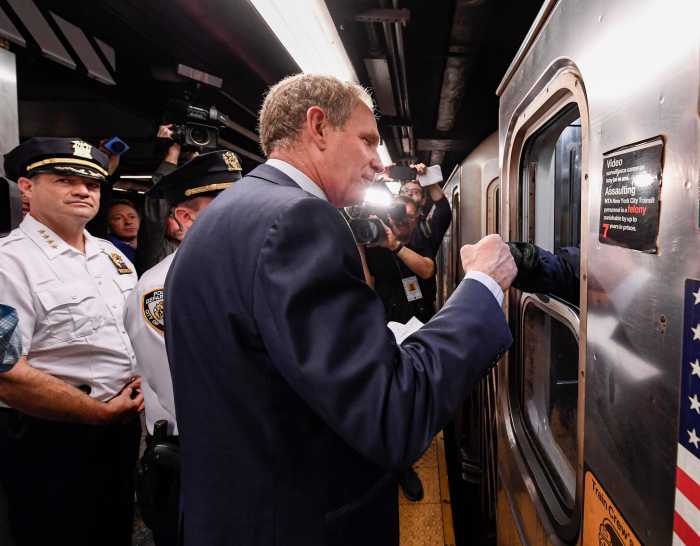
John Samuelsen, president of the Transit Workers Union International, told amNewYork that, according to the union’s contract, an automated IBX will not come to light.
“If the IBX utilizes NYC Transit’s fare medium, and provides seamless transfers into the subway, then it’s TWU 100 work, covered by our contract,” he explained. “Automation and OPTO [one-person train operation] are prohibited. Fully manned trains are required.”
Earlier this week, Samuelsen also referred to the Marron Institute study as “garbage.”
“Academics think working people are stupid,” he said. “They can make data lie for them. They conducted a study of subway systems worldwide. But there’s no subway system in the world like the NYC subway system.””
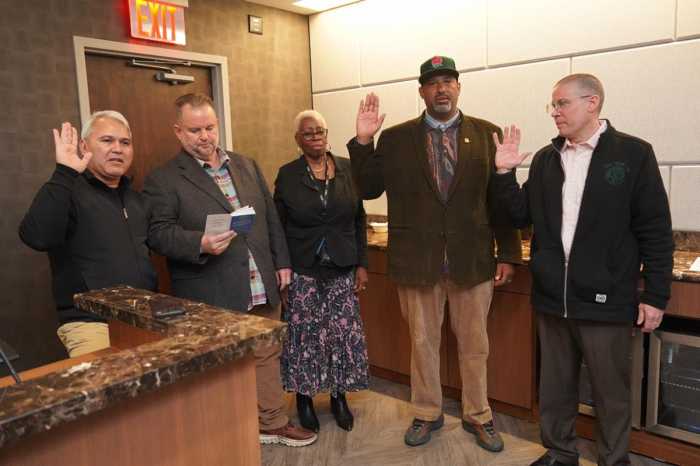
The transit union and many politicians are working to legally solidify this mandate through NYS legislation. Gov. Kathy Hochul has until the end of the year to approve a bill that would mandate the continued presence of conductors on nearly all of NYC’s subway trains, something that would likely extend to the proposed IBX.
amNewYork spoke to some subway riders about the idea of a fully automated IBX in the outer boroughs.
“This is NYC where things will happen on the subway. It is not about if they will happen, like track fires or crime,” Teddy, a Manhattan subway rider said. “We need people on the trains. We need staff on the trains.”
Similarly, Christina Wilkinson of Queens is concerned about public safety.
“It’s rather unsafe to have tens of thousands of people traveling in a 14-mile-long stretch at high speeds without trained personnel aboard,” she said. “There likely won’t be staff at the stations, either, and we already know there won’t be enough cops to patrol it. It’s just an irresponsible idea.”
Liisa Lunden, also from Queens, echoed those sentiments.
“Whether conductor-less or automated, I think that’s a safety risk,” she said. “People already get pushed in front of trains. Light rail will be more desolate.”
She also said train staff act as extra “eyes and ears” on trains and platforms to “see if anything happens,” citing criems in progress, threats, or passengers in need of police or medical help.
In terms of mechanical safety, Goldwyn, from the Marron Institute, explained that automation comes with safeguards in place.
He cited airport trains as an example when describing how automatic trains run — and how they know to stop.
“If there is some issue where the train stops automatically, that information gets sent back to the central system, so the trains behind it know to stop,” he said.
Meanwhile, Rachel Fauss, a senior policy advisor for Reinvent Albany, a group that advocates for transparency and accountability in government, agrees with the Marron Institute study. During an MTA committee meeting on Nov. 19, she said that “the trend globally is clearly towards automation” as modern signaling systems are continue to get installed. While she did not discuss the IBX, she said that Hochul should veto the state legislature’s bill to keep conductors on city trains.
“Unfortunately, our state legislators have reached way too far into micromanaging the MTA by passing this misguided and outdated legislation,” she said.
The MTA has included robust funding in its $68.4 billion 2025-2029 capital plan to modernize the subway system. Fauss emphasized taking “full advantage” of modern signals.
“Let’s not squander this investment. By taking full advantage of modern signals, the MTA can run existing trains more efficiently, and put those savings directly into increased service, a win-win for riders and transit workers,” she said.
The MTA declined to comment on this story.
The IBX, which is expected to cost around $6 billion, is currently in its design and environmental review phases. Although the proposal is on track to come to light in several years, the state-run MTA will continue to plan public meetings and outreach about the ambitious project.
When it came time to choose a kindergarten for her daughter, Natalie, three years ago, Carmen Avila found plenty to like about Uncommon Excellence Girls Elementary School in Brooklyn.
But what stood out most about the free public charter school was that it offered a high-quality education in an all-girls setting designed to build confidence, leadership, and academic ambition without the social pressures typically found in a co-ed setting.
“I chose this school because only girls come, and you know sometimes boys are a little more mischievous, and they don’t focus on what the teacher is saying in class and everything,” Avila said.

[Click HERE to watch an interview with Carmen Avila in Spanish]
Avila was already aware of the value of a single-sex school. Her son, Joel, is an eighth-grader at Uncommon’s high-performing all-boys campus, Excellence Boys, also in Bed-Stuy, Brooklyn.
Through the 1970s, single sex schools were far more commonplace in American education. Today, most K-12 schools are co-educational.
But single sex schools like Excellence Boys and Excellence Girls offer a distinct advantage for students.
Schools like Excellence Girls can build confidence in young women, giving them an edge as they continue their academic pursuits.
Research collected by the National Coalition of Girls’ Schools found that students who graduated from all-girls schools were more likely than those attending coeducational schools to impact their communities, perform better academically, consider majoring in math, science, or technology, and have higher aspirations and greater motivation.
Kim Perez, the Principal of Excellence Girls, sees the impact every day.
“Every time I enter my school, I see the girls walking with so much pride and confidence,” Perez said. “In our school, we teach our girls to see their friends more as sisters rather than just friends.”

Perez said what makes the school unique is that teachers ensure every student is at their level and that they progress to the next level through tutoring and small-group instruction.
“We push them to grow more by closing the learning gaps specific to every student,” she said.
Students who attend the school exceed the state exam averages by wide margins and are projected to outperform the state’s highest-performing subgroup. Between 2024 and 2025, third graders, for example, improved their state test scores by 10% in math and 22% in English Language Arts.
Some of the students who attend the school come from families where Spanish is the first language. The school is particularly well prepared to support students in becoming multilingual learners.
“We help students who speak Spanish because we have a teacher who teaches English as a new language, and we also have materials that we translate into Spanish for the students and also for the parents,” Perez said. Both Perez and Delta Reyes, the Director of Operations at the school, are also bilingual and support families.
Avila, who immigrated from Ecuador, said she feels supported by the staff.
“Latina mothers are always supported,” she said. “The teachers are always calling. They are always very, very communicative and focused on the parents.”
Avila said her daughter spoke little English when she started at Excellence Girls as a kindergartener, but now has mastery of the English language.

Avila said she is delighted with the education her daughter is receiving at Excellence Girls.
“I tell parents to try Excellence Girls, you won’t regret it,” she said. “I would advise parents to bring their kids to this school because it’s a very good school.”
To learn more about Uncommon Excellence Girls Elementary School, visit https://nyc.uncommonschools.org/excellence-girls-school/ and sign up for a school tour.
Among the topics of conversation will be the upcoming Brooklyn Marine Terminal Environmental Review.
The post Brooklyn Marine Terminal will be focus of Cobble Hill Association’s annual meeting Thursday appeared first on Brooklyn Eagle.
The New York State Police Organized Retail Theft Task Force has recovered more than $2.6 million in stolen goods statewide.
The post Hochul: Retail theft task force has recovered $2.6M in stolen goods appeared first on Brooklyn Eagle.
THE U.S. DEPARTMENT OF AGRICULTURE MUST CORRECT ERRORS IN ITS NEW FEDERAL INSTRUCTIONS REGARDING ELIGIBILITY, says Letitia James.
The post Attorneys General demand that USDA correct ‘errors’ on legal immigrants’ SNAP eligibility appeared first on Brooklyn Eagle.

