
The arrest came on the same day an opposition candidate was convicted of a crime that bars him from running for office.
 The Ocean Avenue News - oceanavenuenews.com
As he lay in a hospital bed unable to move or speak, Mikhail Vinitsky was told by a friend he was being sued for over $10,000 in Brooklyn Housing Court for back payment of rent, new fees and a penalty for not recertifying his income at his Mitchell Lama apartment.
This was a shock to Vinitsky: He had set up an autopayment system to pay his rent (which was being deducted from his bank account monthly), so he thought he was covered. He also wasn’t aware of receiving any notice that he needed to pay additional maintenance fees or recertify his income, a yearly requirement for Mitchell Lama tenants.
Vinitsky had been in the hospital for months getting treatment for ALS — the incurable, degenerative neurological disease — so he wasn’t home to see any notice that might’ve been sent to him.
An ex-NYPD officer who’s been living in the Kings Bay Houses for over 30 years and dealing with ALS since 2014, Vinitsky said his landlords are “well aware” of his condition, that the management knows his email and “could have emailed him that there was a problem.” But he said the management instead opted to send any notices by mail — and eventually filed a non-payment suit against him, sent his apartment while he wasn’t there.
When he was first sent photos of the court documents by his friend who checked his mail, Vinitsky didn’t know what to do. He told amNewYork Law he was more than happy to pay any maintenance fees and any difference in rent he owed if it had gone up, but didn’t know how to send that payment in, and didn’t think he should have to pay additional late fees for notices he hadn’t been able to receive since he was in the hospital, but wasn’t sure how to get those charges removed.
He also said he has no family besides his nearly 90-year-old mother. He cannot speak well on the phone (most of his communication is through eye-gaze computer text) and he does not have anyone else who could go to housing court on his behalf to find out more information.
“It’s literally unconscionable to do this and even try to evict a retired NYPD police officer that is straight out on life support and almost completely paralyzed,” Vinitsky wrote in a statement to amNewYork.

It’s not clear whether Vinitsky’s landlord knew he was in the hospital and unable to receive notices at home. By law, when landlords know a tenant has a disability, they are supposed to make reasonable accommodations to ensure tenants are communicated in a way that’s accessible to them. The management company didn’t respond to a request for comment.
The Legal Aid Society said it has reached out to Vinitsky, been in communication with him, and offered him representation after amNewYork Law brought his case to their attention. They cannot make any guarantees about his case, but said they expected to be able to help find a resolution.
Attorneys there said that people finding themselves in situations like Vinitsky’s isn’t uncommon — but it can be incredibly jarring, especially when people thought they had everything covered, as Vinitsky did.
“You’ve put things in place to help you manage your life and your financial responsibilities,” said Legal Aid staff attorney Jeannine Cahill-Jackson. “So, it’s not even on your radar that you could owe money because you believe that you have set up all of the systems to be able to take care of that. … You’re not even on the lookout for court papers [or] aware that you’re behind in rent, which only compounds the confusion of ‘What do I do? What is this for? I didn’t even know I was at risk.’”
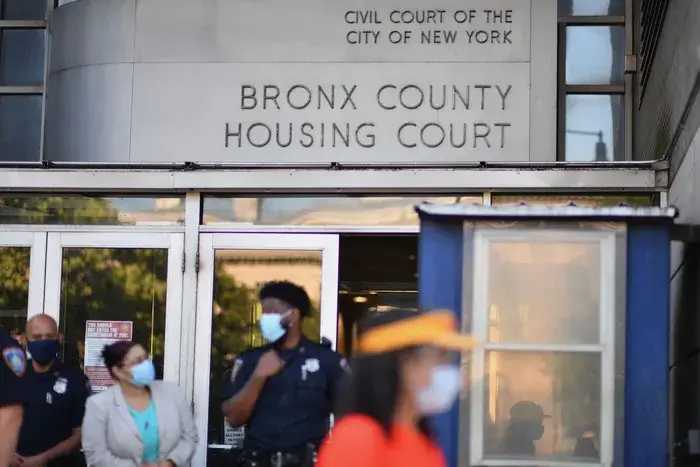
Here’s what Legal Aid says you should do to get the help you need if you’re caught by surprise to learn your landlord has taken you to housing court.
One of the best things you can do, Cahill-Jackson said, is to show up to court in person. If you are being sued because your lease has expired or your landlord is accusing you of violating some term of the lease, known as a holdover, the court date will be on the court papers.
When you show up for your court date, you should be connected with an attorney for free if you qualify via your age or income level under the city’s Right to Counsel program. If you do not have counsel, you’ll still be able to ask questions to ensure you understand everything in front of you.
The court clerk can also explain anything in the papers you may not understand. When you arrive, ask for the clerk or for someone to explain a suit filed against you, and you’ll be able to get your questions answered.
“Even if you just go to the courthouse and say, ‘I got this. What do I do?’” Cahill-Jackson said. “They will help you.”
If you’re being sued for non-payment of rent, you have to file an answer before you’ll get your first court date where you’ll be connected with an attorney. To do so, the most reliable – and sometimes the only – way is to respond in-person, at the courthouse.
Bring your photo ID, your court papers and other notices you’ve received, Cahill-Jackson said. When you get to the court clerk window, show them your documents and answer their questions. Then, you’ll receive a court date where you’ll be connected with an attorney.
You’ll be able to talk with the attorney and coordinate about your case and they’ll be able to appear on your behalf, so you never have to go to court if you’re physically or medically unable to, or if you work a job where you can’t get a day off.
If you cannot go in person to a court date, ask a friend, family member, caretaker, neighbor, or anyone you trust to go on your behalf. They will be able to connect with an attorney for you and can share your contact information with them and their contact information with you, Cahill-Jackson said.
You can also have someone go to the court for you on your behalf and answer for you, or try to do so over the phone (though Cahill-Jackson says she does not recommend relying on this), email the court’s ADA line for a reasonable accommodation or call the tenant helpline via 311 to get the additional legal counsel you need.

The subject of whether or not there are enough housing attorneys to help tenants who are served eviction papers and housing court suits is a tricky one: Cahill-Jackson said there currently aren’t, but that gap is closing a bit each year.
However, showing up in court or having someone show up on your behalf is still the best way to connect with an attorney. And, if getting legal representation that way isn’t working out, getting guidance via the 311 tenant helpline can help you navigate what you need to do, how to respond to court documents, and how to act in court.
If you receive court papers in the mail and do not understand them, calling 311 and asking for the Tenant Helpline is one of the best things you can do, Legal Aid said. The line is staffed by paralegals who can provide specific, individualized guidance on what you should do in your case and what the documents you’ve been sent mean.
Those paralegals can also help guide you through filing your answer to a non-payment case, Cahill-Jackson said.
If you have a disability that prevents you from going to court, another way to get help answering a housing court suit against you is to email or call the court’s Americans with Disabilities Act hotline, where you can let the court know you’re disabled and can’t appear in court or respond to the papers filed against you.
You can also explain your situation a bit, for example, telling the court you haven’t been able to receive your court papers because you’ve been in the hospital due to a disability. The court is supposed to offer a reasonable accommodation or guidance to you in navigating your case.
It’s helpful, said Legal Aid attorney Edward Josephson, but many people don’t know about it and miss out on valuable assistance.
“You can request an accommodation by email or telephone, but people don’t know that that exists,” Josephson said. “So, they default. They just don’t answer the court papers, so then the next step in the procedure is that the landlord would request a judgment on default,” which can lead to eviction.
Cahill-Jackson said one of the most important things to do is ensure that stress and anxiety over being served legal papers doesn’t immobilize you: Things get worse when you don’t respond, she said, and help is available.
“It’s very overwhelming and confusing,” she said. “Try really hard not to get so overwhelmed that you’re forced to inaction, because it can only make the situation trickier. Reach out for help early and often, as much as possible, and don’t be afraid to share that you need help. And, if you need accommodation for a disability, or there’s certain things that you can’t do or understand, raise that early and often as well.”
And, if the above avenues aren’t working, Cahill-Jackson said reaching out to elected officials in your area and asking to be directly connected to free legal service providers, like Legal Aid, or guided through the process by their constituent services teams, who sometimes have an attorney on staff to help people in their districts through these processes.
“These are not the most clear pathways,” Cahill-Jackson said. “But, if you weren’t able to connect other ways, and you do want to try every avenue, those are definitely avenues which can work out.”
They are not guaranteed to work, she said, but people should feel empowered to keep reaching out for help until they get what they need.
The Brooklyn Navy Yard is once again turning one of its busiest corridors into an open-air gallery, unveiling three new public art installations that celebrate the borough’s creativity, industry and entrepreneurial spirit.
The Brooklyn Navy Yard Development Corporation (BNYDC) announced its 2026 Public Art Commissions, a series of temporary installations on Flushing Avenue that will remain on display through early November. The projects — “BUILD THE FUTURE, Brooklyn: Layered Lenses and Brooklyn Becomes” — feature work from professional artists, graduate students and local high school students, reflecting the diverse creative voices that make Brooklyn unique.
The installations are part of BNYDC’s Public Art Program, which aims to activate public spaces, create welcoming entrances to the 300-acre campus and provide opportunities for artists at different stages of their career. The organization celebrated the new works during a public event on June 4 that brought together artists, entrepreneurs, visitors and community members.

Lindsay Greene, president and CEO of BNYDC, said the installation reflects and “ingenuity” of the borough.
“Through our Public Art Program, we are creating opportunities for artists at every stage of their careers to engage with the public realm while celebrating the creativity, industry and entrepreneurial spirit that continue to shape Brooklyn’s future,” she said. “These installations enhance Flushing Avenue, while reinforcing the Navy Yard’s role as a place where creativity and innovation thrive.”
The 2026 commissions continue a public art initiative that began with temporary installations inside Buildings 77 and 92. The program expanded in 2021 with Atmosphere for Invention, a large-scale photo mesh installation stretching nearly three-quarters of a mile along Flushing Avenue, before officially launching as the Brooklyn Navy Yard Public Art Program in 2023.
Now entering its third year, the program continues to showcase Brooklyn’s industrial heritage while highlighting the borough’s future through contemporary art.
The three installations each highlight a different perspective on Brooklyn’s creative identity.

“BUILD THE FUTURE,” by Brooklyn artist and architect Peter Miller, spans 350 feet along the fence outside Building 3. Selected through the Brooklyn Forged open call, the installation uses handwoven strips of colored aluminum that shift in appearance as viewers pass by, symbolizing growth, transformation, and momentum.
At Building 92, “Brooklyn: Layered Lenses” by Pratt Institute graduate students Tanvi Shaha and Joris Van Helmond combines imagery from the Brooklyn Navy Yard, Prospect Park and Coney Island. Created through Pratt’s Project in the Public Realm course, the installation uses layered vinyl and acrylic panels to explore the connections between Brooklyn’s neighborhoods, public spaces and communities.

The final installation, Brooklyn Becomes, features artwork by students from McKinney Secondary School of the Arts. Nineteen pieces were selected from 33 submissions for a 100-foot photo mesh display along Flushing Avenue, presenting students’ visions of Brooklyn’s future through themes including community, diversity, technology and discovery.
The installations will remain on view through early November, continuing the Navy Yard’s mission of using public art to celebrate Brooklyn’s creative community and industrial heritage.
During her tenure, Bichotte Hermelyn has focused on modernizing and expanding the party’s reach while pursuing structural reforms. As the first Black woman to lead the organization, she has been credited with raising the county party’s visibility and influence in local and national Democratic politics. Her efforts to rebuild the party have included expanding voter registration, increasing poll worker recruitment, and making its leadership more diverse and representative. She also led reforms to the party’s Judicial Screening Committee, creating a more transparent, merit-based judicial vetting process with greater community representation.
Alongside her party leadership, Bichotte Hermelyn has continued to advance legislative priorities in the State Assembly, including championing equity for minority- and women-owned businesses, supporting women’s reproductive rights, paid family leave, and universal child care. She has also sponsored public safety measures, including Sedrick’s Law, which requires functional security cameras on MTA train platforms.
Fellow Democratic leaders, peers, and partners in this work have noted that her legislative advocacy is not theoretical; it is the kind of grounded, community-responsive action that strengthens both her role as a legislator and her effectiveness as a party leader. Standing with Mayor Zohran Mamdani in support of free, fast bus service — a vision piloted years ago and now advanced through recent announcements by the mayor and Gov. Kathy Hochul — is one example, supporters say, of how she helps turn community demands into public policy.
Supporters argue that this combination of legislative experience and party leadership has made the Brooklyn Democratic Party more visible, equitable, and politically relevant, not through rhetoric alone but through tangible progress aimed at meeting the needs of the people the party serves.
Critics within the party, however, say the organization continues to play a significant role in determining which candidates receive endorsements and which judges are selected, despite the reforms. Even so, according to a recent article published by the Brooklyn Daily Eagle, “Even inside opponents concede that Bichotte Hermelyn made the Brooklyn Democratic Party more interesting, visible and equitable.”
The article describes an internal political power struggle within Brooklyn’s Democratic Party, centering on Bichotte Hermelyn and her alignment with reform-minded politics. It argues that the party has undergone a transformation under her leadership, becoming more visible, inclusive, equitable, and “transparent.” It also compares her efforts to making county leadership “sexy,” contrasting her tenure with the party’s previous reputation for opaque, patronage-driven politics. The article places the leadership contest in the broader context of New York politics, highlighting Brooklyn’s national political significance and the timing ahead of the upcoming general election.
Bichotte Hermelyn told Caribbean Life, “Real reform is about representation and accountability. I am dedicated to continuing to support the party, using my people skills acumen to help with the continuing success of unifying the party.”
As reported by the Brooklyn Daily Eagle, Bichotte Hermelyn’s tenure as chair of the Brooklyn Democratic Party is facing a significant challenge from reform-oriented Democrats seeking to reshape the organization’s future leadership.

Caribbean Life interviewed several leaders, including Anthony Beckford and Kenesha Trayhman Cooper, who shared the following statements in support of Brooklyn Democratic Party Chair Bichotte Hermelyn:
“If Kings County Democratic Party Chair Rodneyse Bichotte — Hermelyn steps aside, the stability, transparency and credibility of the party will falter. There is a difference between using the Power you wield to help the Party and the People and using the People to gain power and control of the party. As Chair of the Kings County Democratic Party, Rodneyse Bichotte Hermelyn has built a strong coalition of real Democrats across Brooklyn and provided much needed structure within the Party,” said District Leader Anthony Beckford (43rd Assembly District). “There have been countless attacks, because of her identity as the First Woman and First Black Woman Chair of the party, and that speaks volumes about those who work to disrupt progress, unity and stability within the party and our communities. As an actual Progressive Democrat, Activist and Advocate, I can honestly state that the party will lose its hold of our Democracy and Democratic seats in Brooklyn, if Rodneyse Bichotte Hermelyn is no longer the Chair.”
“If Chair Bichotte Hermelyn steps aside, Brooklyn loses more than a Chair; we risk losing the stability, credibility, resources, and momentum she built. She raised critical funds for our Party and invested in districts across Brooklyn, not just her own,” said District Leader Kenesha Trayhman Cooper (56th Assembly District). “I’ve personally watched her show up for leaders throughout this borough. That kind of leadership and infrastructure cannot simply be replaced with a title.”
The Brooklyn Daily Eagle article portrays a growing effort among Democratic leaders and party supporters to defend Bichotte Hermelyn’s leadership as she faces challenges from reform-oriented Democrats seeking to reshape the organization. Supporters argue that her departure could threaten the stability, visibility, and infrastructure she built during her tenure, while critics maintain that the party continues to wield significant influence over endorsements, judicial selections, and internal decision-making. The debate reflects a broader struggle over the future direction of one of the nation’s most influential Democratic organizations.
As Brooklyn’s Democratic Party continues to play a prominent role in New York City politics, Bichotte Hermelyn’s leadership remains a defining part of its recent history. Whether viewed as a leader who modernized the party or as a figure at the center of a broader debate over political power and reform, her tenure has reshaped the conversation about representation, accountability, and the future of Democratic leadership in Brooklyn. The decisions ahead will determine not only the party’s direction but also how her legacy as a barrier-breaking leader and political organizer will be remembered.


