Russia’s defence ministry was later quoted by the country’s state-run news agencies as saying that 13 out of 15 Ukrainian missiles fired on the plant in the city of Kerch, eastern Crimea, were shot down, but a Russian ship was damaged.
Category: Michael Novakhov’s favorite articles
Category Added in a WPeMatico Campaign
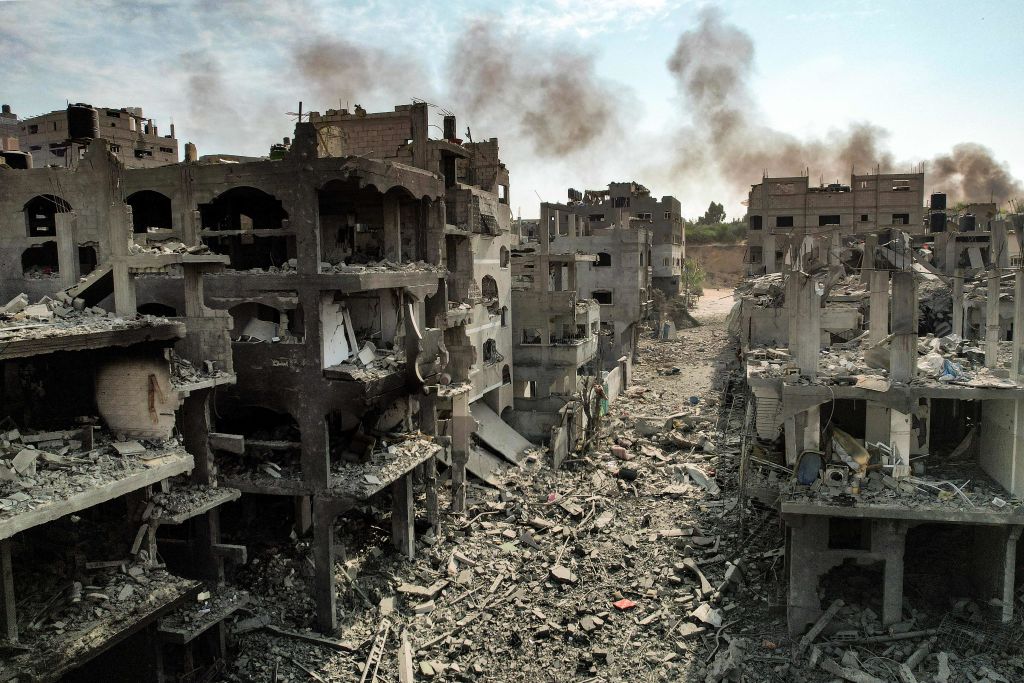
Washington has spent the better part of two years painstakingly building support for the U.S.-led international order after Russia flagrantly violated international law when it launched a full-scale invasion of Ukraine in February 2022. But what success the U.S. has had in building support in the Global South for the rules-based order is coming apart in the wake of President Biden’s muscular support for Israel’s assault on Gaza, which has left at least 9,000 people dead, two-thirds of them women and children.
In the aftermath of Hamas’s Oct. 7 massacre, which left an estimated 1,400 people dead in Israel, Western leaders rightly came out in full condemnation of that attack. That did not create a rift with a Global South that also largely expressed outrage over the horrific attack. But what did was the impression given by many Western politicians, especially in the U.S., that there was a carte blanche for Israel to “defend itself.” The death toll in Gaza is now far above the combined death toll of all prior Hamas-Israel wars.
The linking of Ukraine’s struggle to Israel has also rankled many in the Global South—a comparison encouraged by President Volodymr Zelensky when he said that it recalled “the early days of Russia’s full-scale war on Ukraine” and urged all leaders to visit Israel. It’s an analogy that others, including Biden, have drawn and one in which many in the Global South have rejected. Russia invaded and occupied Ukraine; Hamas launched a horrific attack on Oct. 7, but it is Palestinians who have lived under Israeli occupation for decades.
Read More: The World’s Job During the War on Hamas
As the death toll mounts in Gaza, Bolivia has cut ties with Israel, while Colombia and Chile have recalled their ambassadors. The latter’s President, Gabriel Boric, said during his visit to the White House this week that the Israeli government’s response to the Hamas attack “deserves our clearest condemnation” in a politically awkward moment for Biden (though Boric declined to comment on Biden’s Gaza approach). The U.S. decision to veto a U.N. Security Council resolution on Oct. 18 calling for a “humanitarian pause” also provoked anger. One African diplomat told Reuters that, “They lost credibility with the veto. What is good enough for Ukraine is not good enough for Palestine. The veto told us that Ukrainian lives are more valuable than Palestinian ones.” An Arab diplomat said, “We cannot choose to call on the U.N. Charter’s principles to protect Ukraine and ignore it for Palestine.”
Some senior Western officials have acknowledged that perception of double standards. “What we said about Ukraine has to apply to Gaza. Otherwise we lose all our credibility,” one G7 diplomat told the Financial Times. When Egypt convened the Cairo peace summit on Oct. 21 to discuss ways to de-escalate the Israel-Hamas war—drawing attendance from U.S., European, Arab, African, and Asian officials—some Arab leaders railed at what they called hypocrisy in how Russia had previously come under fire for breaches of humanitarian law, but not Israel. (Israel has been accused of war crimes, including air attacks on Gaza’s Jabalia refugee camp that left at least 195 dead; the U.N. has also said that Hamas’s Oct. 7 attack is a crime under international law.) That’s “geopolitical kryptonite,” as the FT’s Brussels bureau chief put it.
It would be too easy to claim that this is just a Global South vs. Global North rift. When the European Commission President Ursula von der Leyen traveled to Israel on Oct. 13, declaring support for Israel, several European nations expressed outrage over the trip before a common E.U. position was agreed to, and criticized her for not calling on Israel to respect international law amid its ongoing bombardment of Gaza.
In the U.S., it’s clear the Democratic voting base is also in a different place than most Democrat politicians on the Israeli-Palestinian conflict, and there is considerable discontent within the Biden Administration among more junior personnel, who have used the “dissent channel” to voice concern. One noted State Department employee publicly resigned over Biden’s approach to the Israel-Hamas war.
Read More: Don’t Give Hamas What It Wants
For their part, several hundred Western specialists on the Middle East have published an open letter in favor of a ceasefire, reflecting a strong current of thinking across the political spectrum and leading think-tanks.
In cities like New York, London, and Paris, there have been mass demonstrations in favor of a ceasefire—a position that Biden has shied away from. Most countries, however, back one; 120 U.N. General Assembly member nations voted for a ceasefire in a non-binding motion on Oct. 27. (Fourteen nations, including the U.S. and Israel, voted against; 45 abstained.)
There will be further crises in the future—such is the nature of international affairs. Successive U.S. administrations in the post-World War II era have made a lot out of the need for a global order underpinned by international law; if we truly believe that, then a great deal will have to change in Western capitals when it is our allies and ourselves that commit violations. Our partners in the Global South can see double standards clearly enough—from the U.S-led war in Iraq, to Israel’s disproportionate use of force in Gaza.
Let me be clear, the U.S.-led international order is preferable to a “might is right” approach favored by Russia and China. But it needs to be reformed, applied consistently, and based on international law. Otherwise, we can take the words of that G7 diplomat as given: “We have definitely lost the battle in the Global South… Forget about rules, forget about world order. They won’t ever listen to us again.”
Washington has spent the better part of two years painstakingly building support for the U.S.-led international order after Russia flagrantly violated international law when it launched a full-scale invasion of Ukraine in February 2022. But what success the U.S. has had in building support in the Global South for the rules-based order is coming apart in the wake of President Biden’s muscular support for Israel’s assault on Gaza, which has left at least 9,000 people dead, two-thirds of them women and children.
In the aftermath of Hamas’s Oct. 7 massacre, which left an estimated 1,400 people dead in Israel, Western leaders rightly came out in full condemnation of that attack. That did not create a rift with a Global South that also largely expressed outrage over the horrific attack. But what did was the impression given by many Western politicians, especially in the U.S., that there was a carte blanche for Israel to “defend itself.” The death toll in Gaza is now far above the combined death toll of all prior Hamas-Israel wars.
The linking of Ukraine’s struggle to Israel has also rankled many in the Global South—a comparison encouraged by President Volodymr Zelensky when he said that it recalled “the early days of Russia’s full-scale war on Ukraine” and urged all leaders to visit Israel. It’s an analogy that others, including Biden, have drawn and one in which many in the Global South have rejected. Russia invaded and occupied Ukraine; Hamas launched a horrific attack on Oct. 7, but it is Palestinians who have lived under Israeli occupation for decades.
Read More: The World’s Job During the War on Hamas
As the death toll mounts in Gaza, Bolivia has cut ties with Israel, while Colombia and Chile have recalled their ambassadors. The latter’s President, Gabriel Boric, said during his visit to the White House this week that the Israeli government’s response to the Hamas attack “deserves our clearest condemnation” in a politically awkward moment for Biden (though Boric declined to comment on Biden’s Gaza approach). The U.S. decision to veto a U.N. Security Council resolution on Oct. 18 calling for a “humanitarian pause” also provoked anger. One African diplomat told Reuters that, “They lost credibility with the veto. What is good enough for Ukraine is not good enough for Palestine. The veto told us that Ukrainian lives are more valuable than Palestinian ones.” An Arab diplomat said, “We cannot choose to call on the U.N. Charter’s principles to protect Ukraine and ignore it for Palestine.”
Some senior Western officials have acknowledged that perception of double standards. “What we said about Ukraine has to apply to Gaza. Otherwise we lose all our credibility,” one G7 diplomat told the Financial Times. When Egypt convened the Cairo peace summit on Oct. 21 to discuss ways to de-escalate the Israel-Hamas war—drawing attendance from U.S., European, Arab, African, and Asian officials—some Arab leaders railed at what they called hypocrisy in how Russia had previously come under fire for breaches of humanitarian law, but not Israel. (Israel has been accused of war crimes, including air attacks on Gaza’s Jabalia refugee camp that left at least 195 dead; the U.N. has also said that Hamas’s Oct. 7 attack is a crime under international law.) That’s “geopolitical kryptonite,” as the FT’s Brussels bureau chief put it.
It would be too easy to claim that this is just a Global South vs. Global North rift. When the European Commission President Ursula von der Leyen traveled to Israel on Oct. 13, declaring support for Israel, several European nations expressed outrage over the trip before a common E.U. position was agreed to, and criticized her for not calling on Israel to respect international law amid its ongoing bombardment of Gaza.
In the U.S., it’s clear the Democratic voting base is also in a different place than most Democrat politicians on the Israeli-Palestinian conflict, and there is considerable discontent within the Biden Administration among more junior personnel, who have used the “dissent channel” to voice concern. One noted State Department employee publicly resigned over Biden’s approach to the Israel-Hamas war.
Read More: Don’t Give Hamas What It Wants
For their part, several hundred Western specialists on the Middle East have published an open letter in favor of a ceasefire, reflecting a strong current of thinking across the political spectrum and leading think-tanks.
In cities like New York, London, and Paris, there have been mass demonstrations in favor of a ceasefire—a position that Biden has shied away from. Most countries, however, back one; 120 U.N. General Assembly member nations voted for a ceasefire in a non-binding motion on Oct. 27. (Fourteen nations, including the U.S. and Israel, voted against; 45 abstained.)
There will be further crises in the future—such is the nature of international affairs. Successive U.S. administrations in the post-World War II era have made a lot out of the need for a global order underpinned by international law; if we truly believe that, then a great deal will have to change in Western capitals when it is our allies and ourselves that commit violations. Our partners in the Global South can see double standards clearly enough—from the U.S-led war in Iraq, to Israel’s disproportionate use of force in Gaza.
Let me be clear, the U.S.-led international order is preferable to a “might is right” approach favored by Russia and China. But it needs to be reformed, applied consistently, and based on international law. Otherwise, we can take the words of that G7 diplomat as given: “We have definitely lost the battle in the Global South… Forget about rules, forget about world order. They won’t ever listen to us again.”

With the world’s attention shifting to the Israel-Hamas war, Ukraine fears it is being left behind as it continues a costly struggle against Russian forces and anxiously waits on Congress to pass another aid package before the winter sets in.
Ukraine was already concerned before the Gaza war broke out, after Congress failed to include funding for Kyiv in a temporary government spending bill because a faction of House Republicans fiercely resisted it.
And the House this week voted to approve a $14 billion package for Israel without Ukraine aid, rejecting a request from President Biden to combine assistance for the two countries in one package, along funds for Taiwan and U.S. border security.
Kira Rudik, a member of Ukraine’s parliament, said she remains hopeful that Congress will ultimately pass new Ukraine funding, but was “worried” as U.S. elections inch closer and complicate the debate.
“I cannot begin to tell you how it feels being here in Ukraine, talking to people whose ability to fight depends on the decisions that are being made somewhere so far away,” she told The Hill.
“It will have such a huge, gigantic influence on the real life of real people here that have no influence over” Congress, she said of another assistance package, “but whose life will be absolutely changed if the decision will be made late or will not be made at all.”
Newly elected Speaker Mike Johnson (R-La.) has floated a plan to tie Ukrainian assistance to border security and has expressed a willingness to support Kyiv despite past votes against Ukraine aid.
But he insists that Israel aid move separately from Ukraine funding, which could complicate its passage given growing GOP skepticism about ongoing support for Kyiv.
Rep. Don Bacon (R-Neb.), an ardent Ukraine supporter who sits on the House Armed Services Committee, backed Johnson’s plan to separate Ukraine aid from Israel assistance, saying a combined package could delay urgent funding for Israel.
“I’m optimistic we’ll get it done,” Bacon told The Hill. “The more I hear [Johnson] talk, the more confident I am that we can have confidence in him.”
“Doing it with border security gets more Republicans on board,” he added. “If you just did Ukraine by itself … we would lose about half of Republicans.”
Johnson has said the Ukraine aid and border security package will move next, following the Israel legislation, which also includes deep cuts to the Internal Revenue Service (IRS) budget.
The Israel package is facing resistance in the Senate, where Democrats want to combine Israel and Ukraine funding and are opposed to cuts to the IRS in the House-passed legislation.
Sen. Michael Bennet (D-Colo.), who for hours held up a vote on the short-term government spending plan in September because it did not include Ukraine aid, said he would not support any legislation that fails to combine Ukraine and Israel.
“House Republicans are turning their backs on the people of Ukraine,” Bennet said in a statement. “This is a significant test of America’s resolve. This is a moment where the rest of the world is watching how America chooses to lead.”
The Biden administration has also slammed the House Israel bill and Biden has vowed to veto the legislation, in part because it does not include Ukraine funding.
“This is an urgent requirement — as Ukraine heads into a winter of unrelenting attacks on its civilian infrastructure, they need air defense to protect their cities,” the Office of Management and Budget said in a statement.
With more political roadblocks ahead, existing money for Ukraine is running out fast — just as fears of a stalemate in its was with Russia are rising.
Winter is coming soon, and troops will need a steady flow of supplies to keep up an ongoing counteroffensive in the south. Ukraine will also struggle to keep its people warm and safe as Russia is expected to continue targeting energy infrastructure.
European allies can step in to assist, but the U.S. is the largest supporter of Ukraine and would leave an unfillable hole, said Catherine Sendak, director of the Transatlantic Defense and Security program at the Center for European Policy Analysis.
“The ability for partners to meet that demand is going to be a really, really hard conversation and I really hope we don’t get to that point,” she said.
Sendak said if Washington fails to step up to the plate, it will also signal to both allies and Russia the pro-Ukraine alliance is cracking.
“The situation will get very hard because so many look to the U.S. to lead on action,” she added. “It is absolutely prudent upon the U.S. to lead on this effort, which means being out in front of supporting assistance.”
To help make the case to the American people about why Ukraine matters, Biden delivered an Oval Office address last month and underscored that it was vital for the U.S. to protect its allies in order to keep the peace at home.
Support for Ukraine is still an area of bipartisan agreement, especially among national security experts. More than 300 former secretaries, ambassadors, senior diplomats and military leaders from Republican and Democratic administrations sent a letter last month to Congress urging lawmakers to pass Ukraine aid.
But a growing number of Americans, particularly in the Republican party, are cautious about continued support for Ukraine without a clear objective to end the war.
Ukraine’s counteroffensive, too, has struggled five months into the operation. Forces have made some progress in the southeast but are largely stuck against a bulwark of Russian lines.
Russia has launched its own offensives but is also stalled. And both sides are taking enormous losses.
Ukraine’s military commander, Gen. Valery Zaluzhny, added to the skepticism this week when he warned the war was reaching a “stalemate.”
“There will most likely be no deep and beautiful breakthrough,” he told The Economist.
The failure to make any significant progress also comes as the U.S. and other world powers are focusing attention on Israel, which is ramping up its war against the Palestinian militant group Hamas.
That divided attention is worrying for Ukraine, which fears that western citizens are growing tired of the war with Russia — as Time Magazine highlighted in an article published this week.
“It’s logical,” Ukrainian President Volodymyr Zelensky told Time. “Of course we lose out from the events in the Middle East. People are dying, and the world’s help is needed there to save lives, to save humanity.”
But Zelensky said he still believes with strong conviction that Ukraine can win.
Anton Gerashchenko, an advisor to the Minister of Internal Affairs of Ukraine, said “many Ukrainians treated the article from Time very emotionally.”
“The topic of Ukraine has definitely mostly disappeared from the informational agenda,” he posted on X. “Global media have mostly stopped mentioning us or discussing us. Ukrainian leadership and Ukrainian people see that.”
Rudik, the Ukrainian lawmaker, said the Israel-Hamas war makes it even more vital to keep Kyiv in the fight against Russia.
Echoing Biden’s argument for taking on both fights simultaneously, she described the common enemy as “countries that want to bet on instability and countries that unite to commit terrorist attacks and continue terrorizing democracies.”
“What we see,” she said, “is the result of a bigger global problem.”
Copyright 2023 Nexstar Media Inc. All rights reserved. This material may not be published, broadcast, rewritten, or redistributed.
Following Hamas’s surprise assault on Israel and the subsequent Israeli bombardments of Gaza, Jen Tao logged on to the Chinese social media platform Weibo to express her condolences for the thousands who had died on both sides of the conflict.
“I thought I was going to find kind words for the victims, but instead I was shocked to see a lot of hateful things posted about Muslims and Jews,” the 38-year-old surgeon at a hospital in Shanghai, told Al Jazeera.
list of 4 itemslist 1 of 4list 2 of 4list 3 of 4list 4 of 4end of list
Tao was particularly appalled when a video of a Chinese Israeli woman being taken away on a motorcycle by Hamas appeared on Chinese social media.
In the comment section, one netizen wrote: “I do not want to pay attention to her!”
Another accused the woman of being a “Nazi monster” for having served in the Israeli military (most Israeli citizens have to complete military service).
“She is Chinese, but even she got such comments,” Tao said.
The broader discussion of the conflict has similarly been marked by hate speech.
One online comment read: “Palestine has no civilians. It only has little terrorists, old terrorists, female and male terrorists, who should all be wiped out.”
Another called for the killing of Arabs to end terrorism while a third stated that Muslims were terrorists who needed to be bombed for peace to be achieved.
Anti-Semitic comments have been more predominant, however.
“It is really the fault of Little Moustache [Hitler],” a netizen wrote. “If he had burned all of them [Jews], we wouldn’t have this much trouble.”
“In European wars, you will see the shadow of Jews making money, like vultures,” wrote another.
When asked to comment on the anti-Semitic comments on Chinese social media, Chinese foreign ministry spokesperson Wang Wenbin said this week that “China’s laws unequivocally prohibit disseminating information on extremism, ethnic hatred, discrimination and violence via the internet.”
But Tao does not see such laws being enforced.
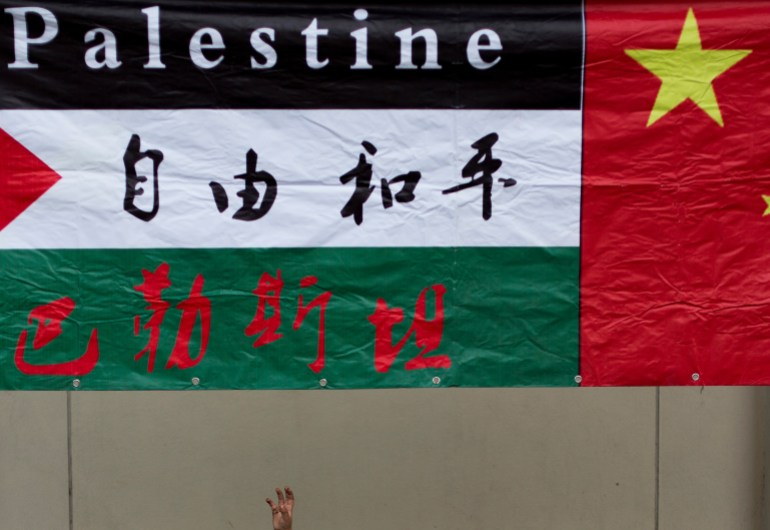 China has long shown its support for the Palestinian cause with protests taking place in Beijing during previous conflicts in Gaza [File: Andy Wong/AP Photo]
And by allowing hatred to flourish, she believes the Chinese leadership is undermining its own diplomatic strategy in the month-long Israel-Gaza war.
The Chinese leadership has called for an immediate ceasefire, and in the long term, called for the realisation of peaceful coexistence between Palestine and Israel.
“When you tolerate hate at home, how can you call for peace internationally?”
A distant conflict
Hongda Fan is a professor at the Middle East Studies Institute of Shanghai International Studies University.
“There are different opinions on the current Israel-Gaza conflict in the Chinese public sphere,” he said in an email to Al Jazeera.
But at the same time, the vast majority of Chinese people do not know the background of the Palestinian-Israeli conflict, according to Fan.
“They are not very aware of the political divisions within Palestine and the differences in governance between Gaza and the West Bank.”
Hsia Liang Hou, 42, a cybersecurity specialist from Chengdu in central China, likewise believes that there are many elements of the conflict that are not broadly understood in China.
“Chinese people generally don’t know a lot about the conflict and its long history because it doesn’t affect China a lot,” he said.
Hsia believes that the general lack of insight regarding the conflict and its history explains some of the racist comments that have circulated on the Chinese internet.
“It is not because all Chinese people are racist towards Arabs and Jews,” he said.
Although Tao was appalled by some of the content on social media, she also cautions against using online comments to make conclusions about the general sentiment of Chinese people regarding anti-Semitism and Islamophobia.
“A lot of people don’t express their opinions on social media, and also the government blocks and censors all sorts of things on the [Chinese] internet all the time,” she said.
“You don’t get to see everything; you get to see what’s acceptable to the government.”
Israel-Palestine uncensored
Anti-Semitism and Islamophobia have not been limited to China’s internet, but unlike much of the rest of the world, online content is strictly monitored and censored within China. For nine years in a row, China has been ranked as having the world’s worst environment for internet freedom.
A recent example of the state’s online interference came with the sudden death of former Chinese premier Li Keqiang. After Li died on October 27, the authorities released instructions on the management of media content related to the former premier.
Subsequently, online discussions of Li were censored and quotes associated with him were removed from online forums.
Deaths of Chinese political leaders have led to political upheaval in the past and are, therefore, considered sensitive by the authorities.
“The authorities censor stuff online that they see as a threat to their power,” said Hsia, the cybersecurity specialist.
The anti-Semitic and Islamophobic content is not a threat to the Chinese government, and in some ways particularly the anti-Semitic content, is making the same arguments that the Chinese state is making – only in more racist terms, according to William Figueroa, an assistant professor at the University of Groningen, who has conducted research on China’s relationship with Middle Eastern countries.
While the top of the Chinese government has called for peace and coexistence, Chinese media and influential figures have been much more conspiratorial and antagonistic in their rhetoric towards Israel and Jewish people in general.
A post on the social media account of the government-controlled CCTV claimed falsely that three percent of Jews in the US control 70 percent of American wealth. The topic was one of the top-trending on the short messaging service, Weibo.
 China has its own messaging platforms, which are usually heavily censored [File: Florence Lo/Reuters]
Meanwhile, Shen Yi, a prominent professor of international relations at Fudan University, compared Israel’s attacks on Gaza to acts of aggression perpetrated by the Nazis, while Hu Xijin, a leading commentator and former editor-in-chief of the state-run Global Times, expressed concern about Israel wiping “the Earth out of the solar system”.
According to Lin Pu, who is a scholar of digital authoritarianism and Chinese influence at Tulane University in the US, the Chinese authorities refrain from censoring certain anti-Semitic comments because they do not disrupt the Chinese government’s messaging of showing sympathy and support for Palestine.
“Anti-Israel sentiment highlights one aspect of the Chinese stance toward this issue that the Chinese government does not want to express explicitly for diplomatic reasons,” he said.
More broadly, censuring offensive and racist speech is generally not a priority for the Chinese state, according to Figueroa.
“You can find all kinds of racist, anti-Semitic, anti-Islamic sentiment on Chinese social media any given day of the week,” he said.
The only way that Figueroa sees that the Chinese government might be concerned with such content is if Western nations use it to portray China negatively.
“But this hasn’t been a significant issue so far.”
Tao believes that Beijing should stay true to its call for peace between Israelis and Palestinians.
“That starts with shutting down the racism and the hate in the media and online here in China,” she said.
“If the government must use its censorship powers, it should use it on this.”
Source: Al Jazeera
Zelenskiy pushes US for more aid, invites Trump to Ukraine https://t.co/T9lJVUAYNg pic.twitter.com/l45YXQ1IYB
— Michael Novakhov (@mikenov) November 5, 2023
The West should not fear Ukraine defeating Russia. This is an historic opportunity to improve security for the entire Eurasian land mass, if we can think/act decisively.https://t.co/nCCxrBEOsp
— Ben Hodges (@general_ben) November 5, 2023
“Homeland Security needs far better oversight before it embraces AI” (@TheHillOpinion) https://t.co/dxAtflBTvG pic.twitter.com/BsaPEBeq2t
— The Hill (@thehill) November 5, 2023

A co-owner of the Brooklyn construction company being scrutinized by the feds as part of a larger probe into Mayor Eric Adams’ fundraising has long flaunted a lavish, jet-setting lifestyle.
Erden Arkan, the globe-trotting 74-year-old owner of KSK Construction Group in Williamsburg, regularly posts dispatches with his wife Itir on social media from fancy locations around the world, including snapshots of their March vacation in Osaka, Japan; scenes of hot air balloons floating in the sky above Cappadocia, Turkey; and souvenir shanties on Greece’s Chios Island.
“#Theking #andhisserf,” Itir, 73, cooed on Instagram in June 2022, while posting a photo of her hubby regally sitting on a chair-shaped marble boulder during their visit to the archaeological site of Aphrodisia in Turkey.
In 2020, the couple forked over $2.1 million for a 6th-floor, 1,193-square-foot apartment in the high-rise condo at 570 Broome Street, which his company constructed and whose higher-profile residents include “Jersey Shore” star Vinny Guadagnino.
They also own a swanky, one-bedroom condo at the Forty2East luxury apartment complex in Williamsburg that they purchased in 2016 for $865,000 and are now renting for $4,200 monthly, records show.
Itir is a former teacher at Marymount School of New York, a tony private Catholic school for girls on the Upper East Side where tuition runs $60,375 a year.
A co-owner of the Brooklyn construction company being scrutinized by the feds as part of a larger probe into Mayor Eric Adams’ fundraising has long flaunted a lavish, jet-setting lifestyle.Michael Dalton
The couple have two daughters: Gunce, 47, and Canem, 43.
Former investment banker Canem was married in 2010 to William Cawthon, a University of Arkansas business school lecturer.
The gala ceremony was held at The Palms in Turks and Caicos, a five-star luxury resort where rooms run on average $1,065 a night and guests are just a stone’s throw from Grace Bay Beach.
The ceremony site was decorated with Calla lilies, orchids and a variety of West Indies flowers. The bride wore an ivory one-shoulder gown by Peter Langer and an ivory veil edged with lace.
Gunce has business degrees from both Harvard University and Stanford University and is chief revenue officer of OmieLife, a company that makes bento lunch boxes, according to LinkedIn.
Erden Arkan, 74, owner of KSK Construction Group in Williamsburg, regularly posts dispatches with his wife Itir on social media from fancy locations around the world.instagram @teachstats
She and her husband own a condo at Carnegie Park on the Upper East Side.
Arkan’s company, KSK, is an offshoot Brooklyn firm another he and his current business partners – including Ulgur Aydim — also ran called KiSKA Construction Corporation.
KSK specializes in hotel and condo development and boasts constructing more than 40 projects on its website – including The Stores at Fulton Mall hotel in Brooklyn and the Hilton Garden Inn in Queens.
It also has more than 30 jobs in the pipeline citywide.
On Thursday, federal agents raided the Crown Heights home of top Adams campaign fundraiser Briana Suggs.
Itir, 73, cooed on Instagram in June 2022, while posting a photo of her hubby regally sitting on a chair-shaped marble boulder during their visit to the archaeological site of Aphrodisia in Turkey.instagram @teachstats
Law enforcement sources told The Post agents were looking for evidence that could show whether Hizzoner’s team conspired with KSK and the Turkish government to use “straw donors” to illegally funnel foreign cash into his campaign coffers in exchange for favors.
A straw donor is a person or company which illegally makes a donation with someone else’s money but using their own name to hide its source.
“The mayor of New York City is one of the most powerful people in the world. And they have a direct line to White House, leaders in Congress, and Wall Street…If you’re the Turkish government, that’s someone you want to be friends with to get ahead on the world stage,” said one Dem strategist.
Turkey-born Erden Arkan donated $1,500 to Adams’ campaign in 2021 and also held fundraiser that May which netted nearly another $70,000 towards the mayor’s war chest, records show.
Neither KSK, Arkan, Adams, Suggs or anyone else have been charged with any wrongdoing, and the mayor has tried to downplay the FBI raid — saying Friday he still has “full confidence” in the young political operative caught up in the possible foreign election interference.
In 2020, the couple made over $2.1 million for a 1,193-square-foot apartment in the high-rise condo at Hudson Square, which his company constructed and whose higher-profile residents include “Jersey Shore” star Vinny Guadagnino.instragram @erden1949
“Where’s there’s smoke, there’s not always fire,” Adams told Dan Mannarino on PIX11 in his first sitdown since the raid on Suggs’ home.
On Saturday, Hizzoner refused to talk to reporters about the probe. He was heavily guarded by his security detail and staff.
While walking into an event at the Louis Armstrong House Museum in Queens, Adams smiled at reporters while an operative told media members, “Thank you for your questions, we’re not taking questions.” “We appreciate your questions.”
Adams, who has done plenty of traveling to Turkey — he recently estimated at least six times — both as mayor and Brooklyn borough president, followed the lead of former Beep Marty Markowitz, who regularly traveled there to promote the borough.
Brooklyn has a large Turkish population, concentrated mostly in neighborhoods including Brighton Beach, Midwood and Sheepshead Bay.
They also own a swanky, one-bedroom condo at a luxury apartment complex that they purchased in 2016 for $865,000 and are now renting for $4,200 monthly, records show.Instagram/@edenarken
Markowitz, who received $2,250 in donations in 2005 from Arkan and his family, said Saturday he recalls KiSKA doing fundraising for him but doesn’t remember Arkan.
“Kiska was well known in the Turkish community, but my interaction was minimal at best,” he said.
Markowitz also predicted other pols will mull challenging the mayor in the 2025 election but believes they’re better off “saving their money.”
“He speaks for a large part of the city in terms of his political base being of relative moderation, so I don’t know how successful [any challenger] would be against him,” he said.
Arkan did not return messages Saturday and a doorman at his building kicked a Post reporter out after she asked for him.
Additional reporting by Georgia Worrell, Georgett Roberts and Khristina Narizhnaya.