Categories
The News And Times – thenewsandtimes.com

Kolomoyskiy Arrest Seen As A ‘Key Test’ Of Zelenskiy’s Anti-Corruption Campaign


For right or wrong, Ukrainian tycoon Ihor Kolomoyskiy has come to epitomize for many in Washington and Brussels the endemic corruption that has held Ukraine back economically and politically since its independence more than three decades ago.

The 60-year-old businessman, who is blacklisted by the United States, has over the years sent armed men to take over companies, threatened officials, cheated state-owned companies, and bought off parliamentarians to stall crucial Western-backed reforms, among other brazen acts. “He is really numero uno in terms of doing active damage. He is the one protecting corrupt interests against the reform tide,” John Herbst, the former U.S. ambassador to Ukraine, told RFE/RL. But Kolomoyskiy’s Teflon-like ability to escape criminal consequences for decades may have come to an end on September 2, when he was arrested in Ukraine on suspicion of fraud and money laundering in relation to a state-owned company and handed a 60-day, pretrial detention. The dramatic jailing of Kolomoyskiy, once the nation’s third-richest man according to Forbes, is the latest in a series of high-profile arrests in Ukraine over the past year as President Volodymyr Zelenskiy tries to portray himself as an anti-corruption crusader.

While Ukrainian leaders have for decades promised to tackle corruption with little to show for all their talk, the issue has grown in urgency since Russia launched its full-scale invasion of Ukraine in February 2022.

Kolomoyskiy arrives at the courtroom in Kyiv on September 2. "This is a signal that in the fight against corruption, the state is ready to take action against very influential people from big business in Ukraine," a Kyiv-based analyst said.


Kolomoyskiy arrives at the courtroom in Kyiv on September 2. “This is a signal that in the fight against corruption, the state is ready to take action against very influential people from big business in Ukraine,” a Kyiv-based analyst said.

Ukrainian citizens, suffering from the deprivation of war, are showing little patience for graft. Meanwhile, some politicians in the West are trying to use Ukraine’s reputation as endemically corrupt as an excuse to curtail crucial military aid. For both Ukrainians and their Western allies, no other arrest could send such a strong signal that Ukraine is determined to fight corruption than that of Kolomoyskiy.

“He is the most well-known name in Ukraine and abroad to showcase the fight against corruption,” Tetiana Shevchuk, a lawyer with the Anti-Corruption Action Center, a Kyiv-based NGO, told RFE/RL.

It was always toxic for Zelenskiy that the oligarch closest to him was being investigated by the United States.”

In an interview with Current Time — the Russian-language network run by RFE/RL in cooperation with VOA — Vladimir Fesenko, a Kyiv-based political analyst, said his arrest was “a demonstration that there are no untouchables.” Ukraine is scheduled to hold elections in the spring of 2024 and, while the war could push it back indefinitely, the spate of corruption-related arrests will undoubtedly bolster Zelenskiy’s ratings.

For those politicians in Washington who back aid to Ukraine, Kolomoyskiy’s arrest is a “wonderful talking point,” Herbst said.

Congress is currently debating whether to approve President Joe Biden’s $40 billion emergency spending bill, more than half of which will go toward crucial military and humanitarian aid for Ukraine as it tries to drive Russian forces out of its territory. A vocal minority of Republicans have balked at giving so much aid to Ukraine, often highlighting the country’s notorious reputation for corruption despite notable improvements in anti-graft reform and investigations.

Kolomoyskiy is arguably the most notorious of the Ukrainian tycoons who emerged from the wreckage of the Soviet Union’s collapse and snapped up former state assets at rock-bottom prices, sometimes deploying extralegal or violent methods.

Kolomoyskiy, the former governor of the Dnipropetrovsk region, poses for a photo in his office in Dnipro in May 2014.


Kolomoyskiy, the former governor of the Dnipropetrovsk region, poses for a photo in his office in Dnipro in May 2014.

A native of Dnipro, a major industrial city in southeastern Ukraine, Kolomoyskiy has owned banks, energy firms, metals companies, airlines, and one of the nation’s most influential television channels. Over the years, as they consolidated their assets, many of the original tycoons tried to clean up their image, stepping back from bare-knuckle tactics. Kolomoyskiy, for the most part, did not, experts say. Until Russia’s 2022 invasion of Ukraine, those tycoons wielded immense power behind the scenes, using their wealth and media assets to win the loyalty of politicians, judges, and parliamentarians and push policies that benefited their companies. Kolomoyskiy’s television station backed Zelenskiy’s presidential election campaign in 2019 and is credited with helping the political novice win in a landslide against the incumbent, President Petro Poroshenko.

It raised alarm at home and abroad that Zelenskiy might be beholden to Kolomoyskiy, especially after he tapped the tycoon’s former lawyer as his chief of staff. Foreign executives working in Ukraine feared it represented “a return to the old ways of doing business,” according to a 2019 U.S. Embassy cable. Zelenskiy continued to be dogged by suspicion even after he passed legislation hurting Kolomoyskiy’s interests.

The pressure on Zelenskiy to publicly distance himself from the notorious tycoon only grew after the FBI announced in August 2020 that it was investigating Kolomoyskiy for allegedly embezzling hundreds of millions of dollars from his Ukrainian bank and using the proceeds to purchase commercial real estate in the United States. Seven months later, the U.S. State Department blacklisted Kolomoyskiy for corruption and undermining democracy at home, in what many experts viewed as a signal to Zelenskiy to bring him to heel.

“It was always toxic for Zelenskiy that the oligarch closest to him was being investigated by the United States,” Shevchuk said.

In 2021, Zelenskiy signed into law an “anti-oligarch” bill that essentially gives tycoons a tough choice: either refrain from politics or sell your media assets. However, the bill was criticized by experts at home and abroad as a “populist” measure that could be abused to target political opponents or their backers. The bill was part of a broader campaign that Zelenskiy called “de-oligarchization,” or the curtailing of tycoons’ power.
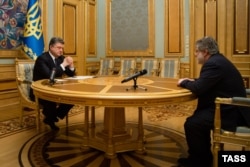
Then-Ukrainian President Petro Poroshenko (left) meets with Kolomoyskiy in Kyiv in March 2015. One analyst says that Kolomoyskiy's ties to current President Volodymyr Zelenskiy have been exaggerated. He didn't so much support Zelenskiy as he sought the ouster of Poroshenko.


Then-Ukrainian President Petro Poroshenko (left) meets with Kolomoyskiy in Kyiv in March 2015. One analyst says that Kolomoyskiy’s ties to current President Volodymyr Zelenskiy have been exaggerated. He didn’t so much support Zelenskiy as he sought the ouster of Poroshenko.

In a 2021 report, Andrew Wilson, a Ukraine expert at the European Council on Foreign Relations, said the “key test” of Zelenskiy’s campaign to rein in tycoons would be how he handled Kolomoyskiy.

“The Ukrainian government had to pursue [Kolomoyskiy] to demonstrate its reformist credentials to the U.S.,” he wrote at the time. As Zelenskiy pursued his campaign, Kolomoyskiy appeared to carry on as usual. Former U.S. Ambassador Herbst told RFE/RL that “it was Kolomoyskiy who seemed to act as if he could do what he wants.” The tycoon continued his fight to recover Privatbank, the nation’s largest lender, which was taken over by the state in 2016 after the central bank said it was on the verge of bankruptcy. The West, which has given billions of dollars over the years in financial aid to Ukraine, vehemently opposed any move to return Privatbank to Kolomoyskiy.

Kolomoyskiy was also making new enemies. According to Forbes’ sources, Zelenskiy’s administration was angered that Kolomoyskiy did not step up enough in the early phases of the 2022 war to help the government financially. The tycoon did play a large role in helping Ukraine defend its territories in 2014-15 when Russian fighters first tried seizing land.

Five months after the start of Russia’s 2022 invasion, rumors spread that Zelenskiy had revoked Kolomoyskiy’s Ukrainian citizenship, though there has never been confirmation from either side. As Ukraine does not extradite its own citizens, such a move potentially opens the door to Kolomoyskiy’s extradition to the United States should the FBI ever file criminal charges.

Analyst Fesenko said that Kolomoyskiy’s ties to Zelenskiy had always been exaggerated. He didn’t so much support Zelenskiy as he sought the ouster of his nemesis, Poroshenko, he said. In a clear reference to Kolomoyskiy’s arrest, Zelenskiy thanked Ukrainian law enforcement for bringing cases to court “that have been hindered for decades.” While Kolomoyskiy’s arrest sends a strong message, there are still voices who doubt the sincerity of Zelenskiy’s commitment to the anti-corruption cause. Western officials have long viewed the Ukrainian Prosecutor-General’s Office, the security services (SBU), and the courts as mired in corruption and incapable of going after high-profile figures. No tycoons had ever been convicted by a Ukrainian court. In exchange for much-needed financial aid following Ukraine’s 2014 revolution, the West required Kyiv to create independent anti-corruption bodies.

But rather than being seen as onboard with those initiatives, Zelenskiy set off alarm bells in the West with what appeared to be attempts to control these new, supposedly independent institutions. After failing to put his preferred choices at the helm of the anti-corruption bodies, two weeks ago, Zelenskiy proposed equating large-scale graft to treason. That would allow the SBU, which is overseen by the presidential administration, to take over cases from the anti-corruption bodies, experts said. The president’s plan was met with pushback from activists and officials at home and abroad.

In a possible sign of Washington’s concern about the proposed legislation of equating graft with treason, U.S. national-security adviser Jake Sullivan met at the White House on September 1 with the heads of the anti-corruption institutions to discuss “safeguarding [their] autonomy.”

The following day, Kolomoyskiy was detained by the SBU.
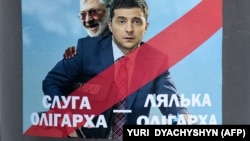
A placard depicting Kolomoyskiy and then-presidential candidate Volodymyr Zelenskiy in Lviv in February 2019. It reads: "Servant of Oligarch, Doll of Oligarch." Kolomoyskiy's television station is credited with helping the political novice win in a landslide against incumbent Petro Poroshenko.


A placard depicting Kolomoyskiy and then-presidential candidate Volodymyr Zelenskiy in Lviv in February 2019. It reads: “Servant of Oligarch, Doll of Oligarch.” Kolomoyskiy’s television station is credited with helping the political novice win in a landslide against incumbent Petro Poroshenko.

The Ukrainian anti-corruption investigative body NABU, which had been investigating Kolomoyskiy since 2019, announced on September 7 that Kolomoyskiy was a suspect in a case involving alleged embezzlement at Privatbank. Fesenko said he expects to soon see more examples of this type of competition between the independent, anti-corruption institutions and the SBU over high-profile corruption cases. As for Kolomoyskiy’s future, analysts are hesitant to predict what will happen next. Herbst said Kolomoyskiy is “not the type of personality who backs down.”

And Fesenko said the tycoon has the resources and the lawyers to drag out the case in Ukraine for a long time.

“The topic of Kolomoisky is not closed. I think this is just the beginning of this [television] series,” he said.

The post Kolomoyskiy Arrest Seen As A ‘Key Test’ Of Zelenskiy’s Anti-Corruption Campaign first appeared on The News And Times – thenewsandtimes.com.
Categories
The News And Times – thenewsandtimes.com

Milei leads polls in Argentina election after primary shock


2023-09-08T15:42:13Z

Argentina’s pollsters, caught out by the surprise win of radical libertarian Javier Milei in August’s presidential primary, now show him easing to first place in an Oct. 22 general election, likely ahead of ruling party economy chief Sergio Massa.

Milei, an economist and former TV pundit, has rattled the political elite with loud, sometimes expletive-ridden critiques of his rivals, along with pledges to shutter the central bank, slash the size of the government and dollarize the economy.

The latest poll from consultancy Analogias shows Milei with 31.1% of the vote, ahead of Massa on 28.1%, with right-wing ex-security minister Patricia Bullrich on 21.2%, a blow for the main conservative opposition, which was once favorite to win.

A second poll from Opinaia gives Milei 35% of the vote, with Massa on 25% and Bullrich at 23%. The polls show Milei’s support stronger among men, youth voters and less affluent groups.

“The result of the primaries was shocking, and the result of the general election will be shocking whatever its result is,” said Analogias communication director Marina Acosta, citing the race being “colored by political novelty.”

The polls suggest the election race will likely go to a head-to-head second round, which would take place in November. A candidate needs 45% of the vote, or at least 40% with a 10-point lead to win outright in the first round.

Milei, who made a name for himself as a “shock jock” TV commentator, has struck a chord with angry Argentine voters grappling with 113% inflation, a cash-strapped government, sagging economy and some four-in-ten people in poverty.

His closest competitor now appears to be Massa, part of the ruling center-left Peronist coalition, seemingly offering two opposing economic models for the embattled country.

“Milei’s and Massa’s strategies are meant to be polar opposites from the other,” said political analyst Julio Burdman from consultancy Observatorio Electoral. “They are doing that quite well, which is letting them both make gains.”

A big caveat, however, is that Argentina’s pollsters got the primary vote badly wrong and misread the last general election in 2019, meaning the final result could shock once again.

Related Galleries:

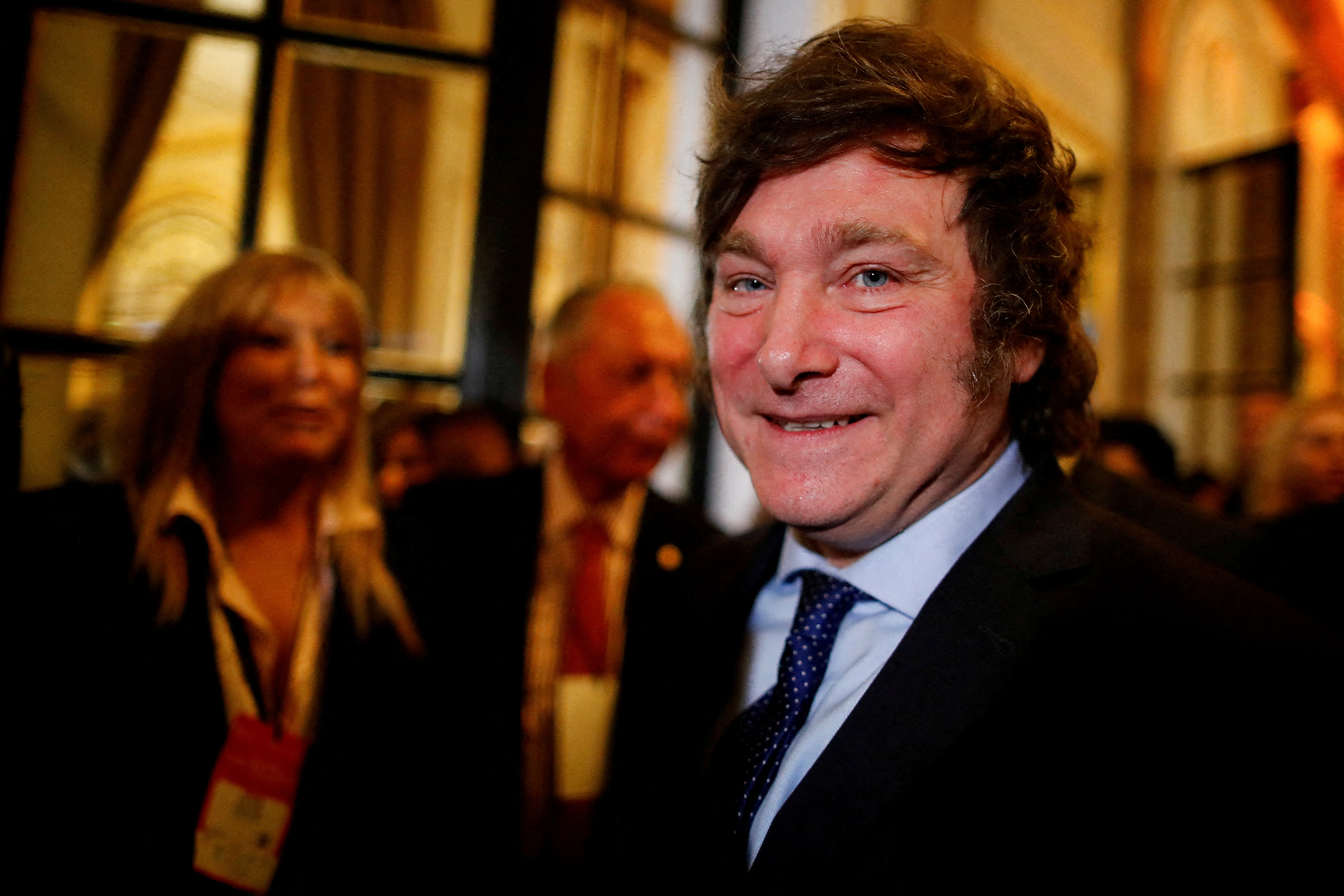
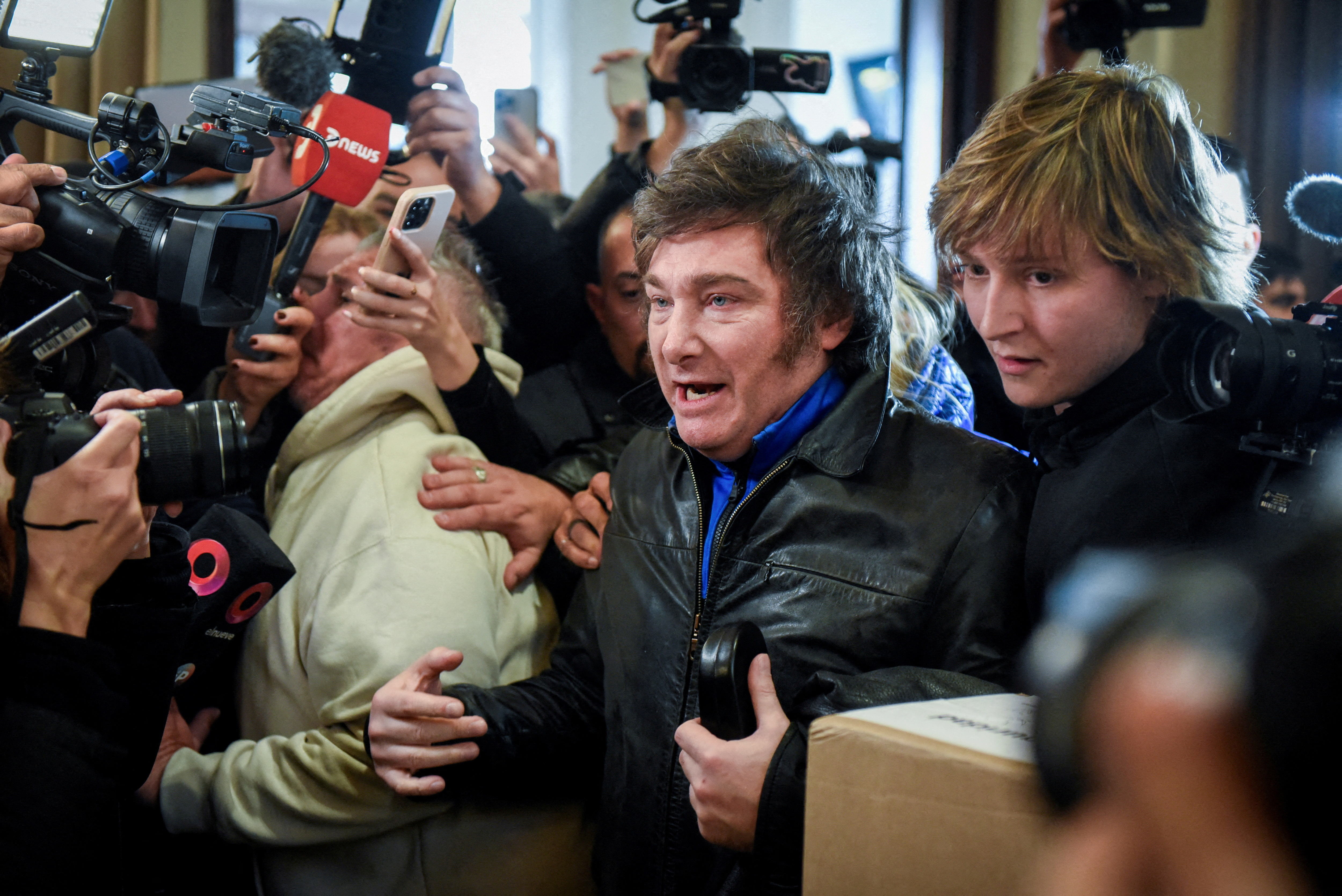
Argentine presidential candidate Javier Milei of La Libertad Avanza alliance attends a business event in Buenos Aires, Argentina August 24, 2023. REUTERS/Agustin Marcarian/File Photo

Argentine presidential candidate Javier Milei of La Libertad Avanza alliance arrives to vote during Argentina’s primary elections, in Buenos Aires, Argentina August 13, 2023. REUTERS/Mariana Nedelcu/File Photo

The post Milei leads polls in Argentina election after primary shock first appeared on The News And Times – thenewsandtimes.com.

Categories
The News And Times – thenewsandtimes.com

Brahimi quoted in The Middle East Eye on meaning of Prigozhin’s death for North Africa


The post Brahimi quoted in The Middle East Eye on meaning of Prigozhin’s death for North Africa first appeared on The News And Times – thenewsandtimes.com.


Categories
The News And Times – thenewsandtimes.com

Azerbaijan Bolsters Cooperation With Balkan Countries


818-Azer.jpeg

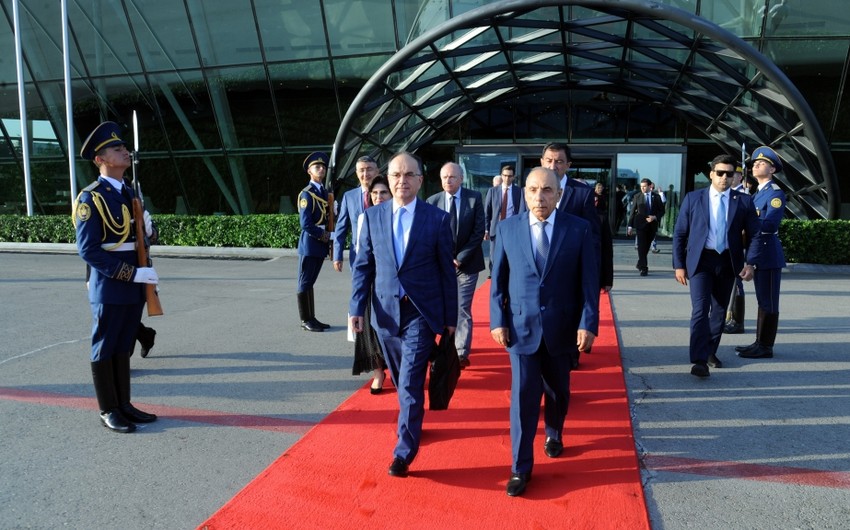
On July 6, Albanian President Bayram Begai visited Azerbaijan and engaged in discussions with his Azerbaijani counterpart Ilham Aliyev on bilateral political relations, joint activities in international organizations, trade, economic matters and investment opportunities (Kaspi.az; Report.az, July 8). These talks underlined Baku’s increased attention to deepening its partnerships with countries in the Balkans. In the case of Albanian-Azerbaijani relations, Aliyev declared, “I would call these relations excellent.”

In recent years, official visits between Azerbaijan and the countries in the region have been steadily intensifying (President.az, July 7). For example, during the 2022 Francophonie Summit, Albania blocked a special resolution that included a clause that Baku characterized as “anti-Azerbaijan.” Interestingly, despite internal conflicts and disagreements in the Balkans, Azerbaijan has managed to establish balanced and rapidly developing relations with each country in the region. Recently, the Azerbaijani president embarked on visits to Albania and Serbia, and, on April 13, he made a trip to Bosnia-Herzegovina (Azertag, November 24, 2022; see EDM, April 24). These visits built on past progress made by Azerbaijan during official talks in Bulgaria, Albania, Serbia and Romania in the latter part of 2022, as well as meetings with the prime ministers of Croatia and Montenegro during the World Economic Forum in January 2023. Equally important are the recent visits of the Albanian, Bulgarian and Romanian presidents as well as Serbian prime minister to Baku (Report.az, April 25).

In 2011, Azerbaijan was selected as a non-permanent member of the United Nations Security Council from Eastern Europe for a two-year term; currently, Albania is fulfilling this role, and this shared designation in and of itself gives special meaning to the two countries’ diplomatic relations (News.un.org, October 24, 2011). Azerbaijan opened its embassy in Albania in 2022, and in a reciprocal gesture, Albania plans to open its embassy in Baku sometime in 2023 (President.az, July 7).

Beyond Albania, in 2022, Azerbaijan and Serbia signed a memorandum on strategic partnership and cooperation. Earlier, in 2021, they signed an agreement on military-technical cooperation (Azertag, November 24, 2022). Additionally, during Aliyev’s visit to Bulgaria in 2015, a joint declaration on strategic partnership was signed, establishing the Azerbaijan-Bulgaria Strategic Dialogue (Musavat.com, accessed August 17).

In recent years, the expansion of relations between Azerbaijan and the Balkan countries has been influenced not only by traditional factors but also by increasing regional tensions, especially Russia’s ongoing war against Ukraine and the recent disputes of Albania and Azerbaijan with Iran. Their growing closeness is additionally influenced by geography, shared interests and security concerns, as well as a common history under Soviet influence. For Azerbaijan, the region is significant as it provides access to the Black, Aegean and Adriatic seas. While not having direct access, Azerbaijan benefits from export and transit opportunities through ports in Georgia and Turkey, enabling the transportation of its goods to Balkan countries. Additionally, critical transit corridors from Asia to Europe pass through Azerbaijan further enhancing its pivotal role (1news.az, December 23, 2022).

Indeed, Baku plays a key role in helping the Balkans states diversify their energy sources. Particularly, amid the war in Ukraine, Moscow’s threats to Europe’s energy security have elevated the importance of alternative sources. The Trans-Adriatic Pipeline (TAP), which transports Azerbaijani natural gas to Europe, passes through the Balkans via Greece and Albania. In 2022, Azerbaijan supplied 1 billion cubic meters (bcm) of natural gas from only its Shah Deniz field to Bulgaria through the TAP via the Greece-Bulgaria gas interconnector (Musavat.com, accessed August 17). Currently, Azerbaijani gas is being transported to Albania, also through the TAP. The primary goal is to eventually transport this gas from the Adriatic to Italy. Additionally, using Albania as a transit point, other Balkan countries can receive gas from Azerbaijan, as they have expressed interest in expanding the transit of hydrocarbons.

New perspectives in energy cooperation between Azerbaijan and the countries in the region have become ever-more relevant since Baku began utilizing the Greece-Bulgaria gas interconnector in 2022. Azerbaijani gas supplied via this interconnector will enter the Romanian market sometime this year. Moreover, efforts are underway to connect Serbia to the overall system through an additional interconnector. Albania’s gasification campaign, including the establishment of gas pipelines and supporting infrastructure, is being carried out through investments from Baku and the involvement of Azerbaijani companies (President.az, July 7). In this, the realization of the Ionian-Adriatic Pipeline will create opportunities to transport Azerbaijan’s energy resources deeper into Europe (Azertag, April 13).

In April 2023, a memorandum of understanding was signed in Sofia between Bulgartransgaz (Bulgaria), Transgaz (Romania), FGSZ (Hungary), Eustream (Slovakia) and the State Oil Company of the Republic of Azerbaijan to promote cooperation on energy matters (President.az, April 25). The memorandum outlines joint development and use of the Southern Gas Corridor, with energy resources being delivered through the enhanced transmission systems of Bulgaria, Romania, Hungary and Slovakia.

Furthermore, in July 2022, Azerbaijan and the European Commission signed a Memorandum of Understanding on Strategic Partnership in Energy. According to the document, plans are in place to double Azerbaijan’s gas supply to European markets by 2027. In 2021, Azerbaijan exported 8 bcm of natural gas to Europe. This year, the target is set at 12 bcm (525.az, April 27).

With Europe’s green energy policies, Azerbaijan and the Balkan countries have initiated collaboration in this direction as well (see EDM, March 21). As part of this effort, a working group was formed this year to lay a 1,195-kilometer electricity cable along the bottom of the Caspian to connect Azerbaijan, Georgia, Romania and Hungary. Currently, Azerbaijan’s export capacity is around 1,000 megawatts (MW). However, Baku is engaged in several projects that will increase Azerbaijan’s green energy export capacity by an additional 700 MW in the coming months (Renewables.az, January 11). Furthermore, Azerbaijan has signed contracts and memorandums of understanding to produce more than 25 gigawatts (GW) of recovered energy. The estimated potential for recovered energy in Azerbaijan is around 200 GW, with 157 GW located in the Caspian. Overall, Europe has been designated as the primary destination for Azerbaijan’s green energy exports, with the first recipients being the Balkan countries (Azertag, April 26).

In recent years, Baku’s relations with the Balkan states have experienced dynamic growth, characterized by reciprocal visits that have significantly expanded diplomatic ties and strengthened transportation connections. For Azerbaijan, the Balkan region serves as a strategic gateway to European markets for its energy resources. The countries of the region in turn have actively collaborated with Azerbaijan, particularly in aligning with Europe’s shift toward green energy. This cooperation has not only facilitated improved energy security in the Balkans by reducing over-reliance on only a couple external suppliers but has also fostered increased investments and the further development of key infrastructure projects. As this cooperation continues to deepen, it will play a central role in easing and increasing the delivery of goods and energy resources from Asia to Europe, to the mutual benefit of Baku and its Balkan partners.

The post Azerbaijan Bolsters Cooperation With Balkan Countries first appeared on The News And Times – thenewsandtimes.com.


Categories
The News And Times – thenewsandtimes.com

Yerevan “confused and disappointed” over Russian Foreign Ministry blaming Armenia for situation in Lachin Corridor


Yerevan “confused and disappointed” over Russian Foreign Ministry blaming Armenia for situation in Lachin Corridor
12:27, 31 August 2023

YEREVAN, AUGUST 31, ARMENPRESS. The Armenian Ministry of Foreign Affairs has responded to the Russian Foreign Ministry spokesperson Maria Zakharova who claimed that the situation in the Lachin corridor is a consequence of the fact that referring to the Alma-Ata Declaration, in Prague, October 2022 Armenia recognized Nagorno-Karabakh as part of Azerbaijan.

The Armenian foreign ministry said that Zakharova’s comments cause “confusion and disappointment.”

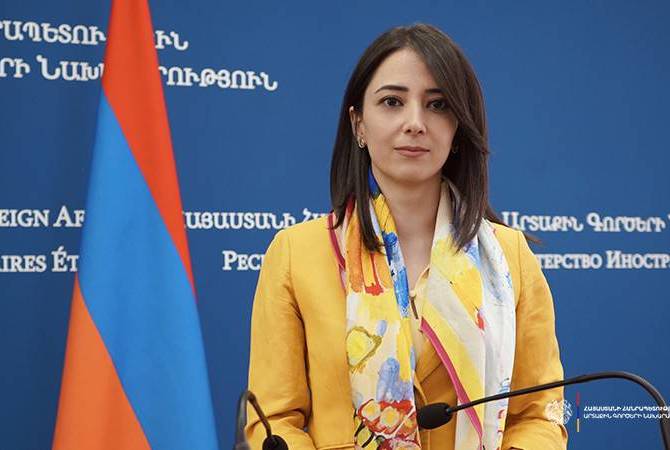
Below is the full statement by Armenian Foreign Ministry spokesperson Ani Badalyan.

“Another comment by the official representative of the Ministry of Foreign Affairs of Russia of similar content claiming that the situation unfolded in the Lachin corridor is a consequence of the fact that referring to the Alma-Ata Declaration, in Prague, October 2022 Armenia recognized Nagorno-Karabakh as part of Azerbaijan, and after that, the task of the Russian peacekeepers became the possible influence on the issues of rights and security of Armenians in Nagorno-Karabakh, causes confusion and disappointment.

We are compelled to recall the following, already well-known chronology and important circumstances.

  • The Nagorno-Karabakh conflict has never been a territorial dispute between Armenia and Azerbaijan. In essence, it has always been and remains an issue of the rights and security of the people of Nagorno-Karabakh.
  • In August 2022, Armenia agreed to Russia’s draft proposal on the normalization of relations between Armenia and Azerbaijan, according to which the discussion of the status of Nagorno-Karabakh was supposed to be postponed for an indefinite period. Azerbaijan rejected the proposal, simultaneously announcing (as it did on August 31 in Brussels) that it is not going to discuss anything related to Nagorno-Karabakh with Armenia, and days later, on September 13, it launched military aggression against the sovereign territory of Armenia.
  • Russia not only did not pursue its proposal after Azerbaijan’s refusal, but also showed absolute indifference to the aggression against the sovereign territory of the Republic of Armenia, leaving Armenia’s official letter to support the Republic of Armenia on the basis of the bilateral legal framework unanswered. Moreover, Russia conditioned the lack of stating the fact of the attack on Armenia and the resulting inaction under the false excuse that the interstate border between Armenia and Azerbaijan is not delimited. By this approach it either intentionally or not supports the obviously false and extremely dangerous thesis which claims that there is no border between Armenia and Azerbaijan, therefore, attacking the border and the invasion into the territory of Armenia are difficult to verify. With the same mindset, Armenia’s similar application in the framework of the CSTO did not receive a proper response either.
  • Under these conditions, on October 6, 2022, in Prague, Armenia and Azerbaijan reaffirmed their loyalty to the Alma-Ata Declaration, which was signed back in 1991 by the former Soviet republics, including Armenia, Azerbaijan and Russia, who recognized each other’s territorial integrity along the former administrative borders of the Soviet states. Therefore, nothing new was decided in Prague: as of October 2022, the Alma-Ata Declaration had been in force for about 31 years. The agreements in Prague did not change anything in the text of the Trilateral statement of November 9, 2020, either. The only novelty was that, based on the results of the Prague meeting, the EU decided to deploy a monitoring mission on the Armenian side of the interstate border between Armenia and Azerbaijan to contribute to the stability at the border.
  • The Russian Federation recognized Nagorno-Karabakh as part of Azerbaijan multiple times, including after the signing of the Trilateral statement of November 9, 2020, and the most recent and perhaps most significant one: it stated that it recognizes the territorial integrity of Azerbaijan in the document on establishing strategic relations with Azerbaijan.
  • On December 12, 2022, the Lachin corridor was blocked, under the false pretext of protests organized by the authorities of Azerbaijan in the area of the control of the Russian peacekeeping contingent. Already in April 2023, in the presence of Russian peacekeepers, Azerbaijan installed an illegal checkpoint in the Lachin corridor. Although these actions were a clear and gross violation of the Trilateral statement, the Russian Federation took no counteractions. Instead, Russian peacekeepers on June 15, 2023, actively supported the attempt to raise the Azerbaijani flag on the sovereign territory of the Republic of Armenia, which is outside the scope of their mission and geographical area of responsibility. This was immediately followed by the total blockade of the Lachin corridor, bringing the situation in Nagorno-Karabakh closer to a true humanitarian catastrophe.
  • In the conditions of such arbitrariness in the presence of Russian peacekeepers, the Azerbaijani side resorts to steps such as the abduction of residents of Nagorno-Karabakh at the illegal checkpoint in the Lachin corridor: the case of abduction of Vagif Khachatryan on July 29, followed by the case of three students on August 28.
  • Unfortunately, such practices of the Russian peacekeeping contingent in Nagorno-Karabakh are nothing new. On December 11, 2020, the violation of the contact line in Nagorno-Karabakh, the illegal occupation of Khtsaberd and Hin Tagher villages, the capture and transfer of 60 Armenian servicemen to Baku took place in Nagorno-Karabakh with the presence and permission of representatives of the Russian peacekeeping contingent. At that time, the agreements of October 6, 2022, were not reached. The same applies to the events of Parukh on March 24, 2022, and Saribab on August 1, 2022, when Azerbaijan again violated the contact line in Nagorno-Karabakh. The logical continuation of this are the shootings by Azerbaijani armed forces in the presence of Russian peacekeepers towards people carrying out agricultural works, one of which ended with the killing of a tractor driver from Martakert; the intimidation of the Nagorno-Karabakh population with night lights and loudspeakers again in the presence of Russian peacekeepers; the thousands of violations of the ceasefire regime by the Azerbaijani armed forces again in the presence of Russian peacekeepers.

We advise the representative of the Russian Foreign Ministry to refrain from maneuvering the circumstances of the situation and thereby further complicating it in the absence of actions from Russian peacekeepers towards the prevention of the blockade of the Lachin corridor or its opening afterwards.

We also reiterate that the Republic of Armenia is faithful to its commitment towards establishing stability in the region on the basis of mutual recognition of territorial integrity and borders. At the same time, we consider imperative for lasting peace the reopening of the Lachin corridor in accordance with the Trilateral statement of November 9, 2020, and in line with the Orders of the International Court of Justice, the prevention of a humanitarian catastrophe in Nagorno-Karabakh and addressing of all existing problems through the Baku-Stepanakert dialogue under international auspices.”

The post Yerevan “confused and disappointed” over Russian Foreign Ministry blaming Armenia for situation in Lachin Corridor first appeared on The News And Times – thenewsandtimes.com.


Categories
The News And Times – thenewsandtimes.com

Migrant crisis will ‘destroy’ New York City, Mayor Adams says


NEW YORK (NewsNation) — New York City Mayor Eric Adams says thousands of migrants are flocking to the city each month, putting a massive strain on city resources, and the crisis “will destroy” the city, as he reiterated his call for more state and federal help.

“We’re getting no support on this national crisis,” Adams  Adams said at a town hall Wednesday. “I don’t see an ending to this. This issue will destroy New York City.”

Meanwhile, New York’s Legal Aid Society and the Coalition for the Homeless called Adams’ remarks reckless and unproductive fear-mongering.

“This dangerous rhetoric is something you’d expect from fringe politicians on the far right of the political spectrum, not the mayor of a city that has always welcomed and celebrated its diverse and critically important immigrant community,” the organizations said in a joint statement.

Adams said more than 100,000 migrants have passed through New York City since April 2022. Currently, the city is caring for nearly 60,000 — placing the migrants at city-sponsored shelters, hotels and makeshift tent cities.

The migrants’ arrival has provoked angry protests in some communities.

“Every service in the city is going to be impacted,” Adams said. “We’re getting 10,000 migrants a month. One time we were just in Venezuela, now we getting Ecuador, now we getting Russian speaking coming through Mexico, now we’re getting Western Africa.”

Without federal funding, Adams says the crisis could cost the city $12 billion by 2025.

Some New Yorkers believe the crisis could have broader national consequences. Cities like Chicago, Washington, D.C., Los Angeles and Philadelphia are also taking in migrants, but New York City is the epicenter.

“I think it’s gonna destroy the country,” one New Yorker said. “I think everyone has to do it legally. That’s how other people did it and why should it make a difference for anyone else.”

Adams has asked President Joe Biden to sign a special order that would allow migrants to receive special work permits. He says with that authorization migrants would be able to get jobs, legally make money and not rely solely on city social services.

Adams said he hasn’t received a response from the White House.

The post Migrant crisis will ‘destroy’ New York City, Mayor Adams says first appeared on The News And Times – thenewsandtimes.com.


Categories
The News And Times – thenewsandtimes.com

Pennsylvania escapee eludes police as search enters ninth day


WEST CHESTER, Pa. (NewsNation) — An escaped murderer on the run in southeast Pennsylvania has so far eluded hundreds of law officers as the search entered its second week and nervous residents stayed alert for any sign of the fugitive.

Danelo Souza Cavalcante, a 34-year-old from Brazil, escaped from the Chester County Prison on Aug. 31 by scaling a wall, climbing over razor wire and jumping from a roof. The breakout mirrored an earlier escape there in May and wasn’t detected by guards for a full hour, authorities said.

Since the escape, there have been eight sightings that police believe could be Cavalcante, the latest around noon Thursday, said Pennsylvania State Police Lt. Col. George Bivens.

A new potential sighting was reported Thursday night near a massive botanical garden that was evacuated and closed indefinitely.

Bivens said authorities began searching the area more closely after the sighting was reported just before noon and continued to look for Cavalcante in the area.

Bivins reported the search area now encompasses an area of 8-10 square miles and said authorities have no reason to believe Cavalcante has left that area.

Thursday night, Longwood Gardens — a botanical garden spanning more than 1,000 acres — said it was closing the property and clearing out guests so police could conduct a search in an “area of interest” on the property. Tenants in the area were also asked to shelter in place.

Bivens said the fugitive has managed to get clothing and unknown supplies, and there’s now a $20,000 reward for information leading to his capture.

Cavalcante received a life sentence last month for killing his ex-girlfriend in front of her children in 2021. He escaped while awaiting transfer to state prison. Prosecutors say he killed her to prevent her from telling police that he’s wanted in a 2017 killing back in Brazil.

Authorities believe he was trying to return to Brazil after his ex-girlfriend’s murder. He was captured in Virginia.

The latest annual reports show Chester County reported only one escape from its facility from 2015 through 2022. That doesn’t include the May escape, when an inmate similarly crab-walked up the walls of the entrance to the exercise yard, climbed to the roof, jumped down and ran for it. He was captured minutes later, officials said.

The Associated Press contributed to this report.

The post Pennsylvania escapee eludes police as search enters ninth day first appeared on The News And Times – thenewsandtimes.com.


Categories
The News And Times – thenewsandtimes.com

Nation-state actors exploit Fortinet FortiOS SSL-VPN and Zoho ManageEngine ServiceDesk Plus, CISA warns


U.S. CISA warned that nation-state actors are exploiting flaws in Fortinet FortiOS SSL-VPN and Zoho ManageEngine ServiceDesk Plus.

The U.S. Cybersecurity and Infrastructure Security Agency (CISA) warned that nation-state actors are exploiting security vulnerabilities in Fortinet FortiOS SSL-VPN and Zoho ManageEngine ServiceDesk Plus.

The US agency has detected the presence of indicators of compromise (IOCs) at an Aeronautical Sector organization as early as January 2023.

The Cybersecurity and Infrastructure Security Agency (CISA), Federal Bureau of Investigation (FBI), and Cyber National Mission Force (CNMF) identified the presence of indicators of compromise (IOCs) at an Aeronautical Sector organization as early as January 2023.

The state-sponsored hackers exploited the CVE-2022-47966 RCE vulnerability in Zoho ManageEngine. The CVE-2022-47966 flaw is an unauthenticated remote code execution vulnerability that impacts multiple Zoho products with SAML SSO enabled in the ManageEngine setup. The issue also impacts products that had the feature enabled in the past. The vulnerability was addressed by the company on October 27th, 2022.

The root cause of the problem is that ManageEngine products use an outdated third-party dependency, Apache Santuario.

“This vulnerability allows an unauthenticated adversary to execute arbitrary code when the above SAML SSO criteria is met.” reads the advisory.

In January, Horizon3 researchers released last week a proof-of-concept (PoC) exploit for the CVE-2022-47966 along with technical analysis. The experts developed the PoC exploit by examining the differences between ServiceDesk Plus version 14003 and version 14004. 

“The vulnerability allows an attacker to gain remote code execution by issuing a HTTP POST request containing a malicious SAML response. This vulnerability is a result of  using an outdated version of Apache Santuario for XML signature validation.” reads the analysis. “One of the critical pieces is understanding that the information flow uses the client’s browser to relay all information between the Service Provider (SP) and the Identity Provider (IDP). In this attack, we send a request containing malicious SAML XML directly to the service provider’s Assertion Consumer (ACS) URL.”

CVE-2022-47966 impacting multiple Zoho ManageEngine products

The researchers tested their PoC exploit against Endpoint Central, however, they believe it can work on many of the ManageEngine products that share some of their codebase with ServiceDesk Plus or EndpointCentral.

“The Cybersecurity and Infrastructure Security Agency (CISA), Federal Bureau of Investigation (FBI), and Cyber National Mission Force (CNMF) identified the presence of indicators of compromise (IOCs) at an Aeronautical Sector organization as early as January 2023.” reads the alert published by the US CISA. “Analysts confirmed that nation-state advanced persistent threat (APT) actors exploited CVE-2022-47966 to gain unauthorized access to a public-facing application (Zoho ManageEngine ServiceDesk Plus), establish persistence, and move laterally through the network. This vulnerability allows for remote code execution on the ManageEngine application.”

The US CISA also reported that multiple APT groups were observed exploiting CVE-2022-42475 to establish a presence on the organization’s firewall device.

In December, Fortinet urged its customers to update their installs to address an actively exploited FortiOS SSL-VPN vulnerability, tracked as CVE-2022-42475, that could be exploited by an unauthenticated, remote attacker to execute arbitrary code on devices.

The CVE-2022-42475 flaw is a heap-based buffer overflow weakness that resides in FortiOS sslvpnd that allowed unauthenticated attackers to crash targeted devices remotely or gain remote code execution.

“A heap-based buffer overflow vulnerability [CWE-122] in FortiOS SSL-VPN may allow a remote unauthenticated attacker to execute arbitrary code or commands via specifically crafted requests.” reads the advisory published by the security vendor. “Fortinet is aware of an instance where this vulnerability was exploited in the wild,”

In the attack detailed in the CISA alert, as early as January 2023, APT actors exploited the vulnerability CVE-2022-47966 for initial access to the target organization. The attackers gained access to a web server hosting the public-facing application, Zoho ManageEngine ServiceDesk Plus.

Threat actors achieved root level access on the web server and created a local user account named ‘Azure’ with administrative privileges.

Then the nation-state actors downloaded malware, enumerated the network, collected administrative user credentials, and performed lateral movement. It is unclear if the attackers gained access to proprietary information or altered it.

“Additional APT actors exploited CVE-2022-42475 on the organization’s firewall device, which was indicated by multiple successful VPN connections from known-malicious IPs between February 1-16, 2023. It was identified that APT actors compromised and used disabled, legitimate administrative account credentials [T1078.003] from a previously hired contractor—of which the organization confirmed the user had been disabled prior to the observed activity.” continues the alert. “Analysis identified that a common behavior for these threat actors was to use disabled administrative account credentials and delete logs from several critical servers in the environment [T1070.001]. This prevented the ability to detect follow-on exploitation or data exfiltration. CISA and co-sealers were also unable to further track the activity due to the organization not having Network Address Translation (NAT) IP logging enabled.”

The attackers have initiated multiple Transport Layer Security (TLS)-encrypted sessions to multiple IP addresses, indicating successful exchanges of data transfer from the firewall device.

Nation-state actors disabled administrative account credentials to delete logs from several critical servers in the targeted network.

The attackers used a Meterpreter as an interactive shell that allowed them remotely control the system.

Between early-February and mid-March 2023, the government experts observed the presence of anydesk.exe on three hosts. The attackers compromised one host and moved laterally to install the executable on the remaining two.

The actors used the legitimate ConnectWise ScreenConnect client to download and utilize the credential dumping tool Mimikats.

The attackers also failed in attempting to to exploit the CVE-2021-44228 Apache Log4j vulnerability in the ServiceDesk system.

“Advance persistent threat actors often scan internet-facing devices for vulnerabilities that can be easily be exploited and will continue to do so.” concludes the alert published by US Cyber Command.

“CNMF and our interagency partners urge organizations to review this CSA and implement the recommended mitigation strategies, which include CISA’s cross-sector cybersecurity performance goals and NSA’s recommended best practices for securing remotely accessible software.”

Follow me on Twitter: @securityaffairs and Facebook and Mastodon

Pierluigi Paganini

(SecurityAffairs – hacking, Fortinet FortiOS SSL-VPN)

The post Nation-state actors exploit Fortinet FortiOS SSL-VPN and Zoho ManageEngine ServiceDesk Plus, CISA warns appeared first on Security Affairs.

The post Nation-state actors exploit Fortinet FortiOS SSL-VPN and Zoho ManageEngine ServiceDesk Plus, CISA warns first appeared on The News And Times – thenewsandtimes.com.


Categories
The News And Times – thenewsandtimes.com

Spanish prosecutor files complaint against Rubiales for sexual assault and coercion


2023-09-08T11:38:21Z

Soccer Football – People protest against Royal Spanish Football Federation President Luis Rubiales – Plaza Callao, Madrid, Spain – August 28, 2023 A woman holds a banner during a protest in Madrid following a kiss between Royal Spanish Football Federation President Luis Rubiales and Spain’s Jennifer Hermoso after the Women’s World Cup Final REUTERS/Isabel Infantes

A Spanish prosecutor filed a complaint with the High Court against suspended soccer federation President Luis Rubiales for sexual assault and coercion over the allegedly unsolicited kiss on the lips of player Jenni Hermoso, the prosecutor’s office said on Friday.

The post Spanish prosecutor files complaint against Rubiales for sexual assault and coercion first appeared on The News And Times – thenewsandtimes.com.


Categories
The News And Times – thenewsandtimes.com

Futures subdued in cautious trading ahead of inflation data


2023-09-08T11:29:17Z

Traders work on the floor of the New York Stock Exchange (NYSE) in New York City, U.S., August 15, 2023. REUTERS/Brendan McDermid

U.S. stock index futures were subdued on Friday as investors awaited a fresh inflation reading next week after recent economic data stoked worries interest rates could remain higher for longer.

Stronger-than-expected services activity data and a fall in weekly jobless claims have dented investor sentiment, dragging the S&P 500 (.SPX) and Nasdaq (.IXIC) 1.4% and 2% lower so far this week, respectively.

The Consumer Price Index reading for August is due on Sept. 13, while the Federal Reserve’s policy decision is scheduled for Sept. 20.

“While our base case is for no further hikes in this cycle, we expect economic uncertainty to keep equity markets volatile and range-bound in the coming months,” said Mark Haefele, chief investment officer at UBS Global Wealth Management.

Traders see a 93% chance of interest rates staying at current levels in September, while pricing in a 55.4% chance for a pause in rate hikes in the November meeting, according to CME FedWatch Tool.

Shares of Apple (AAPL.O) were flat in premarket trading after a two-day selloff following news that Beijing had ordered central government employees in recent weeks to stop using iPhones at workplaces.

Another report on Friday said China was expanding iPhone restrictions to local governments and state-owned companies.

Wall Street analysts see a small hit to Apple’s revenue this year from the curbs, with Morgan Stanley saying the worst case scenario was a 4% drop.

At 7:07 a.m. ET, Dow e-minis were down 30 points, or 0.09%, S&P 500 e-minis were down 4.25 points, or 0.1%, and Nasdaq 100 e-minis were down 22 points, or 0.14%.

Investors also digested mixed commentary from several Fed speakers on Thursday.

New York Fed President John Williams kept his options open over future interest rate policy and Dallas Fed President Lorie Logan said while it “could be appropriate” to skip a rate hike in the upcoming meeting, more policy tightening might be needed.

San Francisco Federal Reserve Bank President Mary Daly is due to speak later in the day.

Among individual stocks, Faraday Future Intelligent Electric (FFIE.O) jumped 9.0% before the bell. The electric-vehicle maker said there were efforts to spread misinformation about the company and manipulate market sentiment.

Adobe (ADBE.O) rose 1.8% after Mizuho upgraded the software firm to “buy” from “neutral”.

DocuSign (DOCU.O) added 3.1% as the e-Signature product provider beat second-quarter results estimates and raised its annual revenue forecast.

GameStop (GME.N) fell 2.3% on a report that the U.S. Securities and Exchange Commission was investigating the videogame retailer’s chairman, Ryan Cohen.


The post Futures subdued in cautious trading ahead of inflation data first appeared on The News And Times – thenewsandtimes.com.