Categories
The News And Times – thenewsandtimes.com

Novo Nordisk launches weight-loss drug Wegovy in Britain


2023-09-04T07:30:15Z

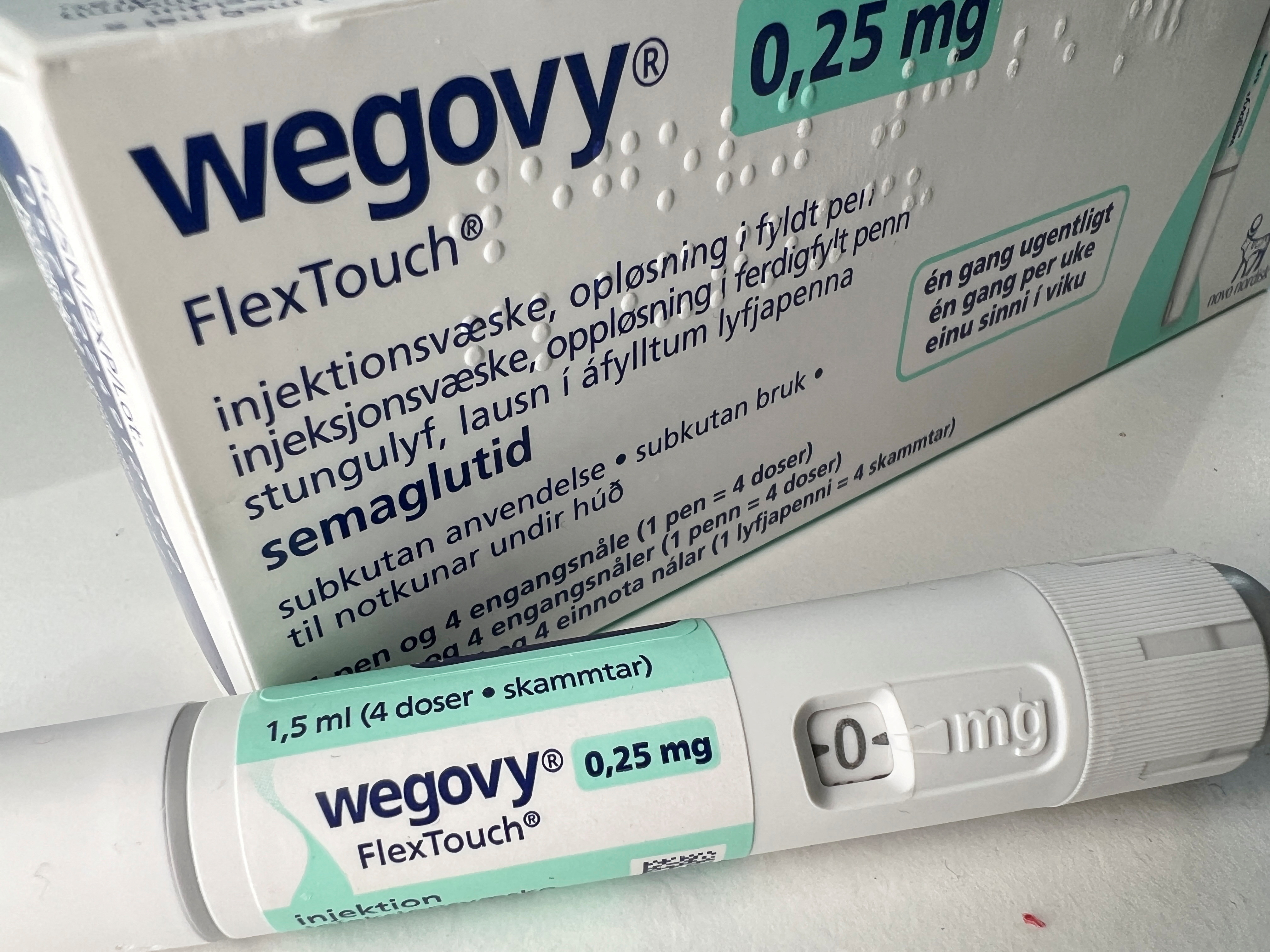
A 0.25 mg injection pen of Novo Nordisk’s weight-loss drug Wegovy is shown in this photo illustration in Oslo, Norway, September 1, 2023. REUTERS/Victoria Klesty/Illustration/File Photo

Novo Nordisk (NOVOb.CO) launched its weight-loss injection Wegovy in Britain on Monday, its second debut in Europe in just over a month as the drugmaker seeks to expand in the region even as it struggles to keep up with soaring demand.

The Danish drugmaker said in a statement that Wegovy would be available in the United Kingdom “through a controlled and limited launch”.

Surging demand for the drug, and Novo’s highly effective diabetes drug Ozempic, have sent the company’s shares and earnings to record highs. On Friday it unseated LVMH (LVMH.PA) as Europe’s most valuable listed company, ending the French luxury group’s 2-1/2 year-long reign at the top.

Wegovy, shown to help patients reduce body weight by around 15% when used along with exercise and lifestyle changes, is so far available in the United States, Norway, Denmark, and as of late July, Germany.

Novo’s inability to keep up with U.S. demand for Wegovy has effectively delayed the launch in most of Europe.

The company has struggled to keep up with demand even as it has added production capacity, and its Chief Executive Officer told Reuters last month it would “take quite some years” before the company can satisfy the whole market.

“We are closely monitoring Wegovy demand and are working with regulators and providers to ensure people living with obesity can have access to and remain on treatment,” the company said in its statement.

In March, Britain’s drug cost-effectiveness watchdog NICE recommended the use of Wegovy in adults with at least one weight-related condition and a body mass index of 35, but only within the National Health Service’s (NHS) specialist weight management scheme.

NICE’s recommendation also calls for Wegovy to be used “for a maximum of two years”.

It was not immediately clear what the cost of Wegovy in the United Kingdom would be. NICE did not immediately respond to a request for comment on Monday morning.

Novo’s statement noted that the drug will be available both within the National Health Service’s weight management scheme and “privately through a registered healthcare professional”.

Novo did not say how much supply it would make available in Britain or how much Wegovy would cost in either of the two treatment scenarios it mentioned. In the United States, the drug sells for as much as $1,350 a month.

It was not immediately clear what the implications would be of the drug being available through private healthcare professionals.

“As we expect supply to be constrained for the foreseeable future, a proportion of available supply will be allocated for use only within the NHS to allow healthcare professionals to implement NICE guidance,” the Novo statement said.

Around 50,000 eligible patients in England could be prescribed Wegovy through NHS specialist weight management services, an NHS spokesperson said in a statement in response to Reuters questions on the launch.

“Despite global supply constraints, NHS England is taking action to begin implementing NICE guidance for weight management, while at the same time working to restore supplies of this class of drug for people with type 2 diabetes,” the NHS spokesperson said.

In June, the British government said it planned to launch a pilot programme exploring how new weekly weight-loss shots such as Wegovy can be given to obese patients by general practitioners, though at the time Wegovy’s launch date was unknown.

Reuters reported last week that supplies of Wegovy were limited in Germany less than a month after its launch in Europe’s largest drug market, highlighting the challenge for Novo’s ambitions in Europe.


The post Novo Nordisk launches weight-loss drug Wegovy in Britain first appeared on The News And Times – thenewsandtimes.com.



Categories
The News And Times – thenewsandtimes.com

Africa Climate Summit opens with focus on financing, continental unity


2023-09-04T07:24:59Z

Africa’s first climate summit kicked off in the Kenyan capital on Monday with delegates aiming to forge a common position ahead of upcoming global conferences and discussing how to fund the continent’s environmental priorities.

Organisers say they anticipate hundreds of millions of dollars in deals to be announced at the three-day summit, during which they aim to showcase Africa as a destination for climate investment rather than a victim of floods, drought and famine.

On Monday environment ministers, business executives and climate campaigners will discuss how to scale up climate finance and carbon markets, investments in adaptation to rising temperatures, and transformation of food systems.

More than 20 presidents and heads of government are expected to attend the summit from Tuesday. They plan to issue a declaration outlining Africa’s position ahead of a U.N. climate conference next month in New York in September and the COP28 U.N. summit in the United Arab Emirates from late November.

In her opening remarks, Kenyan Environment Minister Soipan Tuya stressed the urgency of the moment.

“The climate change debate has entered a new era. It is no longer just about tackling an environmental or development problem, but about addressing climate change in the context of justice,” Tuya said.

“If we do not develop adequate response measures to deal with climate change crisis, it will destroy us.”

African leaders are pushing market-based financing instruments such as carbon credits in a bid to mobilize funding that they say has been slow to arrive from rich-world donors.

Carbon credits allow polluters to offset emissions by funding activities including tree-planting and renewable energy.

One of the top lenders in the Democratic Republic of Congo, Rawbank, and global energy trader Vitol (VITOLV.UL) announced a $20 million investment on Monday in renewable energy, clean cooking and forest conservation in Congo.

Many African campaigners, however, have opposed the summit’s approach to climate finance, saying it advances Western priorities at the expense of the continent.

They say carbon credits and other financing instruments are a pretext for wealthier countries and corporations to continue polluting and that African countries should hold donors to financial commitments they have previously made to poorer ones but so far only met in part.

“Africa needs funding from countries that have got rich off our suffering. They owe a climate debt,” said Mohamed Adow, the director of energy at the Power Shift Africa think tank.

African countries contribute only about 3% of global carbon emissions, according to U.N. figures, but are increasingly exposed to the impact of extreme weather linked to climate change, including the Horn of Africa’s worst drought in decades.

Related Galleries:

People cross a flooded area in Muloza on the border with Mozambique after the aftermath of Tropical Cyclone Freddy, around 100 km outside Blantyre, Malawi, March 18, 2023. REUTERS/Esa Alexander/File Photo

Souloukna Mourga, 50, who has been a farmer for more than 35 years and lost two hectares of cotton and one of millet due to flooding, plods through his submerged red millet field in Dana, Cameroon October 25, 2022. REUTERS/Desire Danga Essigue/File Photo

The post Africa Climate Summit opens with focus on financing, continental unity first appeared on The News And Times – thenewsandtimes.com.


Categories
The News And Times – thenewsandtimes.com

Taiwan to restore power after Typhoon Haikui batters island


2023-09-04T07:44:16Z

Taiwan expects to restore power supply by late on Monday to thousands of homes cut off by Typhoon Haikui in the island’s south and east, where schools and businesses were shut, while domestic airlines cancelled all but a handful of flights.

The first typhoon to directly hit Taiwan in four years, Haikui made landfall on Sunday in the island’s mountainous and sparsely populated far southeast, before moving across the south.

It knocked out power to almost 260,000 households, the economy ministry said, adding that it aimed to restore electricity to the last 26,000 homes by 11 p.m. (1500 GMT) on Monday.

Classes were cancelled and workers given the day off for a second day across southern, eastern and central regions, while Taipei, the capital, received sporadic gusty rain showers.

The world’s largest contract chipmaker, Taiwan Semiconductor Manufacturing (TSMC) (2330.TW), said its plants in Taiwan were operating normally and had not been affected by the storm.

Fire officials reported 116 injuries from the typhoon but were still trying to ascertain if the death of a man found by a roadside in Taitung was linked to it.

Taiwan airlines cancelled 208 domestic flights, leaving just a handful scheduled, while ferry services to surrounding islands were suspended.

International flights, with just 23 cancelled, suffered less disruption, the Civil Aeronautics Administration said.

Haikui is much weaker than Typhoon Saola, which hit Hong Kong and the southern Chinese province of Guangdong on Saturday.

By Monday, Haikui had entered the Taiwan Strait, heading for China, Taiwan’s weather authorities said, though it will continue to bring heavy rain across the island into the middle of the week.

The typhoon is expected to make landfall on the border between the Chinese provinces of Guangdong and Fujian, near the city of Shantou, on Tuesday morning and weaken further, China’s weather forecast centre said.

Related Galleries:

A collapsed canopy is seen at a parking lot as Typhoon Haikui approaches, in Hualien, Taiwan September 3, 2023, in this screengrab taken from a video provided by CTI. CTI via REUTERS

A collapsed canopy is seen at a parking lot as Typhoon Haikui approaches, in Hualien, Taiwan September 3, 2023, in this screengrab taken from a video provided by CTI. CTI via REUTERS

The post Taiwan to restore power after Typhoon Haikui batters island first appeared on The News And Times – thenewsandtimes.com.


Categories
The News And Times – thenewsandtimes.com

INTERNATIONAL EDITION: Russia Drone Attack in Ukraine Puts Two in Hospital


Two people have been hospitalized following a 3½-hour Russian drone barrage in Ukraine’s Odesa region. Israeli Prime Minister Benjamin Netanyahu says he’s “seeking strong steps” after street demonstrations turned violent in Tel Aviv.

The post INTERNATIONAL EDITION: Russia Drone Attack in Ukraine Puts Two in Hospital first appeared on The News And Times – thenewsandtimes.com.

Categories
The News And Times – thenewsandtimes.com

Students Transform Their Drab Dorm Rooms Into Comfy Living Spaces


From $300 studded headboards and $100 coffee table books to custom-made cabinets to disguise your mini-fridge, students are spending big bucks to decorate their dorm rooms, adding yet another layer to the soaring costs of college.

Some are even going so far as to hire interior designers to beautify their 12 feet by 20 feet of space.

Lesley Lachman, 18, planned her furnishings for her dorm room with her roommate immediately after deciding to attend the University of Mississippi back in May. The Rye, New York resident scoured websites like Pinterest and designed her room herself — with hues of pink, purple and green culled from a mix of pricey brands like Essentials with Eden as well as less expensive items from Ikea and Facebook Marketplace. Total cost for the design? About $3,000, covered by her parents.

“There’s so much work that had to be done because it felt lackluster. It didn’t feel homey,” said Lachman, who posted a “before” and “after” video of her room on TikTok.

The “before” video shows stark yellow cinderblock walls, a mustard-colored built-in desk and an open closet. The “after” video shows a complete makeover, with lacey curtains to cover the closet, embroidered pillows and a cushy white headboard to dress up her bed, and customized framed art of hearts.

“I’m so in love with the room,” Lachman said after her redesign. “I want to leave the door open and want everyone to stop by and admire it.”

Overall, the back-to-college season is big business, with families expected to spend an average of about $1,367 per person, up 14% from a year ago, according to an annual survey conducted this summer by the National Retail Federation and market researcher Prosper Insights & Analytics. Spending on big-ticket items such as electronics and dorm furnishings as well as necessities like food accounted for more than half of the increase, NRF said.

Meanwhile, the total cost of college — including tuition, fees, room and board — almost doubled between 1992 and 2022, rising from an inflation-adjusted average of $14,441 per year to $26,903 across all types of universities, according to National Center for Education Statistics, the statistical branch of the Education Department. Dorm costs saw a similar spike over the same time span, rising from $3,824 to $7,097.

Sara Hunt, 19, a sophomore at New York University from Pigeon Forge, Tennessee, wanted her dorm room to look cozy but her budget was $100. That’s because she’s footing 30% — or nearly $30,000 a year — of NYU’s annual college bill. Financial aid picks up the rest.

“I definitely try to work on being positive and not comparing myself to other people because I’m so lucky for what I have. But it is really stressful,” said Hunt, who worked more than 60 hours per week last school year and took a job as a pastry chef this summer to help pay for her college expenses.

For her dorm décor, Hunt scoured Goodwill stores, Dollar Tree, T.J. Maxx and Five Below for deals on neon lights, wallpaper decals and bedding. She also rummaged through bins of returned items from major retailers at a discount bazaar in her hometown.

Jamel Donnor, a professor at William & Mary College in Williamsburg, Virginia, and a leading expert on inequity in education, said the big divide in dorm furnishings marks an “unspoken reality of the have and have nots.” He noted that the stark differences in dorm decorating between those who have money and those who don’t can make some students wonder if they should even be at their college.

“There’s this imposter syndrome,” he said.

Dorm supplies e-tailer Dormify is playing to both ends of the budget. For the first time this fall, it’s offering various bundles of essentials including a pack of 19 items for $159 that includes bath towels and a comforter for those who are more price-conscious. For the big spenders, Dormify unveiled an interior designer service for $450 with interior decorator Jen Abrams; it plans to roll out the offering with other designers next year.

Amanda Zuckerman, co-founder and president of Dormify, noted TikTok has raised the bar in dorm furnishings, creating “the ability to become TikTok famous or go viral because of how well decorated your room is.” Average orders are up 15% this fall, she said.

Dawn Thomas launched an interior design service — After Five Designs — in Jackson, Mississippi 20 years ago for college students after designing dorm rooms for her own children who were going away to school. She said in the past few years, she has seen plenty of other designers now working with students.

Thomas noted parents spend as much as $10,000. One of the more popular items is a custom-made $1,900 cabinet that covers the refrigerator in the dorm.

But she’s also noticing parents are starting to hold back on certain items.

“The economy hasn’t been that great this year,” she said. “And I’ve noticed the sky is not the limit.”

Emma Kirk, who is from Grenada, Mississippi, and a freshman at University of Mississippi, tapped into Thomas’s services and bought a gold studded headboard, custom-made pillows and bedspread among other items. She didn’t know what the total bill was since her parents paid for it. But she said her parents reined her in whenever she picked out something too expensive.

“(Thomas) would work out something where we could get something similar,” she said.

Even on her tight budget, Hunt — the NYU student — says she is happy with her dorm room décor.

“At NYU, so many parents pay for everything. But I’m not here to judge,” she said. “The truth is, even if I had all the money in the world, I probably would still decorate my room the way that I have it now.”


The post Students Transform Their Drab Dorm Rooms Into Comfy Living Spaces first appeared on The News And Times – thenewsandtimes.com.


Categories
The News And Times – thenewsandtimes.com

North Korean Bus Returns From China in a Sign of Border Opening


Maxar satellite imagery of the Sino-Korean Friendship Bridge connecting North Korea and China.

North Korea appears to have dispatched a bus across a bridge with China, satellite imagery showed, in what is likely the first such move since Pyongyang sealed its borders nearly four years ago at the start of the pandemic.

A bus apparently making a return trip to North Korea was photographed crossing the bridge between the Chinese border city of Dandong and the North Korean city of Sinuiju on Aug. 31, the satellite image analyzed by the Open Nuclear Network shows. Several more large vehicles were seen stopping at the customs area on the North Korean side.

[time-brightcove not-tgx=”true”]

The move comes after North Korea sent commercial aircraft to Beijing and Vladivostok at the end of August for the first time since early 2020. North Korea has sent its workers to Russia and China for years, where they earn hard currency desperately needed by Pyongyang, and in defiance of United Nations resolutions that ban the moves.

“Satellite imagery from the past few days suggests North Korea is resuming road-based passenger traffic via the Sino-Korean Friendship Bridge,” said Jaewoo Shin, an analyst for the Open Nuclear Network research group. The North Korean customs area also shows increased activity but no large cargo vehicles have been spotted yet, he added.

“Nonetheless, this is a further sign that North Korea is slowly easing its border lockdown protocols and is likely looking to resume normal trade activities soon,” Shin said.

North Korean leader Kim Jong Un’s decision to seal borders at the start of the pandemic slammed the brakes on the little legal trade conducted by his heavily sanctioned state. It also left stranded its diplomats, students and thousands of workers sent overseas. 

Pyongyang appears to be easing up on the restrictions to help its beleaguered economy recover from the hit the country took when it sealed itself off, South Korea’s Unification Ministry has said.

Signs of a resumption of trade with China, historically Pyongyang’s biggest partner, led Fitch Solutions to estimate North Korea’s economy returned to growth after two full years of contraction. Still, it added that significant uncertainties remain.

There are no indications North Korea is set to resume international tourism, which once brought in hard cash from visitors from places such as China to a country that has sparse foreign currency reserves. 

Over the weekend, North Korea test-fired several long-range cruise missiles for simulated nuclear strikes, just days after it shot off a pair of nuclear-capable ballistic missiles in a show of anger against U.S.-South Korea joint military drills.

The post North Korean Bus Returns From China in a Sign of Border Opening first appeared on The News And Times – thenewsandtimes.com.


Categories
The News And Times – thenewsandtimes.com

AI Project Imagines Adult Faces of Children Who Disappeared During Argentina’s Military Dictatorship


If a baby was taken from their parents four decades ago during Argentina’s military dictatorship, what would that person look like today?

Argentine publicist Santiago Barros has been trying to answer that question using artificial intelligence to create images of what the children of parents who disappeared during the dictatorship might look like as adults.

Almost every day, Barros uploads these images to an Instagram account called iabuelas, which is a portmanteau in Spanish for artificial intelligence, or IA, and grandmother, or abuela — taken from the well-known activist group Grandmothers of Plaza de Mayo that searches for missing children.

“We have seen the photos of most of the disappeared, but we don’t have photos of their children, of those children who were stolen,” Barros told The Associated Press. “It struck me that these people did not have a face.”

During Argentina’s bloody dictatorship from 1976 to 1983, military officials carried out the systematic theft of babies from political dissidents who were detained or often executed and disposed of without a trace. The babies were often raised by families linked to the dictatorship, or those ideologically aligned with it, as if they were their own.

Using an app called Midjourney, Barros combines photos of the disappeared fathers and mothers from the public archive of the Grandmothers website, creating images of what the faces of their children might look like as adults today. For each combination, the app shows two female and two male possibilities. Barros then chooses the image of each gender that seems most realistic.

The project does not intend to replace efforts headed by the Grandmothers group of identifying grandchildren through DNA testing. Instead, Barros says, the goal is to stir the conscience of those over 46 who may have doubts about their origin and to serve as a reminder of the more than four decades the grandmothers have spent trying to locate these children.

The Grandmothers of the Plaza de Mayo estimates around 500 children were snatched from their parents during the dictatorship. The group has located 133 grandchildren through genetic analysis.

The group appreciates Barros’ initiative as a way to raise awareness about the children who were stolen or kidnapped during the dictatorship. But they warn that the only infallible tool to link these people with their families of origin is DNA testing that continues to be carried out by the National Genetic Data Bank, whose creation they promoted in 1987.

In addition to working with photos from the Grandmothers’ archives, Barros uses photographic material provided by interested parties.

In some cases, those who have accessed iabuelas have noticed in the images a tendency towards standardization, raising questions about their approximation to reality. But in others, families searching for a lost relative have been shocked by the resemblance they found in those faces to blood relatives.

Such was the case for Matías Ayastuy, who contacted Barros and provided him with photos of his disappeared parents to see what a possible brother or sister would look like. His mother, Marta Bugnone, was kidnapped in 1977 when she was pregnant. By combining the image of her and that of his father, Jorge Ayastuy, the AI tool was able to come up with some impressive results.

“A lot of people see the masculine image as similar to me. But what generated something very, very strong for me was the feminine one. I found a very striking resemblance to a cousin of mine,” Ayastuy said.

In the month since Barros’ initiative launched, there have not yet been any known cases of an adult seeing themselves as similar to one of his images and then starting a formal process of identification.

All the images of the disappeared parents and their possible children are uploaded to the Instagram account with a note specifying that iabuelas is an “unofficial artistic project” and that results generated by artificial intelligence can be inaccurate.

Pedro Sandoval, a grandson who was identified in 2006, embraced Barros’ initiative at first, but later decided it was imperfect because it seems to rely too much on “standardized patterns” of people with European features. His mother, Liliana Fontana, and his father, Pedro Sandoval, are among the 30,000 missing persons counted by humanitarian organizations.

Barros acknowledged the app might be skewed but noted that many of the disappeared people had European ancestors, in a country with strong European immigration.

As for the grandmothers, they don’t want the AI campaign to create false expectations for those who find similarities with the generated images, so they have urged it to be taken with a grain of salt.

“It is a campaign that shows simulations about possible faces of sons and daughters of the disappeared, but we know that people are much more than 50 percent of each of their parents and that foreign applications are set with genotypes of their populations,” the group said in a statement at the end of July. “Therefore, the results are not accurate.”

The post AI Project Imagines Adult Faces of Children Who Disappeared During Argentina’s Military Dictatorship first appeared on The News And Times – thenewsandtimes.com.


Categories
The News And Times – thenewsandtimes.com

Pope wraps up Mongolia trip, says Church not bent on conversion


2023-09-04T02:11:47Z

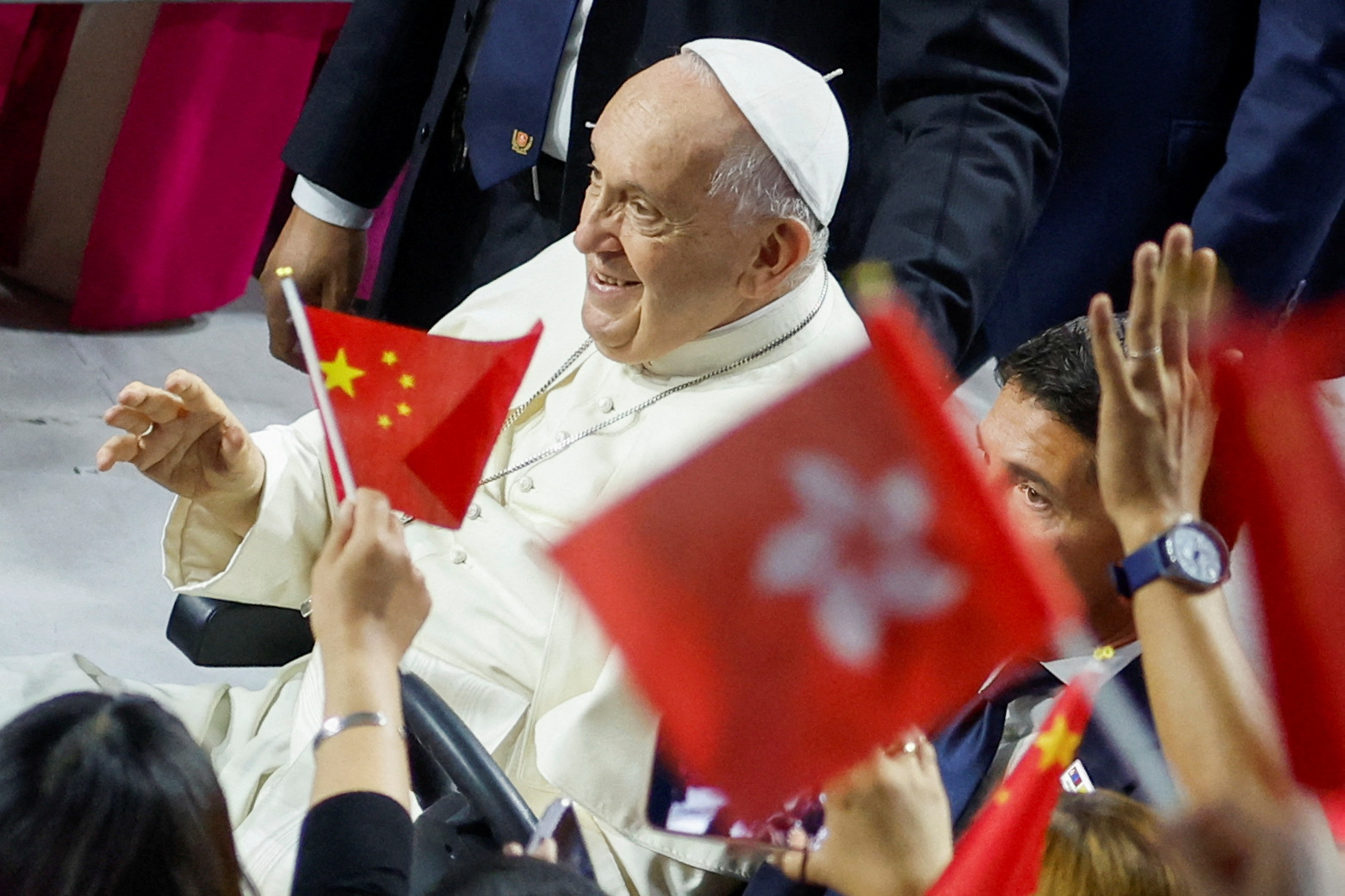
People wave Chinese and Hong Kong flags, as Pope Francis arrives to attend the Holy Mass in the Steppe Arena, during his Apostolic Journey in Ulaanbaatar, Mongolia September 3, 2023. REUTERS/Carlos Garcia Rawlins

Pope Francis on Monday wrapped up a historic trip to Mongolia whose main purpose was to visit the miniscule Catholic community but which took on international connotations because of his overtures to China over freedom of religion in the bordering communist country.

Francis ended his five-day visit with a stop to inaugurate the House of Mercy, a multi-purpose structure to provide temporary health care to the most needy in the Mongolian capital as well as to the homeless, victims of domestic abuse and migrants.

Situated in a converted school and the brainchild of Mongolia’s top Catholic cleric, Italian Cardinal Giorgio Marengo, the House of Mercy is destined to serve as a sort of central charity coordinating the work of Catholic missionary institutions and local volunteers.

“The true progress of a nation is not gauged by economic wealth, much less by investment in the illusory power of

armaments, but by its ability to provide for the health, education and integral development of its people,” Francis said at the house.

He said he wanted to dispel “the myth” that the aim of Catholic institutions was to convert people to the religion “as if caring for others were a way of enticing people to ‘join up’”.

Mostly Buddhist Mongolia has only 1,450 Catholics in a population of 3.3 million and in an unprecedented event on Sunday, just about the entire Catholic population of the country was under the same roof with the pope.

Mongolia was part of China until 1921 and the pope’s trip was dotted by allusions or appeals to the superpower next door, where the Vatican has scratchy relations with the communist government.

At the end of Sunday’s Mass he sent greetings to China, calling its citizens a “noble” people and asking Catholics in China to be “good Christians and good citizens.”

On Saturday, in words that appeared to be aimed at China rather than Mongolia, Francis said governments have nothing to fear from the Catholic Church because it has no political agenda.

Beijing has been following a policy of “Sinicisation” of religion, trying to root out foreign influences and enforce obedience to the Communist Party.

China’s constitution guarantees religious freedom, but in recent years the government has tightened restrictions on religions seen as a challenge to the party’s authority.

In December, the United States designated China, Iran and Russia, among others, as countries of particular concern under the Religious Freedom Act over severe violations.

A landmark 2018 agreement between the Vatican and China on the appointment of bishops has been tenuous at best, with the Vatican complaining that Beijing has violated it several times.

The phrase used by the pope on Sunday – “good Christians and good citizens” – is one the Vatican uses frequently in trying to convince communist governments that giving Catholics more freedom would only help their countries’ social and economic progression.


The post Pope wraps up Mongolia trip, says Church not bent on conversion first appeared on The News And Times – thenewsandtimes.com.


Categories
The News And Times – thenewsandtimes.com

Zelensky Replaces Defense Minister, Citing Need for ‘New Approaches’


The fate of the defense minister, Oleksii Reznikov, had been the subject of increasing speculation in Ukraine. It was the biggest shake-up in Ukraine’s government since Russia’s full-scale invasion.

The Ukrainian defense minister wearing  a green jacket and standing with his arms crossed in a doorway.

Ukraine’s defense minister, Oleksii Reznikov, in April.Credit…Pool photo by Sebastian Gollnow

Sept. 3, 2023Updated 5:46 p.m. ET

President Volodymyr Zelensky said on Sunday that he was replacing his minister of defense, the biggest shake-up in the leadership of Ukraine’s war effort since Russia’s full-scale invasion in February last year, citing the need for “new approaches” as the war stretches toward a second year.

The fate of the defense minister, Oleksii Reznikov, had been the subject of increasing speculation in Ukraine as financial improprieties in the ministry came to light and the government started several investigations into official corruption.

Mr. Zelensky said in a statement that Mr. Reznikov, who has not been personally implicated in the widening investigations into mishandling of military contracts, would be replaced by Rustem Umerov, the chairman of Ukraine’s State Property Fund. Mr. Zelensky said he expected Ukraine’s Parliament, which must approve the change, to sign off on his request.

“Oleksii Reznikov has gone through more than 550 days of full-scale war,” Mr. Zelensky said in a statement announcing his decision on Sunday night. “I believe that the ministry needs new approaches and other formats of interaction with both the military and society at large.”

The decision to replace Mr. Reznikov atop the Defense Ministry comes as Ukraine is in the midst of a major counteroffensive that has made grinding progress in recent weeks, slowly gaining territory in the south and the east. Last week, Ukrainian officials said they had captured the southern village of Robotyne, suggesting that the offensive had penetrated the first layer of minefields, tank traps, trenches and bunkers Moscow has deployed between Ukraine’s forces and Russian-occupied Crimea.

The shake-up arose from an understanding that Ukraine will need new leadership as the war drags on, from Mr. Reznikov’s own requests to step down and from the din of criticism from Ukrainian civil society groups and media over the contracting scandals, said an official in the president’s office, who was not authorized to speak publicly about the dismissal.

Ukrainian soldiers from the 14th Mechanized Brigade firing toward Russian position near Kupiansk, Ukraine, on Sunday.Credit…David Guttenfelder for The New York Times

Mr. Umerov, a former investment banker, was tapped to replace Mr. Reznikov even though he served in Parliament for Holos, a party in opposition to Mr. Zelensky’s government. He is a Crimean Tatar, a member of the ethnic group persecuted under Russia’s occupation of the Crimean Peninsula.

There was no immediate comment from Mr. Reznikov, who has repeatedly faced questions about his future in recent weeks, including about whether he would move to a diplomatic role, ambassador to Britain. Mr. Zelensky’s announcement made no mention of any future assignment for Mr. Reznikov.

Since the start of the war, Mr. Reznikov has become a public face for Ukraine on the world stage. He was among a handful of Mr. Zelensky’s top security officials who remained in Kyiv, the capital, as it was partially surrounded by Russian forces after the start of the invasion.

Despite the decision to replace Mr. Reznikov, Ukraine has experienced far more stability over the course of the invasion than Russia, which has undergone several leadership changes and endured criticism of its battlefield tactics, culminating in the brief rebellion by the mercenary leader Yevgeny V. Prigozhin, who marched members of his Wagner private military company toward Moscow in June then was declared dead in a fiery plane crash last month.

In October 2022, Russia appointed Gen. Sergei Surovikin to command its forces in Ukraine. He lasted just three months before he was replaced by Gen. Valery V. Gerasimov, Russia’s highest-ranking military officer. U.S. officials have said General Surovikin had advance knowledge of the rebellion plans of Mr. Prigozhin, whose death some Western officials have suggested was ordered by President Vladimir V. Putin of Russia.

Rustem Umerov in Kyiv, Ukraine, in May last year.Credit…Dogukan Keskinkilic/Anadolu Agency, via Getty Images

Mr. Reznikov had won praise for negotiating the transfer of vast quantities of donated Western weaponry under the Ramstein talks with allies, named for the city in Germany where they began last year. He oversaw the expansion of the army and its transition from an arsenal of Soviet-legacy armaments to Western systems even as his country was under attack.

Ukraine’s army rebuffed Russia’s invasion with foreign military assistance limited mostly to shoulder-fired anti-tank weapons in the first month of the war, but has since incorporated a wide-ranging arsenal of Western heavy weaponry. In its counteroffensive in the Zaporizhzhia and Donetsk regions in the country’s south, Ukraine relies on U.S. and European armored vehicles, tanks, artillery and guided rockets.

But the Ministry of Defense has been buffeted this year by a string of allegations of mishandling military contracting and corruption as its budget ballooned during the war. At one point, $986 million worth of weaponry the ministry had contracted for was undelivered by dates specified in contracts, according to government figures. Some deliveries are months late.

Ukrainian investigative journalists have found other woes with military contracting, seeming to show huge overpayments for basic supplies for the army such as eggs, canned beans and winter coats.

Mr. Reznikov had said the ministry was suing to recoup money lost in the weapons contracts. Government officials have said many of the problems had arisen in the early, chaotic days of the war in Ukraine’s frantic scramble to buy weapons and ammunition and have since been fixed. Two ministry officials — a deputy minister and head of procurement — were arrested over the winter after the reports of overpriced eggs.

Even so, the contracting scandals prompted calls for Mr. Reznikov’s resignation.

Last week, the White House national security adviser, Jake Sullivan, met with three high-ranking Ukrainian officials to discuss efforts to stamp out wartime corruption, as some critics of the war in the United States have used graft as an argument for limiting military aid to Ukraine. Mr. Sullivan met the heads of a specialized investigative agency, prosecutorial office and court set up with help from the United States after Ukraine’s Western political pivot in the Maidan street uprising in 2014.

But it appears that the change was not anticipated. As of Friday, Mr. Reznikov was scheduled to visit the Pentagon this later this week to meet with Defense Secretary Lloyd J. Austin III. The two men had regular contact and spoke “relatively frequently,” according to a U.S. official who spoke on background as the news was breaking on Sunday. It is believed that they last met in person at the NATO summit in Vilnius, Lithuania, in July.

Corruption has plagued Ukraine for most of its post-independence history but had improved over the past decade, according to assessments by Transparency International, a global anti-corruption group. Mr. Zelensky campaigned on an anti-corruption platform before winning the presidency in 2019, and efforts to fight graft have been widely acknowledged as crucial to Ukraine’s efforts to move closer to its Western allies, including its hopes of joining the European Union.

In recent weeks, Mr. Zelensky has stepped up measures against wartime graft, firing all the country’s recruitment officers after bribery scandals and proposing a law that would punish corruption as treason under martial law.

In May, the head of Ukraine’s Supreme Court was detained in a bribery investigation. And on Friday, Ukrainian media reported that and a court set bail at more than $25,000 for a former deputy minister of economy accused of embezzling humanitarian aid.

The allegations dogging the ministry are not related to Western weapons transfers but to domestic weapons procurement, which is not directly financed by aid from allies. These countries transfer weapons and ammunition directly to the Ukrainian army while financial aid is directed to nonmilitary spending. Ukrainian tax revenues fund defense procurement, where the accusations of mismanagement arose.

In an earlier shake-up last summer, Mr. Zelensky had dismissed the director of his domestic intelligence agency and prosecutor general, also in the wake of allegations of corruption and mismanagement.

Carol Rosenberg and Daniel Victor contributed reporting.

The post Zelensky Replaces Defense Minister, Citing Need for ‘New Approaches’ first appeared on The News And Times – thenewsandtimes.com.


Categories
The News And Times – thenewsandtimes.com

Zelensky Replaces Defense Minister, Citing Need for ‘New Approaches’


The fate of the defense minister, Oleksii Reznikov, had been the subject of increasing speculation in Ukraine. It was the biggest shake-up in Ukraine’s government since Russia’s full-scale invasion.

The Ukrainian defense minister wearing  a green jacket and standing with his arms crossed in a doorway.

Ukraine’s defense minister, Oleksii Reznikov, in April.Credit…Pool photo by Sebastian Gollnow

Sept. 3, 2023Updated 5:46 p.m. ET

President Volodymyr Zelensky said on Sunday that he was replacing his minister of defense, the biggest shake-up in the leadership of Ukraine’s war effort since Russia’s full-scale invasion in February last year, citing the need for “new approaches” as the war stretches toward a second year.

The fate of the defense minister, Oleksii Reznikov, had been the subject of increasing speculation in Ukraine as financial improprieties in the ministry came to light and the government started several investigations into official corruption.

Mr. Zelensky said in a statement that Mr. Reznikov, who has not been personally implicated in the widening investigations into mishandling of military contracts, would be replaced by Rustem Umerov, the chairman of Ukraine’s State Property Fund. Mr. Zelensky said he expected Ukraine’s Parliament, which must approve the change, to sign off on his request.

“Oleksii Reznikov has gone through more than 550 days of full-scale war,” Mr. Zelensky said in a statement announcing his decision on Sunday night. “I believe that the ministry needs new approaches and other formats of interaction with both the military and society at large.”

The decision to replace Mr. Reznikov atop the Defense Ministry comes as Ukraine is in the midst of a major counteroffensive that has made grinding progress in recent weeks, slowly gaining territory in the south and the east. Last week, Ukrainian officials said they had captured the southern village of Robotyne, suggesting that the offensive had penetrated the first layer of minefields, tank traps, trenches and bunkers Moscow has deployed between Ukraine’s forces and Russian-occupied Crimea.

The shake-up arose from an understanding that Ukraine will need new leadership as the war drags on, from Mr. Reznikov’s own requests to step down and from the din of criticism from Ukrainian civil society groups and media over the contracting scandals, said an official in the president’s office, who was not authorized to speak publicly about the dismissal.

Ukrainian soldiers from the 14th Mechanized Brigade firing toward Russian position near Kupiansk, Ukraine, on Sunday.Credit…David Guttenfelder for The New York Times

Mr. Umerov, a former investment banker, was tapped to replace Mr. Reznikov even though he served in Parliament for Holos, a party in opposition to Mr. Zelensky’s government. He is a Crimean Tatar, a member of the ethnic group persecuted under Russia’s occupation of the Crimean Peninsula.

There was no immediate comment from Mr. Reznikov, who has repeatedly faced questions about his future in recent weeks, including about whether he would move to a diplomatic role, ambassador to Britain. Mr. Zelensky’s announcement made no mention of any future assignment for Mr. Reznikov.

Since the start of the war, Mr. Reznikov has become a public face for Ukraine on the world stage. He was among a handful of Mr. Zelensky’s top security officials who remained in Kyiv, the capital, as it was partially surrounded by Russian forces after the start of the invasion.

Despite the decision to replace Mr. Reznikov, Ukraine has experienced far more stability over the course of the invasion than Russia, which has undergone several leadership changes and endured criticism of its battlefield tactics, culminating in the brief rebellion by the mercenary leader Yevgeny V. Prigozhin, who marched members of his Wagner private military company toward Moscow in June then was declared dead in a fiery plane crash last month.

In October 2022, Russia appointed Gen. Sergei Surovikin to command its forces in Ukraine. He lasted just three months before he was replaced by Gen. Valery V. Gerasimov, Russia’s highest-ranking military officer. U.S. officials have said General Surovikin had advance knowledge of the rebellion plans of Mr. Prigozhin, whose death some Western officials have suggested was ordered by President Vladimir V. Putin of Russia.

Rustem Umerov in Kyiv, Ukraine, in May last year.Credit…Dogukan Keskinkilic/Anadolu Agency, via Getty Images

Mr. Reznikov had won praise for negotiating the transfer of vast quantities of donated Western weaponry under the Ramstein talks with allies, named for the city in Germany where they began last year. He oversaw the expansion of the army and its transition from an arsenal of Soviet-legacy armaments to Western systems even as his country was under attack.

Ukraine’s army rebuffed Russia’s invasion with foreign military assistance limited mostly to shoulder-fired anti-tank weapons in the first month of the war, but has since incorporated a wide-ranging arsenal of Western heavy weaponry. In its counteroffensive in the Zaporizhzhia and Donetsk regions in the country’s south, Ukraine relies on U.S. and European armored vehicles, tanks, artillery and guided rockets.

But the Ministry of Defense has been buffeted this year by a string of allegations of mishandling military contracting and corruption as its budget ballooned during the war. At one point, $986 million worth of weaponry the ministry had contracted for was undelivered by dates specified in contracts, according to government figures. Some deliveries are months late.

Ukrainian investigative journalists have found other woes with military contracting, seeming to show huge overpayments for basic supplies for the army such as eggs, canned beans and winter coats.

Mr. Reznikov had said the ministry was suing to recoup money lost in the weapons contracts. Government officials have said many of the problems had arisen in the early, chaotic days of the war in Ukraine’s frantic scramble to buy weapons and ammunition and have since been fixed. Two ministry officials — a deputy minister and head of procurement — were arrested over the winter after the reports of overpriced eggs.

Even so, the contracting scandals prompted calls for Mr. Reznikov’s resignation.

Last week, the White House national security adviser, Jake Sullivan, met with three high-ranking Ukrainian officials to discuss efforts to stamp out wartime corruption, as some critics of the war in the United States have used graft as an argument for limiting military aid to Ukraine. Mr. Sullivan met the heads of a specialized investigative agency, prosecutorial office and court set up with help from the United States after Ukraine’s Western political pivot in the Maidan street uprising in 2014.

But it appears that the change was not anticipated. As of Friday, Mr. Reznikov was scheduled to visit the Pentagon this later this week to meet with Defense Secretary Lloyd J. Austin III. The two men had regular contact and spoke “relatively frequently,” according to a U.S. official who spoke on background as the news was breaking on Sunday. It is believed that they last met in person at the NATO summit in Vilnius, Lithuania, in July.

Corruption has plagued Ukraine for most of its post-independence history but had improved over the past decade, according to assessments by Transparency International, a global anti-corruption group. Mr. Zelensky campaigned on an anti-corruption platform before winning the presidency in 2019, and efforts to fight graft have been widely acknowledged as crucial to Ukraine’s efforts to move closer to its Western allies, including its hopes of joining the European Union.

In recent weeks, Mr. Zelensky has stepped up measures against wartime graft, firing all the country’s recruitment officers after bribery scandals and proposing a law that would punish corruption as treason under martial law.

In May, the head of Ukraine’s Supreme Court was detained in a bribery investigation. And on Friday, Ukrainian media reported that and a court set bail at more than $25,000 for a former deputy minister of economy accused of embezzling humanitarian aid.

The allegations dogging the ministry are not related to Western weapons transfers but to domestic weapons procurement, which is not directly financed by aid from allies. These countries transfer weapons and ammunition directly to the Ukrainian army while financial aid is directed to nonmilitary spending. Ukrainian tax revenues fund defense procurement, where the accusations of mismanagement arose.

In an earlier shake-up last summer, Mr. Zelensky had dismissed the director of his domestic intelligence agency and prosecutor general, also in the wake of allegations of corruption and mismanagement.

Carol Rosenberg and Daniel Victor contributed reporting.

The post Zelensky Replaces Defense Minister, Citing Need for ‘New Approaches’ first appeared on The News And Times – thenewsandtimes.com.